Enterprise Identity Management in Cloud-First Organisations
Identity is the control plane of the modern enterprise. Every access decision — who can reach which system, what data they can see, what actions they can take — ultimately traces back to identity. In a cloud-first organisation where applications run across multiple cloud providers and SaaS platforms, where employees work from anywhere on any device, and where partner and customer identities must be managed alongside employee identities, the identity architecture is arguably the most consequential technical system the enterprise operates.
Yet many enterprises approach identity management as an IT operations concern rather than an architectural one. The result is identity sprawl: Active Directory manages on-premises resources, each cloud provider has its own IAM system, SaaS applications maintain their own user stores, and the relationships between these identity systems are maintained through a fragile web of synchronisation jobs, manual provisioning processes, and legacy federation configurations.
This sprawl creates security risk (inconsistent access policies, orphaned accounts, visibility gaps), operational cost (manual provisioning and deprovisioning, help desk password resets, audit preparation effort), and user friction (multiple credentials, inconsistent authentication experiences, access request delays). For the CTO of a cloud-first organisation, identity architecture modernisation is not an IT project — it is a strategic initiative that affects security posture, operational efficiency, and employee experience.
The Modern Identity Architecture
A modern enterprise identity architecture is built on several interconnected components that together provide a unified, automated, and secure identity foundation.
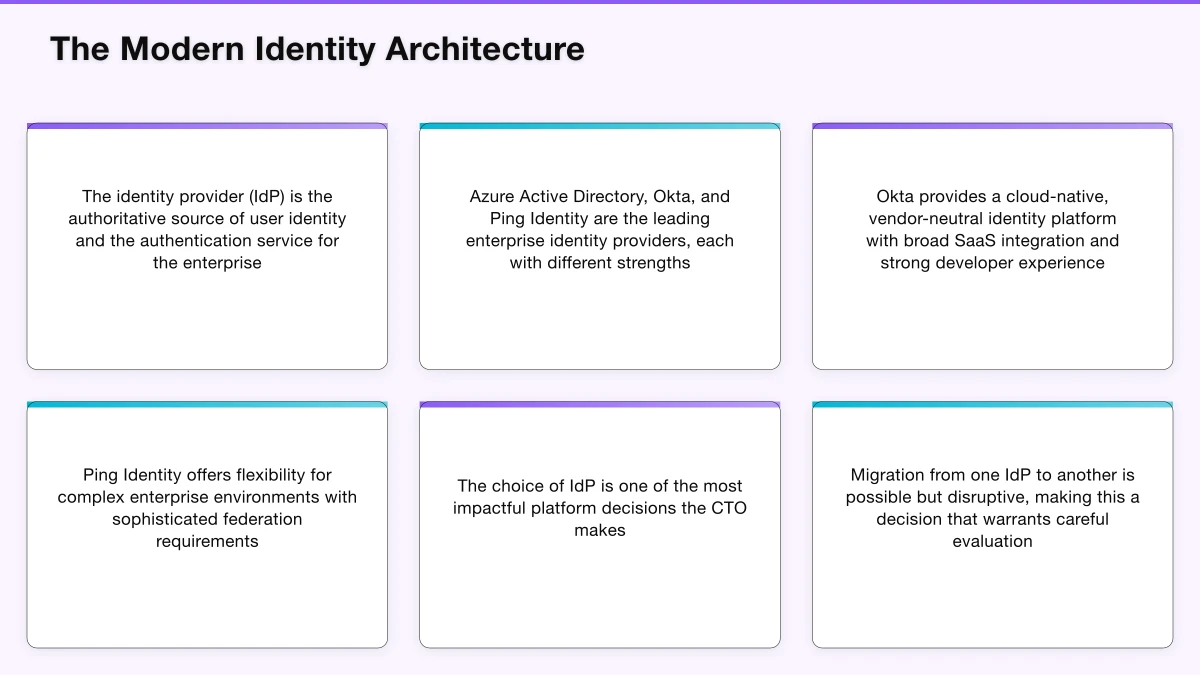
The identity provider (IdP) is the authoritative source of user identity and the authentication service for the enterprise. Azure Active Directory, Okta, and Ping Identity are the leading enterprise identity providers, each with different strengths. Azure AD provides deep integration with the Microsoft ecosystem and strong hybrid identity capabilities for organisations with significant on-premises Active Directory investment. Okta provides a cloud-native, vendor-neutral identity platform with broad SaaS integration and strong developer experience. Ping Identity offers flexibility for complex enterprise environments with sophisticated federation requirements.
The choice of IdP is one of the most impactful platform decisions the CTO makes. It determines the authentication experience for every user, the integration model for every application, and the governance framework for every access decision. Migration from one IdP to another is possible but disruptive, making this a decision that warrants careful evaluation.
Single sign-on (SSO) eliminates the proliferation of credentials by enabling users to authenticate once with the IdP and access all integrated applications without re-authentication. SAML 2.0 and OpenID Connect (OIDC) are the standard protocols, with OIDC increasingly preferred for its modern design and better developer experience. The goal is universal SSO coverage — every application the user accesses, whether cloud-hosted, SaaS, or on-premises, should be integrated with the central IdP.
Multi-factor authentication (MFA) adds a second verification factor beyond the password. The state of the art in MFA is moving beyond SMS-based one-time codes (which are vulnerable to SIM swapping and interception) toward push notifications to authenticator applications, hardware security keys supporting FIDO2/WebAuthn, and biometric verification. The enterprise MFA strategy should mandate strong MFA for all users, with risk-based policies that require additional verification for high-risk access scenarios — accessing sensitive data, signing in from a new device, or authenticating from an unusual location.
Identity governance provides the lifecycle management and compliance framework. This encompasses automated provisioning (creating accounts and granting access when employees join or change roles), automated deprovisioning (removing access promptly when employees leave), access certification (periodic review of access entitlements to ensure they remain appropriate), and segregation of duties enforcement (preventing individuals from holding conflicting access rights). Tools like SailPoint, Saviynt, and the governance capabilities built into Azure AD and Okta provide these functions.
Application Integration Patterns
The identity architecture’s value is realised through its integration with every application in the enterprise portfolio. The integration approach depends on the application’s architecture and the level of control the organisation has over its configuration.
Modern cloud-native applications should implement OIDC-based authentication, delegating all identity concerns to the enterprise IdP. The application receives a JWT (JSON Web Token) from the IdP containing the user’s identity and claims, validates the token, and makes authorisation decisions based on the claims. This pattern eliminates application-level credential management and provides consistent authentication across all applications.
SaaS applications typically support SAML or OIDC integration through their administration console. The enterprise identity team should maintain an integration catalogue of all SaaS applications and their IdP integration status. Applications that do not support standard federation protocols should be flagged for vendor engagement or, in extreme cases, replacement with alternatives that do.
Legacy applications that cannot be modified to support modern authentication protocols require compensating strategies. Reverse proxy architectures (using tools like Azure AD Application Proxy, PingAccess, or open-source alternatives) can add authentication in front of legacy applications without modifying the application itself. The proxy handles authentication with the IdP and passes the authenticated user identity to the legacy application through HTTP headers or other mechanisms.
Service-to-service identity is increasingly important in microservices architectures. Workload identity — authenticating services rather than users — ensures that inter-service communication is authenticated and authorised. Managed identities in Azure, IAM roles in AWS, and service accounts in Google Cloud provide cloud-native workload identity. For cross-cloud or hybrid environments, SPIFFE provides an open standard for workload identity that is infrastructure-agnostic.
Lifecycle Automation
Manual identity lifecycle management does not scale and creates security risk. The time between an employee leaving the organisation and their access being revoked is a window of vulnerability. Manual access provisioning for new employees delays productivity. Manual access certification is tedious, leading to rubber-stamp approvals that provide compliance theatre without genuine security value.
Automated provisioning should be triggered by authoritative HR system events. When the HR system records a new hire, the identity governance platform should automatically create the user account, assign role-based access entitlements, and notify the employee. When the HR system records a role change, access entitlements should be adjusted automatically. When the HR system records a termination, all access should be revoked within minutes, not days.
Role-based access control (RBAC) provides the framework for automated provisioning. Business roles (defined in collaboration between IT and business stakeholders) map to technical entitlements (group memberships, application roles, resource permissions). When a user is assigned a business role, the corresponding technical entitlements are automatically provisioned. This requires upfront investment in role engineering — analysing current access patterns, defining role structures, and mapping roles to entitlements — but the operational efficiency and security improvements are substantial.
Access certification should be continuous rather than periodic. Rather than a quarterly access review where managers rubber-stamp hundreds of entitlements, modern governance platforms support micro-certifications triggered by risk events — a user who has not accessed an application in 90 days, an entitlement that exceeds the user’s role definition, or a separation of duties violation. These targeted reviews are more manageable for approvers and more effective at identifying genuinely inappropriate access.
Measuring Identity Programme Maturity
Identity management maturity can be assessed across several dimensions.
Authentication coverage measures the percentage of applications integrated with the enterprise IdP through SSO. The target is universal coverage, but the reality is a progressive journey. Tracking this percentage and the applications not yet integrated (with remediation plans for each) provides visibility into progress.
MFA adoption measures the percentage of authentications that include a second factor. The target is one hundred percent, with risk-based policies that may reduce MFA friction for low-risk scenarios while requiring it for all high-risk access.
Provisioning automation measures the percentage of access provisioning and deprovisioning that is fully automated. Manual provisioning should be the exception, limited to unusual access requirements that fall outside defined roles.
Time to decommission measures the elapsed time from employment termination to complete access revocation. This is a direct security metric — every hour of delay is an hour of unnecessary exposure.
Identity is the foundation on which every other security control depends. The CTO who invests in a modern, automated, well-governed identity architecture is building the control plane that makes zero trust possible, that enables secure cloud-first operations, and that provides the compliance foundation that regulated industries demand.
If this strategic perspective has you thinking about cloud adoption, Cloud Geeks provides the implementation detail — from AWS setup to security hardening.
Ganda Tech Services is my technology consultancy, bringing together cloud infrastructure, web development, and mobile expertise for Australian businesses.
About the Author
Ashish Ganda is the founder of Ganda Tech Services, a Sydney-based technology consultancy specialising in cloud infrastructure, web development, and mobile app solutions for Australian businesses.
Digital Transformation Roadmap 2026
A 12-month framework for Australian SMBs ready to modernise — phases, tools, and milestones.