CTO Guide to Technology Team Scaling: Building Engineering Organisations in 2025
Introduction
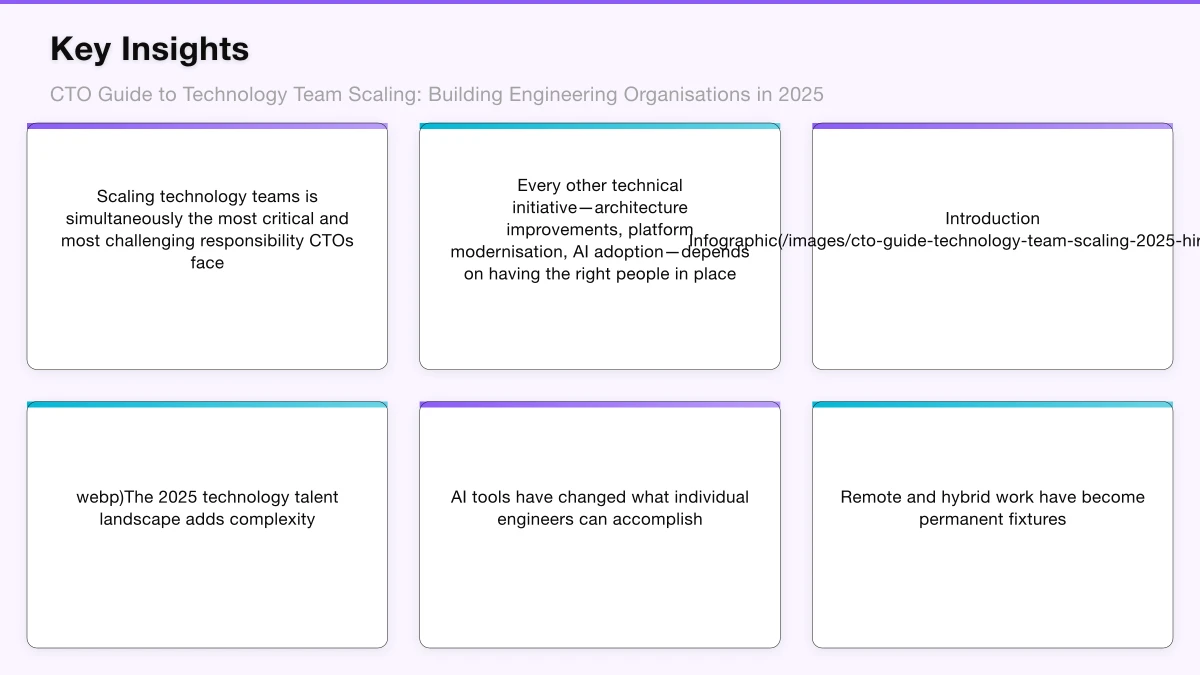
Scaling technology teams is simultaneously the most critical and most challenging responsibility CTOs face. Every other technical initiative—architecture improvements, platform modernisation, AI adoption—depends on having the right people in place. Yet team scaling failures are endemic: organisations hire too fast and create chaos, hire too slow and miss market windows, hire the wrong profiles and build capability gaps, or hire well but fail to integrate effectively.
The 2025 technology talent landscape adds complexity. AI tools have changed what individual engineers can accomplish. Remote and hybrid work have become permanent fixtures. Economic uncertainty creates planning challenges. Competition for senior talent remains fierce while junior hiring has contracted at many organisations.
This guide provides the strategic framework for scaling technology teams effectively—not just adding headcount, but building engineering organisations capable of sustained high performance.
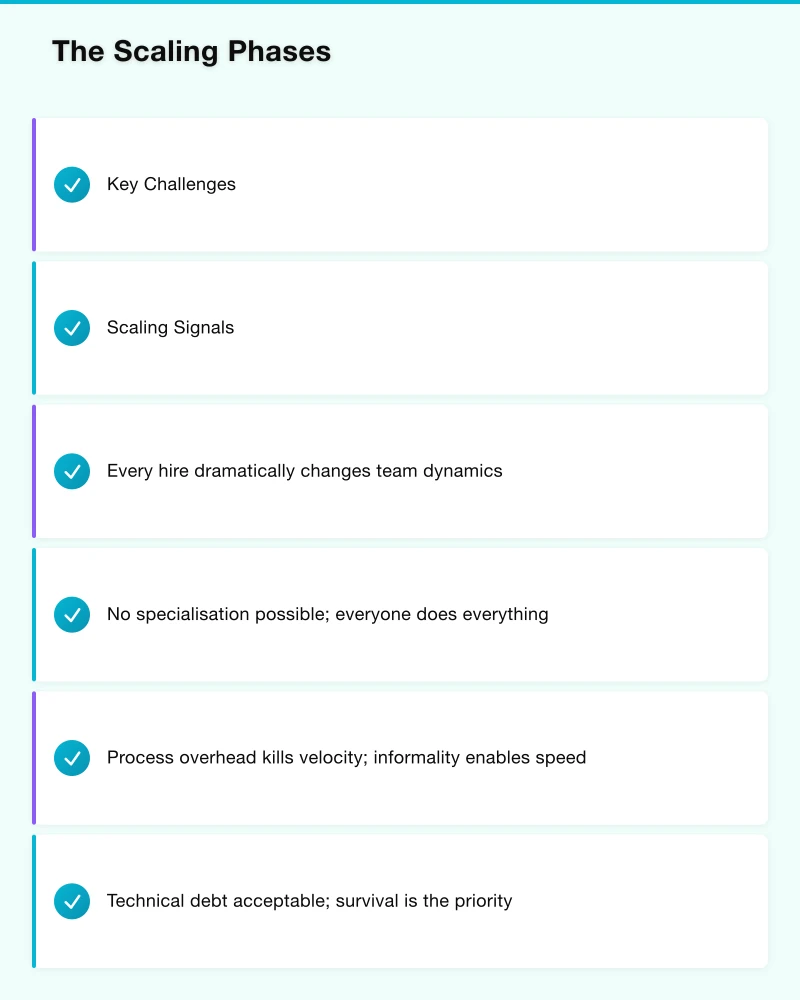
The Scaling Phases
Technology team scaling is not linear. Different challenges emerge at different scales, requiring different approaches:
Phase 1: Founding Team (1-10 Engineers)
The founding team phase favours generalists who can work across the stack, make decisions without extensive process, and tolerate ambiguity. Hiring optimises for individual capability and cultural contribution.
Key Challenges:
- Every hire dramatically changes team dynamics
- No specialisation possible; everyone does everything
- Process overhead kills velocity; informality enables speed
- Technical debt acceptable; survival is the priority
Scaling Signals:
- Consistent inability to ship planned features
- Key person dependencies creating risk
- Team members working unsustainable hours continuously
- Obvious gaps in technical capability
Phase 2: Initial Team (10-30 Engineers)
The transition from founding team to initial team marks the first organisational inflection point. Specialisation becomes possible and necessary. Initial processes emerge.
Key Challenges:
- Introducing structure without killing agility
- Developing first-line engineering managers
- Establishing technical practices that scale
- Maintaining culture as strangers join
Scaling Signals:
- Communication overhead consuming significant time
- Coordination failures between sub-teams
- Quality issues from insufficient review
- Manager span of control becoming unsustainable
Phase 3: Scaling Team (30-100 Engineers)
At this scale, organisation design becomes critical. Multiple teams work on interconnected systems. Coordination mechanisms must formalise. Middle management emerges.
Key Challenges:
- Designing effective team boundaries
- Balancing autonomy and alignment
- Developing engineering management capability
- Maintaining velocity despite coordination overhead
Scaling Signals:
- Decisions requiring multiple team coordination taking weeks
- Architecture drifting without clear ownership
- Talent retention issues from career path limitations
- Inability to take on initiatives requiring many teams
Phase 4: Enterprise Engineering (100+ Engineers)
Enterprise scale introduces organisational complexity requiring dedicated attention. Platform teams, architecture governance, and engineering enablement become necessary investments.
Key Challenges:
- Managing multiple layers of leadership
- Preventing bureaucracy while maintaining coordination
- Ensuring consistent practices across many teams
- Balancing innovation with operational excellence
Scaling Signals:
- The challenges never stop at this scale; continuous evolution required
Organisation Design Principles
Team Topology Models
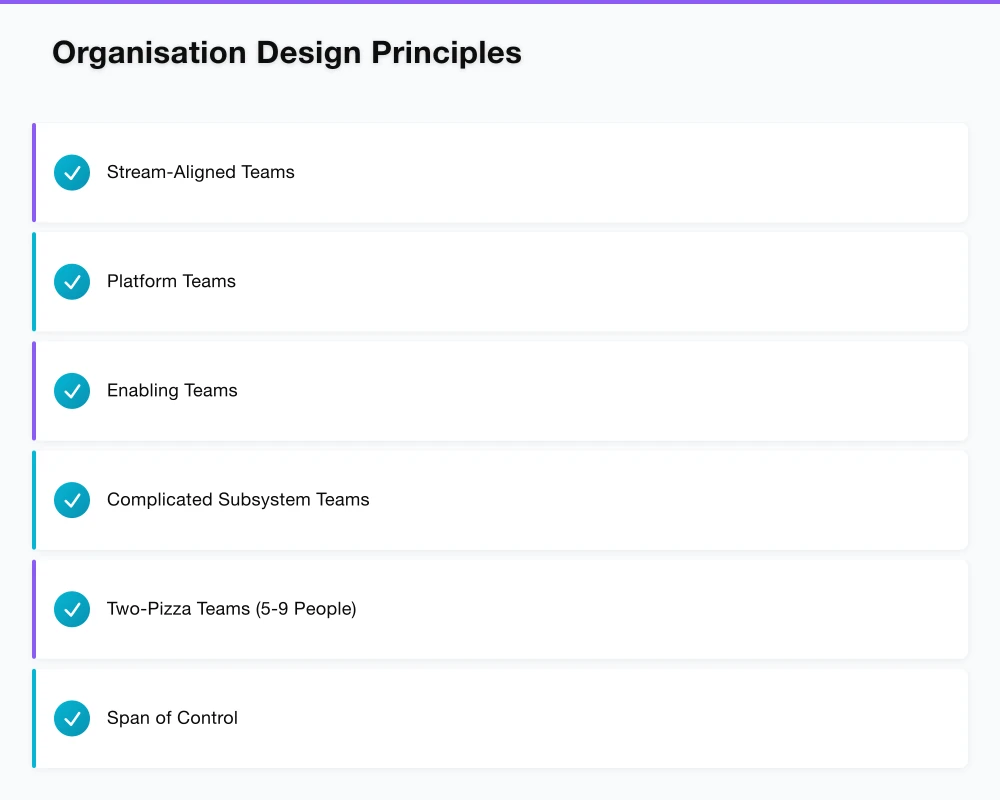
How you organise teams determines what you can build efficiently. Conway’s Law remains as relevant as ever: system architecture mirrors organisation structure.
Stream-Aligned Teams
Primary value-delivery teams organised around products, features, or customer journeys. These teams own end-to-end capability for their domain.
Characteristics:
- Clear ownership of customer outcomes
- Cross-functional capability (frontend, backend, data, sometimes mobile)
- Minimal dependencies on other teams for delivery
- Long-lived, not project-based
Best For: Most of your engineering organisation should be stream-aligned teams delivering customer value.
Platform Teams
Teams that build internal platforms enabling stream-aligned teams to deliver faster. Platform teams create leverage through self-service capabilities.
Characteristics:
- Product mindset toward internal customers
- Self-service interfaces over manual processes
- Measure success by stream team productivity
- Resist becoming service desks
Common Platforms:
- Developer experience (CI/CD, environments, tooling)
- Data platform (pipelines, warehousing, analytics)
- Infrastructure platform (compute, networking, security)
- Integration platform (APIs, messaging, observability)
Enabling Teams
Temporary teams that help stream-aligned teams adopt new capabilities. Enabling teams transfer knowledge and build capability, then move on.
Characteristics:
- Time-boxed engagements with specific objectives
- Measure success by capability transferred, not dependency created
- Staffed with senior specialists
- Work themselves out of necessity
Examples:
- Security enablement helping teams adopt secure development practices
- AI enablement helping teams integrate AI capabilities
- Cloud migration enabling legacy team modernisation
Complicated Subsystem Teams
Teams owning technically complex components requiring specialist expertise. These teams shield stream-aligned teams from complexity they shouldn’t need to understand.
Characteristics:
- Deep technical specialisation
- Clear interfaces hiding complexity
- Small teams of specialists
- Provide capability consumed by many teams
Examples:
- Machine learning model training and serving
- Real-time data processing infrastructure
- Video encoding and streaming
Team Sizing Guidelines
Team size affects communication overhead, ownership clarity, and individual impact.
Two-Pizza Teams (5-9 People)
Amazon’s famous heuristic remains useful. Teams of this size can:
- Communicate without excessive overhead
- Maintain shared context
- Make decisions quickly
- Feel collective ownership
Span of Control
Engineering managers effectively support 5-8 direct reports. Beyond this, quality of coaching and development suffers. Plan organisational structure accordingly.
Growth Patterns
When teams exceed optimal size, split rather than stretch. Splitting criteria:
- Natural domain boundaries within the team’s scope
- Reduced coordination needs between resulting teams
- Sufficient scope for each team to have meaningful ownership
Avoiding Common Anti-Patterns
The Component Team Trap
Teams organised around technical components (frontend team, backend team, database team) create coordination overhead for every feature. Prefer cross-functional teams that can deliver end-to-end.
The Project Trap
Teams assembled for projects, then disbanded, never develop deep ownership or domain expertise. Prefer long-lived teams that own domains, with work flowing to teams.
The Shared Services Trap
Central teams that become bottlenecks rather than enablers. If a “platform” team is mostly doing manual work for other teams, it’s a shared service creating dependencies, not a platform creating leverage.
Hiring Strategy
Defining Hiring Profiles
Before posting roles, define what you actually need:
Level Calibration
Establish clear level expectations (junior, mid, senior, staff, principal). Document expectations for each level across dimensions:
- Technical scope (individual features → system architecture)
- Autonomy (guided → self-directed → direction-setting)
- Influence (individual → team → organisation)
- Leadership (none → mentoring → managing → executive)
Specialist vs. Generalist Balance
Early stages favour generalists. Scale introduces specialist needs. Find the balance:
- Generalists provide flexibility and reduce coordination needs
- Specialists provide depth in critical areas
- Over-specialisation creates bottlenecks and fragility
- Most roles should be “T-shaped”—broad capability with depth in one area
Experience vs. Potential
Senior hires deliver immediate impact but cost more and may resist change. Junior hires require investment but grow with the organisation.
Guidelines:
- Avoid pure senior or pure junior teams
- Target roughly 30% senior, 50% mid, 20% junior in steady state
- Adjust toward senior when rapid scaling or domain expertise needed
- Invest in junior when building long-term capability and culture
Sourcing Strategies
Referral Networks
Employee referrals consistently produce highest-quality hires. Invest in referral programs:
- Meaningful referral bonuses (market rate: $5-15K for engineers)
- Track referral activity and conversion
- Make referring easy (simple submission, regular follow-up)
- Celebrate successful referrals
Direct Sourcing
Build internal sourcing capability:
- Dedicated sourcers for high-volume hiring
- Engineers participating in sourcing sprints
- Systematic outreach to target profiles
- Long-term relationship building
Agency Partnership
Use agencies strategically:
- Specialised agencies for niche roles
- Retained search for executive positions
- Contingent agencies for volume hiring (carefully)
- Negotiate fee structures aligned with outcomes
Employer Branding
Long-term investment in talent attraction:
- Engineering blog demonstrating technical culture
- Open source contributions showing code quality
- Conference presence building visibility
- Social media presence (authentic, not corporate)
Interview Process Design
Interview processes that take months lose candidates. Processes that take days produce bad hires. Find the balance:
Process Structure
A reasonable process for mid-to-senior engineers:
- Recruiter screen (30 min)—basic qualification, mutual fit
- Technical screen (60 min)—coding ability, technical communication
- System design (60 min)—architecture thinking, trade-off analysis
- Behavioural interview (45 min)—collaboration, leadership, culture
- Team fit (30 min)—rapport with future colleagues
Total: 3.5-4 hours of candidate time, completable in 1-2 weeks.
Assessment Principles
- Evaluate job-relevant skills, not puzzle-solving
- Provide realistic problems similar to actual work
- Allow demonstration of thought process, not just answers
- Multiple interviewers reduce individual bias
- Structured scorecards enable fair comparison
Candidate Experience
Every candidate interaction affects employer brand:
- Prompt communication at every stage
- Clear expectations for each interview step
- Interviewer preparation and professionalism
- Timely decisions and feedback
- Respectful rejection (today’s rejected candidate may be tomorrow’s hire)
Compensation Strategy
Market Positioning
Define your compensation philosophy:
- 75th percentile—competitive but not leading
- 90th percentile—talent magnet position
- 50th percentile—competing on other factors
Base position on what you can sustain, not just current funding.
Compensation Components
- Base salary: Primary component, market-competitive
- Equity: Significant for startups, less so for enterprises
- Bonus: Variable component tied to performance
- Benefits: Health, retirement, leave policies
- Perks: Workspace, equipment, learning budget
Geographic Considerations
Remote work forces geographic compensation decisions:
- Location-independent: Same pay regardless of location
- Location-adjusted: Pay adjusted for cost of labor or living
- Hybrid approaches: Ranges by region
No approach is clearly correct. Consistency and transparency matter most.
Building Engineering Culture
Culture as Operating System
Culture determines how work actually gets done, regardless of stated processes. Building intentional culture requires deliberate action:
Values Definition
Articulate engineering values that guide decisions:
- What do we prioritise when trade-offs conflict?
- What behaviours do we celebrate?
- What behaviours do we not tolerate?
- How do we make decisions?
Values Reinforcement
Values without reinforcement become wall decorations:
- Hire for values alignment
- Promote people who embody values
- Address values violations promptly
- Leaders model values consistently
Technical Excellence Culture
Quality Standards
Establish and maintain quality expectations:
- Code review requirements and standards
- Testing expectations (coverage, types, automation)
- Documentation requirements
- Technical debt management practices
Learning Culture
Engineering excellence requires continuous learning:
- Learning time allocation (10-20% common)
- Conference attendance and speaking opportunities
- Internal tech talks and knowledge sharing
- Mentorship programs
Blameless Accountability
Balance accountability with psychological safety:
- Blameless post-mortems for incidents
- Focus on system improvement, not individual punishment
- Accountability for behaviours, not just outcomes
- Celebrate learning from failure
Management Culture
Leadership Development
Invest in developing engineering managers:
- First-time manager training
- Ongoing management development
- Peer support networks
- Clear expectations and feedback
Feedback Culture
Continuous feedback enables growth:
- Regular 1:1s (weekly recommended)
- Real-time feedback (not saved for annual reviews)
- 360 feedback for leadership
- Skip-level meetings for organisational health
Decision-Making Clarity
Clear decision-making reduces friction:
- Document who decides what
- RACI charts for major initiatives
- Escalation paths when decisions stall
- Post-decision alignment (disagree and commit)
Scaling Challenges and Solutions
The 10-30 Transition
Challenge: First-time managers promoted from senior engineers
Solutions:
- Invest heavily in manager training before promotion
- Provide coach or mentor for new managers
- Accept temporary productivity dip during transition
- Create IC track for those who prefer technical work
The 30-100 Transition
Challenge: Middle management layer and cross-team coordination
Solutions:
- Establish engineering management career ladder
- Create technical leadership (staff+) track parallel to management
- Implement cross-team coordination mechanisms (architecture review, tech leads forum)
- Develop explicit team interfaces and contracts
Remote and Hybrid Scale
Challenge: Building culture and coordination without physical presence
Solutions:
- Intentional communication practices (over-communicate)
- Async-first documentation and decisions
- Regular in-person gatherings (quarterly or semi-annual)
- Investment in remote collaboration tools
- Time zone-aware scheduling and expectations
AI Impact on Scaling
Challenge: AI tools changing engineer productivity and role definition
Solutions:
- Embrace AI tooling for productivity enhancement
- Re-evaluate team sizing assumptions
- Shift hiring toward judgment and system thinking over syntax knowledge
- Create space for AI capability development
Metrics for Scaling Health
Delivery Metrics
- Deployment frequency: How often teams ship
- Lead time: Time from commit to production
- Change failure rate: Percentage of deployments causing issues
- Recovery time: Time to restore from failures
Team Health Metrics
- Engagement scores: Regular pulse surveys
- Retention rates: Voluntary turnover by tenure and level
- eNPS: Employee net promoter score
- Manager effectiveness: 360 feedback scores
Organisational Metrics
- Time to productivity: How quickly new hires become effective
- Span of control: Manager-to-IC ratios
- Dependency delays: Time lost to cross-team coordination
- Decision latency: Time for significant decisions to complete
Conclusion
Scaling technology teams is not a problem to be solved but a capability to be built. The organisations that scale effectively treat team building with the same rigour they apply to technical architecture: intentional design, continuous iteration, and investment in fundamentals.
The 2025 landscape presents both challenges and opportunities. AI tools enable smaller teams to accomplish more—but require different skills than before. Remote work expands the talent pool—but demands intentional culture building. Competition for talent remains intense—but organisations with strong cultures and clear missions attract disproportionately.
For CTOs navigating team scaling:
- Design intentionally: Organisation structure determines what you can build efficiently
- Invest in management: Technical excellence requires management excellence to scale
- Build culture deliberately: Culture left to chance becomes culture by accident
- Measure what matters: Metrics enable evidence-based organisational decisions
- Iterate continuously: No organisation design is permanent; evolution is constant
The teams you build today determine the products you can create tomorrow. Build thoughtfully.
Sources
- Skelton, M., & Pais, M. (2017). Team Topologies: Organizing Business and Technology Teams for Fast Flow. IT Revolution Press.
- Forsgren, N., Humble, J., & Kim, G. (2017). Accelerate: The Science of Lean Software and DevOps. IT Revolution Press.
- Larson, W., & Reilly, T. (2017). Staff Engineer: Leadership Beyond the Management Track. Stripe Press.
- Reinertsen, D. G. (2009). The Principles of Product Development Flow. Celeritas Publishing.
- Lencioni, P. (2002). The Five Dysfunctions of a Team. Jossey-Bass.
- DORA. (2025). State of DevOps Report. Google Cloud. https://cloud.google.com/devops/state-of-devops
Strategic guidance for technology leaders building world-class engineering organisations.
Your digital strategy starts with being found online. Cosmos Web Tech covers SEO, WordPress, and web performance for Australian businesses.
Ash Ganda is the founder of Ganda Tech Services, a Sydney-based technology consultancy delivering cloud, web, and mobile solutions for Australian businesses.
About the Author
Ashish Ganda is the founder of Ganda Tech Services, a Sydney-based technology consultancy specialising in cloud infrastructure, web development, and mobile app solutions for Australian businesses.
Digital Transformation Roadmap 2026
A 12-month framework for Australian SMBs ready to modernise — phases, tools, and milestones.