The CTO's Guide to Managing Remote Engineering Teams at Scale
Introduction
Three years after the pandemic forced a global experiment in remote work, the data is clear: distributed engineering teams are not a temporary accommodation but a permanent feature of the enterprise technology landscape. The organisations that have thrived in this environment have not simply transplanted office practices to video calls. They have fundamentally rearchitected how engineering work is organised, communicated, and measured.
For CTOs managing engineering organisations of hundreds or thousands of distributed engineers, the challenge extends far beyond providing collaboration tools. It requires designing communication systems, building culture intentionally, rethinking how productivity is understood and measured, and making deliberate architectural choices that enable rather than hinder distributed work.
The stakes are high. Engineering organisations that master distributed work gain access to global talent pools, reduced real estate costs, and often improved productivity. Those that fail face attrition, coordination overhead that erodes velocity, and cultural fragmentation that undermines innovation. This guide presents a strategic framework for CTOs navigating this challenge.
Designing Communication Architecture for Distributed Engineering
The most consequential decision a CTO makes about distributed engineering is not which collaboration tools to adopt. It is how to design the communication architecture of the organisation. Communication architecture refers to the deliberate structure of how information flows, decisions are made, and knowledge is shared across the engineering organisation.
The fundamental principle is that distributed teams must shift from synchronous, high-bandwidth communication as the default to asynchronous, documented communication as the default. This does not mean eliminating synchronous communication. It means reserving it for activities where real-time interaction adds clear value, such as brainstorming sessions, conflict resolution, and relationship building, while handling routine information sharing, decision-making, and status updates asynchronously.
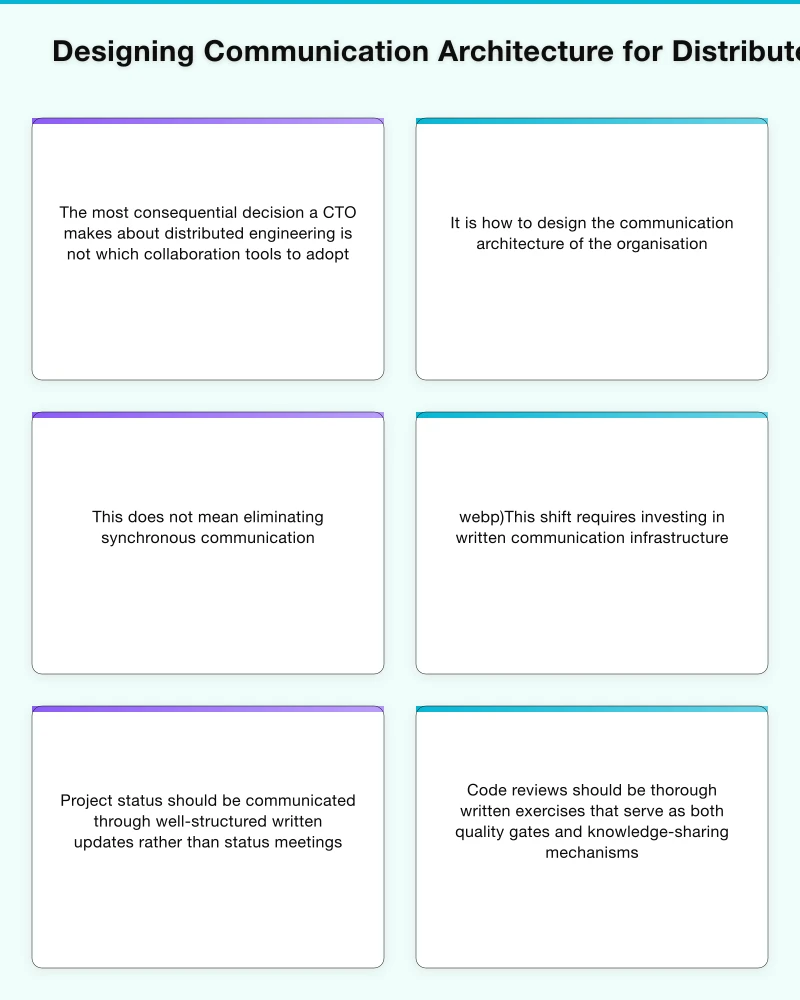
This shift requires investing in written communication infrastructure. Every significant technical decision should be documented in an architecture decision record (ADR) that captures the context, options considered, decision made, and rationale. Project status should be communicated through well-structured written updates rather than status meetings. Code reviews should be thorough written exercises that serve as both quality gates and knowledge-sharing mechanisms.
The tooling choices should support this communication philosophy. A well-structured internal documentation platform, whether Confluence, Notion, or a custom wiki, becomes the organisational memory. A disciplined approach to Slack or Teams usage, with clear norms about channel structure, response time expectations, and when to escalate to synchronous communication, prevents the tool from becoming either a firehose of noise or a graveyard of unanswered questions.
Time zone management deserves specific attention. For globally distributed teams, the overlap window where all team members are available simultaneously may be only a few hours or may not exist at all. CTOs should identify core collaboration hours, typically a four to six hour window that maximises overlap, and reserve this window for activities that genuinely require synchronous participation. All other work should be designed to proceed asynchronously.
Building and Maintaining Engineering Culture Remotely
Culture in a co-located environment emerges organically from daily interactions, hallway conversations, and shared experiences. In a distributed environment, culture must be intentionally designed and actively maintained. This does not mean culture is artificial; it means it requires deliberate investment rather than passive hope.
The foundation of distributed engineering culture is shared values and practices that are explicitly documented and consistently reinforced. What does quality mean in this organisation? How do we handle disagreements? What is the expectation for code review turnaround? How do we celebrate successes and learn from failures? In a co-located environment, new engineers absorb these norms through observation. In a distributed environment, they must be written down, discussed, and modelled by leadership.
Onboarding becomes significantly more important and significantly more challenging in distributed environments. New engineers cannot learn by osmosis, sitting near experienced colleagues and absorbing context through overheard conversations and casual questions. Structured onboarding programmes that pair new hires with experienced mentors, provide clear learning paths, and include regular check-ins are not optional; they are essential to retention and time-to-productivity.
Social connection requires intentional investment. Regular virtual team events, optional social channels, and periodic in-person gatherings all contribute to the social fabric that sustains collaboration. The in-person gatherings, typically quarterly or semi-annually, are particularly valuable. While they represent significant logistical and financial investment, the relationship capital they build pays dividends in improved day-to-day collaboration for months afterward.
Psychological safety, the belief that one can speak up, ask questions, and make mistakes without fear of punishment, is both more important and more fragile in distributed environments. Leaders must actively create space for dissenting opinions, publicly acknowledge their own mistakes, and respond constructively to problems rather than blame. The absence of body language and spontaneous interaction in distributed settings means that negative cultural signals are amplified while positive ones are attenuated.
Rethinking Productivity Measurement
The transition to distributed work has exposed the bankruptcy of input-based productivity measures. When you cannot see engineers at their desks, measuring busyness becomes impossible, and this is actually a good thing. It forces organisations to focus on what matters: output and outcomes.
Effective productivity measurement for distributed engineering teams operates at three levels. At the team level, the DORA metrics, deployment frequency, lead time for changes, change failure rate, and time to restore service, provide well-validated measures of delivery capability. These metrics are particularly valuable because they are outcome-oriented, applicable regardless of work location, and benchmarkable against industry standards.
At the individual level, productivity measurement requires more nuance. Code volume metrics like lines of code or commit frequency are worse than useless; they incentivise exactly the wrong behaviours. Instead, managers should evaluate engineers on the quality and impact of their contributions, the effectiveness of their collaboration and communication, and their growth trajectory. This evaluation is inherently qualitative and requires managers to be actively engaged with their team’s work, not monitoring dashboards from a distance.
At the organisational level, engineering productivity should be connected to business outcomes. How quickly can the organisation deliver new capabilities to customers? How reliably do systems operate? How effectively does the engineering organisation adapt to changing priorities? These questions matter far more than any individual metric and require a holistic view that combines quantitative data with qualitative judgment.
The measurement approach should be transparent and collaborative. Engineers should understand how their work is evaluated and have input into the metrics and processes used. Surprise is the enemy of psychological safety, and opaque evaluation systems breed anxiety and game-playing in distributed environments where engineers already feel less connected to their managers and peers.
Architectural Decisions That Enable Distributed Work
The technical architecture of the systems being built has a profound impact on the effectiveness of distributed engineering teams. Certain architectural choices inherently support distributed work by minimising coordination overhead and maximising team autonomy.
Loosely coupled architectures, whether microservices, modular monoliths, or well-structured service-oriented designs, allow teams to work independently on well-defined components with clear interfaces. This reduces the need for real-time coordination between teams and makes asynchronous communication more effective because the surface area for miscommunication is smaller.
Strong API contracts and comprehensive automated testing provide the safety nets that enable independent work. When teams can verify that their changes do not break other teams’ functionality through automated contract tests and integration suites, the need for manual coordination and synchronous approval processes diminishes. Investment in testing infrastructure is doubly valuable in distributed environments.
Feature flags and progressive delivery mechanisms enable teams to ship code independently while controlling the rollout of user-visible changes. This reduces the coordination overhead of release planning and allows teams to maintain high deployment frequency without creating chaos in production.
Infrastructure as code and self-service platform capabilities, as discussed in the platform engineering paradigm, reduce dependencies on centralised infrastructure teams. When application teams can provision and manage their own environments through self-service platforms, a significant source of distributed work friction is eliminated.
The Strategic Advantage of Distributed Engineering
Distributed engineering, done well, is not merely an accommodation of post-pandemic reality. It is a strategic advantage. Access to global talent markets allows organisations to hire the best engineers regardless of geography. Follow-the-sun development models can accelerate delivery timelines. Reduced real estate costs free budget for investment in tools, training, and compensation.
Realising these advantages requires sustained investment in the communication architecture, culture, measurement systems, and technical foundations outlined here. CTOs who treat distributed work as merely a logistical challenge will continue to struggle. Those who recognise it as a fundamental rearchitecting of how engineering work is done will unlock the full potential of their distributed teams.
For technical deep-dives on the cloud and IT topics I cover strategically, visit Cloud Geeks — our specialist IT infrastructure blog.
Ganda Tech Services is my technology consultancy, bringing together cloud infrastructure, web development, and mobile expertise for Australian businesses.
About the Author
Ashish Ganda is the founder of Ganda Tech Services, a Sydney-based technology consultancy specialising in cloud infrastructure, web development, and mobile app solutions for Australian businesses.
Digital Transformation Roadmap 2026
A 12-month framework for Australian SMBs ready to modernise — phases, tools, and milestones.