The CTO's Guide to Engineering Organisation Design
Introduction
Conway’s Law, the observation that organisations design systems that mirror their communication structures, is one of the most reliably validated principles in software engineering. Yet many CTOs inherit or build engineering organisations without deliberate consideration of how organisational structure shapes the technical architecture and, ultimately, the business capabilities the organisation can deliver.
Engineering organisation design is one of the highest-leverage activities a CTO can undertake. The structure of the engineering organisation determines how quickly teams can deliver, how effectively they collaborate, how well they scale, and how closely the technical architecture aligns with business strategy. A well-designed engineering organisation amplifies every other investment in technology; a poorly designed one undermines them.
This guide presents a strategic framework for CTOs designing or restructuring engineering organisations, drawing on established models like Team Topologies and the Spotify model while addressing the practical constraints of real enterprise environments.
Team Topologies and the Four Team Types
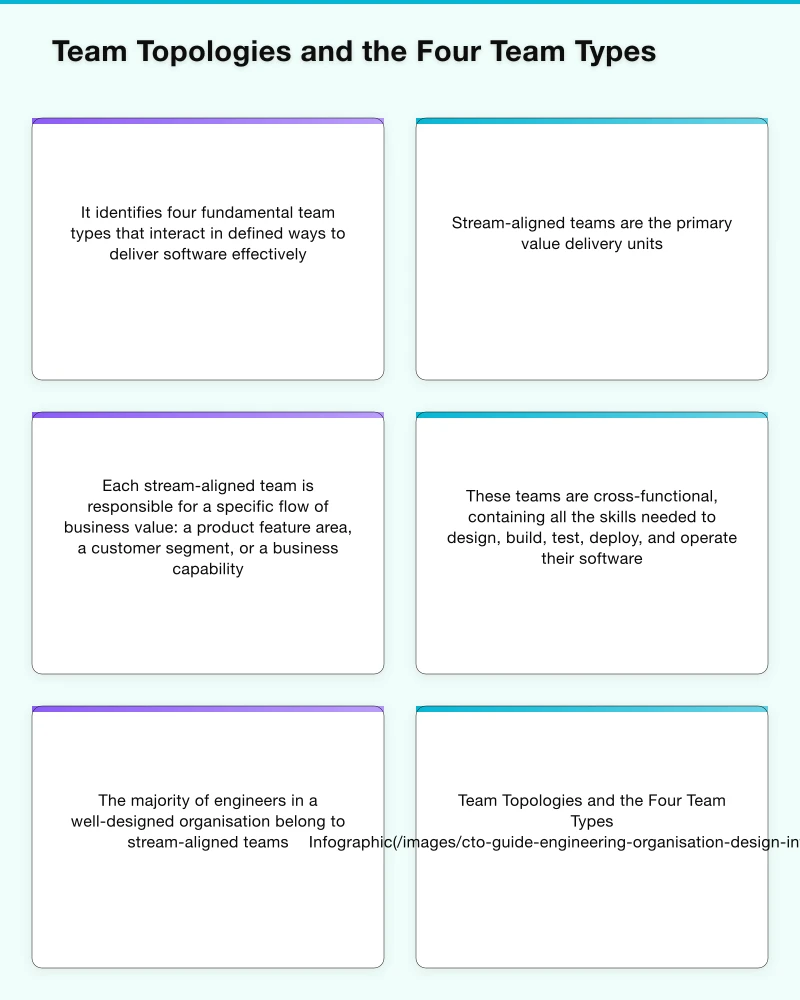
The Team Topologies framework, articulated by Matthew Skelton and Manuel Pais, provides the most rigorous and practical model for engineering organisation design. It identifies four fundamental team types that interact in defined ways to deliver software effectively.
Stream-aligned teams are the primary value delivery units. Each stream-aligned team is responsible for a specific flow of business value: a product feature area, a customer segment, or a business capability. These teams are cross-functional, containing all the skills needed to design, build, test, deploy, and operate their software. They have clear ownership of their domain, end-to-end responsibility for their systems, and the autonomy to make technical decisions within their scope. The majority of engineers in a well-designed organisation belong to stream-aligned teams.
Platform teams provide internal services that reduce the cognitive load on stream-aligned teams. Rather than every stream-aligned team independently solving common technical challenges like CI/CD, infrastructure provisioning, observability, or security scanning, the platform team provides these capabilities as self-service internal products. The platform team’s success is measured by the velocity and satisfaction of the stream-aligned teams it serves.
Enabling teams help stream-aligned teams acquire new capabilities. When a stream-aligned team needs to adopt a new technology, improve a practice, or develop expertise in a new domain, an enabling team provides temporary coaching and guidance. Enabling teams do not do the work for stream-aligned teams; they build the stream-aligned team’s capacity to do the work themselves. Enabling teams might specialise in areas like performance engineering, security, data engineering, or accessibility.
Complicated subsystem teams own technically complex components that require deep specialist expertise. If a stream-aligned team would be significantly slowed by maintaining a component that requires specialised mathematical, scientific, or engineering knowledge, a complicated subsystem team can own that component and provide it as a service. These teams should be created sparingly; most technical complexity should be managed within stream-aligned teams.
Designing Team Boundaries
The most consequential decision in engineering organisation design is where to draw team boundaries. Poor boundary choices create either excessive inter-team coordination (slowing delivery) or duplicated effort (wasting capacity). Good boundaries maximise team autonomy while minimising cross-team dependencies.
Domain-driven design provides the intellectual framework for boundary decisions. Bounded contexts, the core DDD concept, represent coherent areas of business functionality with well-defined interfaces. Teams aligned to bounded contexts can work independently because their scope is cohesive and their dependencies are explicit.
The fracture plane concept from Team Topologies identifies natural separation points where teams can be divided with minimal coordination overhead. Common fracture planes include business domain (each team owns a distinct business capability), user persona (each team serves a distinct user type), regulatory compliance (separating regulated from non-regulated systems), and technology platform (separating mobile from web from backend).
Team size should follow established heuristics. Amazon’s two-pizza team concept (five to nine people) has strong empirical support. Teams smaller than five lack the diversity of skills and perspectives needed for effective software delivery. Teams larger than nine suffer from communication overhead that erodes productivity. The specific optimal size depends on the complexity and scope of the team’s domain, but staying within the five-to-nine range is a reliable guideline.
Cognitive load is the limiting factor for team scope. Each team can effectively own only a limited amount of software complexity. When a team’s cognitive load exceeds its capacity, quality declines, delivery slows, and burnout increases. If a team’s domain is too large or too complex for five to nine people to reason about effectively, the domain should be split into multiple teams with clear interfaces.
Scaling the Engineering Organisation
As the engineering organisation grows, the organisational design must evolve. The patterns that work for twenty engineers do not scale to two hundred, and those that work for two hundred do not scale to two thousand.
At the small scale (under twenty to thirty engineers), a flat structure with two or three stream-aligned teams and minimal platform capability is appropriate. Communication is direct, coordination is lightweight, and the overhead of formal processes is unjustified.
At the medium scale (thirty to one hundred engineers), a second organisational layer is needed. Engineering managers lead teams of five to nine engineers, and a director or VP of Engineering coordinates across teams. Platform team investment becomes necessary as the cost of each team independently managing infrastructure and tooling exceeds the cost of a dedicated platform capability. This is also the scale at which explicit processes for cross-team coordination, such as architecture review and shared roadmap planning, become necessary.
At the large scale (over one hundred engineers), multiple layers of management are unavoidable, and the design of those layers matters enormously. A common and effective structure groups related stream-aligned teams into tribes or groups, each led by a senior engineering leader, with shared platform and enabling teams serving the broader organisation. The challenge at this scale is maintaining alignment and coherence without creating bureaucracy that stifles the team autonomy that delivers velocity.
The ratio of managers to engineers (span of control) should typically be one to five through one to eight. Narrower spans allow more hands-on management and coaching but create deeper hierarchies. Wider spans create flatter organisations but limit managers’ ability to provide individual attention. The appropriate span depends on the team’s autonomy level, the complexity of the work, and the experience of the engineers.
Architecture-Organisation Alignment
Conway’s Law works in both directions. Not only does the organisation shape the architecture, but the architecture constrains the organisation. Achieving alignment between the two is essential for effective engineering at scale.
The inverse Conway manoeuvre involves deliberately designing the organisation to produce the desired architecture. If the strategic architectural direction is a loosely coupled microservices architecture, the engineering organisation should consist of small, autonomous teams, each owning one or a few services with clear interfaces. If the architecture requires tight integration between components, the responsible teams should be co-located (physically or organisationally) to enable the high-bandwidth communication that integration demands.
Cross-cutting concerns, capabilities that span multiple team boundaries like security, performance, accessibility, and data governance, require organisational mechanisms that do not violate team autonomy. Enabling teams, communities of practice, and architecture guilds provide forums for coordinating cross-cutting concerns without creating centralised gatekeeping functions. The key principle is that cross-cutting concerns should be addressed through standards, tooling, and education rather than through approval processes and review gates.
Technical leadership structures should complement the management hierarchy. A principal or staff engineer track provides career progression for engineers who lead through technical influence rather than management authority. Architects, whether embedded in teams or serving in a central function, ensure that individual team decisions align with the broader architectural direction. The relationship between management and technical leadership should be collaborative, with managers owning team health and delivery and technical leaders owning architectural quality and technical direction.
Measuring Organisational Effectiveness
Engineering organisation design should be evaluated based on outcomes, not structure. The ultimate measures of organisational effectiveness are delivery velocity, system reliability, team health, and alignment with business strategy.
DORA metrics provide validated measures of delivery performance: deployment frequency, lead time for changes, change failure rate, and time to restore service. These metrics are influenced by both technical practices and organisational design and provide objective benchmarks for evaluating whether organisational changes improve delivery.
Team satisfaction surveys capture the human experience of working within the organisation. Questions about autonomy, cognitive load, cross-team collaboration effectiveness, and tooling quality reveal whether the organisational design is supporting or hindering the people within it.
Engineering organisation design is not a one-time activity. It requires continuous evaluation and adjustment as the organisation grows, business strategy evolves, and the technology landscape changes. The CTO who treats organisation design as a core responsibility, investing the same analytical rigour as architectural decisions, builds the foundation on which all other engineering investments succeed.
For the practitioner’s view on cloud, IT, and cybersecurity, explore Cloud Geeks — where strategy meets infrastructure.
These insights are drawn from my work leading Ganda Tech Services — helping Australian businesses navigate digital transformation through cloud, web, and mobile.
About the Author
Ashish Ganda is the founder of Ganda Tech Services, a Sydney-based technology consultancy specialising in cloud infrastructure, web development, and mobile app solutions for Australian businesses.
Digital Transformation Roadmap 2026
A 12-month framework for Australian SMBs ready to modernise — phases, tools, and milestones.
Almost done
Check your inbox and click the confirmation link to get your download.