The CTO's Framework for Technology Vendor Evaluation
Technology vendor selection is among the most consequential decisions a CTO makes. A platform choice can define the enterprise’s technical landscape for five to ten years. A poorly evaluated vendor can create dependencies that constrain future options, introduce security vulnerabilities, or simply fail to deliver on promises, leaving the organisation with an expensive investment and no return.
Yet vendor evaluation in many enterprises remains remarkably informal. A proof of concept with the most prominent vendor, influenced by analyst reports and conference presentations, leads to a selection decision based more on familiarity than rigorous assessment. The evaluation criteria are vague, the comparison across vendors is inconsistent, and the risk assessment is superficial.
The stakes demand better. A structured evaluation framework provides the CTO with a repeatable, defensible process for assessing vendors across multiple dimensions, comparing options consistently, and making decisions that serve the enterprise’s long-term interests rather than short-term convenience.
The Evaluation Dimensions
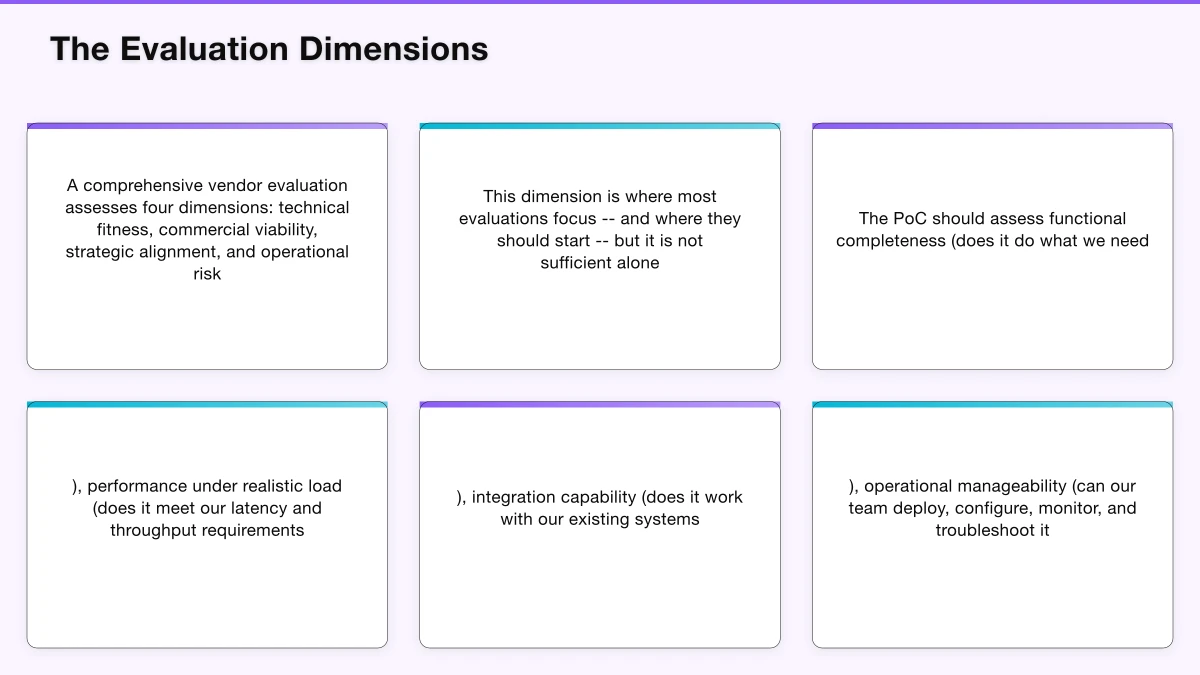
A comprehensive vendor evaluation assesses four dimensions: technical fitness, commercial viability, strategic alignment, and operational risk. Each dimension addresses a different aspect of the vendor relationship, and weakness in any dimension should give pause regardless of strength in the others.
Technical fitness assesses whether the vendor’s product does what the enterprise needs it to do, at the scale and performance level required, with the integration capabilities the architecture demands. This dimension is where most evaluations focus — and where they should start — but it is not sufficient alone.
The technical evaluation should include a structured proof of concept (PoC) that tests the product against real enterprise scenarios, not the vendor’s curated demonstrations. The PoC should assess functional completeness (does it do what we need?), performance under realistic load (does it meet our latency and throughput requirements?), integration capability (does it work with our existing systems?), operational manageability (can our team deploy, configure, monitor, and troubleshoot it?), and security posture (does it meet our security requirements?).
The PoC should be conducted by the team that will operate the product in production, not by a separate evaluation team. The people who will live with the decision should make the decision. Vendor-led PoCs, where the vendor’s engineers do the implementation, provide an optimistic view that does not reflect what the enterprise will experience after the deal is signed.
Commercial viability assesses the vendor’s financial health, market position, and business model sustainability. A technically excellent product from a vendor that may not survive is a risky investment. This dimension examines revenue growth, profitability or path to profitability, funding status and runway (for startups), customer retention rates, and market analyst assessments.
The pricing model deserves particular scrutiny. Per-seat, per-transaction, consumption-based, and tiered licensing models create different cost profiles as usage scales. The CTO should model costs at current usage, at projected three-year usage, and at peak usage to understand the cost trajectory. Hidden costs — professional services for implementation, premium support tiers, data egress fees, and mandatory training — should be identified and factored into the total cost of ownership.
Strategic alignment assesses whether the vendor’s product direction aligns with the enterprise’s technology strategy. Is the vendor investing in cloud-native capabilities if the enterprise is moving to cloud? Does the vendor support the integration standards (APIs, protocols, data formats) that the enterprise architecture requires? Is the vendor’s platform evolution trajectory compatible with the enterprise’s roadmap?
Vendor lock-in is a strategic alignment concern that warrants explicit assessment. What happens if the enterprise needs to move away from this vendor? How portable is the data? How standard are the interfaces? What would migration cost in time, money, and business disruption? Some lock-in is acceptable — the benefits of a deeply integrated platform may outweigh the switching costs. But the lock-in should be understood and accepted deliberately, not discovered retroactively.
Operational risk assesses the risks that the vendor relationship introduces. Security risk: does the vendor handle enterprise data, and if so, how is it protected? What are the vendor’s security practices, certifications (SOC 2, ISO 27001), and breach notification commitments? Continuity risk: what happens if the vendor is acquired, pivots its product strategy, or exits the market? Does the enterprise have access to source code through escrow arrangements? Dependency risk: how critical is this vendor to the enterprise’s operations, and what alternatives exist if the vendor fails to perform?
The Evaluation Process
A structured evaluation process ensures consistency and thoroughness while managing the time investment.
The requirements definition phase articulates what the enterprise needs from the vendor in specific, measurable terms. Requirements should be categorised as must-have (non-negotiable requirements that any vendor must satisfy), should-have (important requirements that differentiate strong candidates), and nice-to-have (desirable capabilities that are not decisive). This categorisation prevents the evaluation from being dominated by non-essential features.
The market scan phase identifies the candidate vendors. This should extend beyond the obvious market leaders to include emerging vendors that may offer superior capabilities or pricing. Analyst reports (Gartner, Forrester), peer recommendations, and community sentiment provide input, but the scan should be broad enough to avoid selection bias.
The shortlist evaluation phase applies the four-dimension framework to a shortlist of three to five vendors. Each vendor receives a structured assessment covering technical fitness, commercial viability, strategic alignment, and operational risk. The assessment uses consistent criteria across all vendors, enabling meaningful comparison.
The proof of concept phase tests the top one or two candidates in the enterprise environment. The PoC should have defined success criteria agreed upon before it begins, a realistic timeline (typically two to four weeks), and be conducted by the team that will operate the product. The PoC outcome should be documented objectively, and the evaluation team should present findings to the decision-making group.
The negotiation and decision phase combines the evaluation findings with commercial negotiation. The CTO should ensure that contract terms address the risks identified during evaluation — service level commitments, data portability provisions, escrow arrangements for source code, and exit terms that do not create unreasonable switching barriers.
Reference Checks and Community Intelligence
Vendor-provided references are necessary but insufficient. The vendor will direct you to their happiest customers, and those conversations will be positive. More valuable intelligence comes from unfiltered sources.
Community forums, user groups, and conferences provide candid feedback from practitioners who use the product daily. The frustrations expressed in these venues are far more informative than polished case studies. Stack Overflow questions, GitHub issues (for open-source components), and Reddit discussions reveal the real-world experience of operating the product.
Peer networking — conversations with CTOs and engineering leaders at other enterprises using the vendor’s product — provides strategic-level feedback. How has the vendor performed as a partner? Has the product evolved as promised? What would they do differently if starting the evaluation today?
Former customers — organisations that have moved away from the vendor — provide the most candid perspective. Understanding why they left, what the migration cost, and what they moved to provides insight that no current customer reference can match.
The CTO who invests in a structured, thorough vendor evaluation process makes decisions that serve the enterprise for years. The upfront investment in rigorous evaluation is a fraction of the cost of a poor vendor choice discovered after implementation and adoption. This is one domain where process discipline directly protects the enterprise’s strategic interests.
Mobile execution is where many digital strategies come to life. Awesome Apps publishes practical guides on app development and mobile UX.
As founder of Ganda Tech Services, I work with Australian businesses to align technology investments with business growth — across cloud, web, and mobile.
About the Author
Ashish Ganda is the founder of Ganda Tech Services, a Sydney-based technology consultancy specialising in cloud infrastructure, web development, and mobile app solutions for Australian businesses.
Digital Transformation Roadmap 2026
A 12-month framework for Australian SMBs ready to modernise — phases, tools, and milestones.
Almost done
Check your inbox and click the confirmation link to get your download.