Engineering Onboarding Strategy: Building Productive Teams Faster
The first ninety days of an engineer’s tenure fundamentally shape their trajectory within an organization. Get onboarding right, and you accelerate a new hire to productivity while building engagement and retention. Get it wrong, and you create a slow-starting employee who may never reach full potential—or worse, leaves within the first year, wasting months of recruiting investment.
Engineering onboarding presents unique challenges compared to general corporate onboarding. Engineers must absorb complex technical architectures, understand domain-specific business logic, navigate development workflows, and integrate with team practices—all while expectations for delivery ramp up quickly. The cognitive load is substantial, and most organizations underestimate the time and structure required for effective knowledge transfer.
For CTOs building engineering organizations, onboarding strategy directly impacts team productivity, retention, and culture. An engineer who spends three months reaching productive contribution versus one who achieves it in six weeks represents significant capacity difference across a growing team. The compound effect across dozens or hundreds of hires determines organizational velocity.
The True Cost of Ineffective Onboarding
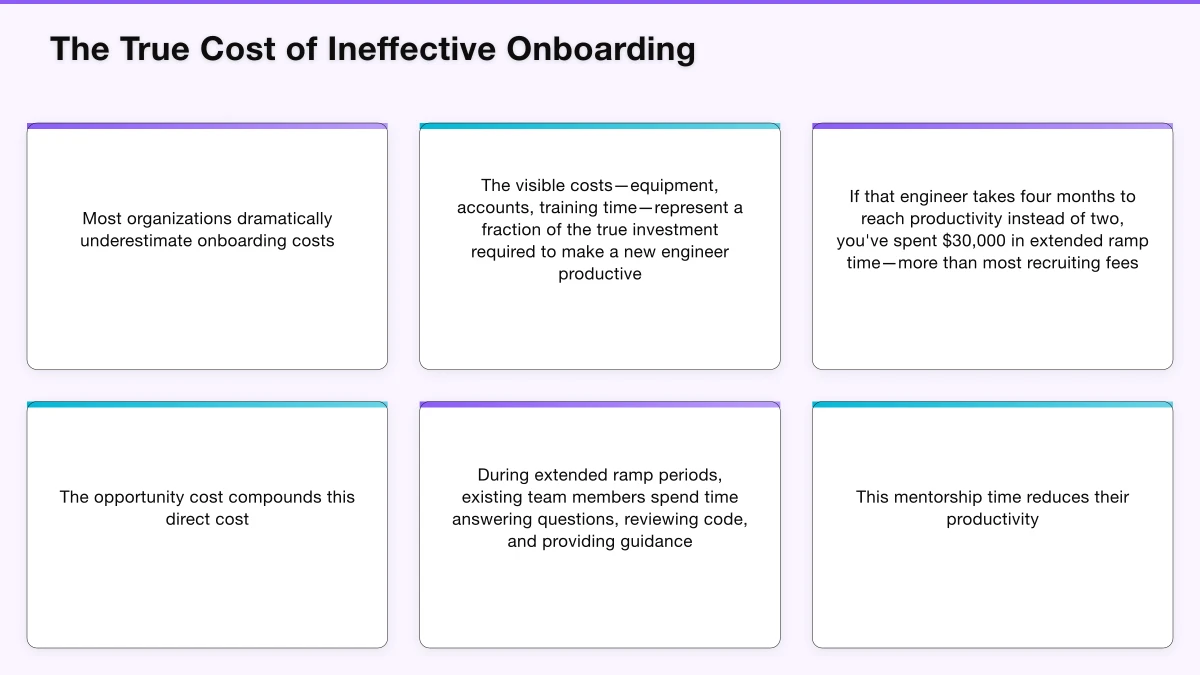
Most organizations dramatically underestimate onboarding costs. The visible costs—equipment, accounts, training time—represent a fraction of the true investment required to make a new engineer productive.
Consider the fully-loaded cost of a senior engineer: salary, benefits, equipment, office space, and management overhead easily exceeds $15,000 per month in competitive markets. If that engineer takes four months to reach productivity instead of two, you’ve spent $30,000 in extended ramp time—more than most recruiting fees.
The opportunity cost compounds this direct cost. During extended ramp periods, existing team members spend time answering questions, reviewing code, and providing guidance. This mentorship time reduces their productivity. Studies suggest that each new hire consumes 10-15% of a mentor’s capacity for the first three months—capacity that could otherwise produce deliverables.
Retention impact extends the cost calculation further. Poor onboarding experiences correlate strongly with early attrition. BambooHR research indicates that employees who experienced poor onboarding are twice as likely to seek new opportunities within the first year. Replacing an engineer who leaves within twelve months compounds recruiting costs while losing whatever productivity was achieved during their tenure.
Culture impact is harder to quantify but equally significant. New engineers form impressions of organizational competence during onboarding. Chaotic onboarding signals organizational dysfunction. Structured, supportive onboarding signals an organization that invests in its people and operates professionally.
The business case for onboarding investment is straightforward: modest upfront investment in onboarding structure returns multiples through accelerated productivity, improved retention, and strengthened culture.
Designing the Onboarding Journey
Effective onboarding follows a structured journey that builds knowledge progressively while providing early wins that build confidence and engagement.
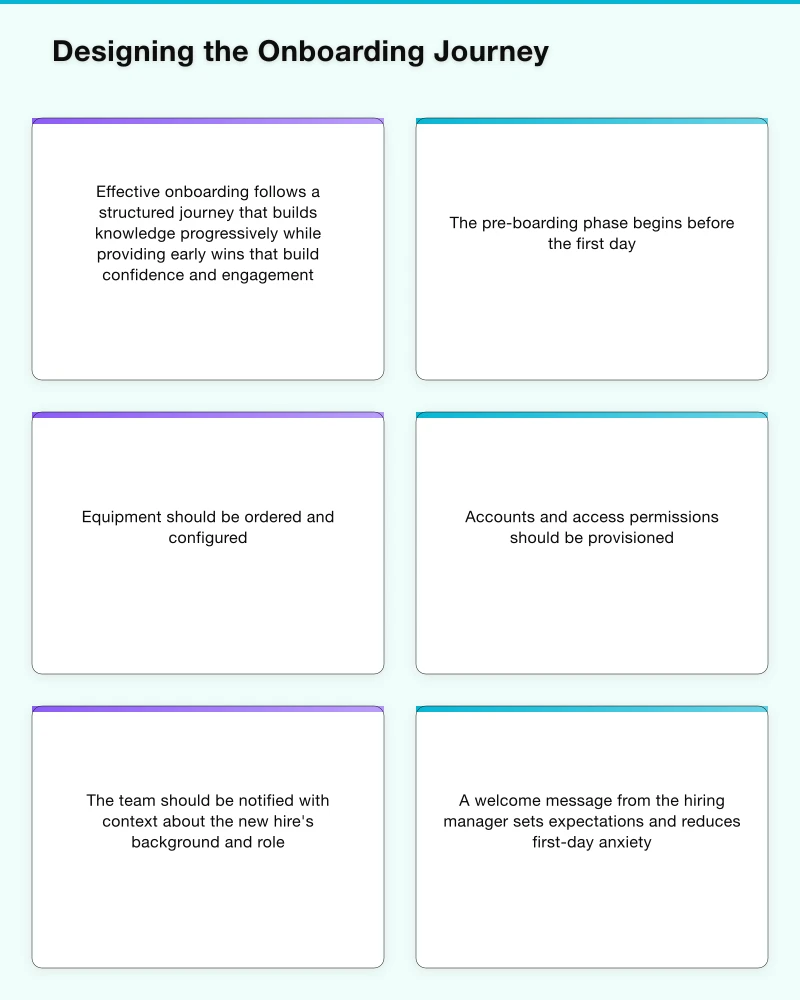
The pre-boarding phase begins before the first day. Equipment should be ordered and configured. Accounts and access permissions should be provisioned. The team should be notified with context about the new hire’s background and role. A welcome message from the hiring manager sets expectations and reduces first-day anxiety. Organizations that nail pre-boarding create a sense of competence and care before the engineer writes their first line of code.
Week one focuses on environmental orientation. The engineer should understand the physical or virtual workspace, meet immediate team members, and complete administrative necessities. Technical setup—development environment, repository access, build systems—should be documented sufficiently that engineers can self-serve with minimal assistance. First-day paperwork and logistics should be streamlined to minimize time spent on non-productive activities.
The first delivery milestone should occur within the first two weeks. This isn’t about significant contribution—it’s about completing the full development cycle: understanding a task, making a change, getting code reviewed, and seeing it deployed. This end-to-end experience demystifies the development workflow and provides a sense of accomplishment. Select a small, well-defined task with clear success criteria.
Weeks two through four deepen technical understanding. The engineer should receive structured exposure to system architecture, key codebases, and domain concepts. Pair programming with experienced team members accelerates knowledge transfer while building relationships. Code review participation—both giving and receiving—develops understanding of team standards and practices.
The first month culminates in an architecture overview session. By this point, the engineer has enough context to absorb a comprehensive explanation of system design, technical debt, and architectural direction. Earlier presentation of this information overwhelms; at the one-month mark, it connects to accumulated experience.
Months two and three transition toward full productivity. Task complexity increases. Independence grows as the engineer demonstrates competence. Check-ins shift from daily guidance to weekly coaching. The mentor relationship evolves from teacher to collaborator.
Technical Knowledge Transfer
Technical knowledge transfer presents the primary challenge in engineering onboarding. Engineers must absorb complex systems built over years, understanding not just what the code does but why it was built that way and how it connects to business requirements.
Documentation forms the foundation of knowledge transfer, but documentation alone is insufficient. Technical documentation should cover architecture overview, development setup, deployment processes, and system operations. The documentation doesn’t need to be comprehensive—it needs to enable the engineer to accomplish common tasks and know where to ask questions. Outdated documentation is worse than no documentation; invest in keeping critical documents current.
Codebase orientation follows a structured path through the system. Start with entry points—API endpoints, message consumers, scheduled jobs—that provide natural starting points for understanding data flow. Progress to core domain logic where business rules are implemented. Address infrastructure and utilities last; these are important but don’t illuminate business understanding.
Architecture decision records (ADRs) capture the “why” behind technical choices. Engineers repeatedly ask why systems are built particular ways; ADRs provide answers without requiring synchronous explanation. For organizations without existing ADRs, onboarding questions reveal which decisions most need documentation—capture explanations as you provide them.
System diagrams visualize relationships that are difficult to convey through text or code. Maintain current diagrams of service dependencies, data flows, and deployment architecture. Tools like Miro, Lucidchart, or even hand-drawn diagrams preserved as images provide reference material that accelerates understanding.
Shadow sessions place new engineers alongside experienced team members during normal work activities. Watching an experienced engineer debug a production issue, review a design document, or navigate a code review provides implicit knowledge transfer that documentation cannot capture.
Structured Learning Programs
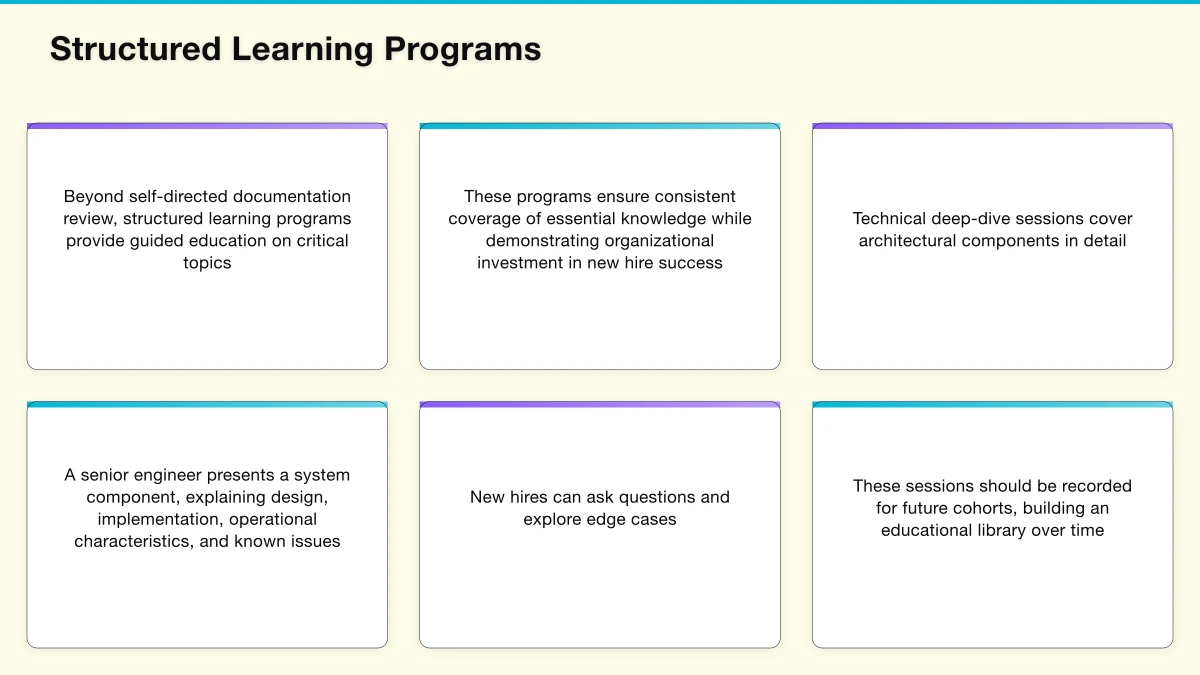
Beyond self-directed documentation review, structured learning programs provide guided education on critical topics. These programs ensure consistent coverage of essential knowledge while demonstrating organizational investment in new hire success.
Technical deep-dive sessions cover architectural components in detail. A senior engineer presents a system component, explaining design, implementation, operational characteristics, and known issues. New hires can ask questions and explore edge cases. These sessions should be recorded for future cohorts, building an educational library over time.
Domain knowledge sessions explain the business context that shapes technical decisions. Engineers make better decisions when they understand why users behave certain ways, what business constraints drive requirements, and how technology serves business strategy. Product managers and business stakeholders should participate in domain sessions, connecting technical and business perspectives.
Operational readiness training prepares engineers for production support responsibilities. This includes alerting systems, incident response procedures, debugging techniques for production systems, and escalation paths. Engineers shouldn’t participate in on-call rotations until they’ve completed operational readiness training and demonstrated competence through shadowed incidents.
Security awareness training covers organization-specific security requirements and practices. Beyond general security hygiene, this includes authentication and authorization patterns, data handling requirements, compliance obligations, and security review processes for code changes.
Learning programs benefit from cohort structures when hiring volume supports it. New hires who start together form natural peer relationships, can learn collaboratively, and create support networks that extend beyond onboarding.
Mentorship and Buddy Systems
Individual mentorship provides personalized support that scales poorly but delivers high impact. Assigning dedicated mentors (sometimes called “onboarding buddies”) ensures that each new hire has a designated person responsible for their success.
Mentor selection matters significantly. Effective mentors combine technical competence with communication skills and patience. They should be experienced enough to answer questions authoritatively but not so senior that they’ve forgotten what it’s like to be new. Mid-level engineers often make excellent mentors—they remember recent challenges while having developed sufficient expertise.
Mentor preparation includes explicit expectations about time commitment and responsibilities. Mentors should expect to spend 5-10 hours per week supporting new hires during the first month, declining to 2-3 hours per week in months two and three. Organizations should account for this capacity in mentor workload planning—mentorship isn’t free.
The mentor relationship should be distinct from the management relationship. New hires may hesitate to reveal uncertainty to managers who evaluate their performance. Mentors from outside the direct reporting line can receive more honest questions and provide a safe space for learning.
Regular mentor check-ins provide structure. Daily brief syncs during the first week, moving to twice-weekly in weeks two through four, and weekly thereafter. These check-ins surface blockers before they impede progress and provide forums for questions that new hires might otherwise hesitate to ask.
Mentor feedback closes the loop on onboarding effectiveness. Mentors observe onboarding from a unique vantage point—they see what works and what creates confusion. Regular mentor feedback sessions help onboarding program managers identify improvement opportunities.
Measuring Onboarding Effectiveness
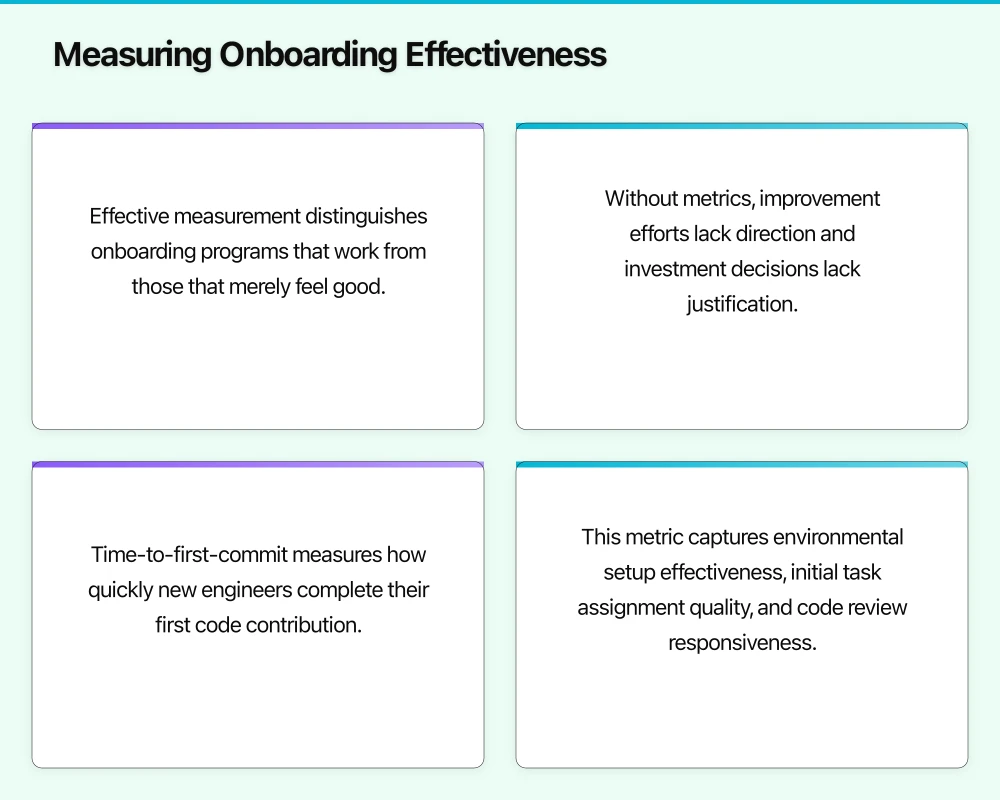
Effective measurement distinguishes onboarding programs that work from those that merely feel good. Without metrics, improvement efforts lack direction and investment decisions lack justification.
Time-to-first-commit measures how quickly new engineers complete their first code contribution. This metric captures environmental setup effectiveness, initial task assignment quality, and code review responsiveness. Industry benchmarks suggest first commits should occur within the first two weeks; anything longer indicates friction.
Time-to-first-production-deploy extends the measurement to full delivery. Many organizations observe significant gaps between first commit and first production deployment—code sits in review, deployment processes are unclear, or production access is delayed. This metric captures the end-to-end delivery experience.
Time-to-productivity is harder to measure but more meaningful. When does a new engineer contribute at a level comparable to established team members? This requires defining productivity standards and assessing engineer output over time. Surveys of managers and new hires provide subjective assessments that, while imperfect, track productivity ramp.
New hire satisfaction surveys capture the qualitative experience. Ask new hires about documentation quality, mentor support, learning program value, and overall onboarding experience. Survey at 30, 60, and 90 days to capture evolving perspectives.
Early attrition rates reveal whether onboarding experiences drive departure. Track voluntary departures within the first year, segmented by time period. Departures within the first 90 days strongly indicate onboarding problems; departures at 6-12 months may reflect onboarding-originated disengagement.
Mentor satisfaction surveys capture the mentor experience. Are mentors adequately prepared? Do they have sufficient time for mentorship responsibilities? Is mentorship recognition appropriately valued? Mentor burnout degrades onboarding quality.
Scaling Onboarding for Growth
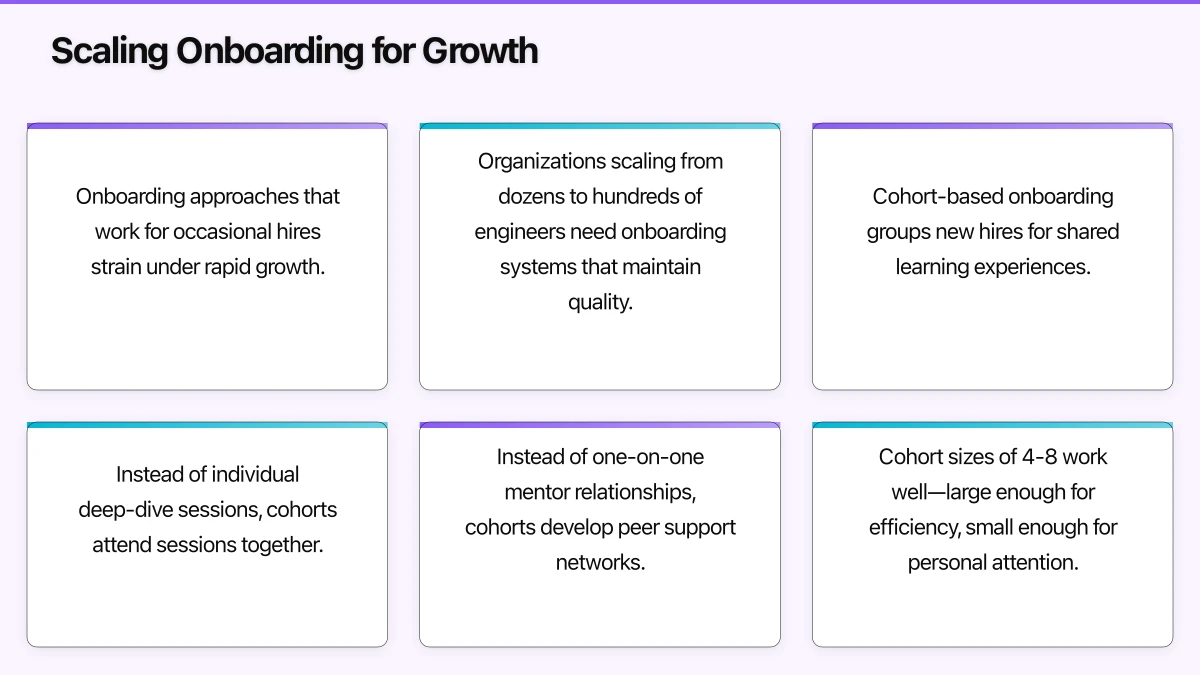
Onboarding approaches that work for occasional hires strain under rapid growth. Organizations scaling from dozens to hundreds of engineers need onboarding systems that maintain quality while reducing per-hire effort.
Cohort-based onboarding groups new hires for shared learning experiences. Instead of individual deep-dive sessions, cohorts attend sessions together. Instead of one-on-one mentor relationships, cohorts develop peer support networks. Cohort sizes of 4-8 work well—large enough for efficiency, small enough for personal attention.
Self-service resources reduce dependency on synchronous human interaction. Recorded session libraries, comprehensive documentation, and interactive tutorials allow new hires to learn independently. Investment in self-service resources creates leverage: once created, they serve unlimited future hires at no marginal cost.
Automated provisioning accelerates environment setup. Infrastructure-as-code for development environments, automated account provisioning, and self-service access requests eliminate waiting for manual setup. New hires should be able to reach a working development environment within their first day without requiring IT support.
Onboarding checklists codify required activities and track progress. Checklists serve dual purposes: they ensure new hires complete necessary activities, and they signal progress to managers and program administrators. Task management or HR systems can host checklists with completion tracking.
Dedicated onboarding roles become justified at scale. Organizations hiring more than 50 engineers per year may benefit from dedicated onboarding specialists who own program development, coordinate logistics, and drive continuous improvement. This investment ensures onboarding receives sustained attention rather than competing with other priorities.
Team-Specific Customization
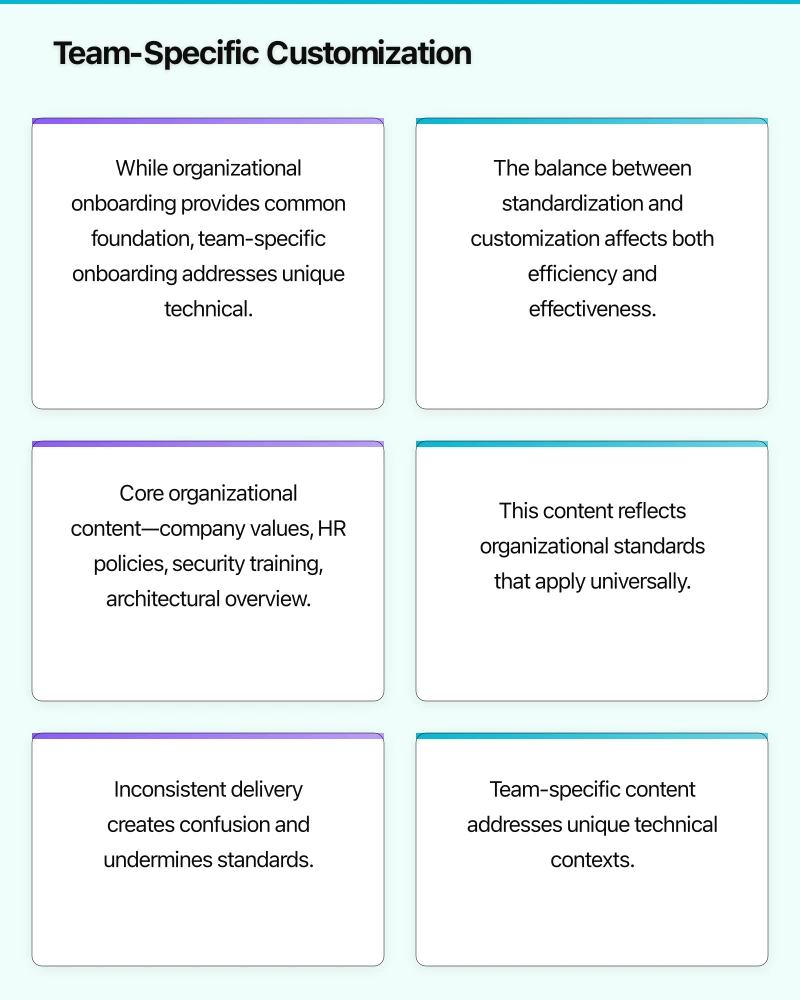
While organizational onboarding provides common foundation, team-specific onboarding addresses unique technical environments, practices, and cultures. The balance between standardization and customization affects both efficiency and effectiveness.
Core organizational content—company values, HR policies, security training, architectural overview—should be consistent across teams. This content reflects organizational standards that apply universally. Inconsistent delivery creates confusion and undermines standards.
Team-specific content addresses unique technical contexts. A data engineering team’s onboarding differs from a mobile development team’s. Different technology stacks, different deployment processes, different domain knowledge requirements. Teams should own their specific onboarding content while adhering to organizational frameworks.
Practice variations require explicit attention. Teams develop local norms around code review, documentation, testing, and collaboration. New hires should understand both organizational standards and team-specific interpretations. Where teams deviate from organizational norms, explain the rationale.
Team culture integration happens through participation, not presentation. New hires learn team culture through sprint rituals, team meetings, social activities, and informal interactions. Onboarding should create opportunities for cultural integration—pair programming, team lunches, participation in team discussions—not just technical training.
First project selection bridges onboarding and ongoing contribution. The initial project should be achievable, valuable, and educational. It should provide exposure to systems the engineer will work with regularly, demonstrate end-to-end delivery processes, and deliver tangible value that creates a sense of accomplishment.
Remote and Distributed Onboarding
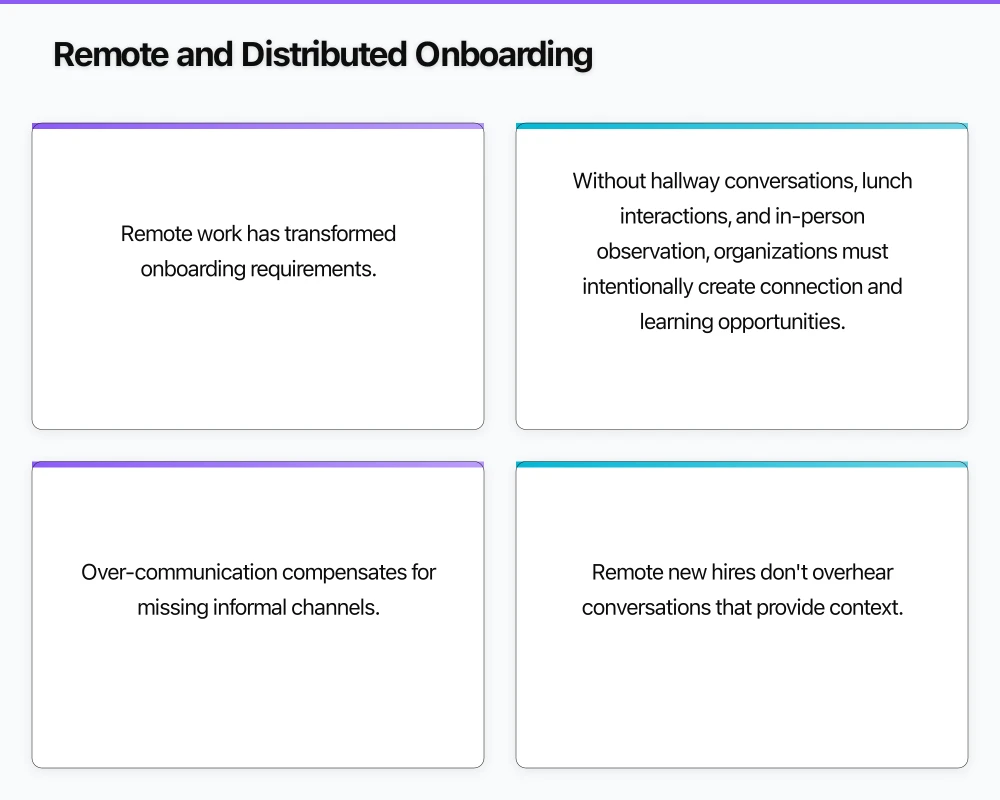
Remote work has transformed onboarding requirements. Without hallway conversations, lunch interactions, and in-person observation, organizations must intentionally create connection and learning opportunities.
Over-communication compensates for missing informal channels. Remote new hires don’t overhear conversations that provide context. They can’t observe team members’ work patterns. Explicit communication about expectations, progress, and feedback replaces implicit information that flows naturally in offices.
Video-first interaction builds relationships. Default to video for meetings, check-ins, and pair programming sessions. Facial expressions and body language create connection that audio-only lacks. Encourage cameras-on culture, especially during onboarding.
Virtual social activities create non-work connection opportunities. Remote coffee chats, virtual team events, and online social spaces provide relationship-building opportunities outside of task-focused work. New hires especially benefit from informal interaction that accelerates belonging.
Asynchronous documentation becomes more important remotely. When mentors aren’t available for immediate questions, comprehensive documentation enables independent progress. Record synchronous sessions for asynchronous viewing. Create written explanations for concepts frequently discussed verbally.
Timezone considerations affect distributed team onboarding. New hires in non-overlapping timezones have limited synchronous access to mentors and team members. Structure onboarding activities to maximize value from overlapping hours while providing asynchronous learning options for non-overlapping time.
Periodic in-person gatherings accelerate relationship building. If budget allows, bringing remote new hires to central locations for initial onboarding intensives creates relationship density that sustains through subsequent remote interaction.
Continuous Improvement Framework
Onboarding programs should evolve continuously based on feedback and changing organizational needs. Static programs degrade as technology, processes, and roles change.
Retrospectives with recent graduates capture fresh perspectives. New hires who completed onboarding within the past 90 days remember pain points and highlights. Monthly retrospectives with recent cohorts identify improvement opportunities while experiences remain fresh.
Content currency reviews ensure materials remain accurate. Technical documentation, system diagrams, and recorded sessions become outdated. Quarterly reviews should verify that onboarding materials reflect current reality and flag items requiring updates.
Metrics trending reveals improvement or degradation over time. Are time-to-productivity metrics improving? Are satisfaction scores stable? Are early attrition rates declining? Trending analysis distinguishes sustained improvement from random variation.
External benchmarking provides comparison points. How do your onboarding metrics compare to industry benchmarks? How do your practices compare to published approaches from leading engineering organizations? External perspective prevents insularity and identifies improvement opportunities.
Onboarding owners need explicit accountability. Without clear ownership, onboarding improvement competes poorly with other priorities. Assign explicit ownership—whether to an engineering manager, a dedicated program manager, or a rotating responsibility—and include onboarding effectiveness in performance evaluation.
The CTO’s Role in Onboarding Excellence
As CTO, your role in onboarding extends beyond program design to cultural leadership. How you engage with new engineers signals organizational values and priorities.
Executive visibility during onboarding demonstrates importance. New hire welcome sessions, architecture discussions led by technical leadership, and accessible channels to senior leaders create connection between new engineers and organizational direction. New hires who understand strategy and feel connected to leadership engage more deeply.
Resource allocation reflects actual priorities. If onboarding is strategically important, invest accordingly. Mentor time, program management capacity, tooling investment, and content development require resources that compete with other demands. Budget allocation signals true priorities.
Culture modeling establishes expectations. When senior leaders demonstrate patience with new hire questions, value for learning time, and investment in knowledge sharing, these behaviors cascade through the organization. When leaders express frustration with ramp time or undervalue mentorship, those attitudes spread equally.
Standards enforcement ensures consistent experience. Organizational onboarding standards have limited value if teams ignore them. Hold teams accountable for onboarding execution, including mentor assignment, checklist completion, and new hire satisfaction.
The investment in onboarding excellence compounds over time. Each well-onboarded engineer reaches productivity faster, stays longer, and creates better onboarding experiences for those who follow. The organizations that master onboarding build self-reinforcing cultures that attract and develop talent at scale.
Building your engineering onboarding program? I work with technology leaders to design systems that accelerate time-to-productivity. Connect to discuss your team’s needs.
Strategy needs execution. Cloud Geeks publishes practical cloud computing and cybersecurity guides for Australian businesses ready to act.
As founder of Ganda Tech Services, I work with Australian businesses to align technology investments with business growth — across cloud, web, and mobile.
About the Author
Ashish Ganda is the founder of Ganda Tech Services, a Sydney-based technology consultancy specialising in cloud infrastructure, web development, and mobile app solutions for Australian businesses.
Digital Transformation Roadmap 2026
A 12-month framework for Australian SMBs ready to modernise — phases, tools, and milestones.
Almost done
Check your inbox and click the confirmation link to get your download.