
Technical Debt Management: An Enterprise Strategy for 2025
Every enterprise technology organisation carries technical debt. The shortcuts taken to meet deadlines. The outdated frameworks nobody has time to upgrade. The architectural decisions that made sense five years ago but constrain current requirements. The documentation never written. The tests never added. The refactoring perpetually deferred.
Technical debt is not inherently bad. Like financial debt, it can be a strategic tool when used deliberately, enabling faster time-to-market when speed matters most. The problem is unmanaged debt: debt accumulated without awareness, without measurement, and without repayment strategy. Unmanaged debt compounds, gradually strangling engineering velocity until organisations spend more effort working around problems than solving them.
For CTOs leading enterprise engineering organisations, technical debt management is a strategic imperative. McKinsey research suggests that 20-40% of technology assets at large organisations qualify as technical debt, consuming engineering capacity that could otherwise deliver business value. Yet most organisations lack systematic approaches to identify, quantify, prioritise, and remediate their debt portfolios.
This guide provides a strategic framework for technical debt management, addressing the full lifecycle from identification through remediation to sustainable engineering practices that prevent future debt accumulation.
Understanding Technical Debt
Ward Cunningham coined the technical debt metaphor to explain why sometimes shipping imperfect code makes sense. Like financial debt, technical debt enables current benefit at the cost of future obligation. The key is being deliberate: knowing what debt you are taking on, understanding the interest rate, and having a repayment plan.
Types of Technical Debt
Not all technical debt is equivalent. Distinguishing types enables appropriate treatment:
Deliberate/Prudent Debt: Conscious decisions to ship now and improve later. “We know this architecture will not scale past 10,000 users, but we need to validate the market first.” This debt is strategic when the tradeoff is understood.
Deliberate/Reckless Debt: Conscious decisions to cut corners without plan to address consequences. “We do not have time for tests.” This debt is problematic because consequences are ignored.
Inadvertent/Prudent Debt: Decisions that seemed right but proved wrong as understanding evolved. “We did not know the framework would be deprecated.” This debt is inevitable in complex systems.
Inadvertent/Reckless Debt: Poor decisions made without awareness they were suboptimal. “I did not know there was a better way.” This debt indicates skill or knowledge gaps.
Technical Debt Categories
Technical debt manifests across multiple dimensions:
Code Debt: Poor code quality, missing abstraction, duplicated logic, complex conditional structures, inadequate error handling.
Architectural Debt: Suboptimal system structure, tight coupling, missing service boundaries, inappropriate technology choices.
Infrastructure Debt: Outdated platforms, manual processes that should be automated, legacy deployment approaches, inadequate monitoring.
Documentation Debt: Missing or outdated documentation, undocumented APIs, tribal knowledge not captured.
Test Debt: Inadequate test coverage, brittle tests, missing test types (integration, performance, security).
Dependency Debt: Outdated libraries, deprecated dependencies, security vulnerabilities in components.
Process Debt: Inefficient workflows, manual processes that should be automated, inadequate tooling.
Each category requires different identification and remediation approaches.
Identifying Technical Debt
You cannot manage what you cannot see. Systematic identification is the foundation of debt management.
Quantitative Signals
Metrics can reveal debt without subjective assessment:
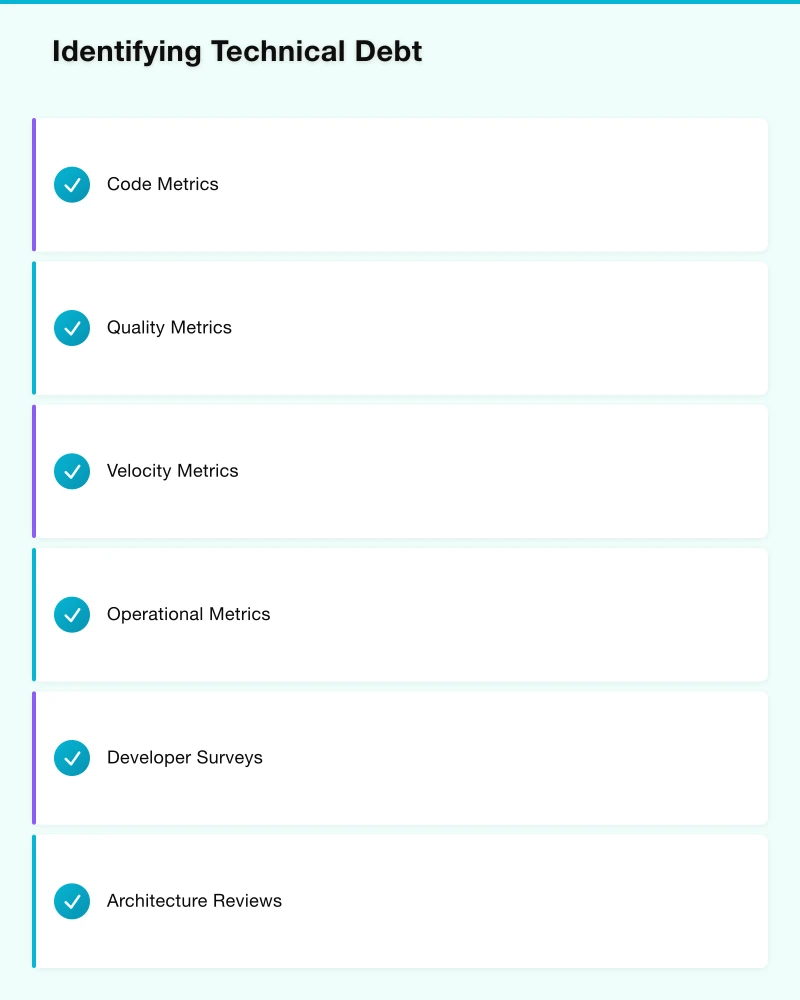
Code Metrics:
- Cyclomatic complexity exceeding thresholds
- Code duplication percentage
- Method and class size violations
- Dependency depth and coupling measures
Quality Metrics:
- Defect rates by component
- Time to resolve defects
- Test coverage percentages
- Security vulnerability counts
Velocity Metrics:
- Deployment frequency trends
- Lead time for changes
- Change failure rate
- Time spent on maintenance vs features
Operational Metrics:
- Incident frequency by component
- Mean time to recovery
- Alert volume trends
- Infrastructure cost efficiency
Static analysis tools (SonarQube, CodeClimate, Codacy) automate code metric collection. Integration with CI/CD enables continuous monitoring.
Qualitative Assessment
Some debt is invisible to metrics. Qualitative approaches surface hidden debt:
Developer Surveys: Ask engineers where they spend time on workarounds, which systems they dread modifying, what slows them down. Engineers know where debt lies.
Architecture Reviews: Structured review of system architecture against current requirements and best practices identifies architectural debt.
Incident Retrospectives: Analyse incident root causes for patterns indicating systemic debt.
Onboarding Friction: New team members surface debt through fresh perspective. Track where onboarding struggles occur.
Debt Inventory
Consolidate identified debt into a managed inventory:
┌─────────────────────────────────────────────────────────────────┐
│                    Technical Debt Item                          │
├─────────────────────────────────────────────────────────────────┤
│  ID: TD-2024-147                                                │
│  Title: Payment service lacks retry handling                     │
│  Category: Code                                                 │
│  Component: payment-service                                     │
│  Description: Failed payment calls not retried, causing         │
│               unnecessary transaction failures                   │
│  Business Impact: ~$50K/month in abandoned transactions         │
│  Engineering Impact: 4 hours/week investigating failures        │
│  Remediation Effort: 3 story points                             │
│  Interest Rate: High (growing transaction volume)               │
│  Created: 2024-11-15                                            │
│  Owner: Payments Team                                           │
└─────────────────────────────────────────────────────────────────┘
Maintaining a debt inventory makes the invisible visible and enables systematic management.
Quantifying Technical Debt
Quantification enables prioritisation and business communication. Without quantification, debt remains abstract and under-prioritised.
Cost of Carry
The ongoing cost of living with debt, analogous to interest payments:
Engineering Time: Hours spent working around the problem, investigating related incidents, explaining to new team members.
Opportunity Cost: Features not built because engineers are managing debt.
Incident Cost: Outages, degraded performance, customer impact attributable to debt.
Risk Exposure: Probability and impact of debt causing future incidents.
Quantify cost of carry in engineering hours per sprint or financial impact per month.
Remediation Cost
The investment required to address the debt:
Engineering Effort: Story points or engineering days to remediate.
Migration Cost: If debt remediation involves migration, include data migration, testing, parallel operation costs.
Risk Cost: Risk of remediation introducing new problems.
Return on Investment
Calculate ROI for debt remediation:
ROI = (Annual Cost of Carry - Remediation Cost) / Remediation Cost

Example:
- Cost of Carry: $120K/year (engineer time + incident cost)
- Remediation Cost: $80K (one-time investment)
- Year 1 ROI: ($120K - $80K) / $80K = 50%
- Year 2+ ROI: $120K / $80K = 150%
ROI enables comparison with feature investments, making debt remediation compete on equal footing.
Technical Debt Ratio
Aggregate metrics provide portfolio-level visibility:
Technical Debt Ratio = Remediation Cost / Development Cost

Example:
- Total estimated remediation cost: $5M
- Annual development budget: $20M
- Technical Debt Ratio: 25%
Organisations with ratios above 40% typically experience significant velocity impacts. Tracking trends over time reveals whether debt is accumulating or reducing.
Prioritising Debt Remediation
With finite engineering capacity, prioritisation determines what gets addressed. Not all debt deserves equal attention.
Prioritisation Frameworks
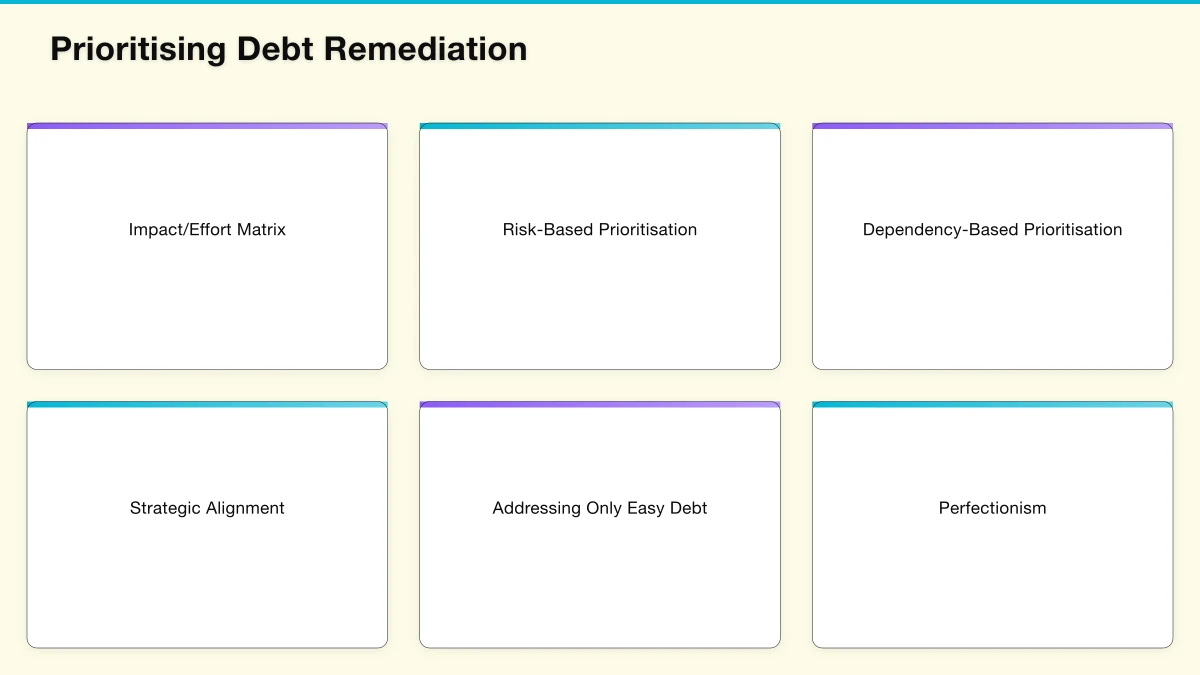
Impact/Effort Matrix: Plot debt items by business impact and remediation effort. Address high-impact/low-effort items first.
             High Impact
                 │
    ┌────────────┼────────────┐
    │  Quick     │  Strategic │
    │  Wins      │  Debt      │
    │  (Do now)  │  (Plan)    │
    ├────────────┼────────────┤
    │  Low       │  Consider  │
    │  Priority  │  Deferring │
    │  (Later)   │  (Maybe)   │
    └────────────┴────────────┘
                 │
              High Effort
Risk-Based Prioritisation: Prioritise debt that creates unacceptable risk: security vulnerabilities, single points of failure, compliance gaps.
Dependency-Based Prioritisation: Address debt blocking other improvements. Foundation debt that enables subsequent remediation deserves priority.
Strategic Alignment: Prioritise debt in areas receiving active development. Debt in dormant systems has lower urgency than debt constraining active initiatives.
Anti-Patterns to Avoid
Addressing Only Easy Debt: Quick wins feel productive but may leave critical debt unaddressed. Balance quick wins with strategic remediation.
Perfectionism: Not all debt needs elimination. Some debt is acceptable to live with. Over-investing in debt remediation starves feature development.
Ignoring Interest: High-interest debt compounds quickly. A 5-point story today becomes 20 points next year. Factor debt growth into prioritisation.
Remediation Without Prevention: Fixing debt while accumulating more faster is futile. Address root causes alongside symptoms.
Remediation Strategies
Different debt types require different remediation approaches:
Code Debt Remediation
Refactoring Sprints: Dedicated time for code improvement. Effective for accumulated code debt but risk of disconnect from feature work.
Boy Scout Rule: Leave code better than you found it. Small improvements with every change. Less disruptive but slower progress.
Strangler Pattern: Gradually replace problematic code with new implementation. Route increasing traffic to new code until old code can be retired.
Rewrite: Complete replacement when debt is pervasive and refactoring impractical. Highest risk but sometimes necessary.
Architectural Debt Remediation
Modularisation: Break monolithic components into smaller, independent modules. Enables independent evolution and reduces coupling.
Service Extraction: Extract functionality into independent services. Particularly valuable when different scaling or deployment characteristics are needed.
API Introduction: Create abstraction layers enabling implementation changes without consumer impact.
Platform Migration: Move to modern platforms when infrastructure debt is fundamental.
Dependency Debt Remediation
Continuous Updates: Maintain dependencies within 1-2 major versions of current. Prevents accumulation of multiple major version gaps.
Dependency Reduction: Evaluate whether dependencies are necessary. Fewer dependencies mean less debt potential.
Automated Updates: Tools like Dependabot automate update pull requests, reducing manual effort.
Test Debt Remediation
Coverage Targets: Set coverage requirements for new code. Existing code improves opportunistically.
Test Pyramid Balance: Ensure appropriate mix of unit, integration, and end-to-end tests.
Test Quality: Address flaky tests that undermine CI reliability.
Sustainable Engineering Practices
Debt remediation without prevention is futile. Sustainable practices prevent future debt accumulation.
Definition of Done
Include quality criteria in definition of done:
- Code review completed
- Tests added/updated
- Documentation updated
- No new security vulnerabilities
- Performance validated
Teams cannot mark work complete while accumulating debt.
Architectural Decision Records
Document significant decisions with rationale and tradeoffs. ADRs prevent inadvertent debt from forgotten context.
# ADR-023: Use PostgreSQL for User Service

## Status
Accepted

## Context
User service needs persistent storage for user profiles and preferences.

## Decision
Use PostgreSQL as primary database.

## Consequences
- Proven technology, low operational risk
- Team has PostgreSQL expertise
- May need to revisit if we exceed 100M users
- Accepting some schema flexibility limitations vs NoSQL
Technical Debt Budgets
Allocate explicit capacity for debt management:
Percentage Allocation: 15-20% of engineering capacity for maintenance and debt remediation.
Debt Sprints: Periodic sprints focused on debt reduction.
Debt Ceiling: Maximum acceptable debt ratio triggering mandatory remediation.
Quality Gates
Automated enforcement prevents debt accumulation:
- Code review requirements
- Test coverage thresholds
- Static analysis quality gates
- Security scanning in CI/CD
- Dependency vulnerability checks
Quality gates make it easier to do the right thing than the wrong thing.
Platform Teams
Dedicated platform teams maintaining shared infrastructure and tooling:
- Keep dependencies updated
- Provide golden paths for common patterns
- Maintain development tooling
- Reduce cognitive load on feature teams
Platform teams prevent duplicated effort and ensure consistent quality.
Organisational Considerations
Technical debt management requires organisational support, not just engineering initiative.
Executive Communication
Translate debt into business language:
Velocity Impact: “Technical debt is reducing our feature delivery capacity by 25%. Addressing it would let us ship X additional features this year.”
Risk Framing: “This architectural debt creates significant outage risk during peak periods. A major incident would cost $X.”
Investment Case: “This remediation costs $X but saves $Y annually in engineering time, with payback in Z months.”
Executives respond to business impact, not technical details.
Incentive Alignment
Ensure incentives support debt management:
- Include quality metrics in engineering goals
- Recognise debt remediation contributions
- Do not penalise teams for surfacing debt
- Reward prevention as much as remediation
Incentives that reward only feature delivery guarantee debt accumulation.
Cultural Factors
Culture determines whether sustainable practices take hold:
Psychological Safety: Teams must feel safe surfacing debt without blame.
Long-term Thinking: Short-term pressure creates debt. Balance urgency with sustainability.
Quality Pride: Engineers who take pride in quality resist accumulating debt.
Continuous Improvement: Treating debt management as ongoing rather than one-time activity.
Cross-Team Coordination
Debt often spans team boundaries:
Shared Ownership: Establish ownership for cross-cutting debt.
Architecture Review: Regular review of system-wide architecture identifies cross-cutting debt.
Platform Investment: Shared infrastructure improvements benefit all teams.
Measuring Progress
Track debt management effectiveness over time:
Leading Indicators
Signals of future debt:
- Definition of done adherence
- Code review thoroughness
- Test coverage trends
- Static analysis violations
Lagging Indicators
Results of debt management:
- Technical debt ratio trend
- Engineering velocity trends
- Incident frequency by cause
- Time spent on unplanned work
Debt Inventory Metrics
Portfolio health:
- Total inventory size
- Age distribution of items
- Items addressed per period
- New items added per period
Sustainability Metrics
Prevention effectiveness:
- Debt added per feature
- Prevention vs remediation investment
- Quality gate effectiveness
- Developer satisfaction scores
Strategic Recommendations for CTOs
For CTOs establishing technical debt programmes:
Make Debt Visible
Debt flourishes in darkness. Establish:
- Debt inventory tracking
- Regular debt reporting to leadership
- Visibility in planning processes
- Connection to business metrics
Establish Ownership
Unowned debt does not get addressed:
- Assign debt items to teams
- Include debt in team objectives
- Hold teams accountable for their debt portfolios
- Recognise debt reduction achievements
Create Sustainable Capacity
Debt cannot be addressed without capacity:
- Allocate explicit engineering time
- Protect debt work from feature pressure
- Build debt reduction into roadmaps
- Staff platform/infrastructure appropriately
Address Root Causes
Symptoms recur without addressing causes:
- Investigate why debt accumulated
- Fix process gaps enabling debt
- Build prevention into standard practices
- Learn from debt patterns
Balance Pragmatism and Idealism
Not all debt needs elimination:
- Accept strategic debt with eyes open
- Do not pursue perfectionism
- Match remediation to business value
- Defer some debt indefinitely
Lead by Example
Technical debt management requires leadership commitment:
- Prioritise debt investment personally
- Communicate importance consistently
- Celebrate debt reduction
- Hold the line when pressure mounts
Conclusion
Technical debt is inevitable in complex software organisations. The question is not whether debt exists but whether it is managed deliberately or allowed to compound uncontrolled.
Managed deliberately, technical debt can be a strategic tool: enabling speed when speed matters most, deferred for planned repayment when timing is right. Unmanaged, debt becomes a strategic liability: consuming engineering capacity, slowing delivery, and creating risk that constrains business agility.
The framework presented here, spanning identification, quantification, prioritisation, remediation, and sustainable prevention, provides a comprehensive approach to debt management. Yet frameworks alone do not solve problems. Success requires organisational commitment: executive support, appropriate incentives, cultural alignment, and sustained investment.
For CTOs, the strategic imperative is clear. In an era where software delivery speed determines competitive advantage, organisations cannot afford to let technical debt consume 30-40% of engineering capacity. The organisations that manage debt effectively will outpace competitors still struggling under accumulated technical burden.
The path forward is not dramatic transformation but systematic improvement: making debt visible, establishing ownership, creating sustainable capacity, and building practices that prevent future accumulation. Progress compounds just as debt does, but in the opposite direction.
Start where you are. Use what you have. Do what you can. The alternative, ignoring debt until crisis forces attention, is far more expensive than deliberate management.
Ash Ganda advises enterprise technology leaders on engineering excellence, digital transformation, and technology strategy. Connect on LinkedIn for ongoing insights on building high-performing engineering organisations.
For the practitioner’s view on web design and digital marketing, explore Cosmos Web Tech — where strategy meets execution.
My consultancy Ganda Tech Services operates three specialist divisions covering cloud infrastructure, web development, and mobile apps for Australian businesses.
About the Author
Ashish Ganda is the founder of Ganda Tech Services, a Sydney-based technology consultancy specialising in cloud infrastructure, web development, and mobile app solutions for Australian businesses.
Tech Stack Selection Guide 2026
Choose the right tools for your Australian business — without the vendor hype or overlapping spend.