Building Enterprise Data Pipelines with dbt and Snowflake
Introduction
The modern data stack has coalesced around a powerful combination: cloud data warehouses for storage and compute, and transformation frameworks for modelling logic. At the centre of this convergence, Snowflake and dbt have emerged as the foundational technologies for enterprise analytical data platforms. Snowflake provides virtually unlimited compute and storage with separation that allows independent scaling. dbt (data build tool) provides a SQL-first transformation framework that brings software engineering practices to data transformation.
Together, they address a persistent enterprise challenge: building data transformation pipelines that are reliable, testable, documented, and scalable enough to serve the growing demands of analytics, business intelligence, and machine learning across the enterprise. For CTOs and data leaders evaluating their analytics infrastructure, the Snowflake-dbt combination represents a mature, well-supported approach that is rapidly becoming the enterprise standard.
This analysis examines the architectural patterns, operational practices, and governance frameworks that distinguish successful enterprise deployments of dbt and Snowflake from those that replicate the problems of previous data platform generations.
Architecture Patterns for Enterprise Scale
The architectural foundation of a dbt-Snowflake enterprise deployment begins with Snowflake’s multi-cluster, multi-database architecture and dbt’s project structure.
Snowflake’s architecture separates storage, compute, and services into independent layers. Storage holds all data in a columnar format with automatic compression and micro-partitioning. Compute is provided by virtual warehouses that can be created, scaled, and suspended independently. This separation is architecturally significant because it allows different workloads, data ingestion, transformation, interactive analytics, and machine learning, to use dedicated compute resources without contending for capacity.
Enterprise deployments should establish a systematic warehouse strategy. Dedicated warehouses for dbt transformation jobs ensure that analytical query performance is not affected by transformation workloads. Separate warehouses for different business units or data domains enable independent scaling and cost allocation. Warehouse auto-suspend and auto-resume ensure that compute resources are consumed only when needed, which is critical for cost management.
The database and schema architecture should follow a layered model that separates raw data, transformed data, and consumption-ready data. A common pattern uses three database layers: a raw layer containing data as ingested from source systems, a transformation layer containing intermediate models, and a marts layer containing business-ready datasets. This layered approach provides clear separation of concerns and enables different access controls at each layer.
dbt’s project structure should mirror this architectural layering. The staging layer contains models that clean and standardise raw data, applying consistent naming conventions, data types, and basic business logic. The intermediate layer contains models that join and transform staged data into business entities. The marts layer contains models optimised for consumption by specific business domains or use cases. This three-layer structure, advocated by dbt Labs as best practice, provides navigability, testability, and maintainability at enterprise scale.
Software Engineering Practices for Data Transformation
dbt’s transformative contribution to data engineering is bringing software engineering practices, version control, code review, testing, documentation, and CI/CD, to SQL-based data transformation. For enterprises, these practices address the governance and reliability gaps that have plagued previous generations of ETL tools.
Version control through Git provides a complete history of every transformation change, enabling audit trails, rollback capability, and collaboration through branching and merging. Every dbt model is a SQL file in a Git repository, subject to the same version control discipline as application code. For enterprises with regulatory requirements for data lineage and change tracking, this version-controlled approach provides audit capability that is difficult to achieve with GUI-based ETL tools.
Code review for data transformations ensures that business logic is validated by peers before being deployed. This practice catches logic errors, identifies performance issues, and spreads knowledge across the data team. Establishing code review as a mandatory step in the data transformation development workflow is one of the highest-value practices enterprises can adopt.
Testing in dbt operates at multiple levels. Schema tests validate data properties: uniqueness of primary keys, referential integrity of foreign keys, accepted values for categorical columns, and not-null constraints for required fields. Custom data tests implement business rules: revenue figures should be non-negative, date ranges should be logically consistent, and aggregated figures should reconcile with source totals. These tests execute as part of every dbt run, catching data quality issues before they propagate to downstream consumers.
Documentation is embedded in the dbt project itself. Each model can be documented with descriptions of its purpose, column definitions, and business context. dbt generates a documentation website from these descriptions, providing a searchable, navigable reference for all data assets. For enterprises where data discovery and understanding are persistent challenges, this auto-generated documentation is invaluable.
CI/CD integration automates the testing and deployment of dbt changes. When a developer submits a pull request, the CI pipeline runs dbt against a development environment, executing all models and tests to verify that the change does not introduce errors. Upon merge, the CD pipeline deploys the change to production. This automation ensures that every change is validated before reaching production and that deployment is consistent and repeatable.
Governance and Access Control
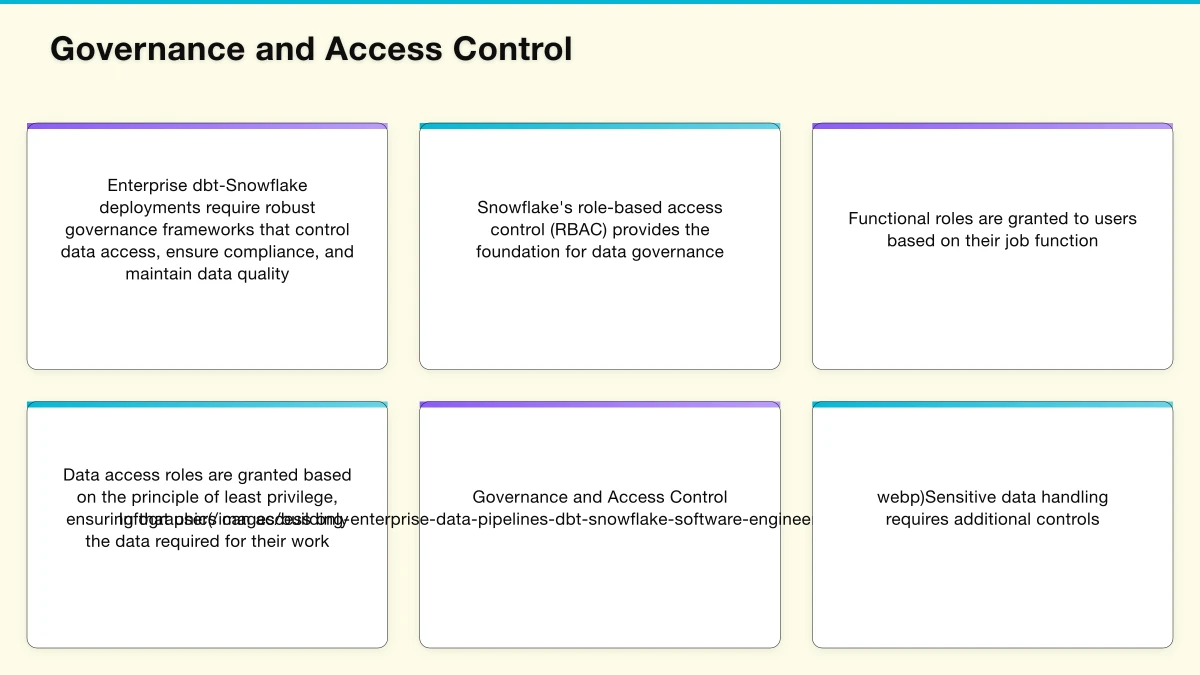
Enterprise dbt-Snowflake deployments require robust governance frameworks that control data access, ensure compliance, and maintain data quality.
Snowflake’s role-based access control (RBAC) provides the foundation for data governance. A well-designed role hierarchy separates functional roles (data engineer, analyst, data scientist) from data access roles (raw data access, transformation layer access, marts access). Functional roles are granted to users based on their job function. Data access roles are granted based on the principle of least privilege, ensuring that users can access only the data required for their work.
Sensitive data handling requires additional controls. Snowflake’s dynamic data masking and row access policies enable fine-grained control over who can see sensitive data elements like personal information, financial details, and health records. These policies are applied at the Snowflake level, ensuring consistent enforcement regardless of how the data is accessed.
Data lineage, the ability to trace the flow of data from source to consumption, is natively supported by dbt’s model reference system. When models reference other models using the ref function, dbt builds a dependency graph that documents the complete lineage of every data asset. This lineage is critical for impact analysis (what is affected if a source system changes?), debugging (where did this incorrect value originate?), and compliance (can we demonstrate how this regulatory report was derived from source data?).
Cost governance in Snowflake requires monitoring and controlling compute consumption. Snowflake’s resource monitors can set spending limits on individual warehouses or account-wide. dbt model tags can classify models by domain, priority, or cost sensitivity, enabling targeted optimisation of expensive transformations. Regular analysis of query performance and warehouse utilisation identifies opportunities for optimisation.
Scaling the Organisation Around dbt
The organisational model for dbt development at enterprise scale is as important as the technical architecture. Two models have emerged: centralised and federated.
In the centralised model, a dedicated data engineering team owns the dbt project and is responsible for all transformation logic. Business teams submit requirements, and the data engineering team implements them. This model provides consistency and quality control but creates a bottleneck as the number of data consumers and transformation requests grows.
In the federated model, domain-specific data teams own their portion of the dbt project, contributing models for their business domain. A central data platform team maintains the shared infrastructure, establishes standards and best practices, and reviews cross-domain changes. This model scales better because domain experts write the transformation logic for their own domains, but it requires stronger governance to maintain consistency and quality across the distributed contributors.
Most enterprises evolve from centralised to federated as their dbt adoption matures. The centralised model is appropriate for initial adoption when the dbt skill base is small and standards are being established. The federated model becomes necessary as the volume of transformation work exceeds the central team’s capacity and as domain-specific expertise becomes more valuable than centralised control.
The dbt-Snowflake combination is not merely a technology choice; it is a strategic investment in the enterprise’s analytical capability. When implemented with the architectural discipline, engineering practices, and governance frameworks described here, it provides a data transformation platform that scales with the enterprise’s analytical ambitions while maintaining the reliability and governance that enterprise operations demand.
Thinking about adding mobile to your digital strategy? Awesome Apps covers app development, Flutter, React Native, and ASO for Australian businesses.
These insights are drawn from my work leading Ganda Tech Services — helping Australian businesses navigate digital transformation through cloud, web, and mobile.
About the Author
Ashish Ganda is the founder of Ganda Tech Services, a Sydney-based technology consultancy specialising in cloud infrastructure, web development, and mobile app solutions for Australian businesses.
Digital Transformation Roadmap 2026
A 12-month framework for Australian SMBs ready to modernise — phases, tools, and milestones.
Almost done
Check your inbox and click the confirmation link to get your download.