Enterprise Real-Time Data Processing with Apache Flink
The shift from batch to real-time data processing represents one of the most consequential architectural transitions in enterprise technology. Organisations that can act on data as it arrives — detecting fraud in milliseconds, personalising customer experiences in real-time, monitoring operational systems continuously — gain decisive competitive advantages. Apache Flink has emerged as the most capable open-source framework for this class of workload, and understanding its strategic implications is essential for technology leaders navigating the real-time data landscape.
Flink is not new — the project originated from a research initiative at TU Berlin in 2010 and entered the Apache Incubator in 2014. But its enterprise adoption has accelerated dramatically over the past two years, driven by the growing recognition that Apache Spark Structured Streaming and Apache Kafka Streams, while capable, have architectural limitations for the most demanding real-time processing requirements. Companies like Alibaba, Uber, Netflix, and Airbnb have built critical infrastructure on Flink, validating its production readiness at extraordinary scale.
Why Flink for Enterprise Stream Processing
The stream processing landscape offers several viable technologies, and understanding why Flink occupies a distinct position requires examining the architectural properties that differentiate it from alternatives.
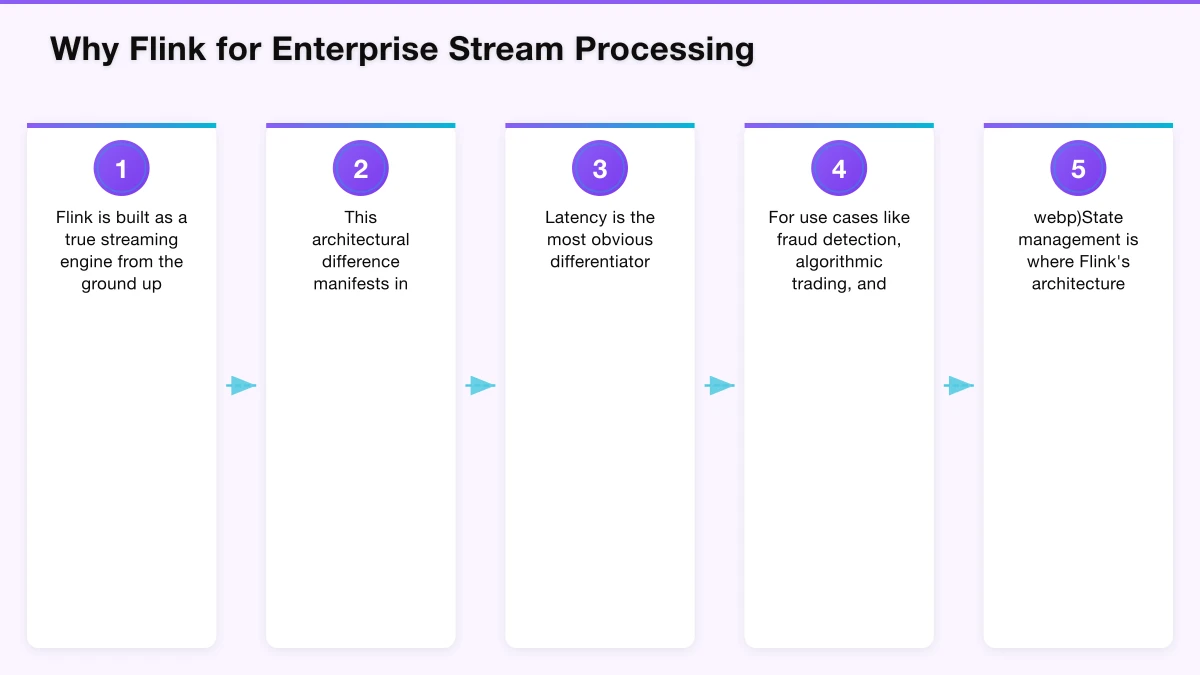
Flink is built as a true streaming engine from the ground up. Unlike Spark Structured Streaming, which implements streaming as micro-batches on top of a batch processing engine, Flink processes events one at a time with genuine record-level processing semantics. This architectural difference manifests in several ways that matter at enterprise scale.
Latency is the most obvious differentiator. Flink achieves true sub-second processing latency for complex event processing workloads, while micro-batch systems introduce inherent latency floors determined by batch interval configuration. For use cases like fraud detection, algorithmic trading, and real-time operational monitoring, this difference is material. When a fraudulent transaction must be detected before the payment completes, or an industrial sensor anomaly must trigger an immediate safety response, milliseconds matter.
State management is where Flink’s architecture truly distinguishes itself. Enterprise stream processing applications are inherently stateful — they need to maintain aggregations, session information, machine learning model state, and temporal patterns across events. Flink provides a first-class state management abstraction with RocksDB-backed state that can scale to terabytes, exactly-once processing guarantees through distributed snapshots (the Chandy-Lamport algorithm adapted for streaming), and transparent state recovery after failures.
The exactly-once processing guarantee deserves particular attention for enterprise applications. In financial services, logistics, and healthcare, processing an event twice or missing an event entirely can have serious business consequences. Flink’s checkpoint mechanism provides exactly-once semantics end-to-end when paired with compatible sources and sinks, without the performance penalties associated with alternative approaches like idempotent processing or transactional commits.
Event time processing is another critical capability. Enterprise data arrives out of order due to network latency, system clock skew, and distributed processing delays. Flink’s watermark mechanism provides a sophisticated framework for handling out-of-order data, allowing applications to define how long to wait for late events and what to do when they arrive. This is essential for accurate analytics on streaming data — window-based aggregations that rely on processing time rather than event time can produce incorrect results that compound into unreliable business intelligence.
Architecture Patterns for Enterprise Deployment
Deploying Flink in enterprise environments requires careful architectural decisions that extend beyond the processing framework itself. The most successful deployments I have observed follow several established patterns.
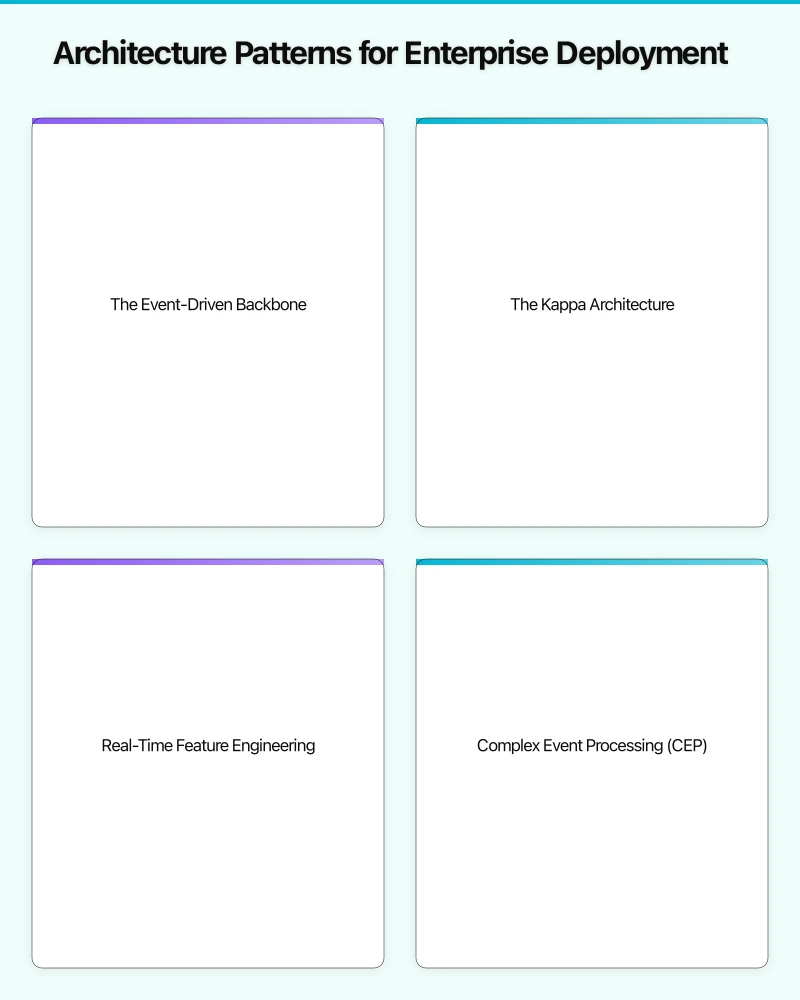
The Event-Driven Backbone: Flink operates as the processing layer in an event-driven architecture, consuming from Apache Kafka topics and producing enriched, transformed, or aggregated results back to Kafka or to downstream data stores. This pattern decouples event production from processing, enables independent scaling of each layer, and provides natural replay capabilities through Kafka’s log retention. Organisations adopting this pattern typically deploy a shared Kafka cluster as the enterprise event bus, with multiple Flink applications consuming different subsets of events.
The Kappa Architecture: For organisations tired of maintaining separate batch and streaming codepaths, Flink enables the Kappa architecture — using a single streaming codebase for both real-time and historical processing. By replaying Kafka topics from the beginning, Flink can reprocess historical data using the same logic that processes live events. This eliminates the code duplication, semantic inconsistencies, and operational complexity of the Lambda architecture that many enterprises have adopted previously.
Real-Time Feature Engineering: Machine learning systems increasingly require real-time features computed from streaming data. Flink excels at this pattern — computing aggregations, detecting patterns, and joining multiple event streams to produce feature vectors that feed into online prediction services. Organisations running recommendation engines, fraud detection models, or dynamic pricing algorithms are finding Flink indispensable for maintaining fresh feature data.
Complex Event Processing (CEP): Flink’s CEP library provides pattern matching capabilities over event streams, enabling detection of complex sequences, correlations, and anomalies in real-time. This is particularly valuable for security monitoring (detecting attack patterns across network events), operational monitoring (identifying cascading failures), and business process monitoring (detecting SLA violations in real-time).
The infrastructure layer supporting Flink deserves strategic attention. Flink can be deployed on bare metal, virtual machines, or container orchestration platforms. Kubernetes has emerged as the dominant deployment target for new Flink installations, and the Flink Kubernetes Operator (currently in active development) simplifies deployment, scaling, and lifecycle management. For organisations already invested in Kubernetes, this reduces the operational overhead of adding Flink to the platform.
Operational Considerations and Organisational Readiness
Enterprise adoption of Flink requires honest assessment of operational complexity. Flink is powerful but not simple, and organisations that underestimate the operational investment risk costly failures.
Cluster management and monitoring require dedicated expertise. Flink’s TaskManager resource allocation, parallelism configuration, and checkpoint tuning all significantly impact performance and reliability. Insufficient checkpoint intervals lead to excessive recovery times after failures. Excessive parallelism wastes resources. Improperly sized state backends can cause cascading failures. Building this operational expertise takes time, and organisations should plan for a learning curve.
State management in production introduces challenges that do not exist in batch processing. Flink applications maintain state across restarts through savepoints and checkpoints, but schema evolution — changing the structure of state as application logic evolves — requires careful planning. Organisations need versioning strategies for stateful applications, migration procedures for state schema changes, and rollback capabilities when deployments introduce issues.
The skill requirements for Flink development differ from traditional enterprise Java or Python development. Developers need to understand distributed systems concepts, streaming semantics, windowing abstractions, and state management patterns. The shift from thinking in terms of complete datasets to thinking in terms of continuous, unbounded data streams is conceptually challenging. Investment in training and knowledge building is essential.
The managed service landscape for Flink is maturing. AWS offers Amazon Kinesis Data Analytics for Apache Flink, which reduces operational burden at the cost of some flexibility and potential vendor lock-in. Ververica (founded by the original Flink creators) offers a commercial Flink platform. Confluent is investing in Flink integration with its Kafka platform. These managed offerings can accelerate adoption for organisations that prefer operational simplicity over full control.
The Competitive Landscape and Strategic Positioning
Understanding Flink’s position relative to alternatives is essential for making sound technology decisions.
Apache Kafka Streams offers a simpler programming model for applications that consume from and produce to Kafka. It runs as a library within your application (no separate cluster), making it operationally simpler. For straightforward transformations, enrichments, and aggregations, Kafka Streams is often sufficient and introduces less operational complexity. However, it lacks Flink’s capabilities for complex event processing, advanced windowing, and multi-source joins.
Apache Spark Structured Streaming leverages the massive Spark ecosystem and is a natural choice for organisations already invested in Spark for batch processing. Its micro-batch model provides exactly-once semantics and integrates well with Spark SQL and MLlib. For use cases where sub-second latency is not required and Spark is already established, Structured Streaming avoids introducing a new technology.
Cloud-native alternatives like AWS Kinesis Data Analytics, Google Cloud Dataflow, and Azure Stream Analytics provide managed streaming capabilities with lower operational overhead. These are appropriate for organisations prioritising simplicity and willing to accept vendor-specific APIs. However, they typically offer less flexibility and control than Flink for complex processing requirements.
Flink’s sweet spot is enterprise workloads that require true real-time processing with strong consistency guarantees, complex stateful processing, and the ability to handle massive scale. If your organisation’s streaming requirements are straightforward, simpler alternatives may be more appropriate. If they are demanding, Flink is increasingly the technology of choice.
Conclusion
Apache Flink represents a maturation of the stream processing space from experimental technology to enterprise-grade infrastructure. Its architectural foundations — true streaming, sophisticated state management, exactly-once processing, and event time semantics — address the requirements of the most demanding enterprise use cases.
For CTOs evaluating real-time data processing strategies in 2022, Flink deserves serious consideration for workloads where latency, consistency, and processing complexity demand more than simpler alternatives provide. The investment in operational expertise and team capability building is substantial but justified for organisations where real-time data processing creates genuine competitive advantage.
The strategic recommendation is to start with a well-scoped use case that genuinely requires Flink’s capabilities, invest in operational expertise alongside application development, and expand adoption as the organisation’s stream processing maturity grows. Attempting to replace all batch processing with streaming overnight is a recipe for failure; building streaming capabilities incrementally on a solid foundation is a path to lasting competitive advantage.
If this strategic perspective has you thinking about your online presence, Cosmos Web Tech provides actionable web design and SEO guidance.
Ganda Tech Services is my technology consultancy, bringing together cloud infrastructure, web development, and mobile expertise for Australian businesses.
About the Author
Ashish Ganda is the founder of Ganda Tech Services, a Sydney-based technology consultancy specialising in cloud infrastructure, web development, and mobile app solutions for Australian businesses.
Digital Transformation Roadmap 2026
A 12-month framework for Australian SMBs ready to modernise — phases, tools, and milestones.
Almost done
Check your inbox and click the confirmation link to get your download.