AI-Powered DevOps Automation: Building Intelligent Enterprise Pipelines
DevOps transformed how enterprises deliver software. Automation pipelines that once took months to establish now deploy in days. Teams release to production multiple times daily rather than quarterly. Infrastructure provisioning that required weeks of procurement now completes in minutes.
Yet as DevOps matures, new challenges emerge. The volume of telemetry data from modern distributed systems exceeds human analysis capacity. Alert fatigue overwhelms operations teams. Configuration complexity grows faster than team capability. The speed of deployment creates risk when issues escape to production.
AI-powered DevOps, increasingly termed AIOps, addresses these challenges by applying machine learning and artificial intelligence to operational processes. Rather than replacing human operators, AIOps augments their capabilities: surfacing relevant insights from overwhelming data volumes, predicting failures before they occur, automating routine remediation, and optimising pipeline performance continuously.
For CTOs leading enterprise technology organisations, AIOps represents the next evolution in operational excellence. The question is no longer whether to adopt AI-enhanced operations, but how to implement it effectively while avoiding the pitfalls that have derailed early adopters.
The AIOps Landscape
AIOps encompasses multiple capability areas, each addressing different operational challenges:
Intelligent Observability
Traditional monitoring generates alerts when metrics exceed thresholds. Intelligent observability learns normal system behaviour and identifies anomalies that static thresholds would miss.
Machine learning models trained on historical telemetry recognise patterns humans cannot perceive. A slight increase in database connection pool utilisation might be normal during morning traffic spikes but anomalous at 3 AM. Intelligent observability understands this context, reducing false positives while catching genuine issues earlier.
Leading implementations correlate across telemetry types. Metrics, logs, and traces contain complementary information that, analysed together, reveals root causes that no single source would expose. When response times increase, intelligent systems automatically identify correlated changes in deployment history, configuration modifications, or upstream service behaviour.
Predictive Operations
Rather than reacting to failures, predictive operations anticipates them. Machine learning models identify patterns that precede incidents, enabling proactive remediation before users experience impact.
Disk space exhaustion is a simple example. Rather than alerting when space falls below 10%, predictive systems analyse consumption trends and alert when exhaustion is projected within a defined window, regardless of current absolute levels. A rapidly filling disk at 50% capacity may be more urgent than a slowly filling disk at 85%.
More sophisticated predictions identify complex failure patterns: memory leaks that will cause crashes in 48 hours, certificate expirations that will break authentication next week, or capacity limits that will cause request failures during the next traffic surge.
Autonomous Remediation
When issues occur, autonomous remediation executes recovery actions without human intervention. This ranges from simple automations like restarting crashed services to sophisticated responses like scaling infrastructure, rerouting traffic, or rolling back deployments.
Effective autonomous remediation requires confidence. Systems must distinguish between situations where automated action is appropriate and situations requiring human judgment. This typically involves defining runbooks with clear triggers, actions, and conditions, then progressively expanding autonomous scope as confidence increases.
Netflix’s chaos engineering approach exemplifies this philosophy. By deliberately introducing failures, they validate that autonomous systems respond correctly, building confidence in progressively automated responses.
Intelligent Release Management
AI enhances the software release process itself. Intelligent deployment systems analyse code changes to predict risk, automatically determine appropriate deployment strategies, and optimise release timing based on historical success patterns.
Feature flag management becomes more sophisticated with AI, automatically adjusting rollout percentages based on real-time impact metrics. If a feature increases error rates for a user segment, intelligent systems can pause or roll back the rollout without human intervention.
Implementing AI-Enhanced CI/CD
The CI/CD pipeline is the primary leverage point for DevOps AI, affecting every code change that flows to production.
Intelligent Test Optimisation
Comprehensive test suites provide confidence but create delays. Running all tests for every change is neither efficient nor necessary. AI-powered test selection identifies which tests are relevant to specific changes, dramatically reducing feedback time while maintaining quality.
Machine learning models learn relationships between code areas and test coverage. When a developer modifies authentication logic, the system prioritises authentication-related tests while deprioritising unrelated test suites. This can reduce CI time from hours to minutes while maintaining the same defect detection rate.
Test optimisation extends to identifying flaky tests: tests that fail intermittently without indicating genuine issues. These tests erode confidence in CI results and waste developer time investigating phantom failures. ML models identify flaky patterns and quarantine problematic tests for remediation while preventing them from blocking legitimate changes.
Google’s internal tooling demonstrates the potential. Their ML-powered test selection system, described in published research, reduced average CI time by 30% while improving defect detection rates through better prioritisation.
Predictive Quality Gates
Traditional quality gates are binary: pass or fail based on predetermined thresholds. Intelligent gates assess risk holistically, considering factors beyond individual metrics.
A change that slightly exceeds a code coverage threshold might be low risk if it modifies well-understood utility code with extensive production history. Conversely, a change meeting all thresholds might be high risk if it modifies critical path code with complex dependencies.
Predictive gates learn from historical patterns. Changes similar to those that caused past incidents receive heightened scrutiny. Changes from developers with strong track records receive appropriate confidence adjustments. Time-based patterns influence assessment; code changes late Friday afternoon warrant more caution than Tuesday morning.
Deployment Risk Assessment
Before production deployment, AI systems assess risk and recommend deployment strategies:
Canary Deployments: High-risk changes deploy to a small subset of infrastructure first. Intelligent systems determine appropriate canary populations based on change characteristics and monitor canary metrics to decide whether to proceed.
Blue-Green Selection: Risk assessment influences whether changes warrant instant rollback capability of blue-green deployments versus progressive rollout strategies.
Deployment Timing: ML models identify optimal deployment windows based on traffic patterns, team availability, and historical success rates. Deploying during low-traffic periods with senior engineers available reduces incident impact.
Automated Rollback Intelligence
When deployments cause issues, automated rollback decisions must balance speed against accuracy. Rolling back too quickly wastes successful deployments on false positive signals. Rolling back too slowly exposes users to degraded experience.
Intelligent rollback systems learn the relationship between early signals and ultimate outcomes. A 5% error rate increase in the first minute might be normal variance for some services but a reliable indicator of problems for others. ML models calibrate detection sensitivity per service based on historical patterns.
Rollback decisions also consider rollback risk. Sometimes the deployed code, despite issues, is less risky than the previous version it replaced. Intelligent systems assess this tradeoff rather than assuming rollback is always the correct response.
AI-Enhanced Observability
Modern distributed systems generate telemetry volumes that exceed human analysis capacity. A single Kubernetes cluster can produce millions of metrics, billions of log lines, and millions of traces daily. AI transforms this data deluge into actionable insight.
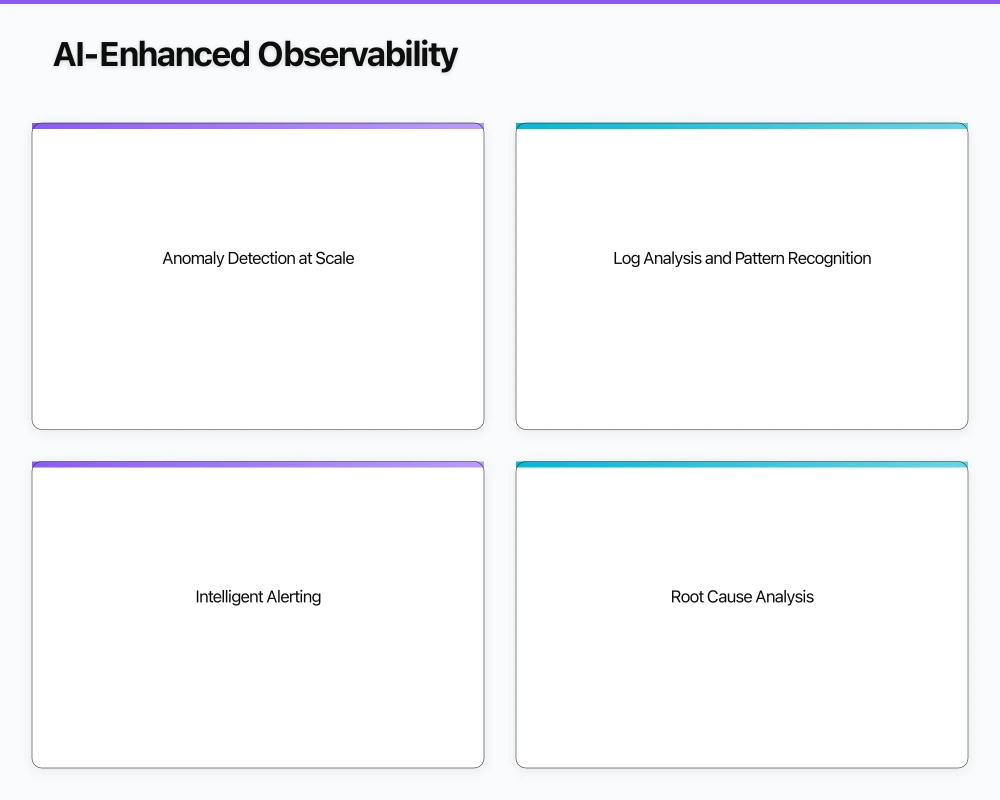
Anomaly Detection at Scale
Statistical anomaly detection identifies deviations from normal behaviour without requiring predefined thresholds. This is particularly valuable for systems with complex seasonal patterns where static thresholds either miss anomalies or generate excessive false positives.
Effective anomaly detection requires understanding what “normal” means in context. Request latency that is normal at 10 AM is anomalous at 3 AM. Error rates acceptable during deployment are concerning during stable periods. AI systems learn these contextual patterns from historical data.
Multi-dimensional anomaly detection identifies issues spanning multiple metrics. A combination of slightly elevated CPU, memory, and latency might not trigger individual alerts but indicates systemic stress when occurring together.
Log Analysis and Pattern Recognition
Log data contains rich operational insight buried in unstructured text. AI-powered log analysis extracts patterns, identifies anomalies, and correlates log events with incidents.
Natural language processing techniques parse log messages, extracting structured information from free-form text. Error messages are clustered by similarity, reducing thousands of unique messages to manageable categories. New error types are automatically detected and surfaced for investigation.
Log pattern analysis identifies sequences preceding failures. The appearance of warning messages, followed by performance degradation, followed by errors represents a pattern that, once learned, enables prediction of failures when early warnings appear.
Intelligent Alerting
Alert fatigue is the enemy of operational effectiveness. When teams receive hundreds of alerts daily, critical notifications drown in noise. AI-powered alerting addresses this through correlation, deduplication, and prioritisation.
Alert correlation groups related alerts into single incidents. A database failover triggers cascading failures across dependent services, generating dozens of alerts. Intelligent systems recognise these as a single incident with one root cause rather than presenting each symptom individually.
Alert prioritisation considers business impact rather than treating all alerts equally. An issue affecting the checkout process during peak shopping hours receives higher priority than the same issue affecting internal tools during low-traffic periods.
Root Cause Analysis
When incidents occur, engineers spend significant time identifying root cause. AI accelerates this process by analysing telemetry, identifying correlations, and suggesting probable causes.
Root cause systems correlate incidents with potential contributing factors: recent deployments, configuration changes, infrastructure events, or upstream service changes. They analyse historical incidents to identify patterns that preceded similar symptoms.
Topology-aware analysis traces through service dependencies. When a service experiences errors, the system examines upstream services for contributing issues, following the dependency graph to identify where problems originate rather than where they manifest.
Autonomous Operations
The ultimate vision of AIOps is autonomous operations: systems that detect, diagnose, and remediate issues without human intervention. This vision requires careful implementation to avoid automated systems causing more harm than they prevent.
Self-Healing Infrastructure
Self-healing systems automatically remediate common issues:
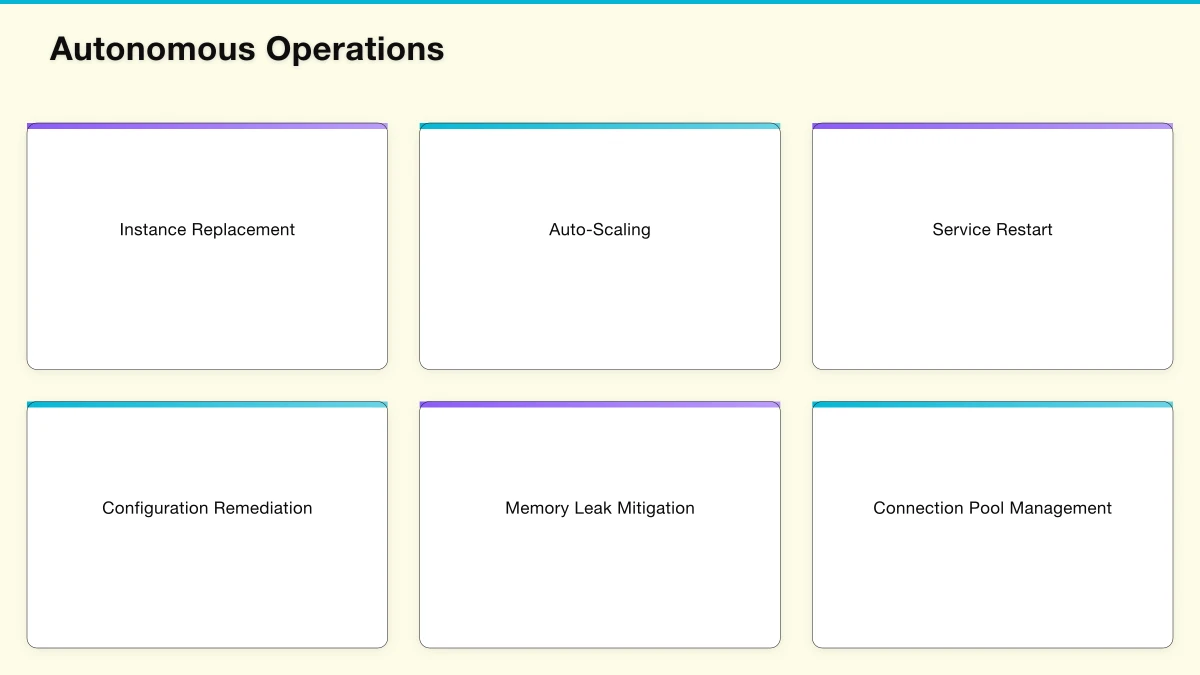
Instance Replacement: When instances fail health checks, automation terminates and replaces them without human involvement.
Auto-Scaling: Capacity adjusts automatically based on demand, scaling out during traffic increases and scaling in during quiet periods.
Service Restart: Crashed services restart automatically with appropriate backoff and circuit breaking.
Configuration Remediation: When drift detection identifies configuration issues, automation restores correct configuration.
These capabilities are table stakes for modern operations. More advanced self-healing addresses complex scenarios:
Memory Leak Mitigation: When memory utilisation patterns indicate leaks, systems proactively restart affected instances before memory exhaustion causes failure.
Connection Pool Management: Intelligent systems monitor connection pool utilisation and preemptively refresh pools approaching exhaustion.
Dependency Circuit Breaking: When downstream services degrade, systems automatically engage circuit breakers to prevent cascade failures.
Intelligent Capacity Management
AI optimises infrastructure capacity beyond simple auto-scaling:
Predictive Scaling: Rather than reacting to load, predictive systems scale before demand arrives. If marketing announces a campaign starting at noon, systems scale preemptively rather than waiting for traffic spikes.
Cost-Performance Optimisation: AI balances cost against performance, identifying optimal instance types and counts for varying workloads. This includes bin-packing optimisation for Kubernetes clusters and spot instance management for cost-sensitive workloads.
Capacity Forecasting: Long-term capacity planning uses ML models to project growth, informing infrastructure investment decisions months in advance.
Chaos Engineering Automation
Chaos engineering deliberately introduces failures to verify system resilience. AI-powered chaos engineering moves beyond random failure injection to intelligent experimentation:
Targeted Experiments: AI identifies system areas lacking recent resilience validation and prioritises experiments accordingly.
Blast Radius Control: Intelligent systems monitor experiment impact and abort experiments that exceed expected blast radius.
Hypothesis Generation: Based on system topology and historical incidents, AI generates hypotheses about potential weaknesses and designs experiments to test them.
Implementation Strategy
Successful AIOps implementation requires systematic approach, not wholesale replacement of existing operational practices.
Phase 1: Observability Foundation
AIOps requires comprehensive, high-quality telemetry data. Before implementing AI capabilities, establish:
Telemetry Coverage: Comprehensive metrics, logs, and traces across all systems. Gaps in observability become gaps in AI capability.
Data Quality: Consistent formatting, reliable collection, and appropriate retention. ML models trained on inconsistent data produce unreliable results.
Correlation Capability: The ability to correlate events across telemetry types and systems. Distributed tracing, log correlation IDs, and unified timestamp standards enable cross-source analysis.
Phase 2: Assisted Intelligence
Start with AI that assists rather than autonomously acts:
Anomaly Surfacing: AI identifies anomalies and presents them to humans for investigation and action.
Root Cause Suggestions: AI analyses incidents and suggests probable causes for human verification.
Alert Enrichment: AI adds context to alerts, reducing investigation time without making decisions.
This phase builds confidence in AI recommendations while keeping humans in the decision loop.
Phase 3: Supervised Automation
Expand to automation with human oversight:
Automated with Approval: AI recommends actions, humans approve execution.
Auto-Remediation for Known Issues: Well-understood issues with proven remediation are automated; novel issues escalate to humans.
Scope-Limited Automation: Automation operates within defined boundaries; actions exceeding boundaries require approval.
Phase 4: Autonomous Operations
Progressively expand autonomous scope based on demonstrated reliability:
Expanded Automation Scope: Actions proven reliable in supervised mode graduate to fully autonomous.
Continuous Learning: Autonomous systems improve from outcomes, expanding capability over time.
Human Oversight for Exceptions: Humans remain in the loop for novel situations and edge cases.
Organisational Considerations
AIOps is not purely a technology initiative. Organisational change is equally important.
Skills Evolution
AIOps shifts required skills. Teams need:
Data Literacy: Understanding ML model capabilities and limitations, interpreting model outputs, and recognising when AI recommendations are unreliable.
Automation Mindset: Identifying opportunities for automation, designing runbooks that AI can execute, and defining appropriate automation boundaries.
Systems Thinking: Understanding complex system behaviour, recognising cascade patterns, and designing for resilience.
Traditional operations skills remain essential but are augmented by these new capabilities.
Process Integration
AIOps must integrate with existing processes:
Incident Management: How do AI-detected incidents enter incident management workflows? How do autonomous remediations get documented?
Change Management: How are AI-driven changes tracked and reviewed? How do autonomous actions comply with change policies?
Capacity Planning: How do AI predictions influence capacity investment decisions? How are forecasting models validated?
Governance and Risk
AI in operations creates governance requirements:
Model Governance: How are ML models validated, deployed, and monitored? Who approves model changes?
Audit Trail: How are autonomous decisions documented for compliance and investigation?
Rollback Capability: How can AI capabilities be disabled if they malfunction?
Bias and Fairness: How do you ensure AI systems do not create biased outcomes affecting customers or employees?
Measuring Success
AIOps investments require clear success metrics:
Mean Time to Detect (MTTD): How quickly are issues identified? AI should reduce detection time.
Mean Time to Resolve (MTTR): How quickly are issues remediated? Autonomous remediation should reduce resolution time for automated issues.
Alert Volume: Has AI-powered alert correlation reduced alert volume while maintaining incident detection?
False Positive Rate: Are anomaly detection systems generating actionable alerts or noise?
Automation Coverage: What percentage of incidents are automatically remediated? This should increase over time.
Prediction Accuracy: How accurate are predictive models? Track predictions against actual outcomes.
Developer Velocity: Has intelligent CI/CD reduced feedback time while maintaining quality?
The Road Ahead
AIOps capabilities are advancing rapidly. Emerging developments reshaping the landscape:
Foundation Models for Operations: Large language models are being adapted for operational contexts, enabling natural language interaction with operational systems and more sophisticated log and documentation analysis.
Closed-Loop Learning: Systems that learn from remediation outcomes, continuously improving responses based on what works.
Cross-Organisation Intelligence: Anonymised insights from operations across many organisations improve models for all participants.
Causal AI: Moving beyond correlation to causation, enabling more reliable root cause analysis and intervention recommendations.
For enterprise CTOs, the strategic imperative is clear. Manual operations cannot scale with system complexity. Teams are overwhelmed by data volumes and alert noise. AI-powered operations is not optional but necessary for maintaining operational excellence as systems grow.
The organisations that implement AIOps effectively will operate more reliably, recover faster from incidents, and deploy with greater velocity and confidence. Those that delay will find their operations increasingly unable to manage the complexity they face.
The transformation has begun. The question is whether your organisation will lead or follow.
Ash Ganda advises enterprise technology leaders on DevOps transformation, AI strategy, and operational excellence. Connect on LinkedIn for ongoing insights on building intelligent operations.
Turning strategy into infrastructure? Cloud Geeks covers managed cloud, DevOps, and IT security for businesses putting digital plans into action.
I lead Ganda Tech Services, where we turn digital strategy into results through specialist cloud, web design, and mobile app teams across Sydney.
About the Author
Ashish Ganda is the founder of Ganda Tech Services, a Sydney-based technology consultancy specialising in cloud infrastructure, web development, and mobile app solutions for Australian businesses.
AI Strategy Primer for Australian Business Leaders
A practical framework for AI adoption in 2026 — cut through the hype and start with what matters.