AIOps for Enterprise IT Operations: Implementing Intelligent Automation at Scale
Introduction
Enterprise IT operations face an impossible scaling challenge. Infrastructure complexity grows exponentially—containers, microservices, multi-cloud deployments, edge computing—while operations teams grow linearly at best. The volume of operational data overwhelms human analysis capacity. Alert fatigue numbs teams to genuine incidents. Manual processes cannot keep pace with infrastructure that changes minute by minute.
AIOps—Artificial Intelligence for IT Operations—promises to break this scaling barrier. By applying machine learning to operational data, AIOps platforms automate pattern detection, correlate events across systems, predict failures before they impact users, and increasingly, automate remediation without human intervention.
Yet AIOps implementations frequently disappoint. Organisations deploy platforms expecting immediate transformation, then struggle with data quality issues, alert noise that decreases rather than increases, and AI recommendations that operators don’t trust. The technology works, but success requires strategic implementation that most organisations skip.
This guide provides the framework for AIOps implementation that delivers on the promise: genuinely intelligent operations that scale beyond human limitations.
Understanding AIOps Capabilities
The AIOps Capability Stack
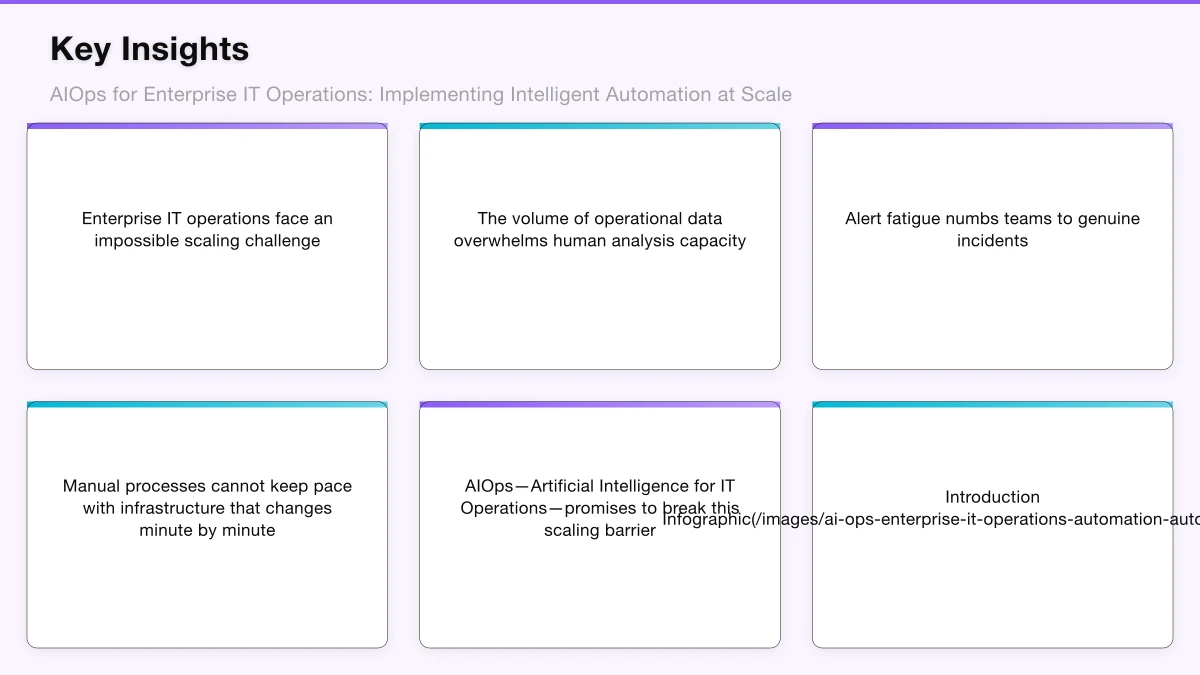
AIOps platforms provide layered capabilities, each building on foundations below:
Layer 1: Data Aggregation and Integration
The foundation layer collects operational data from across the enterprise:
- Metrics from infrastructure and applications
- Logs from systems, applications, and security tools
- Events from monitoring and management platforms
- Traces from distributed systems
- Configuration data from CMDBs and automation platforms
- Topology data describing system relationships
Without comprehensive data aggregation, higher layers cannot function. This layer seems mundane but often determines AIOps success.
Layer 2: Noise Reduction and Correlation
Raw operational data contains enormous noise. This layer applies algorithms to:
- Deduplicate repetitive alerts
- Correlate related events into unified incidents
- Filter transient issues that resolve automatically
- Identify patterns in alert storms
- Group symptoms with probable root causes
Effective noise reduction can reduce alert volume by 90% or more while preserving signal for genuine issues.
Layer 3: Pattern Recognition and Anomaly Detection
Machine learning models learn normal operational patterns and identify deviations:
- Baseline metric behaviour (seasonality, trends, expected variation)
- Detect anomalies that deviate from baselines
- Identify performance degradation before threshold breach
- Recognise patterns preceding past incidents
- Cluster similar issues for pattern analysis
This layer enables proactive detection rather than reactive alerting.
Layer 4: Root Cause Analysis
When incidents occur, AIOps assists determining cause:
- Analyse event sequences leading to incidents
- Correlate changes with incident onset
- Identify upstream dependencies showing issues
- Compare current incident to similar historical incidents
- Suggest probable root causes ranked by confidence
Automated RCA accelerates incident resolution dramatically.
Layer 5: Prediction and Prevention
The most advanced capability predicts issues before they occur:
- Capacity exhaustion predictions
- Failure probability based on leading indicators
- Performance degradation trajectory projection
- Security threat prediction from behaviour patterns
Prediction enables prevention rather than response.
Layer 6: Automated Remediation
The ultimate AIOps goal: autonomous resolution:
- Execute runbooks automatically for known issues
- Scale resources in response to predicted demand
- Restart failed services following validation
- Route issues to appropriate teams when automation cannot resolve
- Learn from human resolution to automate future instances
AIOps Platform Categories
The market offers multiple approaches:
Integrated AIOps Platforms
Full-stack platforms providing all layers:
- Dynatrace: Automatic discovery and AI-powered root cause
- Splunk IT Service Intelligence: Event correlation and ML-based alerting
- BigPanda: Event correlation and incident management focus
- Moogsoft: AIOps pioneer with strong correlation capabilities
- ServiceNow IT Operations Management: ITSM-integrated operations
Strengths: Comprehensive capabilities, integrated experience Considerations: Significant investment, platform lock-in risk
Observability Platforms with AIOps Features
Monitoring platforms adding AI capabilities:
- Datadog: Watchdog AI for anomaly detection and correlation
- New Relic: AI-assisted anomaly detection and error analysis
- PagerDuty: Event intelligence and AIOps-driven incident management
- Elastic Observability: ML-based anomaly detection
Strengths: Build on existing monitoring investments Considerations: AI capabilities may be less mature than dedicated AIOps
Cloud Provider Native Options
Cloud-specific intelligent operations:
- AWS DevOps Guru: AI-powered operational insights for AWS
- Azure Monitor with AI: Intelligent alerting and recommendations
- Google Cloud Operations: AI-driven infrastructure monitoring
Strengths: Deep cloud integration, reduced operational burden Considerations: Limited to specific cloud, multi-cloud challenges
Open Source Foundations
Building blocks for custom AIOps:
- Apache Kafka: Event streaming backbone
- Elasticsearch: Log aggregation and search
- Prometheus: Metrics collection
- Various ML frameworks for custom models
Strengths: Flexibility, no licensing cost Considerations: Significant integration and development effort
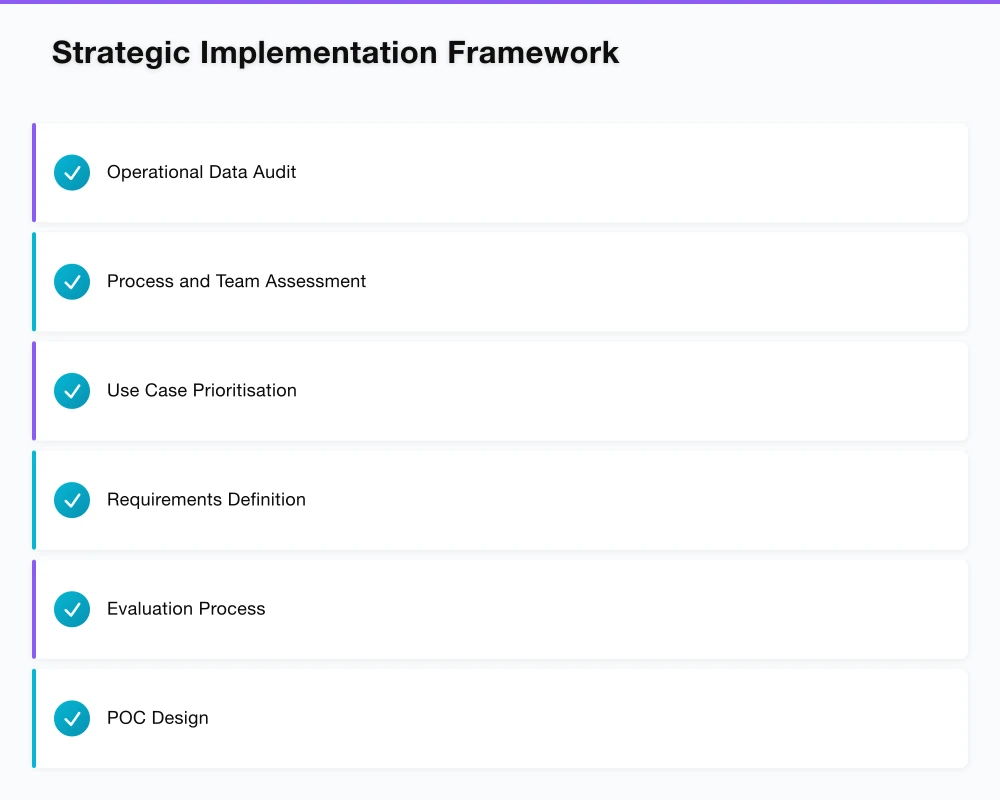
Strategic Implementation Framework
Phase 1: Foundation Assessment (Months 1-2)
Operational Data Audit
AIOps depends on data quality and coverage. Assess current state:
Data Sources Inventory
- What monitoring tools exist today?
- What logs are collected and where?
- What events and alerts flow through what systems?
- What configuration and topology data exists?
- What gaps exist in observability coverage?
Data Quality Assessment
- Are metrics reliable and consistent?
- Is log data structured or semi-structured?
- Do events have consistent severity and categorisation?
- Is topology data accurate and current?
- How long is historical data retained?
Integration Readiness
- What APIs and integration points exist?
- What data formats and protocols are in use?
- What transformation is needed for AIOps consumption?
- What network connectivity exists between systems?
Process and Team Assessment
Technology alone doesn’t transform operations. Assess:
Current Processes
- How are incidents detected, triaged, and resolved today?
- What runbooks exist and how current are they?
- What escalation and communication processes exist?
- How is change management handled?
Team Capabilities
- What operational expertise exists?
- What data science or ML capability exists?
- What appetite exists for operational transformation?
- What resistance should be anticipated?
Use Case Prioritisation
Identify high-impact starting points:
Quick Win Candidates
- Excessive alert noise causing fatigue
- Repetitive incidents amenable to automation
- Time-consuming manual correlation
- Predictable capacity planning needs
Strategic Value Candidates
- Customer-impacting incidents needing faster resolution
- Compliance-related operational requirements
- Cost optimisation opportunities
- Security operations integration
Phase 2: Platform Selection (Months 2-4)
Requirements Definition
Translate assessment findings into requirements:
Functional Requirements
- Data source coverage (what must be integrated)
- Correlation and noise reduction capabilities
- Anomaly detection accuracy requirements
- Automation and integration capabilities
Non-Functional Requirements
- Scale (events per second, data volume)
- Latency (time from event to insight)
- Availability (operations tool availability requirements)
- Security (data handling, access controls)
Operational Requirements
- Deployment model (cloud, hybrid, on-premises)
- Integration with existing ITSM and monitoring
- Reporting and compliance capabilities
- Support and SLA requirements
Evaluation Process
Structured evaluation:
- RFI Phase: Gather information from candidate vendors
- Shortlist: Select 3-4 candidates for detailed evaluation
- Technical POC: Deploy candidates with real operational data
- Evaluation Criteria: Score against requirements
- Reference Validation: Speak with similar organisations
- Selection: Choose platform balancing capability and fit
POC Design
Effective POCs require:
- Representative data sources (not just dev environments)
- Realistic data volume and variety
- Specific success criteria defined before POC
- Time for ML models to learn patterns (weeks, not days)
- Operator involvement in evaluation
Phase 3: Implementation (Months 4-8)
Data Integration
Connect operational data sources:
Priority 1: Core Infrastructure
- Cloud platform metrics and logs
- Kubernetes and container platforms
- Core network infrastructure
- Database and storage systems
Priority 2: Application Stack
- Application performance monitoring
- Application logs
- Distributed traces
- User experience monitoring
Priority 3: Operations Systems
- ITSM and ticketing integration
- Change management systems
- CMDB and asset management
- Automation platforms
Model Training and Tuning
AIOps ML models require training:
Baseline Establishment
- Allow sufficient time for pattern learning (2-4 weeks minimum)
- Ensure data includes normal operations patterns
- Include seasonal patterns if relevant (month-end, campaigns)
- Validate baselines before enabling alerting
Alert Tuning
- Start with high thresholds (minimise false positives)
- Tune based on operator feedback
- Document tuning decisions for future reference
- Accept that tuning is ongoing, not one-time
Correlation Configuration
- Define service topology for correlation context
- Configure correlation windows appropriate to your environment
- Test correlation with historical incidents
- Refine based on live incident correlation quality
Integration Development
Connect AIOps to operational workflows:
Incident Management Integration
- Bi-directional ITSM integration
- Automatic incident creation and enrichment
- Status synchronisation
- Resolution feedback for learning
Automation Integration
- Runbook automation platform connectivity
- Approval workflows for automated actions
- Audit logging for compliance
- Rollback capabilities
Communication Integration
- Collaboration platform notifications (Slack, Teams)
- On-call system integration (PagerDuty, Opsgenie)
- Stakeholder notification workflows
- Status page automation
Phase 4: Operationalisation (Months 8-12)
Process Transformation
Technology enables, process delivers:
Incident Management Evolution
- Update triage procedures to leverage AIOps insights
- Modify escalation based on AIOps severity assessment
- Incorporate correlation data into incident analysis
- Update post-incident review to include AIOps effectiveness
Proactive Operations
- Establish processes for acting on predictions
- Define thresholds for automatic versus manual intervention
- Create workflows for capacity-related predictions
- Integrate predictions into change planning
Continuous Improvement
- Regular review of AIOps effectiveness
- Feedback loops from operators to platform
- Model retraining based on new patterns
- Configuration updates for infrastructure changes
Team Enablement
Build organisational capability:
Training Programs
- Platform operation and administration
- Interpreting AIOps insights
- Tuning and configuration
- Automation development
Role Evolution
- SRE skills for AIOps-enabled operations
- Data engineering for operational data
- ML engineering for custom model development
- Operations architecture for platform evolution
Cultural Change
- Trust building in AI recommendations
- Shifting from reactive to proactive mindset
- Embracing automation over manual heroics
- Data-driven operational decision making
Automation Journey
Automation Maturity Model
AIOps automation typically progresses through stages:
Level 1: Alert Enrichment
AI adds context to alerts without changing workflow:
- Relevant metrics attached to alerts
- Related changes identified
- Similar past incidents surfaced
- Runbook suggestions provided
Value: Faster triage, better informed responders Risk: Minimal—humans remain in complete control
Level 2: Automated Triage
AI categorises and routes incidents:
- Severity assessment based on impact analysis
- Team routing based on service ownership
- Priority adjustment based on context
- Duplicate detection and merging
Value: Reduced manual triage, faster routing Risk: Misrouting possible, human override easy
Level 3: Recommended Actions
AI suggests remediation steps:
- Runbook selection based on incident type
- Remediation steps with confidence scores
- Change recommendations for prevention
- Resource scaling suggestions
Value: Faster remediation, knowledge democratisation Risk: Wrong recommendations possible, human approval required
Level 4: Supervised Automation
AI executes actions with human approval:
- Proposed actions presented for approval
- One-click execution after review
- Automatic rollback on failure
- Audit trail for compliance
Value: Significant time savings, consistent execution Risk: Approval fatigue possible, approval delays in off-hours
Level 5: Autonomous Operations
AI executes actions without human intervention:
- Defined actions execute automatically
- Human notification after action
- Automatic rollback and escalation on failure
- Continuous learning from outcomes
Value: True 24/7 automation, human focus on strategic work Risk: Cascading automation failures, requires mature implementation
Automation Governance
Autonomous operations require governance:
Action Classification
Categorise automation by risk:
- Low Risk: Information gathering, notifications, minor scaling
- Medium Risk: Service restarts, moderate scaling, traffic shifting
- High Risk: Data operations, major infrastructure changes, security actions
Approval Requirements
Match approval to risk:
- Low risk: Automatic with notification
- Medium risk: Automatic during business hours, approval off-hours
- High risk: Always require approval, possibly multiple approvers
Audit and Compliance
Maintain compliance:
- Complete audit trail of all automated actions
- Approval chain documentation
- Action outcome recording
- Rollback and recovery documentation
Measuring AIOps Success
Operational Metrics
Noise Reduction
- Alert volume before and after AIOps
- Signal-to-noise ratio improvement
- Time spent on alert triage
- False positive rate
Incident Performance
- Mean time to detect (MTTD)
- Mean time to acknowledge (MTTA)
- Mean time to resolve (MTTR)
- Incident volume trends
Automation Metrics
- Percentage of incidents with automated triage
- Percentage of incidents with automated remediation
- Automation success rate
- Human intervention rate
Business Metrics
Availability and Reliability
- Service availability improvements
- Customer-impacting incident reduction
- SLA compliance trends
- Error budget consumption
Efficiency Metrics
- Operations team productivity
- Cost per incident
- After-hours escalation reduction
- Tool consolidation savings
Risk Metrics
- Security incident detection improvement
- Compliance posture improvement
- Audit finding reduction
- Risk exposure trending
Common Pitfalls and Mitigations
Pitfall: Data Quality Ignored
AIOps produces garbage insights from garbage data. Organisations skip data quality work, expecting AI to compensate.
Mitigation: Invest in data quality before AIOps deployment. Clean, consistent, complete data is prerequisite.
Pitfall: Unrealistic Expectations
Expecting AIOps to immediately solve all operational challenges leads to disappointment when reality requires gradual improvement.
Mitigation: Set realistic expectations. Plan for 6-12 months to realise significant value. Celebrate incremental wins.
Pitfall: Insufficient Training Time
ML models need time to learn patterns. Organisations enable alerting before models understand normal behaviour, creating noise.
Mitigation: Allow 2-4 weeks minimum for baseline learning. Validate model understanding before enabling production alerting.
Pitfall: Operator Distrust
Operators who don’t trust AI recommendations work around the system rather than leveraging it.
Mitigation: Involve operators in selection and implementation. Start with recommendations, not automation. Build trust gradually.
Pitfall: Static Implementation
Initial configuration becomes stale as infrastructure evolves, degrading AIOps effectiveness over time.
Mitigation: Treat AIOps as living system requiring ongoing care. Schedule regular reviews and updates.
The Autonomous Future
AIOps continues evolving toward greater autonomy:
Generative AI Integration
Large language models enable:
- Natural language incident queries
- Automated runbook generation
- Conversational troubleshooting
- Documentation generation from incidents
Predictive Capabilities Expansion
Improving prediction enables:
- Longer prediction horizons
- Higher confidence predictions
- Broader prediction scope (security, cost, compliance)
- Prescriptive recommendations
Cross-Domain Intelligence
Breaking silos between:
- IT operations and security operations
- Infrastructure and application management
- Development and operations
- Business and technology operations
Conclusion
AIOps represents a fundamental shift in IT operations: from human-centric manual processes to AI-augmented intelligent automation. The organisations that master this capability will operate infrastructure at scales and speeds impossible with traditional approaches.
Yet AIOps success requires more than platform deployment. The strategic imperatives:
- Data foundation first: Quality operational data enables everything else
- Incremental automation: Build trust through progressively increasing autonomy
- Process transformation: Technology enables, process delivers value
- Team evolution: New skills and new mindsets for AI-augmented operations
- Continuous improvement: AIOps is never “done”—it evolves with your environment
The complexity of modern infrastructure will only increase. The organisations investing in AIOps capabilities now will handle that complexity gracefully. Those that don’t will struggle with alert storms, extended outages, and operational teams that cannot keep pace.
Start the journey. Build the foundation. Progress toward autonomous operations.
Sources
- Gartner. (2025). Market Guide for AIOps Platforms. Gartner Research. https://www.gartner.com/en/documents/aiops-platforms
- Dynatrace. (2025). State of AI in IT Operations. Dynatrace Research. https://www.dynatrace.com/aiops-report/
- Moogsoft. (2025). AIOps Implementation Guide. Moogsoft. https://www.moogsoft.com/resources/aiops-guide/
- Forrester. (2025). The Forrester Wave: AIOps Platforms. Forrester Research. https://www.forrester.com/report/aiops-platforms
- Google SRE. (2025). Site Reliability Engineering: How Google Runs Production Systems. O’Reilly Media. https://sre.google/books/
- PagerDuty. (2025). State of Digital Operations. PagerDuty. https://www.pagerduty.com/resources/reports/digital-operations/
Strategic guidance for enterprise technology leaders transforming IT operations.
Turning mobile strategy into a shipped app? Awesome Apps covers Flutter, React Native, and native development for Australian businesses.
As founder of Ganda Tech Services, I work with Australian businesses to align technology investments with business growth — across cloud, web, and mobile.
About the Author
Ashish Ganda is the founder of Ganda Tech Services, a Sydney-based technology consultancy specialising in cloud infrastructure, web development, and mobile app solutions for Australian businesses.
AI Strategy Primer for Australian Business Leaders
A practical framework for AI adoption in 2026 — cut through the hype and start with what matters.