Vendor Management Strategy: Reducing Lock-in While Maintaining Quality
Vendor lock-in represents one of the most significant strategic risks facing enterprise technology leaders today. Yet the alternative—maintaining complete vendor independence—often comes at the cost of integration depth, feature velocity, and operational efficiency. The question isn’t whether to accept vendor dependencies, but how to structure them strategically to preserve optionality while capturing platform value.
This tension has intensified as cloud platforms, SaaS providers, and enterprise software vendors have shifted from selling products to selling ecosystems. AWS Lambda functions become tightly coupled to API Gateway and DynamoDB. Salesforce customizations deepen into Apex code and platform-specific workflows. Microsoft 365’s collaboration suite creates organizational dependencies that extend far beyond simple file storage. Each integration point that drives productivity also increases switching costs.
The strategic imperative for CTOs in mid-2024 is clear: develop vendor management frameworks that balance platform leverage with architectural flexibility, ensuring that today’s efficiency gains don’t become tomorrow’s existential constraints.
The True Cost of Vendor Lock-in
Vendor lock-in extends well beyond contract terms and pricing structures. The strategic cost manifests across multiple dimensions that compound over time, creating switching costs that can reach 3-5x the apparent contract value.
Technical debt accumulation represents the most insidious form of lock-in. Consider a Fortune 500 retailer that built its inventory management system on Oracle’s proprietary PL/SQL stored procedures over a decade. By 2024, the system contains over 2 million lines of database-specific code, with business logic deeply embedded in the data layer. Migration estimates run to $45 million and 18 months—not because Oracle’s platform is technically inferior, but because architectural decisions made incrementally over years created irreversible dependencies.
Knowledge concentration creates organizational vulnerabilities that extend beyond technology. Salesforce platform expertise, for instance, represents a specialized skill set that doesn’t transfer cleanly to alternative CRM systems. Teams that develop deep platform expertise become invested in maintaining that platform, creating organizational inertia that reinforces technical lock-in. A 2023 Gartner study found that enterprises with more than 60% of their development team focused on a single platform vendor exhibited 40% higher resistance to platform migration initiatives, even when business cases demonstrated clear ROI.
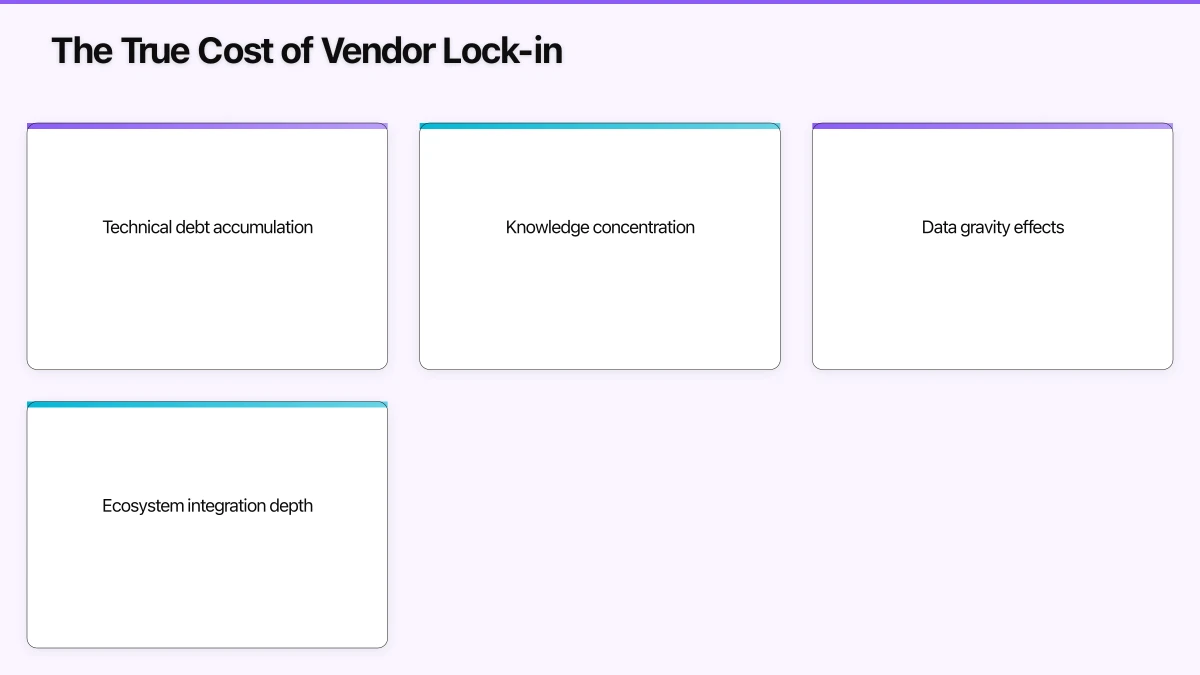
Data gravity effects compound as data volumes grow and integration patterns solidify. AWS S3 storage at petabyte scale doesn’t just represent data at rest—it represents hundreds of Lambda functions, Step Functions workflows, and CloudWatch monitoring configurations tuned specifically to that data’s location and access patterns. Egress costs for moving data become prohibitive, but more significantly, the operational patterns built around data location create switching barriers that purely technical metrics fail to capture.
Ecosystem integration depth multiplies dependencies exponentially. An enterprise running Salesforce Sales Cloud often extends into Service Cloud, Marketing Cloud, and Commerce Cloud. Each addition strengthens the platform relationship but increases the complexity of any future migration. By mid-2024, the average enterprise Salesforce deployment integrates with 14 additional systems, creating a web of dependencies where changing the core platform requires re-architecting dozens of integration points.
The strategic implication: lock-in isn’t a binary state but a spectrum of dependency that requires continuous monitoring and active management. Leading CTOs track “switching cost indicators” as rigorously as they monitor technical debt metrics, measuring dependencies across technical, organizational, and data dimensions.
Multi-Vendor Architecture Strategies
Strategic vendor management begins with architectural decisions that preserve optionality without sacrificing integration depth. The goal isn’t vendor independence—a costly illusion—but structured dependency that maintains negotiating leverage and migration pathways.
Abstraction layer architecture provides the most direct technical approach to reducing platform-specific dependencies. This strategy places vendor-specific implementations behind stable internal APIs, allowing underlying providers to change without affecting consuming applications. HashiCorp’s Terraform has become the de facto standard for infrastructure abstraction, with enterprises using it to maintain consistent provisioning interfaces across AWS, Azure, and GCP. A telecommunications provider interviewed for this analysis runs production workloads across all three major clouds behind a unified infrastructure API, reducing AWS-specific code from 78% of their infrastructure layer to just 23% over an 18-month abstraction initiative.
The challenge with abstraction layers lies in determining appropriate abstraction boundaries. Abstract too aggressively, and you lose access to platform-specific features that drive competitive advantage. Abstract insufficiently, and the layer becomes a maintenance burden without providing real flexibility. The principle: abstract at integration boundaries where vendor switching is plausible, but embrace platform-native features where they provide differentiated capabilities that justify the dependency.
Multi-vendor parallel operation represents a more aggressive approach to maintaining leverage. Rather than abstracting away vendor differences, this strategy deliberately operates multiple vendors simultaneously for the same function, maintaining active expertise and operational capabilities across platforms. A financial services firm runs identical containerized workloads on both AWS EKS and Azure AKS, with traffic split 70/30. The minority platform represents “hot standby” capacity that maintains team expertise and validates migration paths while providing genuine failover capabilities. The cost premium—approximately 15% additional infrastructure spend—provides insurance against vendor-specific outages while maintaining credible negotiating leverage during contract renewals.
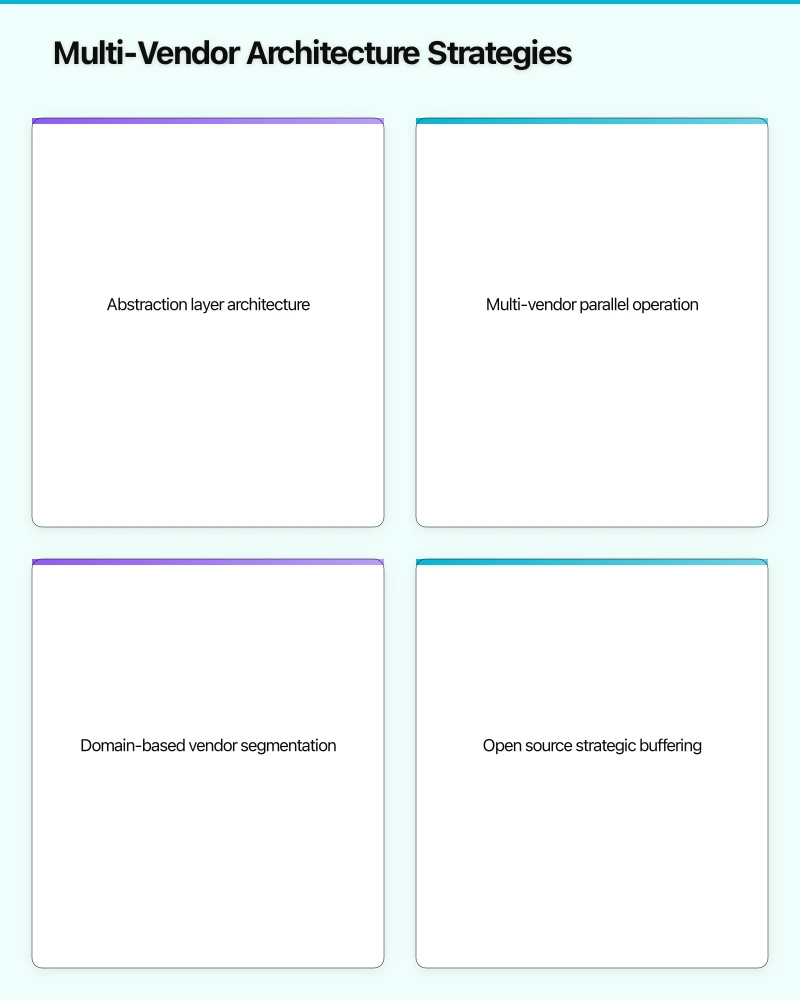
Domain-based vendor segmentation aligns different vendor relationships with specific business capabilities, avoiding the “single platform for everything” trap that maximizes lock-in. This approach might place customer-facing applications on AWS for its mature edge computing capabilities, data analytics workloads on GCP for BigQuery and AI/ML services, and internal enterprise applications on Azure for Microsoft 365 integration. Each workload type aligns with vendor strengths while preventing any single vendor from becoming irreplaceable across all business functions.
The segmentation strategy requires sophisticated architectural governance to prevent the opposite problem: vendor sprawl that creates operational complexity without strategic benefit. A technology manufacturer reduced its vendor count from 47 distinct platform relationships to 12 strategic partnerships, consolidating overlapping capabilities while maintaining multi-vendor coverage across critical domains. The reduction improved operational efficiency while preserving the optionality that matters for strategic leverage.
Open source strategic buffering uses open-source technologies as switching cost insurance. Kubernetes has become the canonical example: by building container orchestration around an open standard, enterprises avoid direct lock-in to AWS ECS, Azure Container Apps, or Google Cloud Run. If cloud provider relationships deteriorate, workloads can migrate to alternative Kubernetes implementations with reasonable effort. The same logic applies to databases (PostgreSQL vs. proprietary systems), message queues (Apache Kafka vs. AWS Kinesis), and workflow orchestration (Apache Airflow vs. Azure Data Factory).
The open source buffer strategy works best for infrastructure and platform services where standards have emerged. Application-layer services—CRM, ERP, HCM—rarely have viable open source alternatives at enterprise scale, requiring different management approaches focused on data portability and integration flexibility rather than platform replaceability.
Contract Negotiation and Commercial Terms
Technical architecture establishes the foundation for vendor flexibility, but commercial relationships determine the actual cost and feasibility of exercising that flexibility. Strategic contract negotiation in 2024 requires explicit attention to exit rights, data portability guarantees, and commercial terms that preserve long-term optionality.
Exit clause architecture transforms contracts from relationship commitments into structured options. Rather than accepting standard 3-year enterprise agreements with auto-renewal clauses, sophisticated buyers negotiate explicit exit rights tied to specific vendor performance failures or competitive condition changes. A manufacturing enterprise negotiated a clause allowing contract termination with 90 days notice if their primary cloud provider suffered more than three significant availability events in a 12-month period. The clause has never been exercised, but its existence shifted the vendor relationship dynamic from captive customer to valued partnership.
Exit clauses extend beyond termination rights to include explicit migration assistance requirements. Progressive contracts specify that vendors must provide technical resources, documentation, and data export assistance if the customer chooses to migrate away, with cost caps that prevent vendors from making exit financially prohibitive. These provisions work best when negotiated during initial contract establishment, when customer leverage is highest and vendor motivation to close the deal is strongest.
Data portability guarantees address the practical barriers to migration that often matter more than contractual exit rights. Standard agreements should specify data export formats (preferably open standards like JSON, CSV, or Parquet), export frequency rights (monthly, weekly, or on-demand), and maximum export delivery timeframes. A retail enterprise negotiated contract language requiring their SaaS ERP vendor to provide complete data exports in open formats within 48 hours of any request, with financial penalties for delays. When they later initiated a competitive platform evaluation, the clause provided the data access necessary to validate migration feasibility without vendor obstruction.
The data portability requirement extends to metadata, configurations, and custom logic—not just raw data records. A comprehensive data exit package includes user accounts and permissions, workflow configurations, integration specifications, and custom business rules documented in portable formats. Leading vendors now offer “migration packages” as standard contract terms, recognizing that customers who feel confident in exit rights are more likely to commit to deeper platform adoption.
Commercial ratchet clauses address the pricing leverage problem that emerges as dependencies deepen. Standard enterprise agreements include volume discounts that reward increased platform usage—but these same discounts create financial penalties for reducing usage or migrating workloads away. Strategic buyers negotiate “plateau protection” clauses that maintain discount tiers even if usage decreases by defined percentages, providing financial flexibility to experiment with alternative vendors or gradually migrate workloads without triggering immediate cost increases.
Competitive benchmarking rights formalize the ability to validate market pricing without triggering vendor relationship strain. Contracts can include provisions allowing customers to request competitive proposals periodically (typically annually or at renewal) with requirements that the incumbent vendor match competitive pricing or agree to structured volume reductions. A telecommunications company’s contract includes an annual “market pricing validation” right where competitive bids establish market rates, with their incumbent cloud provider required to match or provide written justification for any premium above competitive offers.
Multi-year commitment structures require careful calibration between commitment discounts and flexibility preservation. Rather than committing 100% of anticipated workload volume across three years, sophisticated buyers commit 60-70% at discounted rates while maintaining 30-40% at on-demand pricing. The premium paid for flexibility often returns 3-5x value in negotiating leverage and genuine multi-vendor optionality. The same principle applies to feature access: commit to core platform capabilities but maintain flexibility for emerging capabilities where the vendor landscape remains unsettled.
Maintaining Quality During Multi-Vendor Operations
Strategic vendor management must balance optionality with operational excellence. Multi-vendor architectures introduce complexity that can degrade service quality, increase operational overhead, and slow feature velocity if not managed deliberately.
Standardized operational interfaces become critical in multi-vendor environments. Enterprises that successfully maintain quality across diverse vendor relationships establish common operational frameworks for monitoring, incident management, change control, and compliance validation that work consistently regardless of underlying vendor. This requires investing in operational abstraction layers—unified monitoring through tools like Datadog or New Relic, centralized incident management through PagerDuty or Opsgenie, and consolidated compliance frameworks through governance platforms.
A financial services firm’s multi-cloud architecture maintains consistent operational quality by requiring all cloud workloads to emit metrics in OpenTelemetry format, flowing to a vendor-neutral observability platform. Whether applications run on AWS, Azure, or GCP, operations teams use identical dashboards, alerts, and response procedures. The standardization prevented the operational fragmentation that typically accompanies multi-vendor strategies, where team expertise and operational maturity diverge across platforms.
Center of Excellence structures concentrate deep vendor expertise while maintaining cross-platform perspective. Rather than creating isolated AWS teams, Azure teams, and GCP teams that develop conflicting practices, leading enterprises establish platform Centers of Excellence that maintain expertise across multiple vendors while driving consistent practices. A manufacturing enterprise’s Cloud Platform CoE includes engineers with certifications across all three major clouds, who rotate through vendor-specific deep-dive assignments while maintaining perspective on cross-platform patterns and practices.
The CoE model prevents the expertise fragmentation that undermines quality in multi-vendor environments. Teams develop vendor-specific depth when needed for specific projects while maintaining enough cross-platform exposure to recognize when vendor-specific approaches create unnecessary lock-in or diverge from enterprise patterns without good reason.
Vendor relationship tiering recognizes that not all vendor relationships carry equal strategic weight or require equal management intensity. Strategic vendors—those providing capabilities central to competitive advantage or business operations—warrant deep integration, dedicated relationship management, and acceptance of meaningful dependencies. These relationships justify the executive attention and technical investment required to capture full platform value while managing dependencies strategically.
Tactical vendors—those providing commodity capabilities available from multiple sources—should receive minimal integration investment and maximum standardization. Maintain shallow integrations, emphasize standards compliance, and retain genuine multi-vendor competition for these relationships. A technology company categorizes its 200+ vendor relationships into Strategic (8 vendors), Important (25 vendors), and Tactical (167 vendors), with dramatically different relationship management approaches for each tier. Strategic vendors receive quarterly executive business reviews and joint roadmap planning; tactical vendors receive automated vendor management through procurement systems.
Quality metrics standardization ensures that multi-vendor architectures don’t create blind spots where service degradation goes undetected. Establish consistent SLOs across all vendors providing similar capabilities, with unified measurement and reporting. If application latency SLOs target 95th percentile response times under 200ms, that standard applies equally to workloads running on any cloud provider. Consistent metrics expose quality variations that might otherwise hide behind vendor-specific measurement approaches and provide objective data for vendor performance discussions.
Exit Planning and Migration Readiness
The most effective vendor management strategies maintain genuine migration capability, not just theoretical options. Exit planning transforms vendor relationships from dependencies into partnerships grounded in mutual value rather than switching cost captivity.
Migration pathway documentation establishes concrete understanding of what vendor migration would actually require. This goes beyond high-level architecture diagrams to include specific migration sequences, data transformation requirements, integration re-implementation scope, and operational transition plans. A healthcare technology provider maintains quarterly-updated migration runbooks for each strategic vendor relationship, detailing the specific steps required to move core systems to alternative platforms. The documentation discipline alone surfaces architectural dependencies that might otherwise accumulate invisibly, allowing teams to course-correct before dependencies become irreversible.
Regular migration exercises validate that documented pathways remain viable as systems evolve. Leading enterprises conduct annual “migration simulations” where teams execute initial migration phases in sandbox environments, extracting data, testing integration patterns, and validating application functionality on alternative platforms. These exercises serve multiple purposes: they verify migration feasibility, maintain team capability to execute migrations, identify new dependencies that have emerged, and provide powerful negotiating leverage during vendor renewals. When a vendor knows the customer has recently demonstrated migration capability, pricing discussions take on different dynamics.
Financial migration reserves acknowledge that exit optionality requires investment. Organizations maintaining genuine vendor flexibility typically reserve 15-20% of annual vendor spending for potential migration costs, treating vendor switching capability as strategic insurance worth explicit budget allocation. This reserved capacity enables rapid response when vendor relationships deteriorate or competitive alternatives emerge with compelling advantages.
Alternative vendor relationships require active cultivation before they’re needed. Waiting until a vendor relationship fails to establish alternatives means negotiating from weakness. Progressive enterprises maintain “warm standby” relationships with alternative vendors—active proof-of-concept projects, technical architecture reviews, pre-negotiated contract terms awaiting activation. These relationships cost relatively little to maintain but provide the foundation for rapid migration if primary vendor relationships deteriorate.
Looking Forward: Vendor Management in an AI-First World
The rapid evolution of AI platforms in 2024 creates both new opportunities and new lock-in vectors. Foundation model providers, vector databases, GPU cloud capacity, and emerging AI development platforms represent areas where vendor dependencies can crystallize quickly, often in technologies where long-term winners remain uncertain.
AI infrastructure dependencies currently lack the standardization that characterizes mature technology categories. Organizations building on OpenAI’s GPT-4 API develop prompt engineering patterns, fine-tuning datasets, and application architectures specific to that model’s capabilities and limitations. Switching to Anthropic’s Claude or Google’s Gemini models isn’t simply an API endpoint change—it requires rethinking prompts, adjusting expected response patterns, and potentially re-architecting applications around different model strengths.
The strategic response involves deliberate abstraction at the AI interface layer. Rather than embedding model-specific prompts throughout application code, leading implementations use prompt abstraction frameworks that allow model swapping with configuration changes rather than code modifications. Vector database choices receive similar treatment—abstract behind standard interfaces rather than coupling directly to Pinecone, Weaviate, or Chroma-specific features.
GPU capacity relationships represent another emerging lock-in vector. NVIDIA’s H100 dominance creates dependencies not just on hardware but on CUDA programming models, optimized libraries, and operational expertise that doesn’t transfer cleanly to alternative accelerators. Cloud provider GPU capacity allocations—particularly during the current supply constraints—can become strategic chokepoints. Organizations dependent on AWS for H100 access find themselves with limited negotiating leverage when capacity is scarce and demand exceeds supply.
Model fine-tuning and training infrastructure creates perhaps the deepest AI-related lock-in. Organizations that fine-tune models on platform-specific infrastructure (AWS SageMaker, Azure Machine Learning, Google Vertex AI) accumulate dependencies across training data formats, optimization frameworks, model versioning systems, and deployment pipelines. The cost of migrating trained models to alternative platforms can exceed the original training investment.
The strategic imperative: maintain maximum flexibility in AI infrastructure decisions while the market matures. Accept higher short-term costs or reduced feature access in exchange for architectural optionality. The vendor choices made today around AI platforms will determine competitive positioning for years to come, yet the winning platforms and standards remain far from certain. This argues for deliberate vendor diversification, abstraction investment, and contract terms that preserve optionality as the AI landscape continues its rapid evolution.
Strategic Implementation Framework
Effective vendor management requires executive commitment beyond procurement optimization. The framework outlined here—architectural abstraction at strategic boundaries, commercial terms that preserve optionality, multi-vendor operations where justified by scale, and genuine migration capability—represents a coherent approach to balancing platform value capture with strategic flexibility.
The starting point: audit current vendor dependencies across technical, organizational, and commercial dimensions. Identify which dependencies represent conscious strategic choices delivering clear value, and which represent accumulated technical debt that constrains future options without commensurate benefit. Prioritize abstraction investment where switching costs are growing fastest and competitive alternatives exist. Accept deeper integration where platform-specific capabilities drive genuine competitive advantage and the vendor relationship demonstrates sustainable mutual value.
Contract renewals provide natural inflection points for resetting vendor relationships. Use the leverage that comes with committed spending to negotiate enhanced exit rights, data portability guarantees, and commercial terms that maintain flexibility even as platform usage deepens. The discount differential between flexible and committed terms typically ranges from 5-15%—a premium worth paying for strategic optionality in most enterprise contexts.
Vendor management has shifted from a procurement concern to a core component of enterprise technology strategy. CTOs who treat vendor relationships as tactical purchasing decisions cede strategic leverage and accumulate dependencies that constrain future options. Those who approach vendor management as architectural discipline—balancing integration depth with structured optionality, commercial terms with technical flexibility—position their enterprises to capture platform value while preserving the leverage necessary to navigate an evolving technology landscape.
Ash Ganda advises enterprise technology leaders on platform strategy and digital transformation. Follow his analysis of enterprise technology trends on ashganda.com.
If this strategic perspective has you thinking about cloud adoption, Cloud Geeks provides the implementation detail — from AWS setup to security hardening.
These insights are drawn from my work leading Ganda Tech Services — helping Australian businesses navigate digital transformation through cloud, web, and mobile.
About the Author
Ashish Ganda is the founder of Ganda Tech Services, a Sydney-based technology consultancy specialising in cloud infrastructure, web development, and mobile app solutions for Australian businesses.
Digital Transformation Roadmap 2026
A 12-month framework for Australian SMBs ready to modernise — phases, tools, and milestones.
Almost done
Check your inbox and click the confirmation link to get your download.