The Strategic CTO: Navigating Economic Uncertainty in Tech
The technology industry is experiencing its most significant economic adjustment in over a decade. After years of aggressive hiring, expansive budgets, and growth-at-all-costs strategies, the correction has been swift: layoffs across major technology companies, reduced venture capital deployment, tightened enterprise technology budgets, and increased scrutiny on return on investment for every technology dollar spent.
For CTOs, this environment demands a different kind of leadership. The strategies that succeeded in an expansionary environment — hiring aggressively, building comprehensive platforms, investing in long-horizon research initiatives — must be recalibrated for a period where capital is constrained, expectations are heightened, and the margin for error is narrower.
This is not a guide to cost cutting. Cost cutting is a tactical exercise that finance can lead. The CTO’s strategic responsibility is broader: protecting the organisation’s technology capability through the downturn, making investment decisions that create lasting value, and positioning the technology organisation for the recovery that will eventually follow.
Reframing the Investment Portfolio
In expansionary periods, technology investment portfolios tend to broaden. New initiatives are funded liberally, technical debt remediation competes successfully for budget, and experimental projects receive support because the cost of failure is low relative to available resources.
In constrained periods, the portfolio must narrow. The challenge is narrowing it intelligently rather than across the board. Uniform budget cuts — “every team reduces spending by fifteen percent” — are simple to implement and reliably counterproductive. They cut essential and non-essential spending equally, removing the strategic intent from investment decisions.
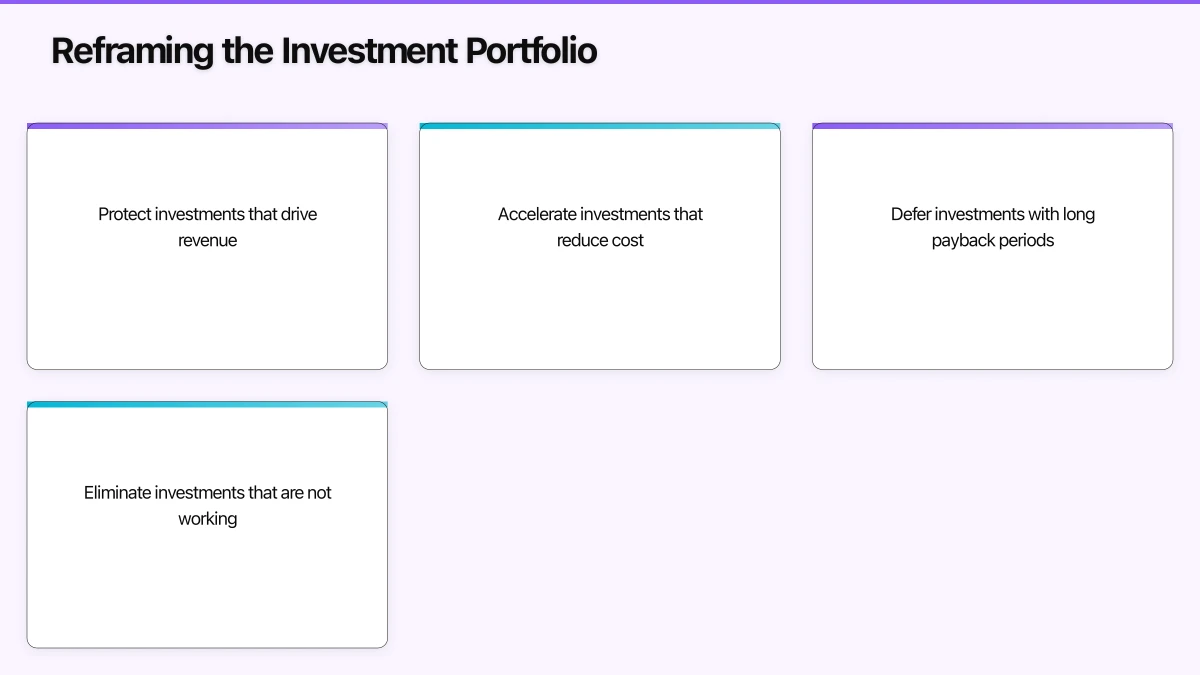
Instead, I recommend a portfolio triage approach:
Protect investments that drive revenue: Technology that directly enables revenue generation — customer-facing products, sales enablement platforms, service delivery systems — should be protected from cuts. These investments have immediate, measurable returns that justify their continuation. Reducing investment in revenue-generating technology creates a downward spiral: lower technology quality leads to lower customer satisfaction, which leads to lower revenue, which leads to further cuts.
Accelerate investments that reduce cost: Automation, efficiency improvements, and cloud cost optimisation initiatives become more valuable in a cost-constrained environment. An automation project that eliminates manual processes reduces ongoing costs permanently. A cloud optimisation initiative that reduces monthly spend by twenty percent compounds over every subsequent month. These investments should be accelerated, not deferred.
Defer investments with long payback periods: Platform modernisation, architectural transformation, and technology exploration initiatives that will not deliver returns for eighteen to twenty-four months can be deferred in favour of investments with shorter payback periods. Deferral is not cancellation — these initiatives should be maintained at a level that preserves momentum and institutional knowledge, but full investment can be resumed when conditions improve.
Eliminate investments that are not working: Every technology organisation carries initiatives that are not delivering value: projects that have been in pilot for years without production deployment, tools that were adopted but never achieved meaningful usage, and experimental capabilities that have not found a business case. Economic pressure provides the political cover to discontinue these investments that would face resistance in expansionary times.
Protecting Core Capabilities
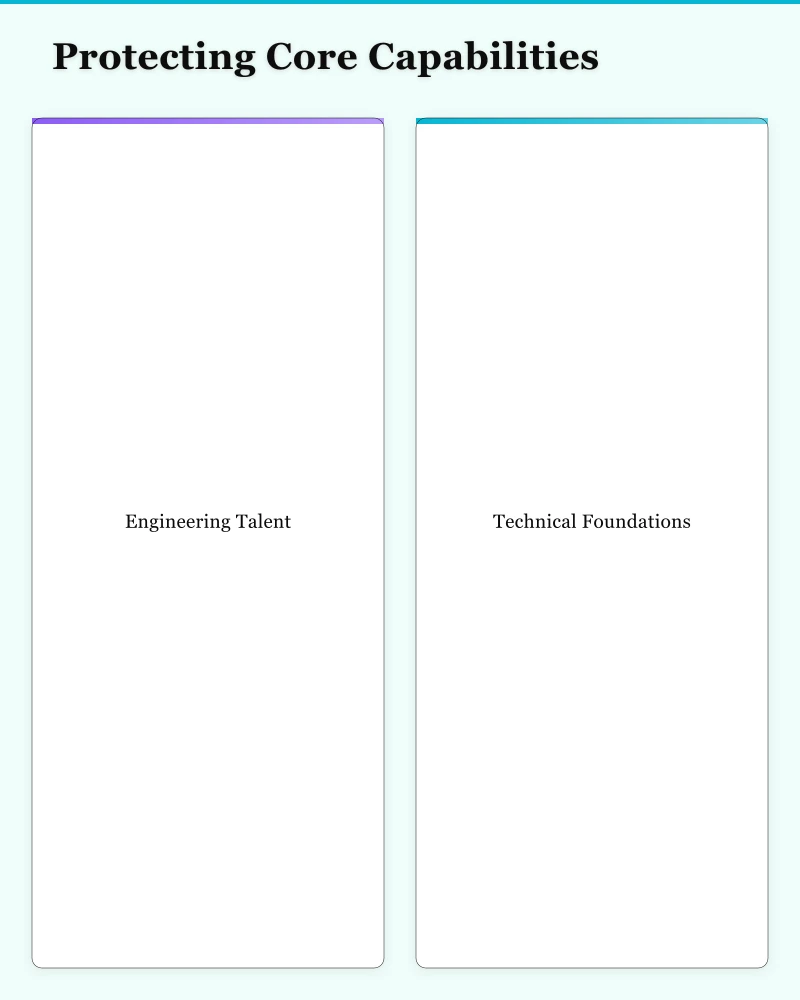
The greatest risk during economic uncertainty is not short-term cost — it is the erosion of core capabilities that take years to rebuild. Two capabilities deserve particular protection:
Engineering Talent: The technology industry’s most valuable asset is its people. Layoffs that reduce engineering headcount may produce immediate budget relief but create capability gaps that constrain the organisation for years. Replacing an experienced engineer who understands the domain, the architecture, and the organisational context takes six to twelve months and significant investment.
Where headcount reductions are unavoidable, they should be targeted based on the organisation’s strategic priorities, not implemented as uniform percentage cuts. Protecting the teams that build and maintain revenue-critical systems, that hold essential domain knowledge, and that possess skills the organisation cannot easily acquire should be the first principle of any workforce reduction.
For the engineers who remain, retention becomes critical. Economic uncertainty creates anxiety that drives attrition of the best people — those who have the most options. Transparent communication about the organisation’s situation and plans, investment in professional development, and recognition of the increased contribution expected from a smaller team help retain the talent the organisation cannot afford to lose.
Technical Foundations: Infrastructure, platform capabilities, and engineering practices that enable productive development are tempting cost reduction targets because their value is indirect. Cutting investment in CI/CD infrastructure, observability platforms, or development environments saves money today but slows every engineering effort tomorrow.
The compounding nature of platform investment works in both directions. Years of investment create productivity gains that compound. Years of disinvestment create productivity losses that compound. An organisation that reduces platform investment for two years may find that restoring the previous level of investment requires three to four years of catch-up.
Strategic Cost Management
Cost management in uncertain times should be strategic, not merely mechanical:
Cloud Cost Optimisation: Most enterprise cloud environments contain twenty to thirty percent waste — overprovisioned instances, unused resources, under-utilised reserved capacity, and inefficient architectures. Systematically addressing this waste produces significant savings without reducing capability. This is the highest-value cost management initiative for most organisations because it reduces spending without reducing output.
Vendor Consolidation: The expansion phase typically leaves organisations with overlapping tools and redundant vendor relationships. Consolidating onto fewer vendors reduces licensing costs, administration overhead, and integration complexity. The consolidation process also provides leverage for renegotiating terms with remaining vendors.
Build vs. Buy Reassessment: Custom-built systems that were justified during expansion may be more expensive to maintain than commercial alternatives. Reassessing build-versus-buy decisions with current cost structures may reveal opportunities to reduce maintenance burden by adopting commercial or open-source alternatives.
Technical Debt Triage: Not all technical debt is equal. Some technical debt imposes ongoing costs through increased maintenance effort, slower development, and higher incident rates. Addressing this high-cost debt reduces ongoing expenses. Other technical debt is stable and imposes minimal ongoing cost. Prioritising debt remediation by ongoing cost impact rather than technical aesthetics produces the best return.
Communicating Through Uncertainty
The CTO’s communication role becomes more important during uncertain periods. Engineering organisations perform best when they understand the context, feel that leadership is making thoughtful decisions, and trust that the organisation is navigating toward a viable future.
Be honest about the situation: Engineers are intelligent professionals who can handle difficult information. Hiding the severity of budget constraints, pretending layoffs are not possible, or presenting cuts as “optimisation” when they are driven by financial pressure erodes trust. Honest communication about the environment, the constraints, and the decisions being made creates the foundation for organisational resilience.
Explain the strategy: When investment priorities change, explain why. When projects are deferred, explain the rationale. When teams are restructured, explain the strategic logic. People can accept difficult decisions when they understand the reasoning. They resist decisions that feel arbitrary or unexplained.
Maintain a forward perspective: While managing current constraints, continue articulating the organisation’s technology vision. The downturn will end, and the organisation needs to emerge positioned for the opportunities that recovery creates. A CTO who communicates only about cost reduction creates an organisation focused on survival. A CTO who balances cost discipline with strategic vision creates an organisation focused on enduring success.
Economic uncertainty tests technology leadership in ways that growth environments do not. The CTO who navigates this period with strategic clarity, honest communication, and disciplined investment decisions emerges with a stronger organisation: leaner, more focused, and better positioned for the growth that follows. The decisions made during constrained periods shape the organisation for years. Making them thoughtfully, with full awareness of their long-term implications, is the CTO’s most important responsibility.
Mobile execution is where many digital strategies come to life. Awesome Apps publishes practical guides on app development and mobile UX.
I lead Ganda Tech Services, where we turn digital strategy into results through specialist cloud, web design, and mobile app teams across Sydney.
About the Author
Ashish Ganda is the founder of Ganda Tech Services, a Sydney-based technology consultancy specialising in cloud infrastructure, web development, and mobile app solutions for Australian businesses.
AI Strategy Primer for Australian Business Leaders
A practical framework for AI adoption in 2026 — cut through the hype and start with what matters.