Enterprise Technology Strategy for Economic Uncertainty
As 2022 draws to a close, the economic outlook has shifted dramatically from the expansionary environment of the past two years. Rising interest rates, persistent inflation, declining public market valuations, and growing recession fears are forcing enterprise leaders to reassess their spending assumptions. For CTOs, this creates a difficult balancing act: reducing costs to meet near-term financial targets while preserving the technology capabilities that drive long-term competitive advantage.
The temptation during economic uncertainty is to cut broadly — freeze headcount, cancel projects, defer infrastructure investment, and reduce vendor spend across the board. This approach feels prudent in the moment but frequently destroys more value than it saves. Technology teams dismantled during downturns take years to rebuild. Strategic projects cancelled to meet quarterly targets cede competitive ground to organisations that maintained their investments. Infrastructure deferred too long accumulates technical debt that compounds into escalating costs and declining reliability.
A more effective approach requires strategic discernment: identifying which investments are essential for competitive survival, which can be deferred without lasting damage, and which represent genuine waste that should be eliminated regardless of economic conditions.
The Cost Optimisation Imperative
Economic uncertainty demands cost discipline, and technology budgets — often the largest operating expense outside of personnel — are a natural focus. The key is pursuing cost optimisation that improves efficiency without degrading capability.
Cloud cost optimisation represents the highest-return, lowest-risk cost reduction opportunity for most enterprises. The combination of overprovisioned resources, unoptimised architectures, and inadequate cost governance means that most organisations are spending 30-40% more on cloud infrastructure than necessary. The optimisation opportunities are well-understood.
Reserved instances and savings plans reduce compute costs by 30-60% compared to on-demand pricing for predictable workloads. Right-sizing instances to match actual resource utilisation eliminates waste from oversized resources. Shutting down non-production environments outside business hours saves 65% of their compute costs. Storage tiering moves infrequently accessed data to lower-cost storage classes. Spot instances serve fault-tolerant workloads at 60-90% discount.
These optimisations are not austerity measures — they are good engineering practices that should be pursued regardless of economic conditions. Economic pressure provides the organisational motivation to implement optimisations that engineering teams have often deferred in favour of feature development.
Vendor spend rationalisation examines the portfolio of commercial software, SaaS subscriptions, and professional services for redundancy, underutilisation, and renegotiation opportunities. Enterprise technology estates typically accumulate overlapping tools (multiple CI/CD platforms, multiple monitoring tools, multiple communication platforms) through organic adoption. Consolidating to fewer tools reduces licence costs, training overhead, and integration complexity.
Contract renegotiation during economic uncertainty can be productive. Vendors facing reduced demand may offer discounts, extended payment terms, or reduced minimums to retain enterprise customers. The CTO who approaches vendor negotiations with data on actual utilisation, competitive alternatives, and willingness to consolidate can achieve meaningful cost reductions without capability loss.
Workforce efficiency is the most sensitive cost lever and the one that requires the most strategic thought. Headcount reductions save money immediately but create lasting capability gaps, damage morale among remaining employees, and incur rehiring costs when conditions improve. Before reducing headcount, CTOs should exhaust other options: reducing contractor spend, pausing hiring without backfilling attrition, redeploying engineers from lower-priority to higher-priority work, and investing in productivity improvements that enable the existing team to deliver more.
If headcount reductions become necessary, they should be strategic rather than proportional. Cutting 10% across all teams treats all capabilities as equally important, which they are not. Instead, identify the teams and capabilities that are most critical to competitive positioning and protect them, while making deeper cuts in areas that are less strategically essential.
Preserving Strategic Investment
The organisations that emerge from economic downturns in the strongest positions are those that maintain strategic investments while competitors retreat. Identifying which investments to protect requires clarity about what creates lasting competitive advantage.
Core platform capabilities that directly enable revenue generation and customer experience should be protected. The capabilities that customers choose you for — product features, platform reliability, data capabilities, user experience — are the foundation of competitive positioning. Degrading these capabilities to meet short-term cost targets trades long-term value for near-term relief.
Technical debt reduction becomes more strategically valuable during downturns, not less. When feature delivery pressure eases (as product roadmaps are rationalised), the opportunity to address accumulated technical debt increases. Technical debt — outdated frameworks, brittle architectures, inadequate test coverage — slows every future initiative. Investing in debt reduction during a downturn positions the organisation to accelerate when growth resumes.
Automation and efficiency investments that reduce ongoing operational costs are particularly justified during economic uncertainty. Investing in CI/CD improvement, infrastructure automation, testing automation, and operational tooling reduces the cost of future development and operations, creating lasting efficiency improvements that compound over time.
Talent development becomes more important when hiring is constrained. When the organisation cannot hire its way out of capability gaps, developing existing talent is the primary mechanism for building needed capabilities. Investment in training, mentoring, and skill development ensures that the team can meet evolving demands even when headcount is frozen.
Strategic Framework for Investment Prioritisation
A structured framework helps CTOs make investment decisions that balance near-term financial constraints with long-term strategic interests.
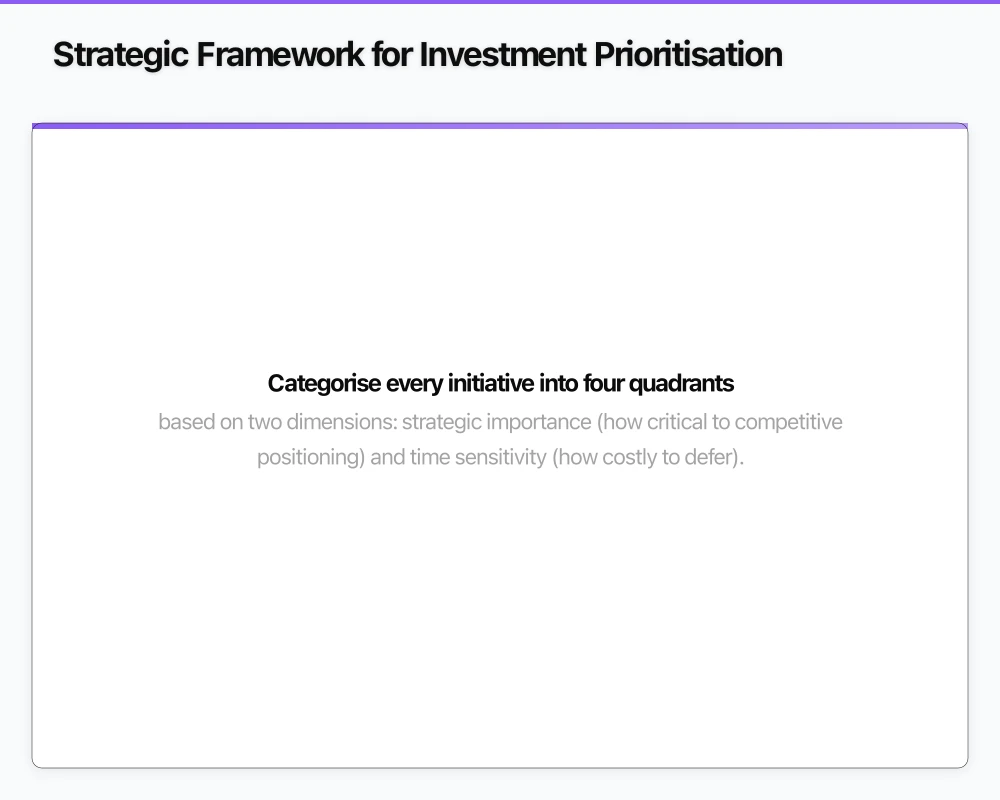
Categorise every initiative into four quadrants based on two dimensions: strategic importance (how critical to competitive positioning) and time sensitivity (how costly to defer).
Quadrant 1 — High strategic importance, high time sensitivity: fund fully. These are the initiatives where delay creates competitive damage. Examples: security remediation for critical vulnerabilities, platform stability for revenue-generating systems, compliance requirements with regulatory deadlines.
Quadrant 2 — High strategic importance, low time sensitivity: fund at reduced pace. These are the initiatives that matter strategically but can be extended without competitive damage. Examples: platform modernisation, new product capabilities with flexible timelines, infrastructure migration. Slow the pace rather than cancel.
Quadrant 3 — Low strategic importance, high time sensitivity: evaluate critically. These initiatives feel urgent but do not create competitive advantage. Examples: internal tool improvements, process changes with deadline pressure, vendor-driven upgrade cycles. Question whether the urgency is genuine and whether the initiative is truly necessary.
Quadrant 4 — Low strategic importance, low time sensitivity: defer or cancel. These initiatives are neither strategically important nor time-sensitive. Examples: technology explorations without clear business application, nice-to-have improvements, speculative projects. Defer without guilt.
This categorisation should be a collaborative exercise involving the CTO, product leadership, and business stakeholders. Technology leadership alone cannot determine strategic importance — that requires business context. Business leadership alone cannot assess time sensitivity for technical initiatives — that requires technology context.
Communicating Technology Strategy During Uncertainty
The CTO’s communication role becomes more critical during economic uncertainty. Engineering teams are anxious about layoffs, uncertain about priorities, and potentially demoralised by cancelled projects. Business stakeholders are pressuring for cost reduction while expecting continued delivery. Board members want assurance that technology investments are prudent.
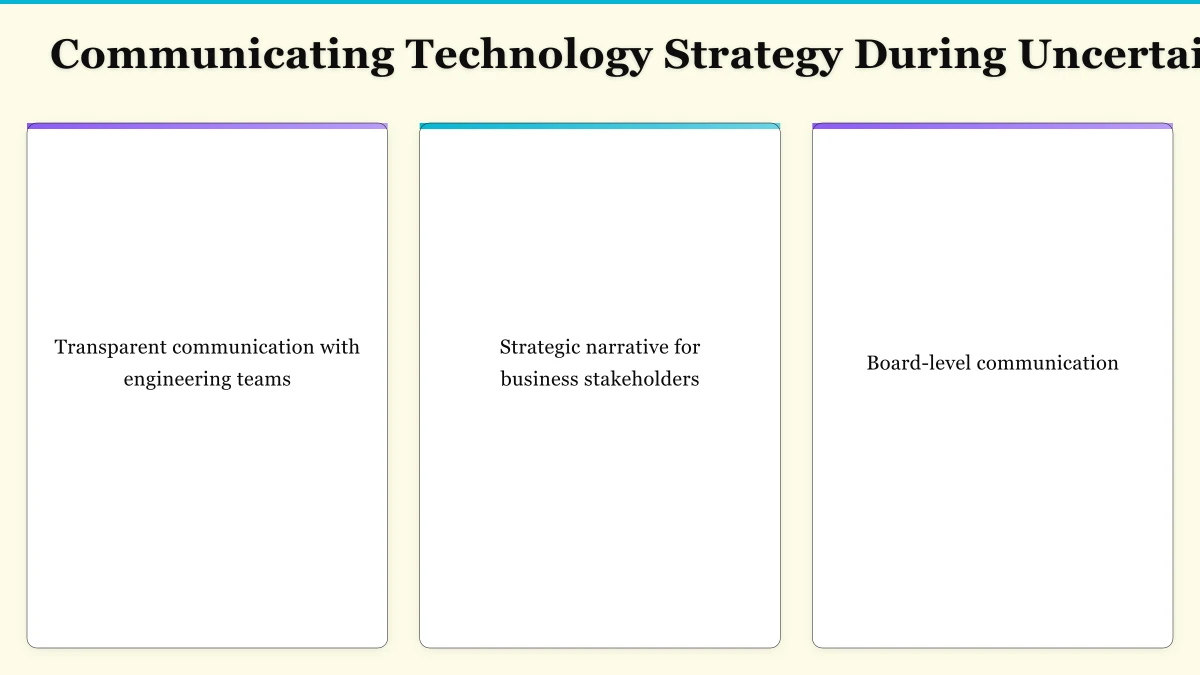
Transparent communication with engineering teams about the economic situation, the organisation’s response, and what it means for technology priorities builds trust and reduces the corrosive effects of uncertainty. Engineers who understand the strategic rationale behind prioritisation decisions are more likely to support them than engineers who perceive arbitrary cost-cutting.
Strategic narrative for business stakeholders should frame technology cost optimisation as efficiency improvement, not capability reduction. Emphasise the initiatives that are being maintained and their connection to business outcomes, not just the costs being reduced. Position technology as an investment in competitive advantage, not just an expense to minimise.
Board-level communication should articulate the technology strategy in business terms: how technology investments protect revenue, reduce risk, and position the organisation for recovery. The CTO who communicates technology strategy as business strategy — not as a list of projects and tools — earns the board’s confidence to maintain strategic investment.
Conclusion
Economic uncertainty is a test of strategic discipline. The CTOs who respond with thoughtful prioritisation — optimising costs where waste exists, protecting investments that create competitive advantage, and communicating strategy clearly to all stakeholders — will emerge from the downturn with stronger, more efficient technology organisations.
The organisations that cut indiscriminately will face years of rebuilding: rehiring dismantled teams, restarting cancelled initiatives, and remediating the technical debt that accumulated during the austerity period. The organisations that invest strategically — maintaining core capabilities, reducing technical debt, and building efficiency — will be positioned to accelerate when conditions improve.
The next twelve months will likely be challenging for enterprise technology organisations. The CTOs who navigate this period with strategic clarity will define the competitive positioning of their organisations for years to come.
If this strategic perspective has you thinking about your online presence, Cosmos Web Tech provides actionable web design and SEO guidance.
Ganda Tech Services is my technology consultancy, bringing together cloud infrastructure, web development, and mobile expertise for Australian businesses.
About the Author
Ashish Ganda is the founder of Ganda Tech Services, a Sydney-based technology consultancy specialising in cloud infrastructure, web development, and mobile app solutions for Australian businesses.
AI Strategy Primer for Australian Business Leaders
A practical framework for AI adoption in 2026 — cut through the hype and start with what matters.