
The Role of Design Thinking in Digital Transformation Projects
Introduction
A global insurance company invested $45 million in a digital transformation project: modernizing their claims processing system. Eighteen months later, the platform launched with cutting-edge technology—blockchain for security, AI for automation, cloud infrastructure for scalability. Within three weeks, claim processing times had increased by 40%, customer complaints tripled, and adjusters threatened to quit.
What went wrong? The technology worked perfectly. The problem was nobody asked adjusters how they actually worked. Research from McKinsey’s digital transformation analysis shows 70% of digital transformations fail—and most failures stem not from technology but from misunderstanding user needs and workflows.
Design thinking offers a radically different approach. According to the Design Management Institute, design-led companies outperform the S&P 500 by 219% over 10 years—not because their technology is better, but because their solutions actually work for real humans in real contexts.
Stanford’s d.school research shows digital transformation projects using design thinking achieve 2.2x higher user adoption rates and 40% faster time-to-value than technology-first approaches. The difference: starting with human needs rather than technical capabilities.
What is Design Thinking?
Design thinking, pioneered at Stanford and popularized by IDEO, is a human-centered approach to innovation combining empathy, creativity, and rationality. Unlike traditional engineering approaches that start with technical specifications, design thinking starts with understanding the people who will use the solution.
The methodology rests on three core principles:
Human-Centricity: Solutions must work for actual humans in their actual contexts—not idealized users in perfect conditions. Research from Nielsen Norman Group shows that user-centered design reduces support costs by 35-50% and increases feature adoption by 60-75%.
Collaborative Problem-Solving: Cross-functional teams work together, combining diverse perspectives. Studies from MIT Sloan demonstrate that diverse design teams generate 3x more innovative solutions than homogeneous technical teams.
Experimental Iteration: Rapid prototyping and testing with users—failing fast and cheap rather than slow and expensive. IBM’s design thinking research shows iterative approaches reduce project risk by 40% while accelerating delivery by 30%.
The Five Phases
1. Empathize: Understanding Real User Contexts
Empathy goes beyond surveys and focus groups—it requires observing and engaging with users in their natural environments. Stanford d.school guidelines recommend:
Contextual observation: Watch users work without interference. What workarounds do they use? What causes frustration? Where do they struggle?
Deep interviews: Ask “why” repeatedly to uncover root motivations. Research methodology studies suggest 5-8 in-depth interviews per user segment reveal 85% of usability issues.
Immersion: Experience the user’s world firsthand. Procter & Gamble’s “Living It” program requires product managers to live with customers, experiencing products in context rather than labs.
GE Healthcare’s MRI redesign exemplifies this. Engineers visited hospitals and noticed children terrified of MRI machines. Rather than improving technical specifications, they redesigned the experience as an adventure—machines became pirate ships or spaceships. Patient satisfaction increased 90% without changing core technology.
2. Define: Articulating the Real Problem
Most digital transformation failures stem from solving the wrong problem brilliantly. Research from MIT Sloan shows that teams spending time defining problems correctly are 4x more likely to succeed.
The Define phase synthesizes research into actionable problem statements focusing on user needs, not technology. For example:
Bad problem statement: “We need to implement blockchain for supply chain tracking.” Good problem statement: “Warehouse managers need real-time visibility into shipment status to reduce emergency calls and customer complaints.”
IDEO’s problem framing methodology uses “How Might We” questions to reframe challenges as opportunities. This linguistic shift from “We must…” to “How might we…” opens possibility spaces rather than constraining solutions.
3. Ideate: Generating Diverse Solutions
Traditional IT projects move from requirements directly to implementation. Design thinking inserts an explicit creative phase generating dozens of potential solutions before selecting one.
Research from Stanford on creative problem-solving shows structured ideation produces 3-5x more viable options than unstructured brainstorming. Effective techniques include:
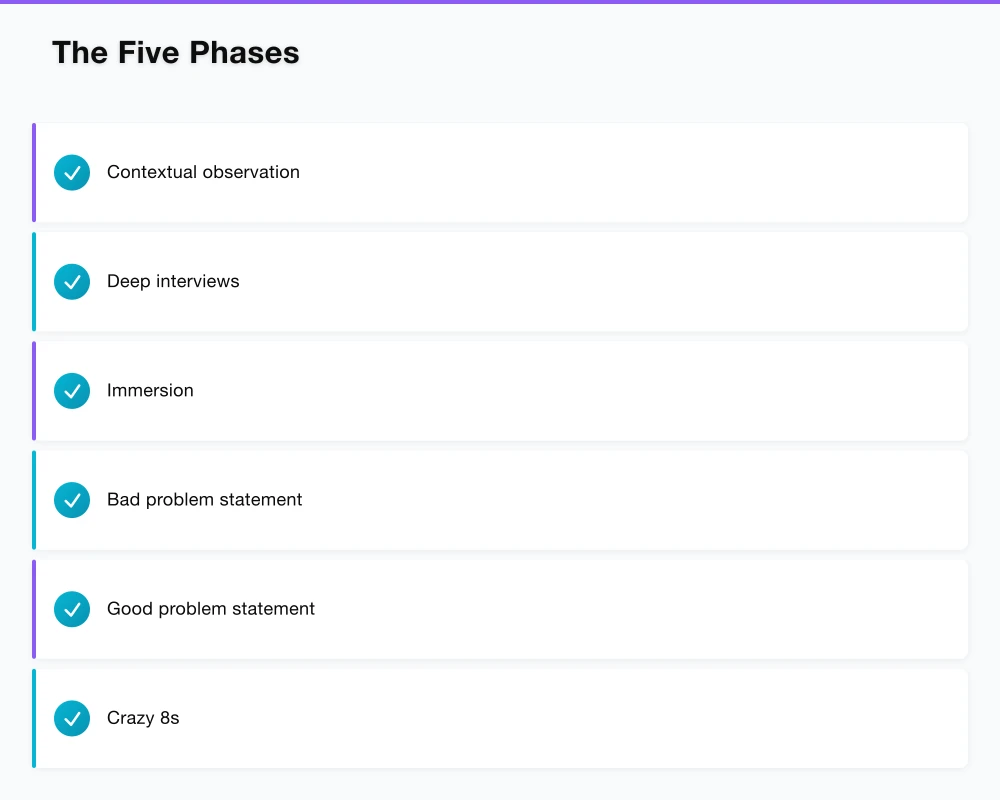
Crazy 8s: Each participant sketches 8 different solutions in 8 minutes—forcing rapid idea generation without over-thinking.
SCAMPER: Systematic prompts (Substitute, Combine, Adapt, Modify, Put to other use, Eliminate, Reverse) generate alternatives.
Cross-industry inspiration: Examining how other industries solve similar problems. Apple’s scroll wheel came from studying audio equipment, not computing.
Bank of America’s “Keep the Change” program emerged from observing people physically saving spare change in jars—then translating that behavior digitally. The program enrolled 12 million customers, proving simple ideas from user observation beat complex technical solutions.
4. Prototype: Making Ideas Tangible
Prototypes aren’t functional systems—they’re quick, cheap experiments testing specific hypotheses. IDEO’s prototyping principles emphasize “fail fast” with minimum investment.
Effective prototypes match fidelity to questions being answered:
Paper prototypes: Hand-drawn interfaces testing workflow and navigation. Cost: 30 minutes. Usability testing shows paper prototypes find 85% of major issues.
Clickable prototypes: Interactive mockups testing task completion. Tools like Figma or InVision enable same-day prototyping and user testing.
Wizard of Oz prototypes: Humans manually executing “automated” processes behind the scenes to test viability before building. Research from Carnegie Mellon shows this approach validates concepts 10x faster than actual development.
Zappos famously started with zero inventory—photographing shoes in stores, posting online, then buying and shipping when ordered. This prototype validated demand before investing in warehouses and inventory systems.
5. Test: Learning from Real Users
Testing isn’t validation—it’s learning. Stanford d.school research emphasizes testing to discover what you don’t know, not prove what you think you know.
Effective user testing methodology from Nielsen Norman Group recommends:
- 5 participants per round find 85% of usability issues
- Multiple small test rounds beat one large test
- Think-aloud protocols reveal mental models
- Task-based testing shows actual usage patterns
Each test round informs prototype iterations. Research from IBM shows projects with 3+ prototype-test cycles achieve 2.3x higher user satisfaction than single-cycle projects.
Why Design Thinking for Digital Transformation?
User Adoption: Building Solutions People Actually Use
Gartner’s digital transformation research found that 65% of digital initiatives fail due to poor user adoption, not technical problems. Design thinking directly addresses this.
Kaiser Permanente’s nurse shift change redesign illustrates the power. Traditional approach: optimize handoff forms for data completeness. Design thinking approach: observe shift changes, understand information nurses actually need, design solutions matching real workflows. Result: 50% fewer errors, 12% faster shifts, 95% nurse satisfaction—without new technology.
Innovation: Beyond Incremental Improvements
Technology-first transformation optimizes existing processes. Design thinking reimagines them entirely. Research from the Design Management Institute shows design-led companies achieve 41% higher revenue growth than industry averages.
Intuit’s TurboTax transformation exemplifies this. Rather than incrementally improving tax software, they asked: “What if filing taxes felt easy?” Design thinking sessions revealed users wanted guidance, not just forms. The redesigned experience guides users conversationally, increasing completion rates by 35% and customer satisfaction by 28%.
Risk Reduction: Failing Fast and Cheap
Traditional IT projects fail slowly and expensively—months of development before discovering users reject solutions. Research from the Standish Group shows 52% of IT projects require massive rework or fail entirely.
Design thinking inverts this: fail in prototyping (costing hours) rather than production (costing months). IBM’s research documents 40% reduction in project risk using design thinking—identifying fatal flaws before significant investment.
Alignment: Uniting Stakeholders Around Users
Digital transformation involves IT, business units, customers, and executives—groups with conflicting priorities. McKinsey research on transformation shows misalignment causes 45% of project failures.
Design thinking provides neutral ground: everyone aligns around user needs rather than defending departmental interests. Collaborative workshops force diverse perspectives to synthesize into shared understanding.
Practical Applications
Customer Journey Redesign: Mapping current experiences, identifying pain points, designing improvements. REI’s digital transformation used journey mapping to integrate online and in-store experiences, increasing customer lifetime value by 25%.
New Digital Product Development: Airbnb’s entire product philosophy centers on design thinking—understanding both host and guest needs, prototyping solutions, iterating based on feedback. This approach transformed struggling startup into $70 billion company.
Process Optimization: Hospitals using design thinking to redesign patient admission reduced wait times by 35% and paperwork by 50%—not through automation, but by understanding and eliminating unnecessary steps.
Employee Experience Improvement: Microsoft’s digital workplace transformation used design thinking to redesign internal tools, increasing employee satisfaction by 40% and productivity by 15%.
Integration with Agile
Design thinking and agile complement each other—design thinking explores “what to build,” agile executes “how to build it.” Research from Harvard Business Review shows integrated approaches deliver 30% faster time-to-market with 25% higher quality.
Discovery sprints: Design thinking identifies user needs and potential solutions before agile development begins. Google Ventures’ Design Sprint methodology compresses this into 5 days.
Continuous user feedback: Agile sprints include user testing, informing next sprint priorities. Spotify’s squad model embeds UX researchers in development teams for continuous insight.
Iterative refinement: Both methodologies embrace iteration—design thinking through prototype cycles, agile through sprint increments. SAFe framework explicitly integrates design thinking into agile at scale.
Success Factors
Research from MIT Sloan on design thinking implementation identifies critical success factors:
Executive support for experimentation: Leaders must accept that prototypes will fail—that’s their purpose. P&G’s former CEO required teams to show failed experiments, not just successes.
Cross-functional teams: Combining IT, business, design, and users. McKinsey analysis shows cross-functional teams deliver 35% faster than siloed approaches.
Time and space for creativity: Design thinking requires dedicated time, not squeezed between operational duties. IBM allocates 10-15% of project time to discovery and ideation.
User access and engagement: Direct user contact throughout, not filtered through proxies. Continuous user research maintains empathy and validates assumptions.
Willingness to iterate: Accepting that first solutions rarely optimize. Netflix tests 100+ variations before finalizing features—embracing iteration as strategy, not failure.
Conclusion
The insurance company from our introduction eventually pivoted. They brought in design thinking facilitators, interviewed adjusters, observed claim processing, prototyped alternatives, and tested with users. The reimagined system launched 8 months later. Claim processing times decreased 35%, adjuster satisfaction increased 60%, and customer complaints dropped 45%.
The technology in both versions was nearly identical. The difference: the second version solved problems adjusters actually had rather than problems engineers imagined they had.
Design thinking doesn’t replace technical expertise or agile methodology—it complements them by ensuring solutions address real user needs. Research consistently shows that design-led digital transformation delivers superior user adoption, innovation, and business outcomes.
The question for digital transformation isn’t whether to use design thinking—it’s whether you can afford not to. In a world where 70% of transformations fail, mostly due to ignoring user needs, human-centered design isn’t optional—it’s survival.
Sources
- McKinsey - Digital Transformation Success - 2024
- Design Management Institute - Design Value - 2023
- Stanford d.school - Design Thinking Resources - 2024
- IDEO - What is Design Thinking - 2024
- Nielsen Norman Group - Design Thinking Article - 2024
- MIT Sloan - Why Design Thinking Works - 2018
- IBM Design Thinking - 2024
- Harvard Business Review - Design Thinking - 2018
- Gartner - Digital Transformation - 2024
- Standish Group - Chaos Report - 2015
Learn more about innovation methodologies.
The digital strategies I discuss here often start with a strong website. Cosmos Web Tech publishes practical guides on web design and online marketing.
Ash Ganda is the founder of Ganda Tech Services, a Sydney-based technology consultancy delivering cloud, web, and mobile solutions for Australian businesses.
About the Author
Ashish Ganda is the founder of Ganda Tech Services, a Sydney-based technology consultancy specialising in cloud infrastructure, web development, and mobile app solutions for Australian businesses.
Digital Transformation Roadmap 2026
A 12-month framework for Australian SMBs ready to modernise — phases, tools, and milestones.
Almost done
Check your inbox and click the confirmation link to get your download.