Discover How Three Companies Successfully Navigated Digital Transformation and the Valuable Lessons They Offer
Introduction
In 2015, Target’s CEO faced a stark reality: online sales represented only 2.6% of revenue while Amazon captured 43% of US e-commerce. Five years later, Target’s digital sales grew 145% in 2020 alone, positioning them as a digital retail leader. This transformation didn’t happen by accident—it resulted from systematic strategy, sustained investment, and cultural change.
McKinsey research shows that 70% of digital transformations fail to achieve their objectives, yet the 30% that succeed generate average returns of 20-30% above industry benchmarks. Understanding what separates success from failure provides critical insights for organizations embarking on transformation journeys.
These three case studies—retail, manufacturing, and financial services—illustrate diverse transformation approaches while revealing common success factors. According to Boston Consulting Group, successful transformations share five characteristics: clear vision, customer focus, agile execution, talent development, and sustained leadership commitment.
Case Study 1: Target’s Digital Retail Transformation
The Challenge
Target faced existential threats in 2014-2015. Store traffic declined 3-5% annually as customers shifted online. Amazon’s 30%+ annual e-commerce growth captured market share. A 2013 data breach affecting 40 million customers damaged brand trust. Legacy systems couldn’t support omnichannel experiences customers demanded.
The Approach
Target invested $7 billion over 5 years (2017-2021) in digital transformation across three pillars:
Omnichannel Integration: Launched same-day services—Order Pickup (2017), Drive Up (2018), Same Day Delivery via Shipt (2018). These services leveraged 1,800+ stores as fulfillment centers, turning physical footprint into competitive advantage.
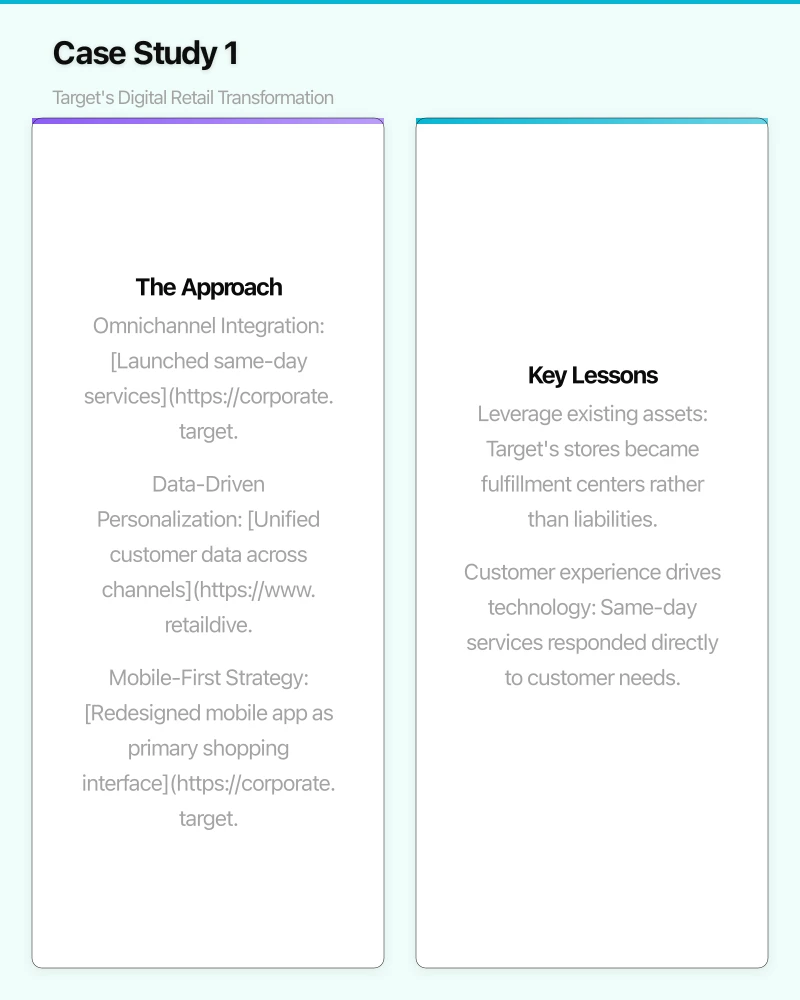
Data-Driven Personalization: Unified customer data across channels, enabling personalized recommendations, targeted promotions, and inventory optimization. Rebuilt technology stack for real-time analytics.
Mobile-First Strategy: Redesigned mobile app as primary shopping interface. Integrated in-store navigation, digital coupons, and Circle loyalty program. Mobile became 40%+ of digital sales.
Results
Digital sales grew from $3 billion (2016) to $18 billion (2021)—a 6× increase. Same-day services accounted for 95% of digital growth. Customer satisfaction improved 35 points. Comparable sales growth averaged 8%+ annually 2018-2021 vs. 2% industry average.
Key Lessons
Leverage existing assets: Target’s stores became fulfillment centers rather than liabilities. Customer experience drives technology: Same-day services responded directly to customer needs. Integration over replacement: Unified digital and physical rather than choosing one.
Case Study 2: Siemens Manufacturing Digitalization
The Challenge
Siemens faced aging industrial systems across 300+ factories globally. Maintenance costs consumed 12% of revenue. Production planning relied on manual processes. Industry 4.0 competitors threatened market position.
The Approach
Siemens invested €10 billion in industrial digitalization (2014-2020):
IoT Implementation: Deployed 50,000+ sensors across facilities tracking equipment performance, energy consumption, and production metrics. MindSphere platform aggregates 1 billion data points daily.
Predictive Maintenance: Machine learning models predict equipment failures 2-4 weeks in advance, enabling scheduled maintenance preventing costly downtime.
Process Automation: Automated 60% of production planning and scheduling, reducing planning cycles from weeks to days.
Results
Unplanned downtime reduced 30%. Maintenance costs decreased 20%. Overall equipment effectiveness improved from 72% to 88%. Energy consumption dropped 15% through optimization.
Key Lessons
Build on existing strengths: Leveraged deep manufacturing expertise rather than starting fresh. Phase implementation carefully: Piloted in single facilities before scaling globally. Measure continuously: ROI tracking justified ongoing investment.
Case Study 3: JPMorgan Chase Digital Banking Evolution
The Challenge
JPMorgan faced $200+ billion in fintech investments threatening traditional banking models. Regulatory complexity constrained innovation. Legacy systems blocked rapid product development—new products took 18+ months to market.
The Approach
JPMorgan invested $12 billion annually in technology (2017-2023):
API-Based Architecture: Migrated to microservices architecture enabling modular development. Built 300+ APIs for internal and partner integration.
Customer Journey Redesign: Applied design thinking to redesign banking experiences. Digital account opening reduced from 20 minutes to 5 minutes.
Agile Transformation: Trained 40,000+ employees in agile methodologies. Created 350+ agile squads owning end-to-end customer journeys.
Results
Mobile banking users grew to 50+ million. Digital product launches accelerated from 18 months to 2-3 months. Customer satisfaction scores improved 28 points. Operating efficiency improved 25% through automation.
Key Lessons
Architecture enables agility: Microservices unlocked rapid innovation. Customer experience first: Every change validated through user research. Culture change required: Agile training created shared language and practices.
Common Success Factors
Leadership Commitment: All three CEOs championed transformation personally, dedicating board time, resources, and political capital. Customer Focus: Every initiative tied directly to customer value rather than technology for its own sake. Agile Approach: Iterative progress with continuous learning rather than big-bang rollouts. Talent Development: Multi-year investments in reskilling existing workforce created internal capability.
Conclusion
Target, Siemens, and JPMorgan demonstrate that digital transformation succeeds when driven by clear strategy, customer focus, sustained investment, and cultural change. While contexts differ, the pattern repeats: understand customer needs, leverage existing assets, invest systematically, and commit for the long term.
The 70% failure rate reflects organizations treating transformation as technology implementation rather than business model evolution. Success requires reimagining how value is created and delivered—with technology as enabler, not endpoint.
Sources
- Target - Digital Transformation Timeline - 2020
- McKinsey - The New Digital Edge - 2023
- Siemens - Digitalization Case Studies - 2024
- JPMorgan - Technology Insights - 2024
- BCG - Digital Transformation Overview - 2024
- Retail Dive - Target Digital Transformation - 2024
- McKinsey - Capturing Industry 4.0 Value - 2023
- Harvard Business Review - Digital Transformation Leadership - 2019
Learn more about digital transformation best practices.
Case Study 2: Manufacturing Modernization
The Challenge
Aging systems and inefficient operations.
The Approach
- IoT implementation
- Predictive maintenance
- Process automation
Results
Reduced downtime and improved productivity.
Key Lessons
- Build on existing strengths
- Phase implementation carefully
- Measure results continuously
Case Study 3: Financial Services Innovation
The Challenge
Regulatory complexity and fintech competition.
The Approach
- API-based architecture
- Customer journey redesign
- Agile transformation
Results
Faster product launches and improved customer experience.
Key Lessons
- Embrace modular architecture
- Put customer experience first
- Develop agile capabilities
Common Success Factors
Leadership Commitment
Strong executive support for transformation.
Customer Focus
Every initiative tied to customer value.
Agile Approach
Iterative progress rather than big-bang changes.
Talent Development
Investing in skills for the digital future.
Conclusion
These success stories demonstrate that digital transformation is achievable with the right strategy, leadership, and execution.
Learn more about digital transformation best practices.
Strategy needs execution. Cloud Geeks publishes practical cloud computing and cybersecurity guides for Australian businesses ready to act.
As founder of Ganda Tech Services, I work with Australian businesses to align technology investments with business growth — across cloud, web, and mobile.
About the Author
Ashish Ganda is the founder of Ganda Tech Services, a Sydney-based technology consultancy specialising in cloud infrastructure, web development, and mobile app solutions for Australian businesses.
Digital Transformation Roadmap 2026
A 12-month framework for Australian SMBs ready to modernise — phases, tools, and milestones.