
The Lotus Blossom Method in Design Thinking
Introduction
A product team at Sony faced a creative block. They needed to reimagine the Walkman for the digital age, but brainstorming sessions kept circling back to obvious ideas: “Make it smaller,” “Add more storage,” “Improve battery life.” These incremental improvements wouldn’t create the revolutionary product they needed.
Then a facilitator introduced the Lotus Blossom method. Starting with “Portable Music Experience” at the center, the team expanded through eight dimensions: Technology, User Behavior, Social Context, Form Factor, Content Access, Listening Environment, Emotional Connection, and Business Model. Each dimension spawned eight more ideas. Within 90 minutes, they had 64 interconnected concepts. One combination—easy content access plus social sharing—evolved into the iPod and iTunes ecosystem that revolutionized the industry.
The Lotus Blossom method, developed by Japanese management consultant Yasuo Matsumura in the 1970s, provides structure to creative chaos. Unlike free-form brainstorming where ideas scatter randomly, it systematically explores problem spaces through expanding layers—like a lotus flower unfolding petal by petal.
Research on creative problem-solving from Stanford shows structured ideation techniques like Lotus Blossom generate 3-4x more diverse ideas than unstructured brainstorming—and more importantly, reveal 5x more unexpected connections between concepts where innovation often hides.
What is the Lotus Blossom Method?
The Lotus Blossom (also called Lotus Diagram or Renrakuzu) is a visual thinking technique that systematically expands from a central theme through multiple layers of related concepts. The method earned its name from resembling a lotus flower’s radial symmetry—petals spreading outward from the center.
The technique operates on four core principles:
Structured Divergence: Unlike chaotic brainstorming, Lotus Blossom provides a framework forcing exploration of multiple dimensions systematically. Studies on creative process show constraints actually enhance creativity by channeling rather than restricting thought.
Visual Organization: Ideas map spatially, making relationships visible. Research on visual thinking shows visual problem-solving improves comprehension by 400% and retention by 60% compared to text-only approaches.
Forced Association: The structure compels connecting seemingly unrelated concepts—where breakthrough innovations emerge. 3M’s Post-it Notes came from connecting weak adhesive (a “failed” product) with bookmark needs—an association forced by systematic exploration.
Scalable Depth: The method scales from 8 first-level ideas to 64 second-level ideas to 512 third-level ideas—providing whatever depth the problem demands.
How the Lotus Blossom Works
The Basic Structure: Layer One
Start with a 3x3 grid—9 cells arranged in rows and columns. The central cell contains your core problem or theme. The eight surrounding cells hold major dimensions or themes related to that central concept.
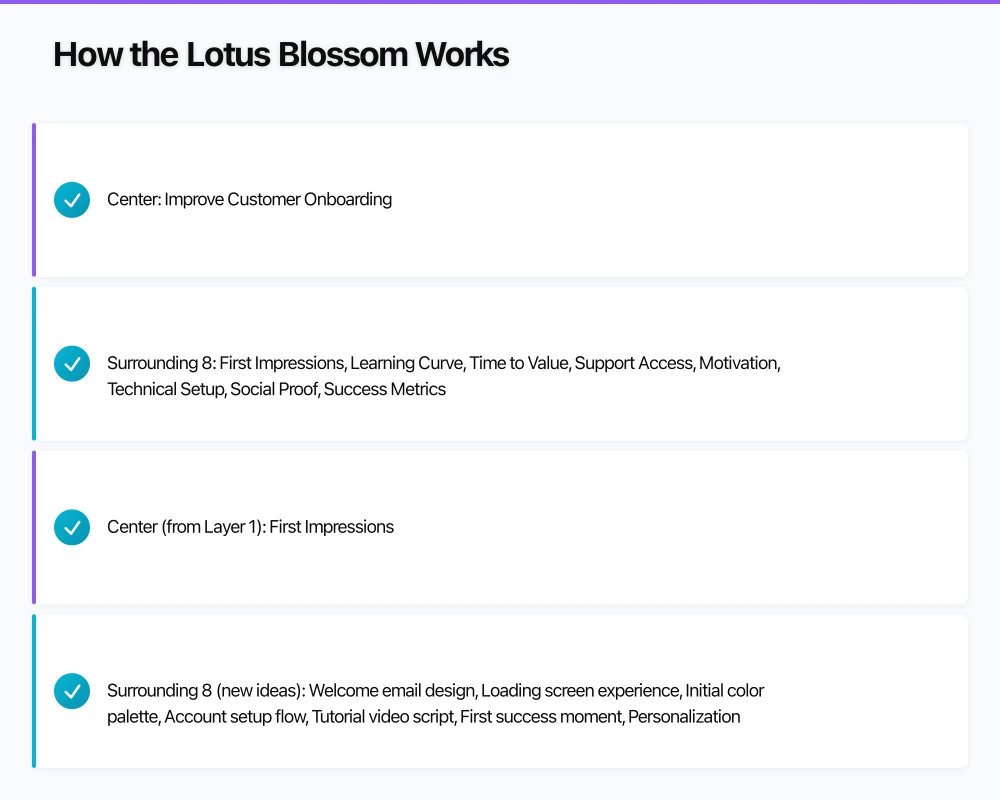
For example, if the core problem is “Improve Customer Onboarding”:
- Center: Improve Customer Onboarding
- Surrounding 8: First Impressions, Learning Curve, Time to Value, Support Access, Motivation, Technical Setup, Social Proof, Success Metrics
This first layer forces comprehensive problem exploration. Research on problem decomposition shows breaking complex challenges into 7-10 components improves solution quality by 45%.
Expansion: Layer Two
Each of the eight surrounding themes becomes the center of its own 3x3 grid. For “First Impressions”:
- Center (from Layer 1): First Impressions
- Surrounding 8 (new ideas): Welcome email design, Loading screen experience, Initial color palette, Account setup flow, Tutorial video script, First success moment, Personalization questions, Brand voice consistency
Repeat this for all eight themes from Layer 1. The result: 8 themes × 8 ideas = 64 total concepts, all systematically connected back to the original core problem.
Optional Layer Three
For complex problems, any Layer 2 idea can become the center of another 3x3 grid, generating 512 total concepts (8 × 8 × 8). Toyota’s product development process reportedly uses three-layer Lotus Blossom explorations for major innovations, ensuring exhaustive exploration before committing resources.
Step-by-Step Implementation
1. Define the Core Problem Precisely
The quality of outputs depends entirely on input clarity. Problem framing research from MIT shows well-defined problems are 80% of the solution.
Good core problem: “Reduce cart abandonment in checkout process” Poor core problem: “Fix website issues”
The good version provides direction while remaining open to diverse solutions. The poor version is too vague to guide useful exploration.
2. Identify Eight Related Dimensions
These shouldn’t be solution ideas yet—they’re themes or aspects of the problem. Effective dimension identification considers multiple perspectives:
- User-focused (experience, needs, pain points)
- Business-focused (revenue, costs, operations)
- Technical-focused (feasibility, integration, performance)
- Context-focused (environment, timing, circumstances)
Aim for diversity. If all eight dimensions are technical, you’ll miss user experience innovations. If all focus on features, you’ll miss business model opportunities.
Research on perspective-taking in problem-solving shows that deliberately adopting multiple viewpoints increases creative output by 50-70%.
3. Expand Each Theme with Eight Ideas
For each dimension from step 2, generate eight specific, concrete ideas. These should be:
- Actionable: “Implement one-click checkout” not “Make checkout easier”
- Specific: “Add progress indicator showing 3/5 steps complete” not “Show progress”
- Diverse: Don’t generate eight variations of the same concept
Fluency in ideation research shows quantity enables quality—64 ideas provide sufficient volume to include truly novel concepts alongside incremental improvements.
4. Analyze Patterns and Connections
With 64 ideas mapped visually, patterns emerge:
- Clusters: Multiple ideas addressing similar underlying needs suggest priority areas
- Gaps: Empty areas or weak themes indicate blind spots needing exploration
- Combinations: Ideas from different themes that could integrate powerfully
- Contradictions: Conflicting ideas revealing strategic choices requiring decision
Pattern recognition in creative problem-solving typically identifies 15-20% of ideas as truly novel, 60-70% as incremental improvements, and 10-15% as impractical—but the novel 15-20% justify the entire process.
5. Select, Combine, and Develop
Not all 64 ideas warrant implementation. Prioritization frameworks help identify high-impact concepts:
- Impact vs. Effort: Which ideas deliver maximum value for minimum investment?
- User Desirability: Which resonate most with target users?
- Strategic Alignment: Which advance organizational goals?
- Uniqueness: Which differentiate from competitors?
Often the most powerful solutions combine ideas from different dimensions. The iPod’s success came from combining hardware innovation (form factor) with business model innovation (iTunes store) with user experience innovation (scroll wheel)—connections visible through systematic exploration.
Benefits of the Lotus Blossom Approach
Comprehensive Exploration: The structure ensures systematic coverage rather than gravitating toward familiar territory. Cognitive bias research shows unstructured brainstorming suffers from anchoring bias—early ideas dominate. Lotus Blossom’s structure counteracts this.
Balance of Structure and Creativity: Provides enough framework to be productive while maintaining enough openness for creativity. Research comparing ideation methods shows structured techniques generate 40% more ideas than unstructured sessions while maintaining comparable creativity.
Visual Clarity: Spatial mapping makes relationships visible and memorable. Teams can reference specific areas (“Let’s explore the Social Proof cluster more”) rather than vague concepts.
Collaborative Engagement: The grid format naturally accommodates multiple participants simultaneously. Group creativity research shows parallel ideation (individuals working simultaneously) generates more and better ideas than sequential brainstorming.
Unexpected Connections: Cross-theme combinations often yield breakthrough innovations. Studies on combinatorial creativity show that most creative innovations combine existing concepts in novel ways rather than inventing entirely new concepts.
When to Use Lotus Blossom
Complex, Multi-Dimensional Problems: Strategic planning initiatives benefiting from comprehensive exploration. Example: “Develop 5-year growth strategy for expanding into new markets.”
New Product or Service Ideation: When incremental improvements won’t suffice and breakthrough thinking is needed. IDEO uses similar structured exploration in early discovery phases.
Process Redesign: When processes involve multiple stakeholders and dimensions. Toyota’s kaizen methodology incorporates Lotus Blossom thinking for process improvement.
Strategic Decision-Making: Exploring implications and options before committing to major directions. Scenario planning frameworks use similar structured expansion to explore strategic options.
Tips for Successful Implementation
1. Don’t Censor Ideas Initially: Research on creative ideation shows that evaluating ideas during generation reduces total output by 40% and eliminates 60% of novel concepts. Separate generation from evaluation.
2. Involve Diverse Perspectives: Studies on team diversity and creativity show cognitively diverse teams generate 45% more creative solutions than homogeneous teams. Include different functions, levels, backgrounds.
3. Look for Cross-Theme Connections: The intersections between dimensions often contain the most innovative ideas. Combinatorial innovation research shows that 85% of patents combine elements from different domains rather than advancing single domains.
4. Use Large Visual Space: Visual thinking research shows physical scale affects thinking. Use whiteboards, large paper, or digital tools that allow zooming out to see the entire diagram.
5. Time-Box Each Phase: Productivity research shows constraints improve focus. Allocate specific time (15-20 minutes per layer) preventing overthinking while ensuring thorough exploration.
Conclusion
The product team that used Lotus Blossom to reimagine portable music didn’t just generate 64 ideas—they systematically explored every dimension of the problem space. When they identified the connection between easy content access and social sharing, they weren’t lucky—they created conditions for discovery through structured exploration.
Research consistently shows that innovation isn’t about waiting for lightning-strike inspiration. It’s about systematically exploring possibility spaces, making unexpected connections visible, and combining concepts in novel ways. The Lotus Blossom method provides exactly that structure—turning creative exploration from unpredictable magic into reproducible process.
The next time your team faces a complex challenge and brainstorming circles familiar ground, try unfolding a lotus. You might discover that the breakthrough idea was always there—you just needed the right structure to see it.
Sources
- Stanford d.school - Design Thinking Resources - 2024
- Interaction Design Foundation - Lotus Blossom Technique - 2024
- Gamestorming - Lotus Blossom - 2023
- Design Thinking Methods - Lotus Blossom - 2024
- Nielsen Norman Group - Visual Thinking - 2024
- MIT Sloan - Problem Finding Problem Solving - 2021
- Fast Company - Walkman to iPod History - 2019
- IDEO U - Lotus Blossom Method - 2024
Explore more design thinking techniques.
For the practitioner’s view on mobile app development and app store success, explore Awesome Apps — where strategy meets the app store.
My consultancy Ganda Tech Services operates three specialist divisions covering cloud infrastructure, web development, and mobile apps for Australian businesses.
About the Author
Ashish Ganda is the founder of Ganda Tech Services, a Sydney-based technology consultancy specialising in cloud infrastructure, web development, and mobile app solutions for Australian businesses.
Digital Transformation Roadmap 2026
A 12-month framework for Australian SMBs ready to modernise — phases, tools, and milestones.