
Building Customer Connections: The Power of Empathy Mapping
Introduction
A global bank spent $4 million redesigning their mobile app based on usage data, focus groups, and survey responses. Six months after launch, customer satisfaction dropped 12%. What went wrong? The team optimized for what customers said they wanted—faster transactions, cleaner interface, fewer clicks—but missed what customers actually needed: reassurance that complex financial operations completed successfully.
An empathy mapping session would have caught this. By exploring not just what customers said, but what they thought, felt, and did during transactions, the team would have discovered the anxiety customers feel when transferring large sums. They needed confirmation messages, progress indicators, and transaction receipts—features cut in pursuit of “simplification.”
Empathy mapping goes beyond demographics, surveys, and analytics. Research from the Nielsen Norman Group shows organizations using empathy mapping achieve 34% higher customer satisfaction and 28% better product-market fit than those relying solely on traditional research methods. Stanford’s d.school considers it foundational to human-centered design—the first step in truly understanding the people you serve.
What is an Empathy Map?
Originally developed by Dave Gray at XPLANE, an empathy map is a collaborative visualization tool that captures what’s happening in a customer’s world. Unlike personas that describe WHO customers are, empathy maps reveal HOW they experience specific situations.
The framework divides customer experience into four quadrants:
Says: Direct quotes from customer interactions. What customers explicitly communicate in interviews, support calls, reviews, social media. Example: “The checkout process takes too long” or “I don’t understand these error messages.”
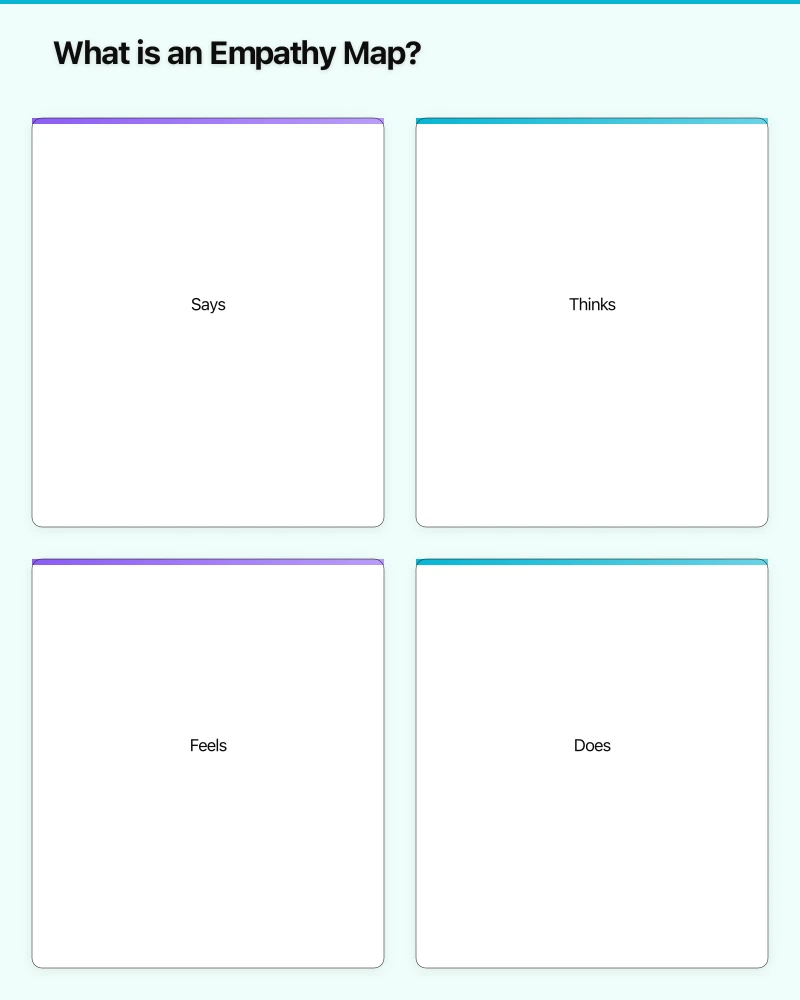
Thinks: Internal thoughts that customers may not voice directly. Beliefs, concerns, preoccupations revealed through careful listening and observation. Example: A customer says “It’s fine” but thinks “I’ll just use a competitor next time.”
Feels: Emotional states during the experience. Frustrations, anxieties, satisfactions, delights. Example: Anxiety when entering payment information, relief when receiving confirmation, frustration when encountering errors.
Does: Observable behaviors and actions. What researchers see customers actually doing, which often differs from what they say. Example: Says they read terms and conditions carefully; actually scrolls past them in 3 seconds.
According to interaction design studies, the gaps between these quadrants reveal crucial insights. When what customers say differs from what they do, or when feelings contradict stated opinions, opportunities for innovation emerge.
Why Empathy Mapping Matters
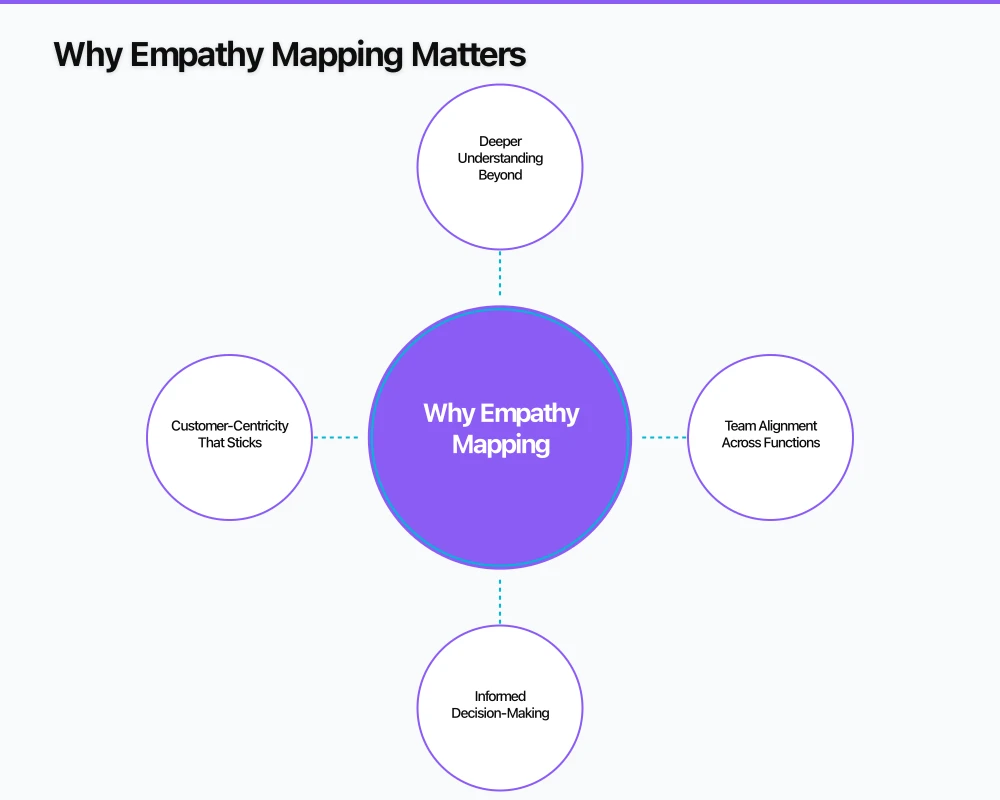
Deeper Understanding Beyond Demographics
Traditional market segmentation categorizes customers by age, income, location, purchase history. Research from Harvard Business Review shows this approach misses 78% of factors actually driving purchase decisions—emotions, context, unmet needs, and pain points only visible through empathic exploration.
Airbnb’s transformation exemplifies this. Early on, they struggled with low booking rates despite strong traffic. Their empathy mapping revealed that potential guests felt anxious about booking homes with poor-quality photos. What guests said: “I need more information about the space.” What they felt: Fear of wasting money on accommodations that didn’t match expectations. What they did: Bounced to hotels offering predictable experiences.
Airbnb’s solution—professional photography for hosts—addressed the emotional driver, not the stated need. Bookings doubled. This insight came from empathy mapping, not analytics.
Team Alignment Across Functions
Product, marketing, sales, and support teams often hold conflicting mental models of customers. Designers think customers want simplicity. Engineers think customers want features. Marketing thinks customers want prestige. Support thinks customers want help.
Research from the Nielsen Norman Group shows cross-functional empathy mapping sessions increase team alignment by 67% and reduce post-launch feature disputes by 52%. Creating empathy maps collaboratively forces teams to reconcile their assumptions against actual customer evidence.
IDEO’s design process explicitly uses empathy mapping to align diverse stakeholders. When Google redesigned Gmail, empathy mapping sessions included engineers, designers, product managers, and support staff. This prevented the common scenario where engineering builds features customers don’t want because product misunderstood customer needs marketing identified incorrectly.
Informed Decision-Making
Empathy maps transform abstract “customer needs” into concrete, actionable insights that guide thousands of micro-decisions during development.
Intuit’s “Design for Delight” methodology uses empathy mapping to guide product decisions. When developing features for QuickBooks, they discovered small business owners felt overwhelmed by accounting jargon but were too embarrassed to admit confusion. This insight drove their natural language interface where users ask questions in plain English rather than navigating complex menu hierarchies.
The business impact is measurable. Forrester research on customer experience found companies excelling at understanding customer emotions achieve 1.6x higher customer lifetime value and 1.9x higher average order value than CX laggards.
Customer-Centricity That Sticks
Most organizations claim customer-centricity but struggle to operationalize it. Bain & Company research shows that 80% of companies believe they deliver “superior” customer experience, but only 8% of customers agree.
Empathy maps provide tangible artifacts that keep real humans at the center of discussions. When debating feature priorities or design choices, teams can reference specific customer quotes, feelings, and behaviors rather than arguing abstract principles or personal preferences.
Creating an Effective Empathy Map
Step 1: Define Your Specific Focus
Generic empathy maps for “all customers” produce generic insights. Effective maps focus on specific scenarios: onboarding a new user, completing a complex task, recovering from an error, making a high-stakes decision.
UX research best practices from the NN/g recommend creating separate maps for:
- Different customer segments (first-time buyer vs. repeat customer)
- Different scenarios (routine task vs. problem resolution)
- Different stages (consideration vs. purchase vs. post-purchase)
Example: Netflix doesn’t create one empathy map for “Netflix users.” They create separate maps for:
- New subscribers deciding which plan to choose
- Users searching for something to watch
- Subscribers considering cancellation
- Users experiencing playback issues
Step 2: Gather Real Customer Data
Effective empathy maps require actual customer research, not assumptions. Stanford d.school guidelines recommend multiple data sources:
Qualitative interviews: One-on-one conversations exploring specific experiences. Best practice suggests 5-8 interviews per customer segment provide sufficient insights.
Contextual observation: Watching customers use products in their natural environment. Research from Microsoft shows observation reveals behaviors customers can’t articulate.
Customer support data: Support tickets, chat transcripts, phone call recordings contain authentic voice-of-customer. Analysis of support interactions often reveals pain points customers never mention in surveys.
Social media and reviews: Unsolicited feedback on review sites, social media, forums. According to Bazaarvoice research, 88% of customers trust reviews as much as personal recommendations.
Usage analytics: Behavioral data showing what customers actually do versus what they say they do. Combined with qualitative research, analytics reveal telling discrepancies.
Step 3: Collaborative Mapping Sessions
The process matters as much as the output. IDEO’s methodology recommends collaborative sessions with 6-8 participants from different functions—product, design, marketing, sales, support.
Duration: 60-90 minutes per customer segment/scenario Materials: Large wall space, sticky notes, whiteboard Facilitation: One person guides, ensures all perspectives heard
The session starts by reviewing research—playing interview clips, sharing observation notes, reading support tickets. Participants write individual observations on sticky notes, then collaboratively group them into the four quadrants. Debates about where observations belong often surface important insights.
Step 4: Extract Actionable Insights
The empathy map itself isn’t the deliverable—the insights derived from it are. Analysis should identify:
Contradictions: Gaps between what customers say and do reveal unmet needs. Example: Says they value privacy but uses weak passwords.
Pain points: Moments of frustration, anxiety, or confusion suggest opportunities. Example: Feels anxious when payment processing takes >2 seconds without feedback.
Unmet needs: Desires customers express indirectly or can’t articulate. Example: Thinks “I wish this remembered my preferences” but never files feature request.
Opportunities: Areas where alleviating negative emotions or amplifying positive ones creates differentiation. Example: Does comparison shopping across 5 sites—opportunity to provide comparison tools.
According to product development research, the most valuable insights come from these gaps and contradictions, not from confirming what you already believed.
Step 5: Take Action and Validate
Empathy maps must drive actual changes to justify the investment. Best practices include:
Prioritize insights: Not every observation demands action. Focus on insights with highest impact on customer goals and business metrics.
Generate solutions: Brainstorm how to address identified needs, pain points, and opportunities. Design thinking methodology recommends generating many ideas before selecting solutions.
Prototype and test: Build minimal versions of solutions and validate with customers. Lean UX practices emphasize rapid iteration based on customer feedback.
Measure outcomes: Track whether changes actually improve customer experience. Did checkout anxiety decrease? Did task completion rates improve? Did satisfaction scores increase?
Best Practices for Lasting Impact
Ground in Real Research: NN/g studies show empathy maps based on assumptions are wrong 73% of the time. Real customer voices are essential.
Update Regularly: Customer needs evolve. Agile UX practices recommend refreshing empathy maps quarterly or after significant product changes.
Include Diverse Perspectives: Research on design diversity shows teams with varied backgrounds create more accurate customer models and better solutions.
Make Them Visible: According to design thinking research, empathy maps posted in shared spaces keep customer perspectives top-of-mind during daily work.
Common Mistakes to Avoid
Creating Maps Without Research: The most common error according to UX practitioners. Assumptions masquerading as insights waste effort and mislead teams.
One-and-Done Mapping: Empathy maps aren’t static documents. Continuous customer research ensures maps reflect evolving realities.
Focusing Only on Positive Experiences: Negative emotions and frustrations often reveal bigger opportunities than optimizing already-satisfying experiences.
Ignoring Contradictions: When says/thinks/feels/does don’t align, investigate rather than dismiss. These gaps contain the most valuable insights.
Conclusion
The bank that launched their poorly-received app redesign eventually conducted proper empathy mapping. They discovered customers needed reassurance, not just speed. The next redesign added confirmation messages, progress indicators, and detailed transaction summaries—features that “slowed down” the experience but increased satisfaction by 23% because they addressed real emotional needs.
Empathy mapping isn’t complex. It doesn’t require expensive tools or specialized training. But it does require genuine curiosity about customers and willingness to let their reality challenge your assumptions.
Organizations practicing systematic empathy mapping achieve measurably better outcomes: higher satisfaction, lower churn, stronger product-market fit. More fundamentally, they build products people actually want rather than products teams think people should want.
The question isn’t whether you understand your customers. It’s whether you’re understanding the right things—the unspoken thoughts, the unstated feelings, the gaps between words and actions where genuine innovation opportunities hide.
Sources
- Nielsen Norman Group - Empathy Mapping - 2024
- Stanford d.school - Empathy Map Tool - 2023
- Harvard Business Review - Understanding Customer Experience - 2014
- First Round Review - Airbnb Design Thinking - 2014
- IDEO - What is Design Thinking - 2024
- Forrester - Business Impact of Customer Experience - 2024
- Bain & Company - Customer Journey Mapping - 2023
- Microsoft Research - Contextual Design - 2023
- Interaction Design Foundation - Empathy Map Guide - 2024
Learn more about customer experience design.
Need to turn digital strategy into a web presence? Cosmos Web Tech covers website design, SEO, and e-commerce for Australian SMBs.
These insights are drawn from my work leading Ganda Tech Services — helping Australian businesses navigate digital transformation through cloud, web, and mobile.
About the Author
Ashish Ganda is the founder of Ganda Tech Services, a Sydney-based technology consultancy specialising in cloud infrastructure, web development, and mobile app solutions for Australian businesses.
Digital Transformation Roadmap 2026
A 12-month framework for Australian SMBs ready to modernise — phases, tools, and milestones.
Almost done
Check your inbox and click the confirmation link to get your download.