The Future of Enterprise Collaboration Platforms
The pandemic-driven shift to remote and hybrid work accelerated enterprise collaboration platform adoption by years. Microsoft Teams grew from 75 million daily active users in April 2020 to over 270 million by early 2022. Slack, Zoom, and Google Workspace experienced similar trajectories. But as the urgency of “make remote work possible” subsides, a more strategic question emerges: what should enterprise collaboration look like, and how should CTOs invest in the collaboration technology stack?
The first generation of pandemic-era collaboration was reactive — organisations deployed the tools that kept people connected. The next generation must be intentional — designing collaboration experiences that improve productivity, preserve institutional knowledge, and support the hybrid work models that most organisations are adopting.
Beyond Messaging: The Integrated Digital Workspace
The dominant collaboration platforms — Teams, Slack, and Google Workspace — started as messaging and video conferencing tools but are rapidly evolving into integrated digital workspaces that encompass communication, document collaboration, project management, workflow automation, and knowledge management.
This expansion creates both opportunity and risk for enterprise CTOs.
The opportunity is platform consolidation. Rather than maintaining separate tools for messaging, video conferencing, document management, project tracking, and workflow automation, organisations can consolidate onto a single platform ecosystem. This reduces licensing costs, simplifies administration, and creates a more cohesive user experience.
The risk is platform dependency. Consolidating onto a single vendor’s ecosystem creates deep lock-in that constrains future choices. Microsoft’s strategy of bundling Teams with Microsoft 365, integrating it with Power Platform, and positioning it as the front end for Dynamics 365 creates a gravitational pull toward the Microsoft ecosystem that is difficult to reverse. This bundling has drawn regulatory scrutiny — the European Commission is investigating Microsoft’s Teams bundling practices.
For CTOs, the strategic decision is not which platform to adopt but how deeply to integrate. A shallow adoption — using Teams or Slack for messaging and video while maintaining independent tools for other functions — preserves flexibility. A deep adoption — using the platform’s integrated capabilities for document management, automation, and knowledge management — delivers efficiency at the cost of portability.
Asynchronous Communication as a Strategic Capability
The shift to hybrid work has elevated the importance of asynchronous communication. When teams span time zones and schedules, real-time communication (meetings, instant messages) creates coordination overhead that scales poorly. Asynchronous communication — well-structured written messages, recorded video updates, threaded discussions — enables collaboration across time boundaries.
This shift has practical implications for collaboration architecture:
Searchable Knowledge Bases: Conversations in chat channels are ephemeral by nature — important information scrolls past and becomes unfindable within days. Enterprise collaboration must include mechanisms to capture decisions, insights, and knowledge from conversations into persistent, searchable repositories. Notion, Confluence, and emerging tools like Coda and Slite provide this capability, but the integration between conversation and knowledge management remains immature.
Structured Channels and Spaces: The tendency for collaboration platforms to devolve into noise — hundreds of channels with overlapping purposes, cross-posted messages, and notification fatigue — undermines their value. Intentional channel architecture that aligns with organisational structure and communication patterns reduces noise and improves signal.
Video Messaging: Loom, Vimeo, and features within Teams and Slack enable asynchronous video messages that convey nuance and context more effectively than text. For complex topics, status updates, and demonstrations, recorded video provides richer communication without requiring schedule coordination.
Workflow Automation Within Collaboration
The most strategically significant evolution in collaboration platforms is the integration of workflow automation. Microsoft’s Power Platform (Power Automate, Power Apps, Power BI) integrates directly with Teams. Slack’s Workflow Builder and growing app ecosystem enable automated processes within the collaboration platform. Google’s AppSheet provides similar capabilities within Google Workspace.
This convergence of collaboration and automation creates new architectural patterns:
Conversational Workflows: Business processes triggered and managed through chat interactions. An employee requests time off by messaging a bot in Slack; the bot routes the approval to the manager, collects the response, and updates the HR system. This pattern is natural for simple, frequent workflows that benefit from the low friction of conversational interaction.
Notification and Escalation Hubs: The collaboration platform serves as the primary interface for alerts from monitoring systems, approval requests from business applications, and status updates from automated processes. Rather than checking multiple systems, users receive and act on information within the platform they already use.
Low-Code Application Hosting: Platforms like Power Apps and AppSheet enable business users to build simple applications that run within the collaboration platform. A project status tracker, an equipment reservation system, or an expense approval workflow can be built and deployed within the platform without involving the engineering team.
For CTOs, this trend raises important governance questions. Low-code tools democratise application development but can create ungoverned shadow IT — business-critical processes running on tools built by non-engineers without security review, testing, or operational monitoring. The governance framework must enable innovation while maintaining appropriate oversight.
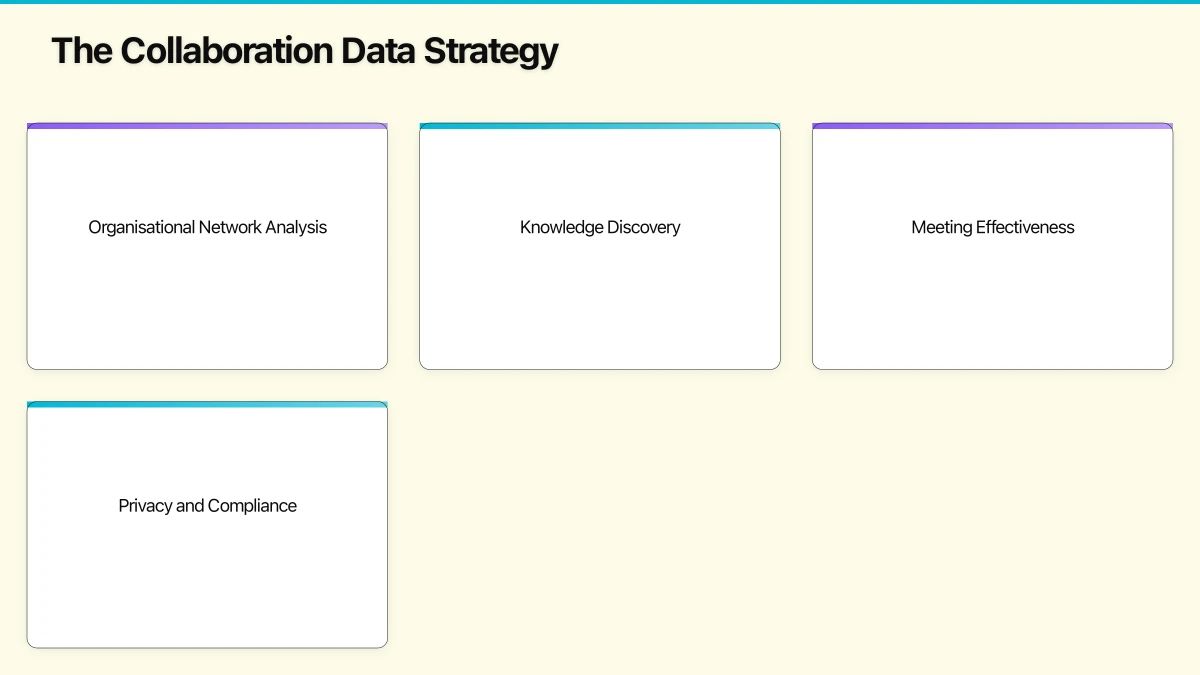
The Collaboration Data Strategy
Enterprise collaboration platforms generate enormous volumes of data: messages, documents, meeting recordings, workflow executions, and interaction patterns. This data has strategic value that most organisations have not yet explored.
Organisational Network Analysis: Communication patterns reveal the actual organisational network — who collaborates with whom, which teams are well-connected, and which are isolated. This data informs organisational design, identifies collaboration bottlenecks, and measures the effectiveness of cross-functional initiatives.
Knowledge Discovery: The institutional knowledge embedded in collaboration data — decisions made in channels, context shared in documents, expertise revealed in discussions — is valuable if it can be surfaced. Enterprise search that spans collaboration platforms, documents, and knowledge bases enables employees to find information regardless of where it was created.
Meeting Effectiveness: Meeting data — frequency, duration, participant count, and overlap — provides insight into how organisations spend their most expensive resource: people’s time. Analysis often reveals that meetings consume a disproportionate share of knowledge workers’ time, suggesting opportunities for process improvement.
Privacy and Compliance: The data generated by collaboration platforms is subject to privacy regulations, employment law, and industry-specific compliance requirements. CTOs must ensure that collaboration data is managed with appropriate retention policies, access controls, and compliance monitoring. The temptation to analyse collaboration data extensively must be balanced against employee privacy expectations and legal constraints.
Enterprise collaboration is evolving from a communication utility to a strategic platform that shapes how organisations work, learn, and innovate. The CTO who approaches collaboration strategically — making deliberate platform choices, investing in asynchronous capability, governing low-code development, and leveraging collaboration data responsibly — positions the organisation for the hybrid work future that is now the permanent reality.
Strategy without a web presence is invisible. Cosmos Web Tech publishes practical guides on building websites that attract and convert Australian customers.
As founder of Ganda Tech Services, I work with Australian businesses to align technology investments with business growth — across cloud, web, and mobile.
About the Author
Ashish Ganda is the founder of Ganda Tech Services, a Sydney-based technology consultancy specialising in cloud infrastructure, web development, and mobile app solutions for Australian businesses.
Digital Transformation Roadmap 2026
A 12-month framework for Australian SMBs ready to modernise — phases, tools, and milestones.