API Strategy for Enterprise: GraphQL vs REST vs gRPC in 2024
The API architecture decisions your organization makes today will shape competitive advantage for the next five to seven years. As enterprise systems evolve from monolithic architectures to distributed microservices, CTOs face a critical inflection point: REST’s dominance is being challenged by GraphQL’s flexibility and gRPC’s performance, yet each paradigm serves fundamentally different architectural needs.
The stakes are substantial. Gartner reports that 65% of enterprise API initiatives fail to meet their ROI targets due to architectural misalignment, while organizations that strategically match API protocols to use cases achieve 3.2x faster time-to-market for new features. The question isn’t which protocol is “best”—it’s which combination optimally serves your specific enterprise requirements.
The Strategic Context: Why API Architecture Matters Now
Enterprise API strategies have reached an inflection point driven by three converging forces. First, the proliferation of client experiences—mobile apps, IoT devices, partner integrations, and AI agents—demands more flexible data delivery mechanisms. Second, microservices adoption has exploded; Forrester’s Q1 2024 research shows 78% of enterprises now operate distributed architectures with 50+ services. Third, real-time data requirements have intensified as customer expectations shift from eventual consistency to sub-second responsiveness.
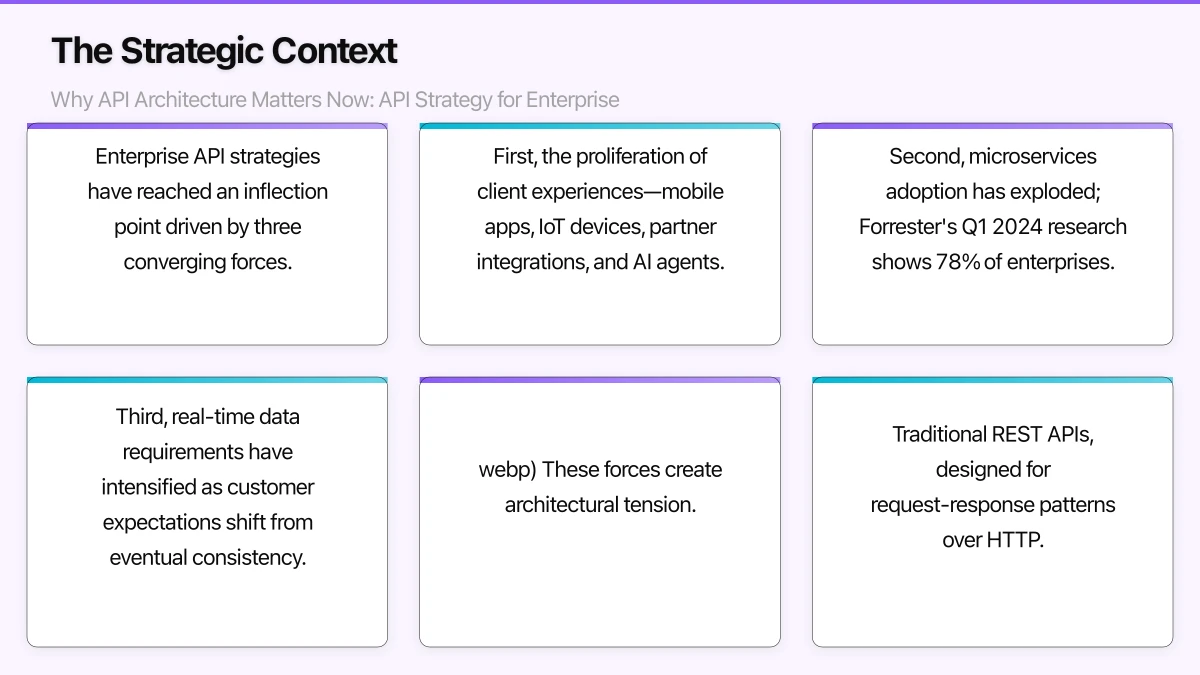
These forces create architectural tension. Traditional REST APIs, designed for request-response patterns over HTTP, struggle with chatty client-server communication when mobile apps require data from a dozen microservices to render a single screen. GraphQL emerged to solve this over-fetching problem but introduces complexity in caching, security, and rate limiting. Meanwhile, gRPC’s binary protocol and HTTP/2 multiplexing deliver microsecond-level performance for service-to-service communication but lack browser support and developer familiarity.
The enterprise architecture challenge is compounded by legacy constraints. Most organizations cannot simply rip-and-replace existing REST APIs serving production traffic. Instead, CTOs must architect hybrid approaches that introduce GraphQL or gRPC selectively while maintaining backward compatibility. Stripe, for example, operates all three protocols simultaneously: REST for public APIs maintaining 99.99% uptime commitments, GraphQL for their dashboard reducing bandwidth by 40%, and gRPC for internal payment processing handling 10,000+ requests per second.
REST: The Established Foundation
REST remains the enterprise standard for public-facing APIs, third-party integrations, and any interface requiring broad compatibility. Its HTTP-based nature means universal tooling support—every programming language, API gateway, and monitoring platform understands REST natively. The stateless request-response model aligns perfectly with HTTP caching, enabling CDNs like Cloudflare and Fastly to cache responses at edge locations for sub-100ms global latency.
Enterprise REST implementations have matured significantly. OpenAPI 3.1 specifications enable design-first development where API contracts drive code generation, reducing contract-drift bugs by 60% according to Postman’s 2024 State of the API report. Tools like Stoplight and Apigee provide visual designers that generate both documentation and mock servers, accelerating partner onboarding from weeks to days.
However, REST’s limitations become pronounced at scale. Mobile applications frequently require data from multiple endpoints, resulting in waterfall request patterns that inflate latency. Netflix famously addressed this with their Backend for Frontend (BFF) pattern, where dedicated REST endpoints aggregate data from microservices specifically for each client platform. This approach works but requires maintaining separate BFF services for iOS, Android, web, and TV platforms—significant operational overhead.
The REST versioning challenge also intensifies in distributed systems. When a data model changes, you must either version the API (creating /v2/customers alongside /v1/customers) or maintain field-level backward compatibility indefinitely. Companies like Salesforce manage 50+ API versions simultaneously, each requiring testing and security patches. The operational burden is substantial.
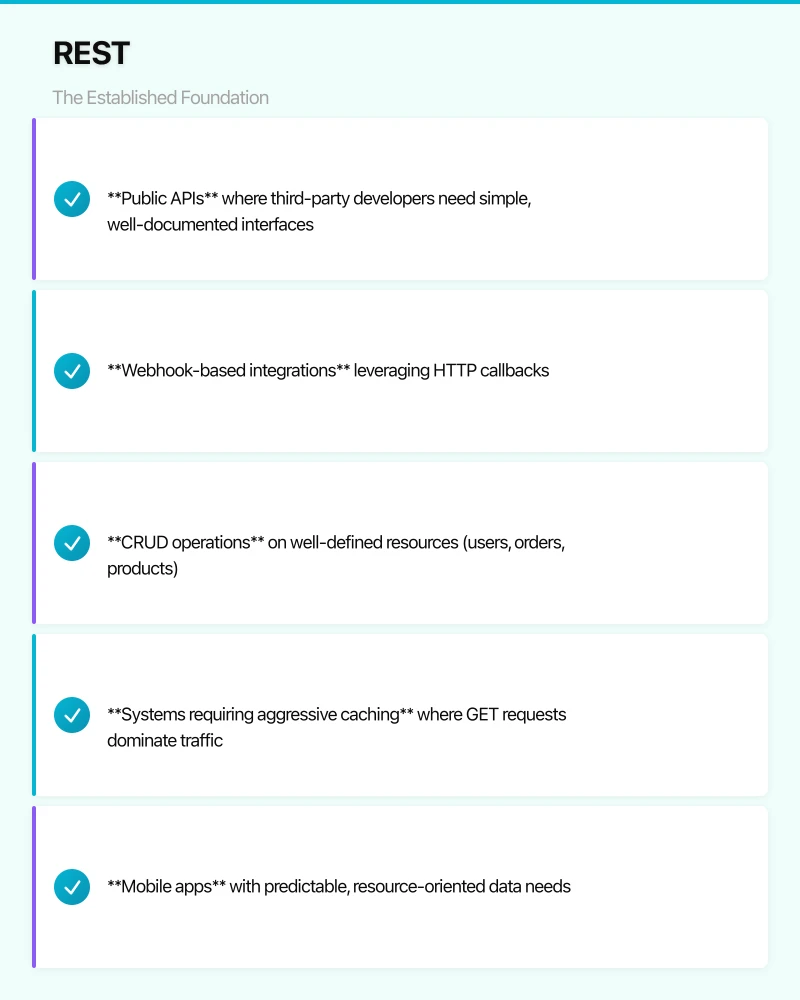
For enterprise use cases, REST excels in:
- Public APIs where third-party developers need simple, well-documented interfaces
- Webhook-based integrations leveraging HTTP callbacks
- CRUD operations on well-defined resources (users, orders, products)
- Systems requiring aggressive caching where GET requests dominate traffic
- Mobile apps with predictable, resource-oriented data needs
GraphQL: Flexibility for Complex Client Requirements
GraphQL fundamentally reimagines the client-server contract by shifting query control to the client. Instead of rigid endpoints returning fixed data shapes, clients specify exactly what fields they need through declarative queries. This eliminates over-fetching (receiving unnecessary data) and under-fetching (requiring multiple round-trips), reducing mobile bandwidth consumption by 30-50% in typical implementations.
The developer experience advantages are compelling. Frontend teams gain autonomy to iterate on UI without waiting for backend API changes. At GitHub, GraphQL v4 API adoption reduced their mobile app’s API calls by 60% while simultaneously decreasing backend load—fewer requests, less data transfer, better performance for both parties. The strongly-typed schema provides IDE autocomplete and compile-time validation, catching integration bugs before deployment.
Enterprise GraphQL implementations require sophisticated infrastructure. Unlike REST where each endpoint has predictable computational cost, GraphQL queries can arbitrarily combine fields and nested relationships, creating the “N+1 query problem” where a single client query triggers hundreds of database queries. Solutions like DataLoader (batching) and query complexity analysis (rate limiting) are essential. Apollo Federation enables multiple teams to contribute types to a unified graph, critical for enterprises with dozens of microservice owners.
Security and governance present new challenges. Traditional API gateways apply rate limits and authentication per endpoint, but GraphQL exposes a single endpoint with infinite query variations. Tools like GraphQL Shield enable field-level authorization, but require careful schema design. Companies like Shopify publish query cost algorithms where each field has a cost value, and client queries are limited by total cost rather than request count—a more sophisticated but necessary approach.
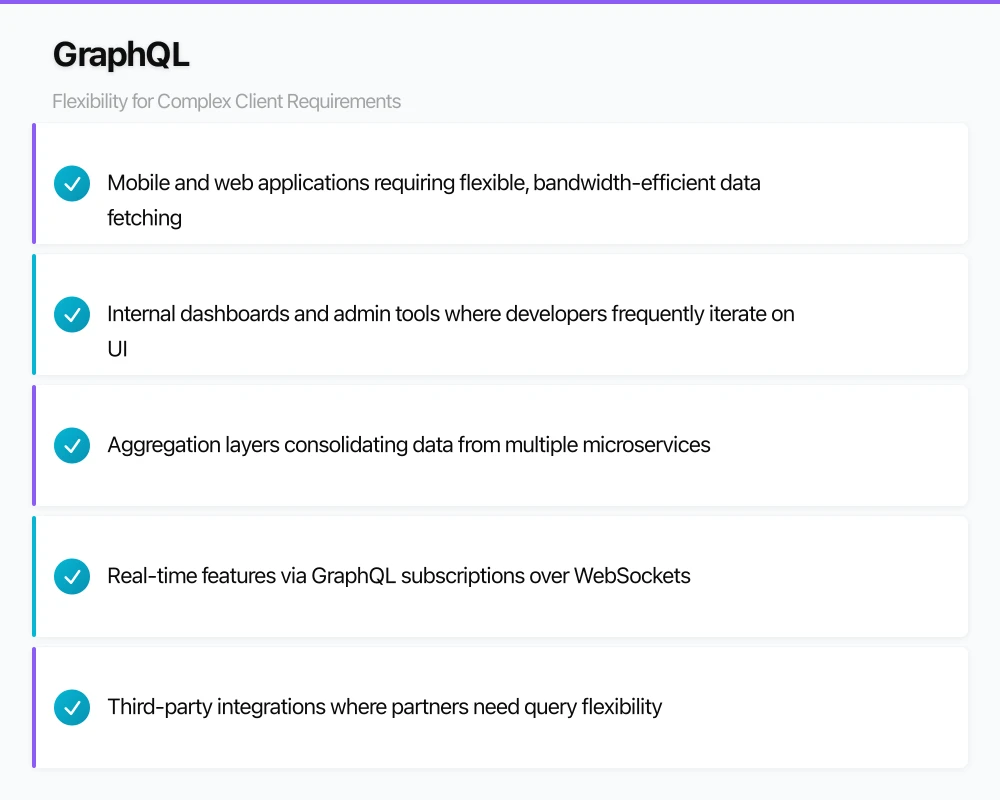
GraphQL’s sweet spot in enterprise architecture:
- Mobile and web applications requiring flexible, bandwidth-efficient data fetching
- Internal dashboards and admin tools where developers frequently iterate on UI
- Aggregation layers consolidating data from multiple microservices
- Real-time features via GraphQL subscriptions over WebSockets
- Third-party integrations where partners need query flexibility
The migration path typically starts with a GraphQL gateway layer that wraps existing REST microservices. AWS AppSync, Hasura, and Apollo Server can generate GraphQL schemas from REST endpoints, enabling incremental adoption without rewriting backend services. As teams gain experience, they decompose the monolithic graph into federated subgraphs owned by individual service teams.
gRPC: Performance for Service-to-Service Communication
gRPC represents a fundamentally different design philosophy: maximize efficiency for machine-to-machine communication by abandoning human readability. Built on HTTP/2 and Protocol Buffers, gRPC achieves message sizes 30-50% smaller than JSON and serialization speeds 5-7x faster than REST, according to benchmarks from Google Cloud.
The architectural advantages compound in microservices environments. HTTP/2 multiplexing allows dozens of concurrent requests over a single TCP connection, eliminating connection setup overhead. Bi-directional streaming enables real-time data pipelines where both client and server send messages asynchronously—perfect for IoT telemetry, log aggregation, or ML model training data. Uber’s microservices platform processes 50+ million gRPC requests per second, with median latencies under 2 milliseconds.
Protocol Buffers provide powerful versioning capabilities through field numbering and optional fields. Adding new fields to a message doesn’t break existing clients—they simply ignore unknown fields. This forward and backward compatibility enables independent service deployments, critical for continuous delivery at scale. Netflix, Lyft, and Dropbox have all standardized on gRPC for internal service meshes specifically for these operational benefits.
However, gRPC’s limitations are equally significant. Browser support remains incomplete due to HTTP/2 requirements, forcing workarounds like gRPC-Web proxies that sacrifice performance. The binary protocol complicates debugging—you can’t simply curl a gRPC endpoint and inspect JSON responses. Tooling like grpcurl and BloomRPC helps, but the developer experience is objectively harder than REST. Load balancing requires L7 proxies that understand HTTP/2, adding infrastructure complexity.
Enterprise gRPC adoption follows a clear pattern: internal first, public later. Start with high-throughput, latency-sensitive service-to-service calls where performance justifies the complexity. Kubernetes service meshes like Istio and Linkerd natively support gRPC load balancing and observability. As teams gain operational maturity, expand to partner integrations where SDK distribution is feasible (gRPC clients are code-generated from .proto files).
Optimal gRPC use cases:
- Microservices communication where milliseconds matter and both sides control clients
- Real-time bidirectional streaming for IoT, gaming, or collaborative applications
- High-throughput data pipelines processing millions of messages per second
- Internal APIs where SDK distribution is viable and performance is critical
- Polyglot environments where type-safe code generation reduces integration bugs
Decision Framework: Matching Protocol to Use Case
Enterprise API strategy requires portfolio thinking rather than religious protocol adherence. The optimal approach combines protocols based on specific constraints:
Client Type Analysis: Public third-party developers → REST with OpenAPI. Internal web/mobile teams needing flexibility → GraphQL. Service-to-service with performance requirements → gRPC. Each protocol serves different client needs.
Data Access Patterns: Simple CRUD operations on single resources → REST. Complex queries aggregating multiple entities → GraphQL. High-volume streaming or bidirectional communication → gRPC.
Performance Requirements: Sub-50ms response times acceptable → REST. Bandwidth constraints (mobile) → GraphQL. Sub-10ms latency required → gRPC.
Team Capabilities: Small teams with limited operational bandwidth → Start with REST. Mature platform teams with service mesh expertise → Introduce gRPC. Frontend-focused teams needing autonomy → GraphQL.
Ecosystem Integration: Must integrate with SaaS platforms and third-party tools → REST’s ubiquity wins. Building closed-loop systems with controlled clients → gRPC’s efficiency pays off.
Consider PayPal’s hybrid architecture: REST APIs for merchant integrations (broad compatibility), GraphQL for their web and mobile apps (efficient data fetching), and gRPC for fraud detection services (real-time, high-throughput). This trimodal strategy matches each protocol to its optimal context.
Migration Strategies and Coexistence Patterns
Enterprises cannot forklift-replace production APIs. Successful migrations follow incremental patterns that maintain service continuity while introducing new protocols.
The Strangler Fig Pattern wraps existing REST services with a GraphQL layer that initially proxies all requests. New fields and queries are added to the GraphQL schema, gradually expanding its coverage. Legacy REST endpoints remain operational until client traffic drops to zero. Twitter used this pattern to migrate their iOS app from REST to GraphQL over 18 months without user-visible disruption.
Backend for Frontend (BFF) creates dedicated API layers per client type. Mobile apps get a GraphQL BFF aggregating multiple services, web apps use a different GraphQL schema optimized for their data needs, and third-party partners continue using stable REST APIs. This pattern accepts operational complexity (multiple BFFs to maintain) in exchange for optimal client experiences.
The API Gateway Translation Layer enables protocol conversion at the edge. AWS API Gateway can invoke Lambda functions from REST requests, which then call internal gRPC services—clients see REST, backend services use gRPC. Kong and Envoy provide similar capabilities. This pattern works well for organizations with established gRPC infrastructure adding public REST APIs.
Federated GraphQL allows teams to independently own schema portions while exposing a unified graph. E-commerce platforms might have separate teams managing product catalog, inventory, pricing, and recommendations—each publishing a GraphQL subgraph. Apollo Federation stitches these into a single graph that clients query. This enables organizational scaling while maintaining developer experience.
Migration sequencing matters. Start with internal use cases where you control both client and server. Netflix began GraphQL with their internal Studio Tools team, validating the architecture before expanding to mobile apps. Measure success with concrete metrics: query count reduction, bandwidth savings, developer velocity (features shipped per sprint), and operational costs.
Governance, Security, and Observability
Multi-protocol environments require sophisticated governance frameworks. Traditional API management platforms like Apigee, Kong, and AWS API Gateway now support REST, GraphQL, and gRPC, but require protocol-specific configuration.
Authentication and authorization must span protocols. OAuth 2.0 and JWT tokens work across all three, but enforcement points differ. REST validates per endpoint, GraphQL requires field-level directives, gRPC uses interceptors. Unified identity management through tools like Okta or Auth0 ensures consistent security policies regardless of protocol.
Rate limiting strategies vary fundamentally. REST counts requests per endpoint, GraphQL measures query complexity (fields × depth), gRPC can limit by message size or stream duration. Organizations like GitHub publish cost calculators so clients can predict when they’ll hit limits—essential transparency for developer experience.
Observability becomes more challenging in heterogeneous environments. Distributed tracing with OpenTelemetry provides protocol-agnostic request tracking, but you must instrument GraphQL resolvers and gRPC interceptors explicitly. Tools like Datadog and New Relic now support GraphQL query performance analysis, showing which resolver functions create bottlenecks.
Schema governance prevents breaking changes from reaching production. Tools like Apollo Studio and Buf detect backward-incompatible schema changes before deployment. Establishing schema registries where all teams publish contracts enables dependency analysis—you can see which clients will break before merging a change.
The Path Forward: Emerging Patterns
Looking ahead, several trends will shape enterprise API strategies. GraphQL Federation is maturing rapidly, with 40% year-over-year growth in enterprise adoption according to Apollo’s 2024 survey. This enables the organizational scaling that previously limited GraphQL to smaller teams.
The gRPC ecosystem is improving developer experience. Buf’s schema registry and code generation tools reduce friction, while gRPC-Web makes browser support viable for internal tools. Expect continued expansion from service meshes to partner integrations.
REST isn’t disappearing—it’s evolving. Hypermedia controls (HATEOAS) are seeing renewed interest as a way to make REST APIs more self-describing and evolvable. JSON:API and HAL specifications provide standardization that reduces custom implementation variations.
The most successful enterprises will operate all three protocols simultaneously, with clear governance on when to use each. The API strategy document should answer: When do we choose REST vs GraphQL vs gRPC? Which teams can make those decisions? How do we measure success?
Strategic Recommendations
For CTOs evaluating API architecture in 2024, consider this phased approach:
Phase 1 - Inventory and Analysis: Catalog existing APIs by client type, traffic patterns, and performance characteristics. Identify pain points: Are mobile apps making excessive requests? Are microservices experiencing latency issues? Are third-party partners requesting more flexible queries?
Phase 2 - Pilot Programs: Start with low-risk use cases. Introduce GraphQL for an internal dashboard that aggregates microservices data. Implement gRPC between two high-traffic services where you control both ends. Measure bandwidth, latency, and developer velocity improvements against REST baselines.
Phase 3 - Platform Investment: Build shared infrastructure—API gateway with multi-protocol support, schema registries, observability dashboards. Establish governance: schema review processes, breaking change policies, security standards that span protocols.
Phase 4 - Organizational Enablement: Train teams on protocol selection criteria. Create reference implementations and libraries. Document migration patterns. Empower teams to choose the right tool while maintaining architectural coherence.
The organizations that thrive won’t be those that pick the “winning” protocol—they’ll be those that strategically deploy each protocol where it delivers maximum value. API architecture is no longer about standardizing on a single approach; it’s about orchestrating a portfolio of protocols that collectively enable your business strategy.
Your competitive advantage lies not in the protocols themselves, but in the architectural maturity to deploy them thoughtfully, the governance to maintain consistency at scale, and the organizational capability to evolve as requirements shift. That strategic capability is what separates leaders from followers in the next era of enterprise architecture.
As enterprise architectures evolve toward distributed systems, API strategy becomes a competitive differentiator. At Ashganda, we help CTOs evaluate API protocols, design hybrid architectures, and execute migration strategies that balance innovation with operational stability. Let’s discuss your API architecture challenges.
For the practitioner’s view on web design and digital marketing, explore Cosmos Web Tech — where strategy meets execution.
These insights are drawn from my work leading Ganda Tech Services — helping Australian businesses navigate digital transformation through cloud, web, and mobile.
About the Author
Ashish Ganda is the founder of Ganda Tech Services, a Sydney-based technology consultancy specialising in cloud infrastructure, web development, and mobile app solutions for Australian businesses.
Digital Transformation Roadmap 2026
A 12-month framework for Australian SMBs ready to modernise — phases, tools, and milestones.