
The Strategic Value of Technical Architecture Reviews
Architecture decisions are among the most consequential choices an engineering organisation makes. They determine the structural constraints within which teams operate for years, influence operational costs, affect team autonomy, and shape the organisation’s ability to respond to changing business requirements. Yet in many enterprises, these decisions are made informally — by the most senior engineer in the room, under time pressure, without systematic evaluation of alternatives or their long-term implications.
Technical architecture reviews, when conducted effectively, transform architecture from an ad-hoc practice into a deliberate discipline. They improve decision quality by ensuring that alternatives are considered, trade-offs are explicit, and decisions are informed by diverse perspectives. They reduce risk by identifying potential issues before they are embedded in code. And they create organisational knowledge by documenting the rationale behind decisions, enabling future teams to understand not just what was decided but why.
The challenge is conducting these reviews in a way that improves outcomes without creating bureaucratic overhead that slows delivery. Too many organisations have architecture review boards that function as gatekeeping committees, adding weeks to project timelines while contributing limited value. The goal is to find the model that maximises decision quality while minimising delivery friction.
When Architecture Reviews Matter Most
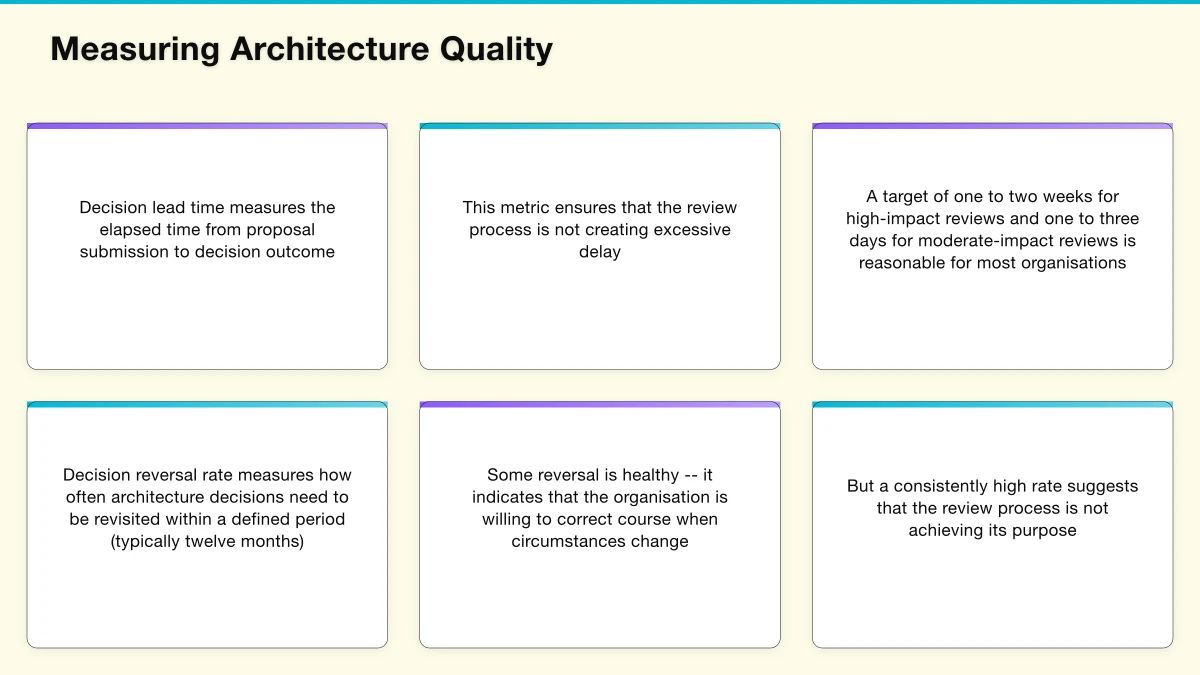
Not every technical decision warrants a formal review. The investment in a review process should be proportionate to the decision’s impact and reversibility.
High-impact, low-reversibility decisions demand thorough review. These include the selection of core technology platforms (database engines, messaging systems, orchestration platforms), the design of system boundaries and integration patterns, the establishment of data models for shared business domains, and security architecture decisions that affect the organisation’s risk posture. These decisions create structural constraints that persist for years and affect multiple teams. Getting them wrong is expensive to correct.
Moderate-impact decisions benefit from lightweight review. The design of a new service within an established architecture, the selection of a library within an approved technology portfolio, or the implementation approach for a complex feature can be reviewed through peer consultation or asynchronous documentation review without convening a formal panel.
Low-impact, high-reversibility decisions should not require review. The choice of an internal data structure, the design of a function’s interface, or the selection of a testing framework for a single project are decisions that teams should make autonomously. Requiring reviews for these decisions signals a lack of trust and creates unnecessary process overhead.
The key variables are impact scope (how many teams, systems, or users are affected) and reversibility (how expensive is it to change course). A two-by-two matrix of these dimensions provides a simple triage framework that teams can apply without ambiguity.
The Review Process
An effective architecture review process has three phases: preparation, deliberation, and documentation.
Preparation is the most important and most frequently shortcircuited phase. The team proposing the architecture produces a written document that describes the problem being solved, the constraints that must be satisfied, the alternatives considered, the recommended approach, and the trade-offs accepted. This document forces structured thinking before the review meeting and enables reviewers to prepare informed feedback.
Architecture Decision Records (ADRs) provide an excellent format for this document. An ADR captures the context (what situation motivates this decision?), the decision (what are we choosing to do?), the consequences (what are the implications of this decision?), and the alternatives considered (what did we evaluate and why did we reject it?). The ADR format is lightweight enough to be practical and structured enough to be useful.
Deliberation brings diverse perspectives to the decision. The review panel should include the proposing team, experienced architects who can identify potential issues, representatives from teams that will be affected by the decision, and security and operations perspectives as appropriate. The discussion should focus on trade-offs and risks rather than style preferences. The goal is not consensus on every detail but confidence that the significant trade-offs have been identified and that the recommended approach is sound.
Documentation captures the outcome for organisational memory. The ADR is updated with the decision outcome and any conditions or concerns identified during the review. These records, stored in a searchable repository, become an invaluable resource for future teams facing similar decisions. The question “why was this designed this way?” can be answered definitively rather than speculatively.
Organisational Models
The structure of the architecture review function varies across enterprises, and the right model depends on the organisation’s size, maturity, and culture.
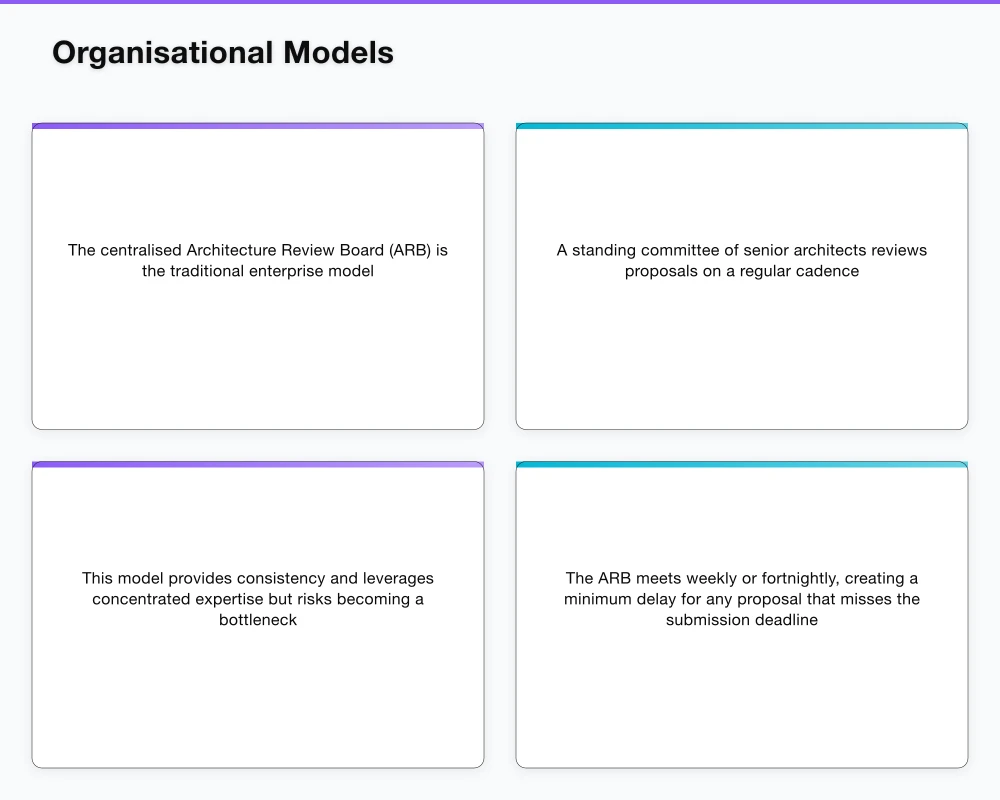
The centralised Architecture Review Board (ARB) is the traditional enterprise model. A standing committee of senior architects reviews proposals on a regular cadence. This model provides consistency and leverages concentrated expertise but risks becoming a bottleneck. The ARB meets weekly or fortnightly, creating a minimum delay for any proposal that misses the submission deadline. If the ARB’s feedback requires rework and re-review, the delay compounds.
The distributed review model empowers teams to conduct their own reviews within defined guardrails. Each team has access to experienced architects who can participate in reviews, and the organisation provides review templates and decision criteria. This model is faster and more scalable but risks inconsistency — different teams may apply different standards.
The hybrid model combines elements of both. Routine decisions follow the distributed model, with teams conducting their own reviews using standard templates. High-impact decisions are escalated to a lightweight central review — not a standing committee but an on-demand panel assembled from relevant experts. This model balances speed with rigour and is the approach I recommend for most enterprise contexts.
Regardless of the model, the architecture review function should operate with clear service level expectations. Teams should know how long a review will take, what is expected in the proposal document, and what criteria will be used to evaluate proposals. Transparency about the process builds trust and encourages teams to engage with it proactively rather than attempting to circumvent it.
Measuring Architecture Quality
Architecture reviews contribute to organisational decision quality, but measuring that contribution requires metrics that go beyond counting reviews completed.
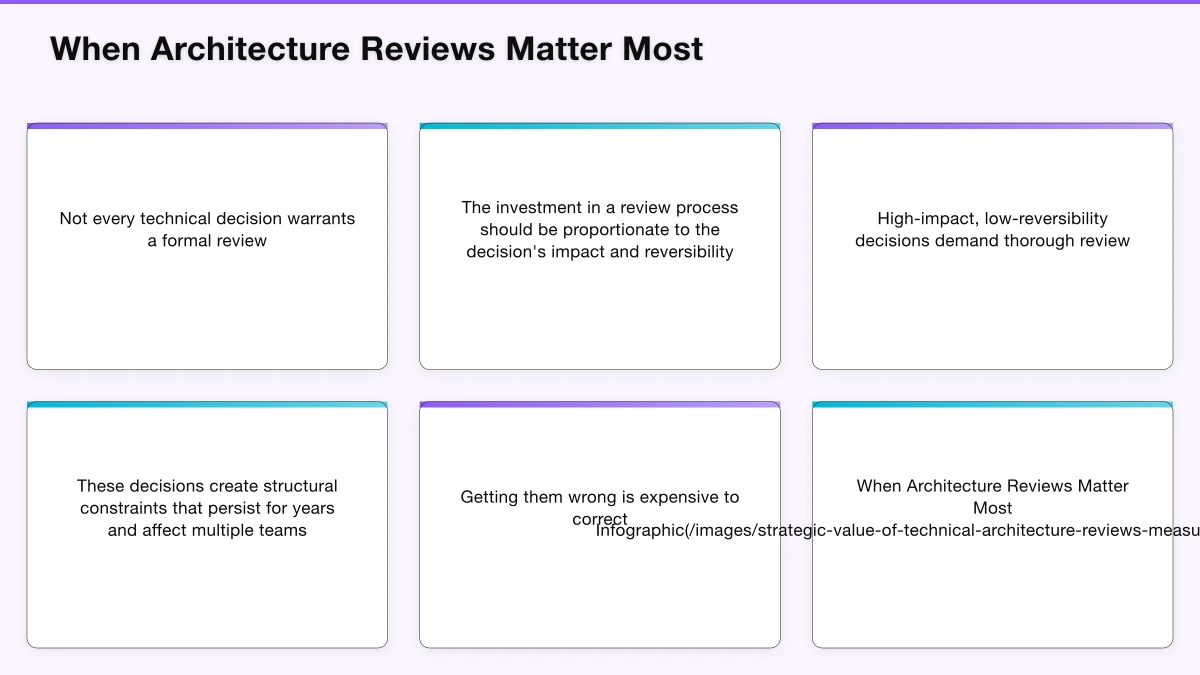
Decision lead time measures the elapsed time from proposal submission to decision outcome. This metric ensures that the review process is not creating excessive delay. A target of one to two weeks for high-impact reviews and one to three days for moderate-impact reviews is reasonable for most organisations.
Decision reversal rate measures how often architecture decisions need to be revisited within a defined period (typically twelve months). A high reversal rate may indicate insufficient analysis during the review process, changing requirements that were not anticipated, or overly rigid decisions that do not accommodate evolution. Some reversal is healthy — it indicates that the organisation is willing to correct course when circumstances change. But a consistently high rate suggests that the review process is not achieving its purpose.
Architectural debt accumulation rate tracks whether the organisation’s architectural fitness is improving or deteriorating over time. This can be measured through periodic architecture fitness assessments, architecture fitness function results, or qualitative assessments by the architecture community. The review process should contribute to managing this metric by ensuring that new decisions do not introduce unnecessary debt.
The strategic value of architecture reviews is not in preventing bad decisions — though they do that. It is in raising the collective architecture capability of the organisation. Every review is a learning opportunity where engineers gain exposure to architectural thinking, trade-off analysis, and cross-cutting concerns. Over time, this builds an engineering culture where architectural thinking is embedded in daily practice rather than confined to a specialist function.
For the CTO, architecture reviews are a governance mechanism that compounds in value. Each reviewed decision is better than it would have been without review. Each documented decision informs future decisions. And each review participant becomes a better architectural thinker, raising the quality of decisions throughout the organisation.
The digital strategies I discuss here often start with a strong website. Cosmos Web Tech publishes practical guides on web design and online marketing.
Ash Ganda is the founder of Ganda Tech Services, a Sydney-based technology consultancy delivering cloud, web, and mobile solutions for Australian businesses.
About the Author
Ashish Ganda is the founder of Ganda Tech Services, a Sydney-based technology consultancy specialising in cloud infrastructure, web development, and mobile app solutions for Australian businesses.
Digital Transformation Roadmap 2026
A 12-month framework for Australian SMBs ready to modernise — phases, tools, and milestones.
Almost done
Check your inbox and click the confirmation link to get your download.