
The Rise of Platform Engineering Teams in Enterprise
A pattern is emerging across enterprise engineering organisations that represents one of the most significant structural shifts in how technology teams operate. Companies at the leading edge of software delivery — the ones consistently appearing in the DORA high-performer category — are establishing dedicated platform engineering teams whose mission is to build and operate internal developer platforms that make product teams faster, more autonomous, and more productive.
This is not a rebranding of the infrastructure team or a new name for DevOps. Platform engineering represents a distinct discipline with a specific mandate: treat the internal developer experience as a product, with product teams as the customers. The platform team builds the paved paths that product teams follow, abstracts infrastructure complexity behind self-service interfaces, and continuously improves the development experience based on internal feedback.
The catalyst for this shift is the cognitive load problem. As enterprises adopt microservices, Kubernetes, cloud-native architectures, and DevOps practices, the cognitive burden on individual product teams has grown unsustainably. A product team that is responsible for application development, CI/CD configuration, container packaging, Kubernetes manifests, monitoring setup, security scanning, compliance documentation, and infrastructure provisioning cannot possibly be expert in all of these domains while also delivering features at the pace the business demands.
Team Topologies, the influential book by Matthew Skelton and Manuel Pais published in 2019, provides the theoretical framework. The platform team is one of four fundamental team types, alongside stream-aligned teams (product teams), enabling teams (specialist teams that help others), and complicated subsystem teams (teams that own complex technical components). The platform team reduces cognitive load on stream-aligned teams by providing self-service capabilities that abstract away the complexity of the underlying technology stack.
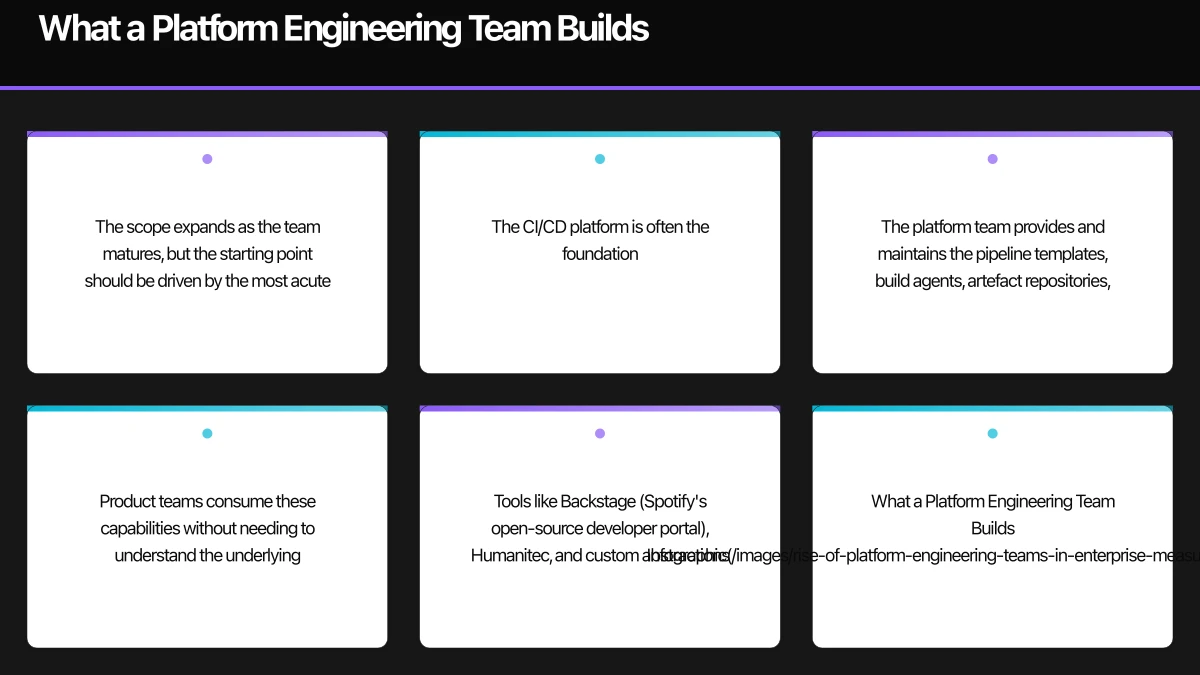
What a Platform Engineering Team Builds
The internal developer platform is not a single product but an evolving collection of capabilities that the platform team builds, integrates, and operates. The scope expands as the team matures, but the starting point should be driven by the most acute pain points experienced by product teams.
The CI/CD platform is often the foundation. Product teams should be able to create deployment pipelines for new services through a simple, self-service process — ideally generating a working pipeline from a template with minimal configuration. The platform team provides and maintains the pipeline templates, build agents, artefact repositories, and deployment mechanisms. Product teams consume these capabilities without needing to understand the underlying infrastructure.
The container and orchestration platform — typically Kubernetes — is abstracted through higher-level interfaces that shield product teams from Kubernetes complexity. Rather than writing raw Kubernetes manifests, product teams interact with simplified configuration that expresses intent (deploy this service with three replicas, this much CPU and memory, connecting to these dependencies) and the platform translates that into the appropriate Kubernetes resources. Tools like Backstage (Spotify’s open-source developer portal), Humanitec, and custom abstractions serve this purpose.
The observability platform provides integrated logging, metrics, tracing, and alerting as a turnkey capability. When a product team deploys a new service, it should automatically appear in the monitoring system with baseline dashboards and alerting. The platform team manages the observability infrastructure (Prometheus, Grafana, Elasticsearch, Jaeger, or their managed equivalents) and provides instrumentation libraries that product teams integrate with minimal effort.
The security and compliance platform automates security scanning, vulnerability management, and compliance checks. Container image scanning, dependency vulnerability detection, static analysis, and compliance validation run automatically in the CI/CD pipeline. Security findings are surfaced to product teams with clear remediation guidance. Policy enforcement — ensuring that deployments meet security and compliance baselines — is automated rather than relying on manual review gates.
The developer environment platform addresses the increasingly complex challenge of providing consistent, productive development environments. With microservices architectures, a developer may need to run or connect to dozens of services to test their changes locally. Platform teams are exploring approaches ranging from remote development environments to service virtualisation to intelligent environment composition that makes local development tractable.
Operating as a Product Team
The critical success factor for platform engineering is operating with a product mindset. The platform team must treat product teams as customers, understand their needs through research and feedback, and prioritise features based on impact.
This requires product management capability within the platform team. A platform product manager (or a technically oriented product owner) gathers requirements from product teams, analyses usage data, prioritises the roadmap, and communicates plans. Without this role, the platform team risks building capabilities that are technically interesting but do not address the most impactful pain points.
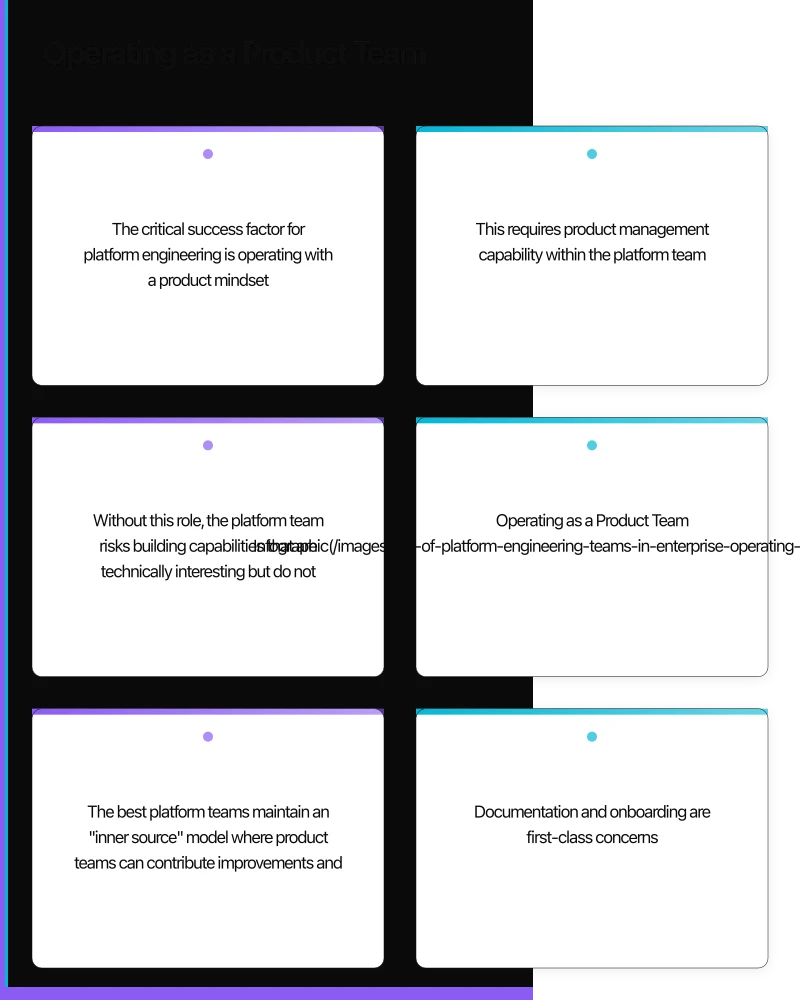
User research for platform teams involves regular conversations with product team engineers, observation of how teams interact with the platform, analysis of support requests and common failure modes, and periodic surveys that measure developer satisfaction and productivity perception. The best platform teams maintain an “inner source” model where product teams can contribute improvements and extensions to the platform.
Documentation and onboarding are first-class concerns. Every platform capability should have clear, maintained documentation that enables product teams to self-serve. Onboarding a new team to the platform should be a guided but efficient process. The quality of documentation directly impacts adoption — a powerful platform that is poorly documented will be underutilised and resented.
Service level objectives (SLOs) for platform services formalise the commitment to reliability. The CI/CD pipeline should have defined availability and latency targets. The Kubernetes platform should have defined uptime and performance guarantees. The monitoring system should have defined data freshness and query performance targets. These SLOs create accountability and enable product teams to plan their work with confidence in the platform’s behaviour.
Organisational Design Considerations
The platform team’s position in the organisation and its relationship with other teams significantly affects its effectiveness.
Reporting structure matters. Platform engineering teams that report through the same engineering leadership as product teams maintain alignment with delivery priorities. Teams that are buried within infrastructure or operations organisations risk optimising for operational concerns at the expense of developer experience.
Team size scales with the organisation. A rough guideline is one platform engineer for every ten to fifteen product engineers, though this varies based on the scope of the platform and the maturity of the tooling. Starting too small — a single engineer tasked with building “the platform” — is a common failure mode that leads to burnout and an underinvested product.
The interaction model between the platform team and product teams should be primarily self-service, with a collaboration mode for complex integrations or new capability development. The platform team is not a ticket-taking service team that processes requests from product teams. It is a product team that builds capabilities consumed through self-service interfaces.
Feedback loops are essential. Regular platform retrospectives, where product team representatives share their experience with the platform, provide qualitative insight. Usage metrics — pipeline execution counts, deployment frequency, self-service adoption rates — provide quantitative data. Together, they inform the platform roadmap.
Measuring Platform Value
Demonstrating the value of platform engineering investment requires metrics that connect platform capabilities to business outcomes.
Developer productivity metrics include deployment frequency (how often product teams ship), lead time (how quickly a code change reaches production), and the percentage of time developers spend on product work versus infrastructure and tooling concerns. The DORA metrics provide a robust framework that is increasingly well-understood by executive leadership.
Platform adoption metrics track how many teams use the platform, how deeply they use it, and how satisfied they are. High adoption with low satisfaction indicates that the platform is mandated rather than valued — a sign that the product approach is not working effectively.
Operational efficiency metrics capture the reduction in incident frequency, the improvement in mean time to recovery, and the decrease in support requests related to infrastructure and tooling. These metrics demonstrate that the platform investment is not just improving speed but also improving reliability.
Time to onboard — how quickly a new team or a new service can be deployed through the platform — captures the self-service aspiration. Reducing this time from weeks to hours represents a tangible improvement that product leadership values.
Platform engineering is not a trend to watch — it is a structural response to the real complexity challenges facing enterprise engineering organisations. The CTOs who invest in this capability are making a deliberate choice to treat internal developer experience as a strategic priority, and the evidence from high-performing organisations suggests this investment delivers outsized returns in delivery velocity, reliability, and engineering satisfaction.
For practical web design and SEO guidance, my team at Cosmos Web Tech helps Australian businesses build high-performing websites.
As founder of Ganda Tech Services, I work with Australian businesses to align technology investments with business growth — across cloud, web, and mobile.
About the Author
Ashish Ganda is the founder of Ganda Tech Services, a Sydney-based technology consultancy specialising in cloud infrastructure, web development, and mobile app solutions for Australian businesses.
Tech Stack Selection Guide 2026
Choose the right tools for your Australian business — without the vendor hype or overlapping spend.