Service Mesh for Enterprise: Istio vs Linkerd vs Consul
As enterprises accelerate their transition to microservices architectures, the service mesh has emerged from a novel concept to a strategic infrastructure imperative. Yet the decision between Istio, Linkerd, and Consul represents more than a technical choice—it’s a architectural commitment that will influence operational complexity, team productivity, and infrastructure costs for years to come.
The stakes are considerable. Recent analysis from the Cloud Native Computing Foundation shows that 54% of enterprises running production Kubernetes workloads have adopted or are evaluating service mesh technology. This isn’t surprising: as microservice deployments scale beyond 50 services, traditional networking approaches begin to fragment under the weight of service-to-service communication complexity, security policy management, and observability requirements.
For CTOs navigating this landscape, the question isn’t whether to adopt a service mesh, but which platform aligns with your organization’s maturity, operational capabilities, and strategic trajectory.
The Strategic Case for Service Mesh
Before diving into platform comparison, it’s worth establishing the business case that justifies the operational overhead service mesh introduces.
Traditional microservices architectures embed networking logic—retries, timeouts, circuit breaking, load balancing—directly into application code. This approach creates three fundamental problems at enterprise scale. First, it fragments security policies across development teams, creating inconsistent implementation and audit challenges. Second, it couples application logic with infrastructure concerns, slowing development velocity. Third, it makes observability an afterthought, forcing teams to instrument each service individually.
Service mesh solves these problems by extracting networking logic into a dedicated infrastructure layer. This separation of concerns delivers immediate operational benefits: centralized security policy enforcement through mutual TLS, consistent traffic management without code changes, and unified observability across all services.
The business impact is measurable. Goldman Sachs reported that their Istio implementation reduced mean time to resolution for production incidents by 40% through improved request tracing and traffic visualization. Nordstrom cited service mesh as instrumental in achieving zero-downtime deployments across 300+ microservices. These aren’t marginal improvements—they represent fundamental shifts in operational capability.
Istio: The Feature-Rich Powerhouse
Istio emerged from Google’s internal service mesh implementations and has evolved into the most feature-complete platform in the market. Backed by Google, IBM, and Lyft, Istio currently commands the largest community and ecosystem among service mesh solutions.
The platform’s architecture centers on Envoy proxy as the data plane, with a control plane that manages configuration distribution, certificate rotation, and telemetry aggregation. This separation provides sophisticated traffic management capabilities that extend well beyond basic service routing.
Istio’s advanced traffic management sets it apart. The platform supports canary deployments with graduated traffic shifting—you can route 1% of production traffic to a new service version, monitor error rates and latency, then progressively increase traffic based on automated criteria. This capability proved essential for Spotify, which uses Istio to orchestrate progressive rollouts across their microservices platform, achieving deployment failure rates under 0.1%.
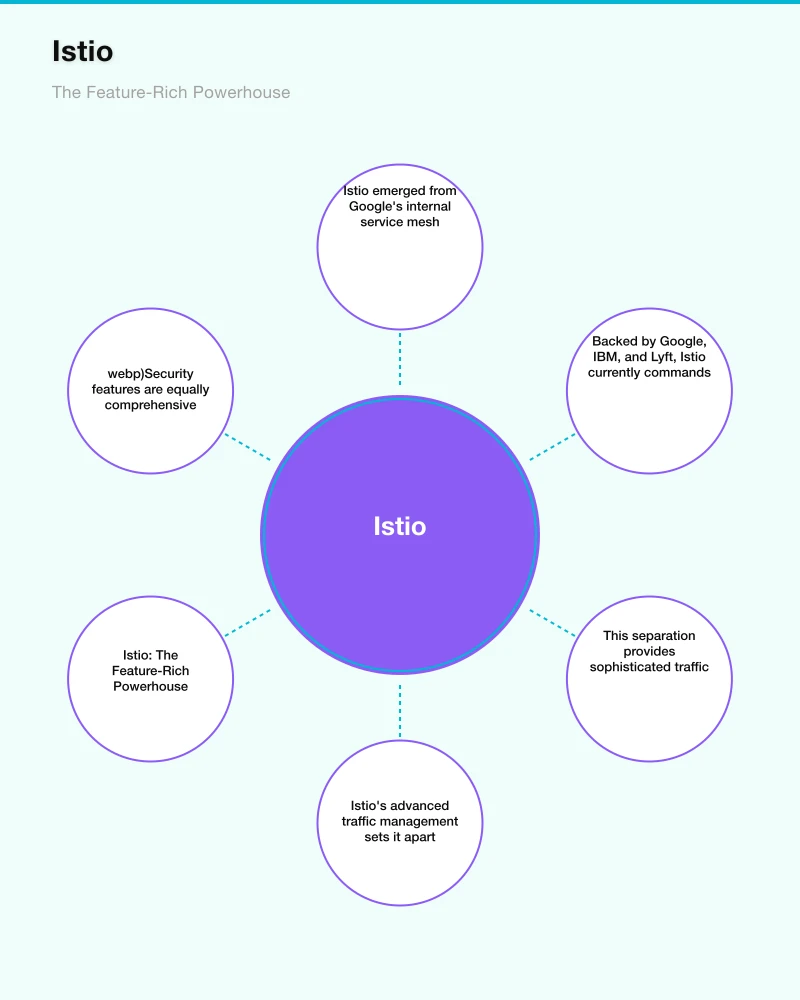
Security features are equally comprehensive. Istio automates mutual TLS across all service-to-service communication, rotating certificates every 24 hours by default. Authorization policies support fine-grained access control at the request level, including JWT validation and external authorization through custom policy engines. T-Mobile leveraged these capabilities to achieve SOC 2 compliance across their microservices platform without modifying application code.
The observability stack provides deep visibility. Istio generates detailed metrics for all inter-service traffic, distributed traces for request flows, and access logs for security auditing. Integration with Prometheus, Grafana, and Jaeger creates a unified observability platform that spans the entire service mesh.
However, this feature richness comes with complexity costs. Istio’s learning curve is steep—teams typically require 3-6 months to develop operational competence. The control plane architecture consumes significant resources; a typical production deployment requires 4-6 vCPUs and 8-12GB memory for control plane components alone. Configuration complexity can become overwhelming as the number of services grows, requiring dedicated platform teams to manage mesh operations.
The total cost of ownership reflects this complexity. Beyond infrastructure costs, enterprises should budget for specialized training and dedicated operational staff. E-commerce giant Otto found that their Istio deployment required two full-time engineers focused exclusively on service mesh operations and troubleshooting.
Linkerd: Simplicity and Performance
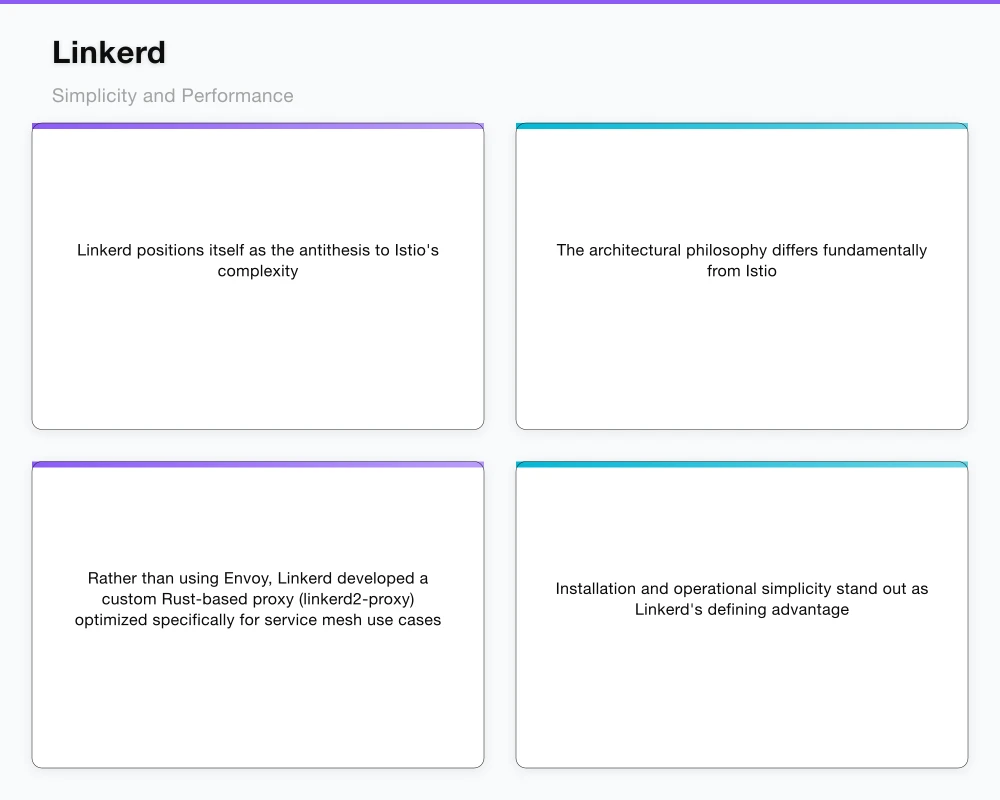
Linkerd positions itself as the antithesis to Istio’s complexity. Originally developed by Buoyant and now a CNCF graduated project, Linkerd prioritizes operational simplicity, minimal resource consumption, and predictable performance.
The architectural philosophy differs fundamentally from Istio. Rather than using Envoy, Linkerd developed a custom Rust-based proxy (linkerd2-proxy) optimized specifically for service mesh use cases. This purpose-built approach delivers remarkable performance characteristics: sub-millisecond P99 latency overhead and memory consumption around 10MB per proxy instance.
Installation and operational simplicity stand out as Linkerd’s defining advantage. The entire control plane deploys via a single CLI command, with production-ready defaults requiring minimal tuning. There are no CRDs to learn beyond the basic ServiceProfile resource. Traffic policies apply through simple Kubernetes annotations rather than complex YAML configurations.
This simplicity translates to faster time-to-value. Fintech company Entain deployed Linkerd across 200 microservices in under two weeks, compared to their previous three-month effort attempting an Istio implementation. Their operations team reported that Linkerd “just works,” requiring minimal ongoing attention once deployed.
Security capabilities, while less extensive than Istio, cover enterprise fundamentals. Automatic mutual TLS provides encryption for all service communication. Authorization policies support service-to-service access control, though without the request-level granularity Istio offers. For most organizations, these capabilities satisfy security requirements without operational overhead.
Observability is streamlined but effective. Linkerd provides golden metrics (success rate, request rate, latency distribution) for all services through built-in dashboards. Distributed tracing integrates with Jaeger, though configuration requires more manual setup than Istio’s automatic trace propagation.
The tradeoffs become apparent in advanced scenarios. Linkerd doesn’t support complex traffic management patterns like Istio’s fault injection or mirroring capabilities. Multi-cluster mesh configurations, while possible, lack Istio’s sophisticated cross-cluster routing. Teams requiring these advanced features will find Linkerd’s simplicity limiting.
Resource consumption provides a compelling economic case. Media company Hulu reported that Linkerd’s resource footprint was 60% lower than their previous Istio deployment, translating to $180,000 in annual infrastructure savings for their production clusters.
Consul: The Multi-Platform Integration Solution
HashiCorp’s Consul brings a different perspective to service mesh, rooted in the company’s broader infrastructure automation portfolio. Unlike Istio and Linkerd, which target Kubernetes-native environments, Consul provides service mesh capabilities across heterogeneous infrastructure—Kubernetes, VMs, and bare metal.
This multi-platform support addresses a critical enterprise reality: most organizations operate hybrid environments where legacy VM-based applications coexist with modern containerized workloads. Consul’s service mesh can bridge these worlds, providing consistent networking and security policies across the entire infrastructure landscape.
The architecture leverages Envoy as the data plane proxy, similar to Istio, but integrates with Consul’s service discovery and configuration management capabilities. This integration provides unique advantages for organizations already using HashiCorp’s ecosystem—Vault for secrets management, Terraform for infrastructure automation, and Nomad for workload orchestration.
Criteo, the advertising technology company, exemplified this use case. Their infrastructure spans Kubernetes clusters for new services and legacy VM fleets running established applications. Consul Connect (their service mesh product) provided unified security policies and traffic management across both environments, enabling gradual migration to Kubernetes without creating security gaps or networking silos.
Traffic management capabilities are robust, supporting canary deployments, traffic splitting, and advanced routing based on HTTP headers or service metadata. The integration with Consul’s intention system provides intuitive service-to-service authorization—teams define which services can communicate in a declarative format that maps naturally to organizational security policies.
Multi-datacenter and multi-cloud support sets Consul apart. The platform handles service mesh federation across regions and cloud providers, managing certificate authorities and routing policies for geographically distributed deployments. This proved essential for global logistics company Maersk, which operates Consul service mesh across 15 data centers spanning five continents.
The operational model requires deeper HashiCorp ecosystem expertise. Teams need to understand Consul’s gossip protocol, raft consensus, and service catalog concepts before effectively managing the service mesh layer. This learning curve is less steep than Istio but more demanding than Linkerd.
Enterprise licensing represents another consideration. While Consul offers an open-source version, production-grade features like audit logging, advanced federation, and OIDC integration require Consul Enterprise. Pricing follows HashiCorp’s node-based model, which can become expensive for large-scale Kubernetes deployments where node counts grow rapidly.
Complexity vs Capability: The Strategic Tradeoff
The fundamental tension in service mesh selection balances operational complexity against functional capability. This isn’t a simple spectrum—each platform optimizes for different enterprise contexts.
Istio maximizes capability. If your architecture requires sophisticated traffic management, your security posture demands fine-grained authorization, or your observability needs span complex request flows, Istio delivers. The cost is operational complexity that demands dedicated platform engineering talent and substantial infrastructure resources.
Organizations succeeding with Istio share common characteristics: platform engineering teams of 5+ engineers, Kubernetes expertise across the organization, and architectural complexity justifying the operational investment. Typically, this means 100+ microservices in production with active development across multiple teams.
Linkerd optimizes for simplicity and efficiency. If your primary needs are mutual TLS, basic traffic management, and service-level observability, Linkerd delivers these capabilities with minimal operational burden and exceptional resource efficiency. The tradeoff is accepting functional limitations in advanced scenarios.
Linkerd excels in organizations where platform teams are small, Kubernetes experience is developing, or cost optimization drives infrastructure decisions. Companies with 20-100 microservices often find Linkerd’s capabilities sufficient while appreciating the operational simplicity.
Consul targets heterogeneous infrastructure. If your environment spans Kubernetes and VMs, requires multi-datacenter federation, or already leverages HashiCorp tooling, Consul provides unique integration value. The consideration is accepting ecosystem lock-in and enterprise licensing costs.
Implementation Strategy and Cost Analysis
The financial impact of service mesh adoption extends beyond infrastructure costs to encompass operational staffing, training investments, and productivity implications during implementation.
Infrastructure costs vary significantly by platform. Based on analysis of production deployments across 100-service environments:
Istio infrastructure costs typically range from $15,000-25,000 annually for control plane resources in managed Kubernetes environments. Sidecar proxy overhead adds approximately 10-15% to overall compute costs. For a medium-sized deployment, expect total infrastructure costs around $40,000-60,000 annually.
Linkerd infrastructure costs are substantially lower due to efficient resource utilization. Control plane resources cost $3,000-5,000 annually, with sidecar overhead around 5-8% of compute costs. Total infrastructure costs typically land in the $15,000-25,000 range for comparable deployments.
Consul costs depend heavily on licensing model and deployment size. Open-source deployments have infrastructure costs similar to Istio, while enterprise licensing adds per-node charges. For 100 services across VM and Kubernetes infrastructure, expect combined costs of $50,000-80,000 annually including enterprise features.
Operational staffing represents the larger expense. Istio deployments typically require 1-2 dedicated platform engineers at $150,000-200,000 annual compensation. Linkerd reduces this to 0.5-1 FTE, while Consul requires similar investment to Istio when managing multi-platform deployments.
Training costs shouldn’t be underestimated. Bringing a platform team to operational competence requires:
- Istio: $20,000-30,000 for external training and certification
- Linkerd: $5,000-10,000 for focused training programs
- Consul: $15,000-25,000 including broader HashiCorp ecosystem training
Migration planning should account for gradual rollout rather than wholesale adoption. Successful implementations follow a phased approach: start with non-critical services, establish operational runbooks, train teams on troubleshooting patterns, then expand to business-critical workloads. This typically spans 6-12 months for enterprise environments.
Making the Decision: A Framework for CTOs
The service mesh decision framework should start with honest assessment of organizational capabilities and architectural requirements.
Choose Istio if:
- Your architecture demands sophisticated traffic management (A/B testing, canary analysis, fault injection)
- Security requirements include fine-grained authorization at the request level
- You operate multiple clusters requiring advanced multi-cluster mesh
- Platform engineering teams have deep Kubernetes expertise
- You can commit dedicated staff to service mesh operations
- The microservices count exceeds 100 services with complex interactions
Choose Linkerd if:
- Operational simplicity and resource efficiency are primary concerns
- Core requirements are mutual TLS, basic traffic splitting, and observability
- Platform teams are small or Kubernetes experience is developing
- Cost optimization drives infrastructure decisions
- Microservices architecture is maturing (20-100 services)
- You value fast time-to-value over maximal features
Choose Consul if:
- Infrastructure spans Kubernetes, VMs, and potentially bare metal
- Multi-datacenter or multi-cloud federation is required
- You already leverage HashiCorp ecosystem (Vault, Terraform, Nomad)
- Service mesh must integrate with existing Consul service discovery
- Enterprise support and vendor relationship are valued
- Budget accommodates enterprise licensing costs
The Path Forward
Service mesh technology continues rapid evolution. As Kubernetes matures as the enterprise application platform, service mesh adoption will accelerate from current 54% evaluation/adoption rates toward ubiquity in microservices environments.
The competitive landscape is consolidating around these three platforms. Istio’s feature leadership and community momentum position it as the default choice for complex requirements. Linkerd’s simplicity and efficiency create a compelling alternative for organizations prioritizing operational excellence. Consul maintains differentiation through multi-platform support and HashiCorp ecosystem integration.
For CTOs evaluating this decision today, the key is matching platform capabilities to organizational maturity and architectural requirements. There’s no universal “best” choice—only the right choice for your specific context, constraints, and strategic trajectory.
The service mesh platforms chosen today will form the networking substrate for your microservices architecture throughout its lifecycle. Make this decision deliberately, with clear-eyed assessment of the operational commitment each platform demands. The infrastructure patterns established now will either enable or constrain your organization’s cloud native journey for years ahead.
At Ashganda, we help enterprise technology leaders navigate complex infrastructure decisions. Our strategic advisory services provide independent analysis, vendor evaluation frameworks, and implementation roadmaps for cloud native architectures. Contact us to discuss your service mesh strategy.
Need to put cloud strategy into action? Cloud Geeks provides in-depth guides on AWS, Azure, and cybersecurity for Australian SMBs.
My consultancy Ganda Tech Services operates three specialist divisions covering cloud infrastructure, web development, and mobile apps for Australian businesses.
About the Author
Ashish Ganda is the founder of Ganda Tech Services, a Sydney-based technology consultancy specialising in cloud infrastructure, web development, and mobile app solutions for Australian businesses.
Digital Transformation Roadmap 2026
A 12-month framework for Australian SMBs ready to modernise — phases, tools, and milestones.