Enterprise Service Discovery with HashiCorp Consul
As enterprises accelerate their migration to microservices architectures, the challenge of service discovery has evolved from a technical concern to a strategic imperative. In monolithic systems, services communicated through well-known endpoints configured at deployment time. In dynamic, containerized environments where services scale horizontally and instances appear and disappear within seconds, this static approach fundamentally breaks down.
HashiCorp Consul has emerged as the leading solution for enterprise service discovery, combining robust service registration with health checking, key-value storage, and multi-datacenter awareness. For CTOs evaluating infrastructure investments, understanding Consul’s architecture and implementation patterns is essential for building resilient, scalable systems.
The Service Discovery Imperative
Before examining Consul’s capabilities, it’s worth establishing why service discovery has become a critical infrastructure layer for modern enterprises.
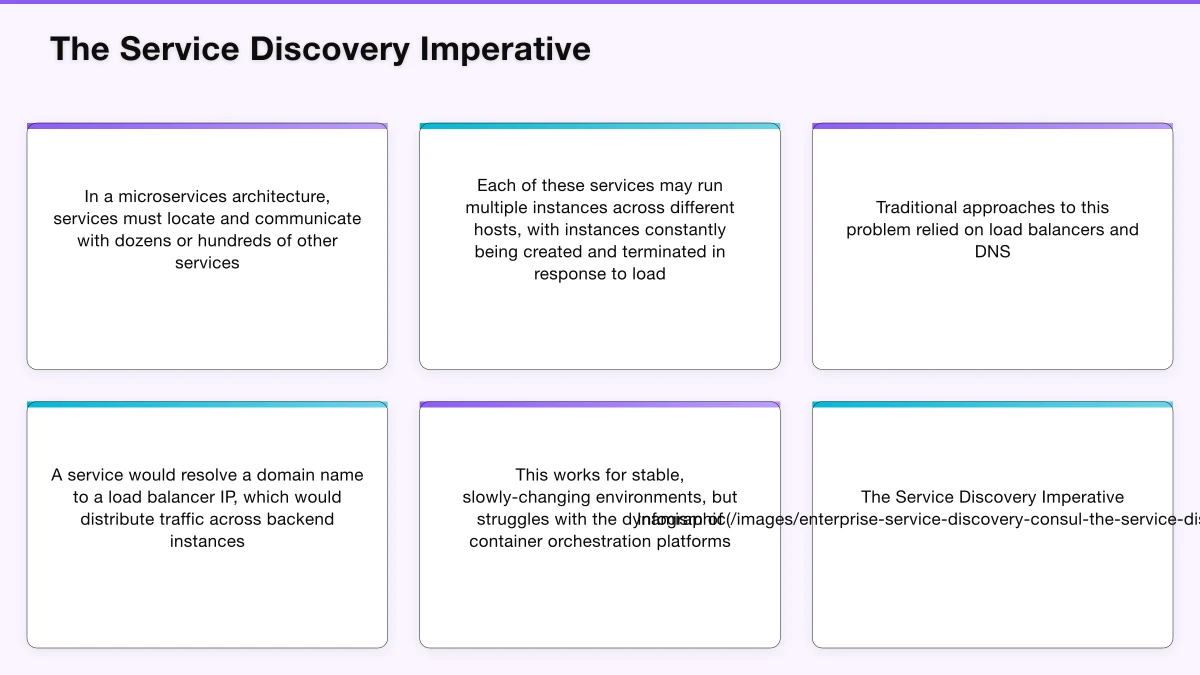
In a microservices architecture, services must locate and communicate with dozens or hundreds of other services. Consider a typical e-commerce platform: the checkout service needs to communicate with inventory, pricing, payment processing, and notification services. Each of these services may run multiple instances across different hosts, with instances constantly being created and terminated in response to load.
Traditional approaches to this problem relied on load balancers and DNS. A service would resolve a domain name to a load balancer IP, which would distribute traffic across backend instances. This works for stable, slowly-changing environments, but struggles with the dynamism of container orchestration platforms.
DNS TTLs introduce latency—clients may continue routing to terminated instances until their cache expires. Load balancers become single points of failure and create bottlenecks at scale. Configuration management becomes a nightmare as the number of services grows, requiring manual updates to routing rules and backend pools.
Modern service discovery systems address these limitations through real-time service registration, health checking, and direct service-to-service communication. When a service instance starts, it registers itself with the discovery system. When it fails a health check or terminates, it’s automatically removed. Other services query the discovery system to find healthy instances, receiving up-to-date routing information within seconds.
The business impact is significant. Netflix pioneered this approach with Eureka, reporting that real-time service discovery reduced their mean time to recovery by 70% compared to their previous DNS-based system. Airbnb’s adoption of Consul enabled them to achieve 99.99% availability across their microservices platform, with automatic failover completing in under 5 seconds.
Consul Architecture Deep Dive
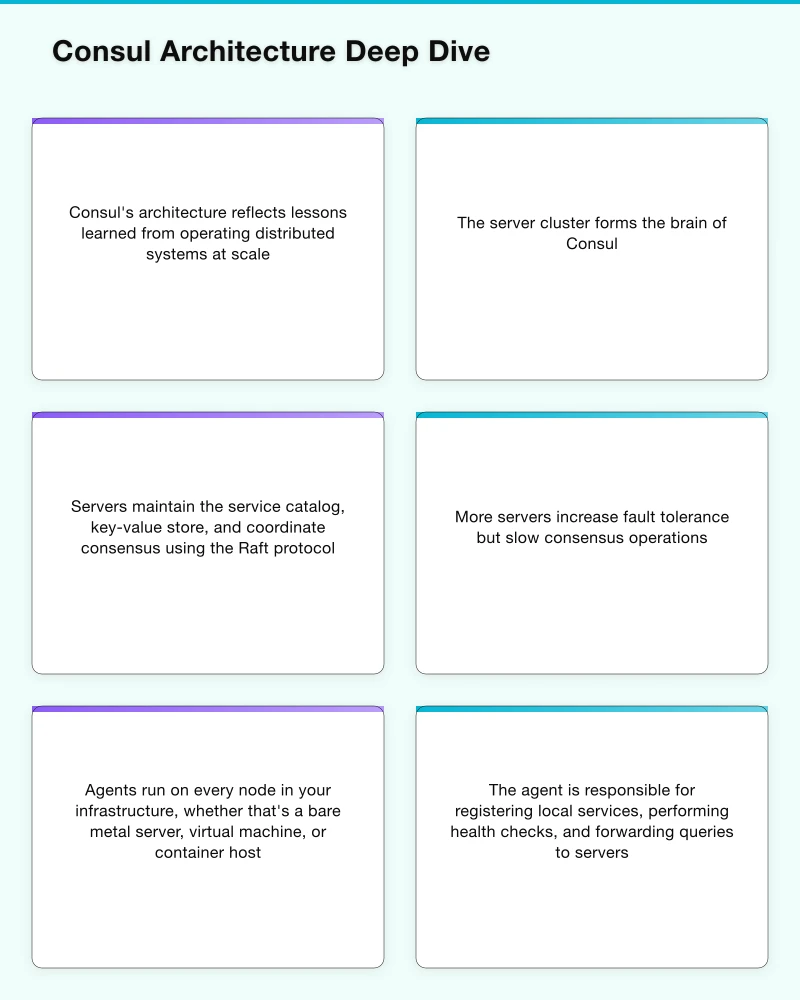
Consul’s architecture reflects lessons learned from operating distributed systems at scale. The platform consists of two primary components: servers that maintain state and participate in consensus, and agents that run on every node to perform local health checking and service registration.
The server cluster forms the brain of Consul. Servers maintain the service catalog, key-value store, and coordinate consensus using the Raft protocol. In production deployments, HashiCorp recommends running either three or five servers—three provides fault tolerance for a single server failure, while five tolerates two simultaneous failures. More servers increase fault tolerance but slow consensus operations.
Agents run on every node in your infrastructure, whether that’s a bare metal server, virtual machine, or container host. The agent is responsible for registering local services, performing health checks, and forwarding queries to servers. This distributed architecture means that even if servers become temporarily unreachable, agents continue to serve cached data and maintain local health checks.
The gossip protocol provides cluster membership and failure detection. Consul uses the SWIM (Scalable Weakly-consistent Infection-style Membership) protocol, enhanced with optimizations for reliability and performance. When an agent joins the cluster, it learns about other members through gossip, eventually developing a complete view of the cluster topology.
Service registration can occur through multiple mechanisms. Services can register themselves via Consul’s HTTP API, allowing dynamic registration from application code. Alternatively, service definitions can be provided as configuration files, useful for services that don’t have native Consul integration. In Kubernetes environments, Consul’s integration automatically registers pods as services.
Health checking ensures that the service catalog reflects reality. Consul supports multiple health check types: script checks execute a command and interpret the exit code, HTTP checks perform GET requests expecting a 2xx response, TCP checks verify that a port accepts connections, and TTL checks require services to periodically report their health. Failed health checks result in immediate removal from the service catalog, preventing traffic from routing to unhealthy instances.
Designing for Multi-Datacenter Operations
Enterprise deployments rarely span a single datacenter. Whether for disaster recovery, latency reduction, or regulatory compliance, organizations typically operate across multiple geographic regions. Consul’s multi-datacenter architecture provides native support for these requirements.
Each datacenter operates as an independent Consul cluster with its own servers and consensus. This isolation ensures that network partitions between datacenters don’t affect local operations—services within a datacenter continue to discover each other even when WAN connectivity fails.
Cross-datacenter communication occurs through WAN federation. Server nodes in each datacenter participate in a separate WAN gossip pool, learning about servers in other datacenters. When a service needs to discover instances in another datacenter, the query is forwarded to a server in the target datacenter, which returns results based on its local service catalog.
This federated model provides several advantages. Latency for local service discovery remains low, as queries are served from local servers. Cross-datacenter queries incur WAN latency but provide accurate, real-time results. If WAN connectivity fails, local operations continue unaffected while cross-datacenter queries fail gracefully.
Configuration requires careful consideration of network topology. Consul servers need to communicate over TCP port 8300 for RPC, 8301 for LAN gossip, and 8302 for WAN gossip. The WAN gossip pool uses a separate encryption key, providing security for cross-datacenter communication. Most enterprises deploy Consul servers in private subnets with WAN federation occurring over VPN tunnels or dedicated network links.
Stripe’s implementation demonstrates the multi-datacenter model at scale. Their Consul deployment spans four geographic regions, supporting service discovery for over 500 microservices. During a recent network partition between their US East and US West datacenters, local service discovery continued operating while cross-region traffic automatically rerouted through their European datacenter.
Service Mesh Integration
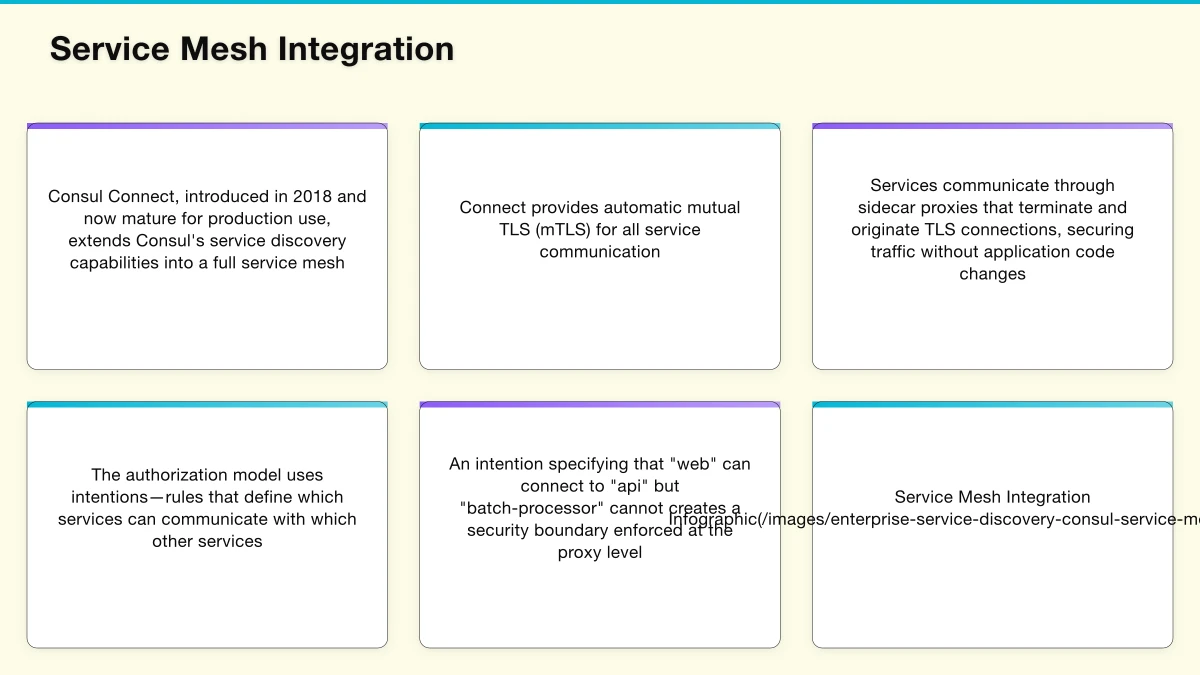
Consul Connect, introduced in 2018 and now mature for production use, extends Consul’s service discovery capabilities into a full service mesh. This integration represents a natural evolution: once you’ve solved service discovery, the next challenge is securing and managing service-to-service communication.
Connect provides automatic mutual TLS (mTLS) for all service communication. When enabled, Consul generates and manages certificates for each service, automating the rotation and distribution that would otherwise require significant operational overhead. Services communicate through sidecar proxies that terminate and originate TLS connections, securing traffic without application code changes.
The authorization model uses intentions—rules that define which services can communicate with which other services. An intention specifying that “web” can connect to “api” but “batch-processor” cannot creates a security boundary enforced at the proxy level. This allow/deny model provides defense in depth, ensuring that even if an attacker compromises a service, they cannot freely communicate with other services in the mesh.
Connect integrates with Consul’s existing service discovery. When a service queries for another service’s address, Connect-aware applications receive the sidecar proxy address along with the necessary certificates to establish a secure connection. This tight integration means organizations already using Consul for service discovery can adopt Connect incrementally, migrating services to the mesh without disrupting existing functionality.
Performance overhead is minimal. The sidecar proxy (either Consul’s built-in proxy or Envoy) adds approximately 0.3ms of latency per hop for encrypted communication. Memory consumption averages 50-100MB per proxy instance. For most enterprises, this overhead is negligible compared to the security and operational benefits.
DigitalOcean’s implementation provides a practical reference. They migrated 200 services to Consul Connect over six months, achieving zero-trust networking without significant infrastructure investment. Their security team reported that Connect reduced their attack surface area by 60% by eliminating unencrypted service-to-service communication.
Production Deployment Patterns
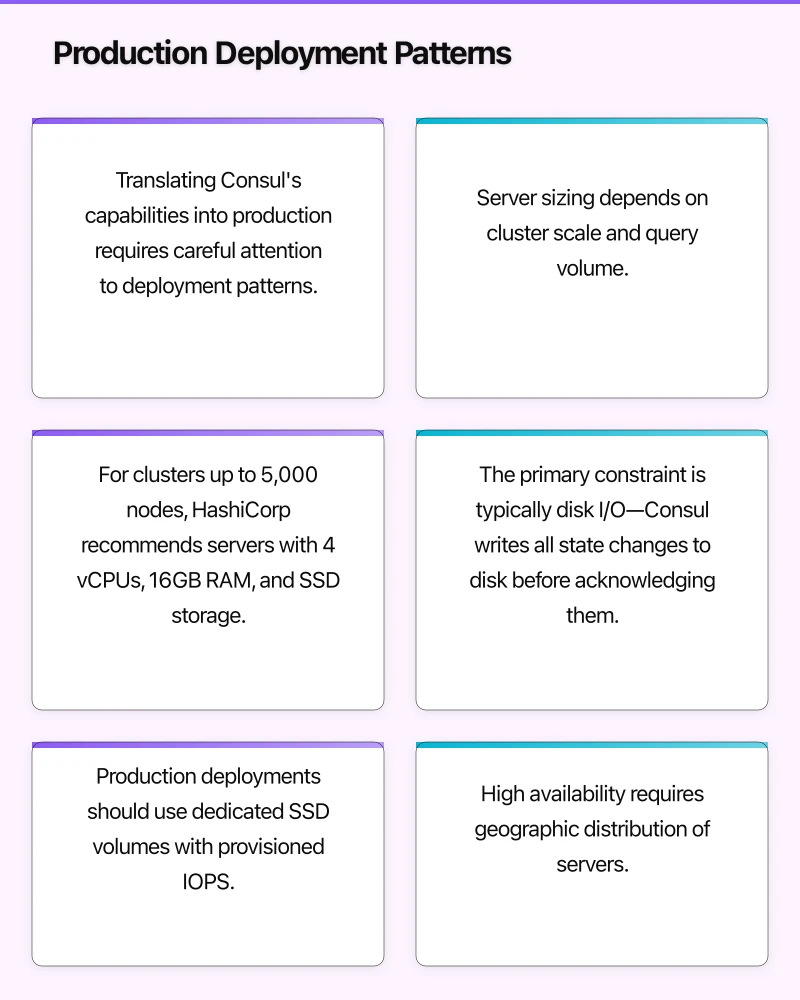
Translating Consul’s capabilities into production requires careful attention to deployment patterns, capacity planning, and operational procedures.
Server sizing depends on cluster scale and query volume. For clusters up to 5,000 nodes, HashiCorp recommends servers with 4 vCPUs, 16GB RAM, and SSD storage. The primary constraint is typically disk I/O—Consul writes all state changes to disk before acknowledging them, ensuring durability at the cost of write latency. Production deployments should use dedicated SSD volumes with provisioned IOPS.
High availability requires geographic distribution of servers. For a three-server cluster, distribute servers across three availability zones within a region. This ensures that an availability zone failure doesn’t cause quorum loss. For critical deployments, some organizations run five servers across five availability zones, though this increases operational complexity.
Backup and recovery procedures are essential. Consul provides the consul snapshot command for creating consistent backups of the entire state. Automated daily snapshots should be stored in a separate system—if Consul fails, you’ll need to restore from backup without access to Consul itself. Test your recovery procedures regularly; an untested backup is not a backup.
Monitoring should cover server health, consensus performance, and service catalog metrics. Key metrics include consul.raft.commitTime (should remain under 50ms), consul.catalog.services (total services registered), and consul.rpc.request (query rate). Alerting on consensus failures is critical—if a server loses quorum, service registration and discovery will fail.
Upgrading requires careful orchestration. Consul supports rolling upgrades: upgrade followers one at a time, then transfer leadership to an upgraded follower before upgrading the final server. Never upgrade all servers simultaneously, and always test upgrades in staging environments that mirror production topology.
Kubernetes Integration Strategies
As Kubernetes adoption accelerates, integrating Consul with container orchestration platforms has become a common requirement. The integration strategy depends on whether you’re using Consul as a complement to or replacement for Kubernetes’ native service discovery.
The complementary approach runs Consul alongside Kubernetes’ native DNS-based service discovery. Kubernetes services continue to use kube-dns for intra-cluster communication, while Consul provides service discovery for communication with services outside the cluster—legacy systems, databases, or services in other datacenters. This approach minimizes disruption to existing Kubernetes workflows while extending service discovery across hybrid environments.
Consul’s Helm chart simplifies deployment in Kubernetes. The chart deploys Consul servers as a StatefulSet with persistent volumes, ensuring state survives pod restarts. Agents run as a DaemonSet, placing an agent on every node. The chart handles service account creation, RBAC configuration, and network policy setup.
Automatic service registration through the connect-inject webhook eliminates manual configuration. When enabled, the webhook intercepts pod creation and injects a sidecar proxy container along with the necessary configuration for service registration. Services gain Consul registration and Connect mesh participation without any application changes.
The catalog sync feature bridges Kubernetes services into Consul and vice versa. Services registered in Consul become available in Kubernetes through synthetic Service objects, allowing Kubernetes pods to discover external services using standard Kubernetes DNS. Conversely, Kubernetes services can be exported to Consul, making them discoverable by non-Kubernetes clients.
Lyft’s implementation demonstrates the hybrid approach. They run Consul across their infrastructure, which includes both Kubernetes clusters and traditional VM-based services. The catalog sync feature enables seamless service discovery between the two environments, with developers using consistent APIs regardless of where their dependencies run.
Security Hardening for Enterprise
Production Consul deployments require comprehensive security hardening. The service catalog contains sensitive information about your infrastructure, and the key-value store may contain configuration secrets. Unauthorized access could enable reconnaissance, data exfiltration, or service disruption.
Enable ACLs (Access Control Lists) to control access to Consul’s API. ACLs use tokens that grant specific permissions—a token might allow reading the service catalog but deny access to the key-value store. Bootstrap ACLs during initial deployment; retrofitting ACLs onto an existing cluster is significantly more complex.
Encrypt all communication using TLS. Generate a CA certificate for your Consul cluster and issue certificates for each server and agent. Configure Consul to verify incoming connections against the CA, preventing unauthorized agents from joining the cluster. For WAN federation, use separate certificates and keys for the WAN gossip pool.
The key-value store should not contain plaintext secrets. While Consul provides a convenient location for configuration data, secrets should be stored in dedicated secrets management systems like HashiCorp Vault. Vault integrates natively with Consul, providing dynamic secrets with automatic rotation and audit logging.
Network security complements application-level controls. Consul servers should only be accessible from trusted networks—place them in private subnets with security groups limiting access to known agent IPs. The HTTP API should never be exposed to the public internet, even with ACLs enabled.
Audit logging tracks all operations against Consul. Enterprise Consul provides comprehensive audit logs capturing who accessed what data and when. For open-source Consul, implement logging at the network level through API gateways or proxy servers.
Operational Excellence and Troubleshooting
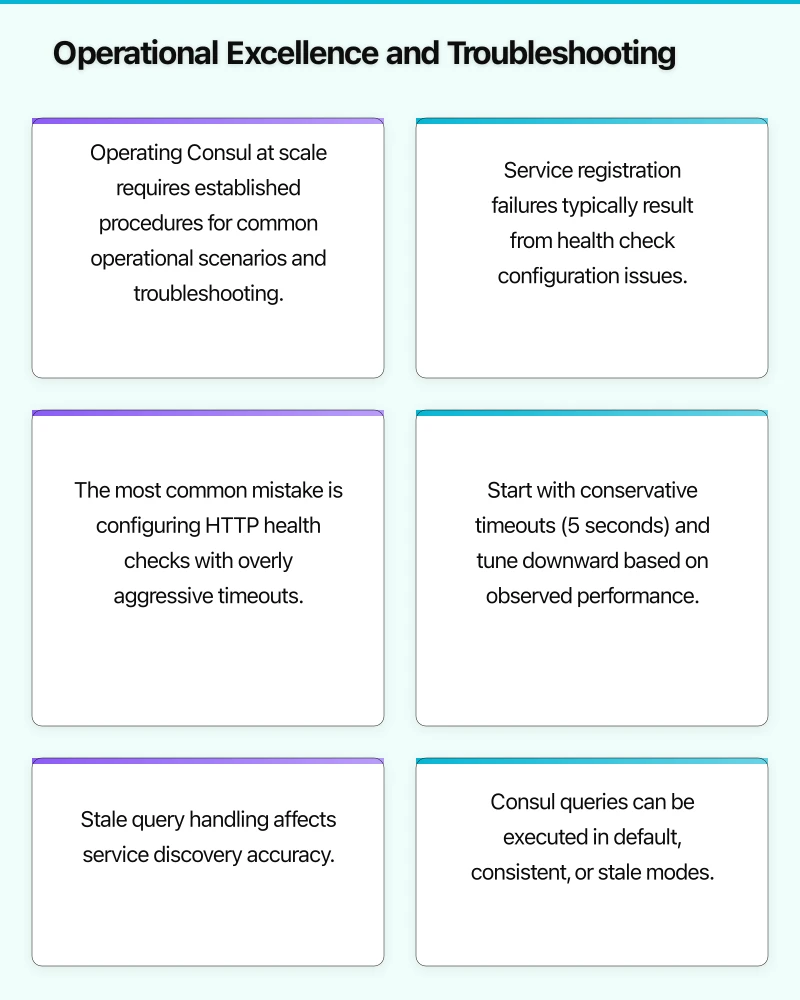
Operating Consul at scale requires established procedures for common operational scenarios and troubleshooting techniques for when things go wrong.
Service registration failures typically result from health check configuration issues. The most common mistake is configuring HTTP health checks with overly aggressive timeouts—if your service takes 100ms to respond to health checks but the timeout is 50ms, the service will never appear healthy. Start with conservative timeouts (5 seconds) and tune downward based on observed performance.
Stale query handling affects service discovery accuracy. Consul queries can be executed in default, consistent, or stale modes. Default mode provides strong consistency but requires a healthy leader. Stale mode returns cached data that may be slightly out of date but remains available during leader elections. For most service discovery use cases, stale reads provide acceptable accuracy with improved availability.
Network partitions require careful handling. When a datacenter becomes partitioned from others, local service discovery continues operating, but cross-datacenter queries fail. Design your applications to handle these failures gracefully—retry with backoff, fall back to cached values, or degrade functionality rather than failing completely.
Performance degradation usually traces to server resource constraints. Monitor server CPU, memory, and disk I/O carefully. A server under CPU pressure will process consensus operations slowly, increasing raft.commitTime and potentially causing timeouts. Add more servers or increase server resources if you observe sustained performance degradation.
The Consul CLI provides essential troubleshooting tools. consul members shows cluster membership and identifies failed nodes. consul operator raft list-peers displays the Raft peer configuration and identifies the current leader. consul debug captures diagnostic information for analysis by HashiCorp support.
Strategic Considerations for CTOs
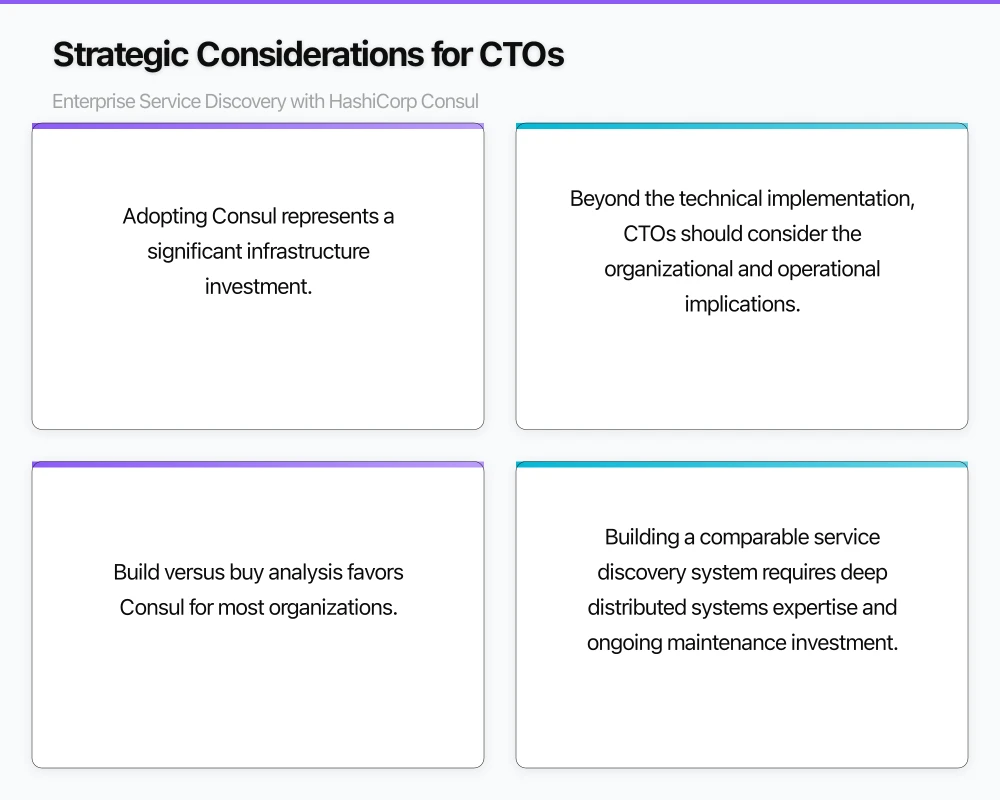
Adopting Consul represents a significant infrastructure investment. Beyond the technical implementation, CTOs should consider the organizational and operational implications.
Build versus buy analysis favors Consul for most organizations. Building a comparable service discovery system requires deep distributed systems expertise and ongoing maintenance investment. Consul’s open-source model provides enterprise-grade functionality without licensing costs, while HashiCorp’s commercial support options provide peace of mind for mission-critical deployments.
Team skills development requires investment. While Consul’s operational model is straightforward compared to alternatives, it still requires understanding of distributed systems concepts, network security, and operational procedures. Budget for training and expect a 3-6 month ramp-up period before teams achieve operational competence.
Integration with existing infrastructure varies by environment. Organizations running HashiCorp Terraform and Vault will find Consul integration straightforward—the tools share operational models and integrate natively. Organizations with significant investments in other infrastructure tools should evaluate integration requirements carefully.
Migration strategy depends on your starting point. For greenfield microservices deployments, implement Consul from the beginning. For brownfield environments, start with a pilot project—migrate a non-critical service chain to Consul, validate operational procedures, then expand gradually. Avoid big-bang migrations that risk widespread disruption.
The service mesh evolution provides optionality. Starting with Consul for service discovery creates a natural path to Connect for service mesh capabilities. This incremental approach allows organizations to adopt mesh functionality as their needs evolve, without requiring a platform change.
Looking Forward
Service discovery has evolved from a nice-to-have convenience to a critical infrastructure layer that underpins microservices reliability and operational efficiency. Consul’s combination of mature service discovery, multi-datacenter support, and service mesh capabilities positions it as a strategic platform for enterprise infrastructure.
The investments made in service discovery today will compound as your microservices architecture grows. Organizations that establish robust service discovery early in their microservices journey avoid the technical debt and operational complexity that accumulates when discovery is an afterthought.
For CTOs evaluating their infrastructure roadmap, Consul deserves serious consideration. The platform’s stability, community support, and natural integration with the broader HashiCorp ecosystem make it a safe choice for organizations building the next generation of distributed systems.
Building enterprise-grade service discovery? I work with organizations to design and implement scalable infrastructure patterns. Connect with me to discuss how Consul fits your architecture.
For the practitioner’s view on cloud, IT, and cybersecurity, explore Cloud Geeks — where strategy meets infrastructure.
These insights are drawn from my work leading Ganda Tech Services — helping Australian businesses navigate digital transformation through cloud, web, and mobile.
About the Author
Ashish Ganda is the founder of Ganda Tech Services, a Sydney-based technology consultancy specialising in cloud infrastructure, web development, and mobile app solutions for Australian businesses.
Digital Transformation Roadmap 2026
A 12-month framework for Australian SMBs ready to modernise — phases, tools, and milestones.