
Natural Language Processing in Enterprise Applications
Natural language processing has moved from research curiosity to enterprise capability. The convergence of transformer-based language models, cloud-based AI services, and growing volumes of unstructured text data has created practical opportunities for organisations willing to invest in NLP capabilities strategically.
Yet many enterprise NLP initiatives still fail. Not because the technology is inadequate, but because organisations underestimate the data engineering requirements, overestimate the out-of-the-box accuracy of pre-trained models, and fail to design for the operational realities of deploying language models in production.
This article examines where NLP delivers genuine enterprise value today, the architectural patterns that support production deployment, and the strategic considerations CTOs should evaluate when building NLP capabilities.
High-Value Enterprise NLP Use Cases
The highest-return NLP applications in enterprise settings share a common characteristic: they automate or augment cognitive work that is currently performed manually, at high volume, with significant cost and inconsistency.
Intelligent Document Processing: Enterprises process enormous volumes of documents — contracts, invoices, regulatory filings, insurance claims, medical records. Traditional approaches rely on rigid templates and rules-based extraction that break when document formats change. Modern NLP techniques, combining named entity recognition, relationship extraction, and document classification, can process unstructured documents with accuracy rates approaching ninety percent, with human review for low-confidence extractions.
The architecture for document processing typically combines optical character recognition (OCR) for digitisation, pre-trained language models for entity extraction and classification, and domain-specific fine-tuning to achieve acceptable accuracy. AWS Textract, Google Document AI, and Azure Form Recognizer provide managed services that handle the OCR and basic extraction, while custom models built on frameworks like Hugging Face Transformers address domain-specific requirements.
Customer Intent Analysis: Understanding what customers want from their communications — support tickets, chat messages, emails, social media posts — enables better routing, prioritisation, and response. NLP-powered intent classification can categorise incoming communications, extract key entities (product names, account numbers, issue types), and assess sentiment to identify escalation-worthy interactions.
The business value is substantial. Organisations that implement intelligent routing based on NLP analysis typically see fifteen to thirty percent reductions in handling time and meaningful improvements in first-contact resolution. The key is training intent classifiers on the organisation’s actual data rather than relying on generic models.
Compliance and Risk Monitoring: Financial services, healthcare, and regulated industries generate vast volumes of communications that must be monitored for compliance. NLP enables automated surveillance of email, chat, and voice communications for potential regulatory violations, conflicts of interest, or policy breaches. The alternative — manual review of a sample — is expensive, inconsistent, and leaves significant gaps in coverage.
Knowledge Management and Search: Enterprise search has been a persistent pain point. Traditional keyword-based search fails when users do not know the right terms, when documents use different terminology for the same concepts, or when the answer requires synthesising information across multiple documents. Semantic search powered by language models understands meaning rather than matching keywords, dramatically improving the relevance of search results. Organisations using semantic search report thirty to fifty percent improvements in search success rates.
Architecture Patterns for Production NLP
Deploying NLP models in enterprise environments requires architecture patterns that address latency, scalability, accuracy, and operational management.
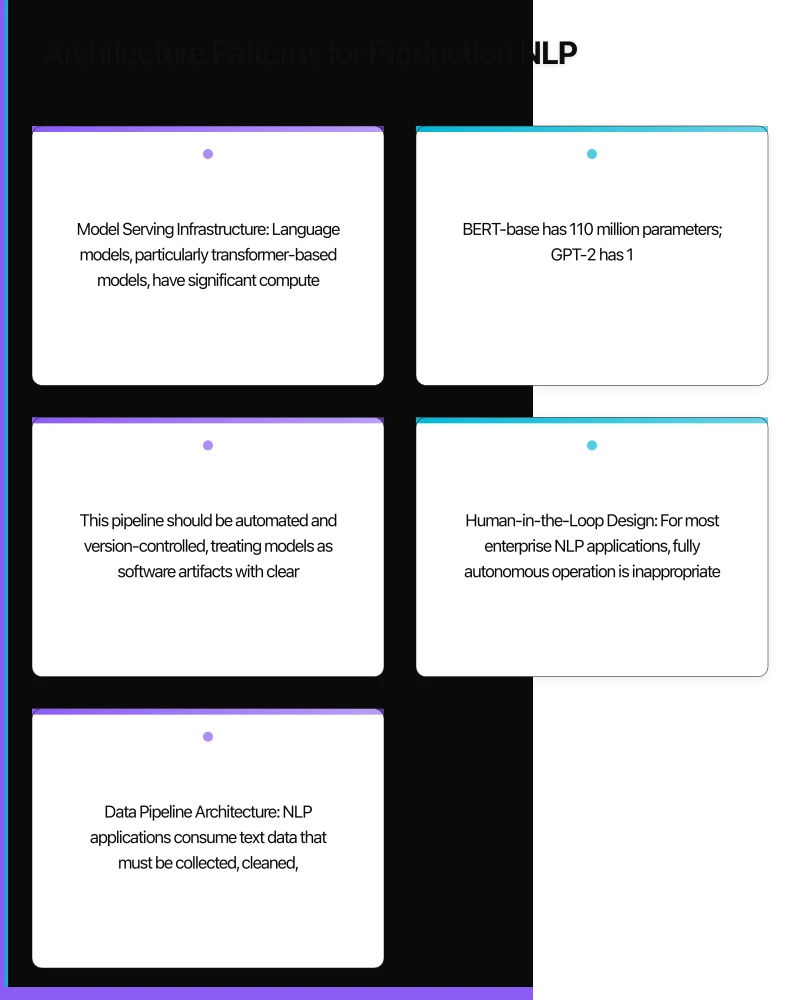
Model Serving Infrastructure: Language models, particularly transformer-based models, have significant compute requirements. BERT-base has 110 million parameters; GPT-2 has 1.5 billion. Serving these models at production scale requires GPU-enabled infrastructure with model optimisation techniques like quantisation, pruning, and distillation to reduce inference latency and cost.
The choice between self-managed model serving (using frameworks like TensorFlow Serving, TorchServe, or Triton Inference Server) and managed cloud services (Amazon Comprehend, Google Natural Language API, Azure Cognitive Services) depends on the organisation’s ML engineering maturity, customisation requirements, and data residency constraints.
The Fine-Tuning Pipeline: Pre-trained models provide a strong foundation but rarely achieve acceptable accuracy on domain-specific tasks without fine-tuning. The architecture needs to support a continuous improvement cycle: collect labelled data from domain experts, fine-tune models, evaluate against held-out test sets, and deploy improved models. This pipeline should be automated and version-controlled, treating models as software artifacts with clear provenance and rollback capabilities.
Human-in-the-Loop Design: For most enterprise NLP applications, fully autonomous operation is inappropriate. The architecture should route low-confidence predictions to human reviewers, use human corrections to generate additional training data, and provide transparency about model confidence levels. This pattern — machine processing for the clear cases, human review for the ambiguous ones — achieves better outcomes than either fully manual or fully automated approaches.
Data Pipeline Architecture: NLP applications consume text data that must be collected, cleaned, normalised, and prepared before model inference. This data pipeline needs to handle various input formats (PDF, email, HTML, plain text), perform preprocessing (tokenisation, normalisation, language detection), and manage data lineage for compliance and debugging. Apache Kafka or AWS Kinesis for streaming text data, combined with Apache Spark or AWS Glue for batch processing, form a common infrastructure pattern.
Building vs. Buying NLP Capabilities
The build-versus-buy decision for NLP capabilities is more nuanced than for many technology investments because the landscape spans a wide spectrum from fully managed services to custom model development.
Managed API Services: Cloud providers offer NLP APIs for common tasks: sentiment analysis, entity recognition, language translation, and text classification. These services require minimal ML expertise, handle infrastructure management, and charge on a per-request basis. They are appropriate for generic NLP tasks where domain-specific accuracy is not critical and where data can be sent to external APIs.
Pre-Trained Models with Fine-Tuning: The Hugging Face model hub hosts thousands of pre-trained language models that can be fine-tuned on domain-specific data. This approach requires ML engineering expertise but produces models tailored to the organisation’s specific needs. It is the sweet spot for most enterprise NLP applications: leveraging billions of dollars of pre-training compute investment while adapting to specific domains.
Custom Model Development: Training language models from scratch requires massive datasets and compute resources that are rarely justified for enterprise applications. The exceptions are organisations with truly unique data (proprietary corpora in specialised domains) or extremely specific requirements that pre-trained models cannot address.
For most CTOs, the recommended strategy is to start with managed API services for initial validation, move to fine-tuned pre-trained models as accuracy requirements increase, and reserve custom development for the rare cases where existing models fundamentally cannot address the need.
Strategic Considerations for NLP Investment
Several strategic factors should inform the CTO’s approach to NLP capabilities:
Data is the moat: The competitive advantage in NLP comes not from the models, which are increasingly commoditised, but from the training data. Organisations that systematically collect, label, and curate domain-specific text data build capabilities that competitors cannot easily replicate. Every customer interaction, document processed, and knowledge article created is potential training data.
Talent scarcity: NLP engineering talent is in high demand and short supply. Organisations that cannot attract dedicated NLP engineers should invest in upskilling existing software engineers through transfer learning frameworks that lower the barrier to entry, and in managed services that reduce the operational burden.
Ethical and bias considerations: Language models trained on internet text inherit the biases present in that text. For enterprise applications that affect customers — credit decisions, hiring, customer service prioritisation — bias testing and mitigation must be part of the development process. Frameworks for fairness evaluation are emerging but not yet standardised.
Multilingual requirements: Global enterprises need NLP capabilities across multiple languages. Multilingual transformer models like mBERT and XLM-RoBERTa provide cross-lingual capabilities, but accuracy varies significantly across languages. Low-resource languages require careful evaluation and potentially language-specific fine-tuning.
NLP is transitioning from an emerging technology to an enterprise infrastructure capability. The organisations that invest now in data pipelines, model fine-tuning infrastructure, and NLP engineering skills will compound those advantages over time. The CTO’s role is to identify the highest-value use cases, build the foundational infrastructure that supports multiple applications, and maintain realistic expectations about what NLP can and cannot do in its current state.
For practical web design and SEO guidance, my team at Cosmos Web Tech helps Australian businesses build high-performing websites.
I lead Ganda Tech Services, where we turn digital strategy into results through specialist cloud, web design, and mobile app teams across Sydney.
About the Author
Ashish Ganda is the founder of Ganda Tech Services, a Sydney-based technology consultancy specialising in cloud infrastructure, web development, and mobile app solutions for Australian businesses.
AI Strategy Primer for Australian Business Leaders
A practical framework for AI adoption in 2026 — cut through the hype and start with what matters.