
AI Ethics and Governance: An Enterprise Framework
Introduction
Artificial intelligence has transitioned from experimental technology to enterprise essential. Organizations deploy machine learning models across customer service, risk assessment, hiring, pricing, and countless other domains. The business value is clear—McKinsey estimates AI could deliver $13 trillion in additional global economic output by 2030.
Yet this rapid adoption outpaces governance maturity. Headline-grabbing failures demonstrate the risks: biased hiring algorithms that discriminated against women, facial recognition systems with unacceptable error rates for certain demographics, recommendation engines that amplified harmful content. Each incident erodes public trust and invites regulatory scrutiny.
The European Union is advancing the AI Act, which would impose substantial requirements on high-risk AI systems. The United States, while taking a less prescriptive approach, is increasing enforcement around algorithmic discrimination. China has implemented AI governance requirements for recommendation algorithms.
For enterprise CTOs, AI ethics and governance is no longer optional. It is a strategic imperative that affects regulatory compliance, reputational risk, customer trust, and talent attraction. This article provides a comprehensive framework for establishing AI ethics and governance within enterprise environments.
Understanding the AI Ethics Landscape
Before building governance structures, leaders must understand the ethical dimensions of AI deployment and the stakeholders whose interests must be balanced.
Core Ethical Principles
While specific implementations vary, most AI ethics frameworks converge on common principles:
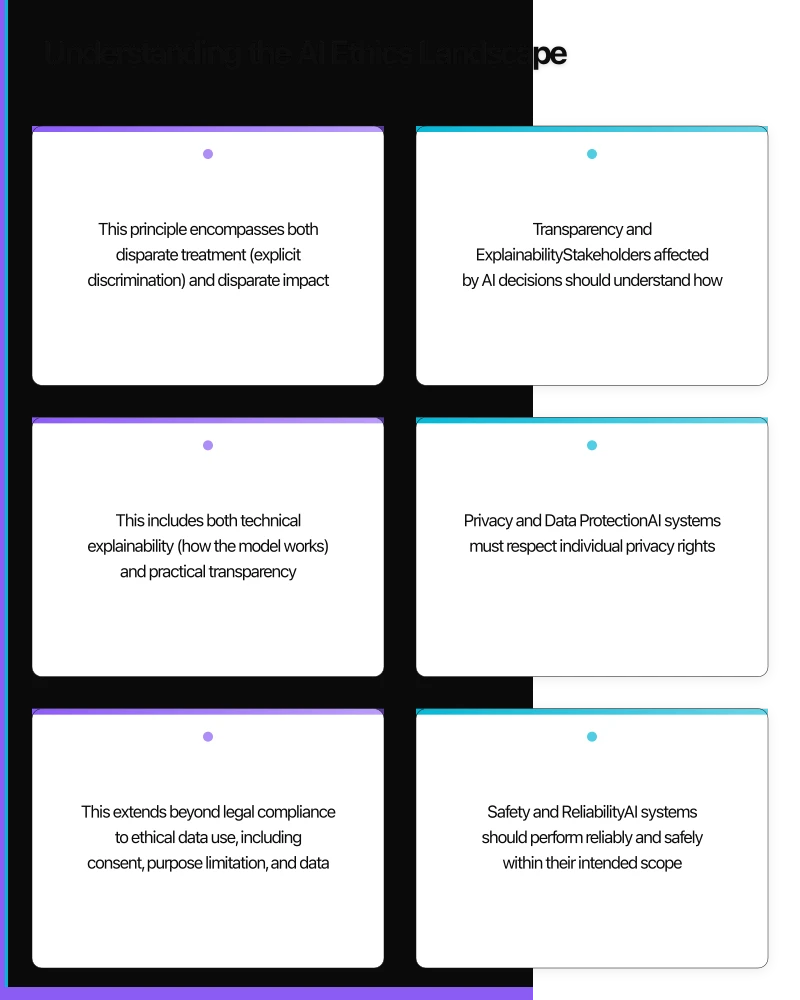
Fairness and Non-Discrimination AI systems should not create or reinforce unfair bias against individuals or groups. This principle encompasses both disparate treatment (explicit discrimination) and disparate impact (neutral policies with discriminatory effects).
Transparency and Explainability Stakeholders affected by AI decisions should understand how those decisions are made. This includes both technical explainability (how the model works) and practical transparency (communicating to affected individuals).
Privacy and Data Protection AI systems must respect individual privacy rights. This extends beyond legal compliance to ethical data use, including consent, purpose limitation, and data minimization.
Safety and Reliability AI systems should perform reliably and safely within their intended scope. Organizations must understand system limitations and implement appropriate safeguards.
Accountability Clear human accountability must exist for AI system outcomes. Automated decisions do not eliminate the need for human responsibility.
Human Oversight Humans should maintain appropriate oversight and control over AI systems, particularly for high-stakes decisions affecting individuals’ lives, livelihoods, or liberty.
Stakeholder Perspectives
Effective AI governance balances multiple stakeholder interests:
Affected Individuals: Those subject to AI-influenced decisions. Their interests center on fairness, transparency, and recourse.
Customers: Those who purchase products or services incorporating AI. Their interests include quality, safety, and value alignment.
Employees: Those building, deploying, and maintaining AI systems. Their interests include clear guidance, professional standards, and protection from complicity in harmful systems.
Shareholders: Those with financial stake in the organization. Their interests include risk management, regulatory compliance, and sustainable value creation.
Regulators: Those responsible for public interest protection. Their interests include compliance, cooperation, and systemic risk management.
Society: The broader community affected by AI deployment at scale. Interests include social benefit, equitable access, and harm prevention.
The Enterprise AI Ethics Framework
We propose a four-layer framework that addresses AI ethics comprehensively while remaining practical for enterprise implementation.
Layer 1: Principles and Values
The foundation layer establishes organizational commitment to ethical AI through clear articulation of principles and values.
Developing AI Principles
- Engage broadly: Include diverse perspectives—technologists, ethicists, legal, business leaders, and external stakeholders
- Contextualize: Adapt general principles to organizational context and industry
- Prioritize: Acknowledge tensions between principles and establish guidance for conflicts
- Communicate: Publish principles internally and externally with executive endorsement
- Operationalize: Connect abstract principles to concrete guidance
Example Principle Structure:
Principle: We commit to AI fairness across demographic groups.
Interpretation: AI systems should not produce outcomes that systematically disadvantage protected groups without legitimate business justification.
Application: All AI systems influencing consequential decisions require fairness assessment before deployment.
Accountability: Model owners are responsible for fairness monitoring; AI ethics board reviews high-risk systems.
Layer 2: Governance Structure
Governance structure establishes organizational mechanisms for AI ethics oversight.
AI Ethics Board
An enterprise AI ethics board provides strategic oversight and decision-making for AI ethics matters.
Composition:
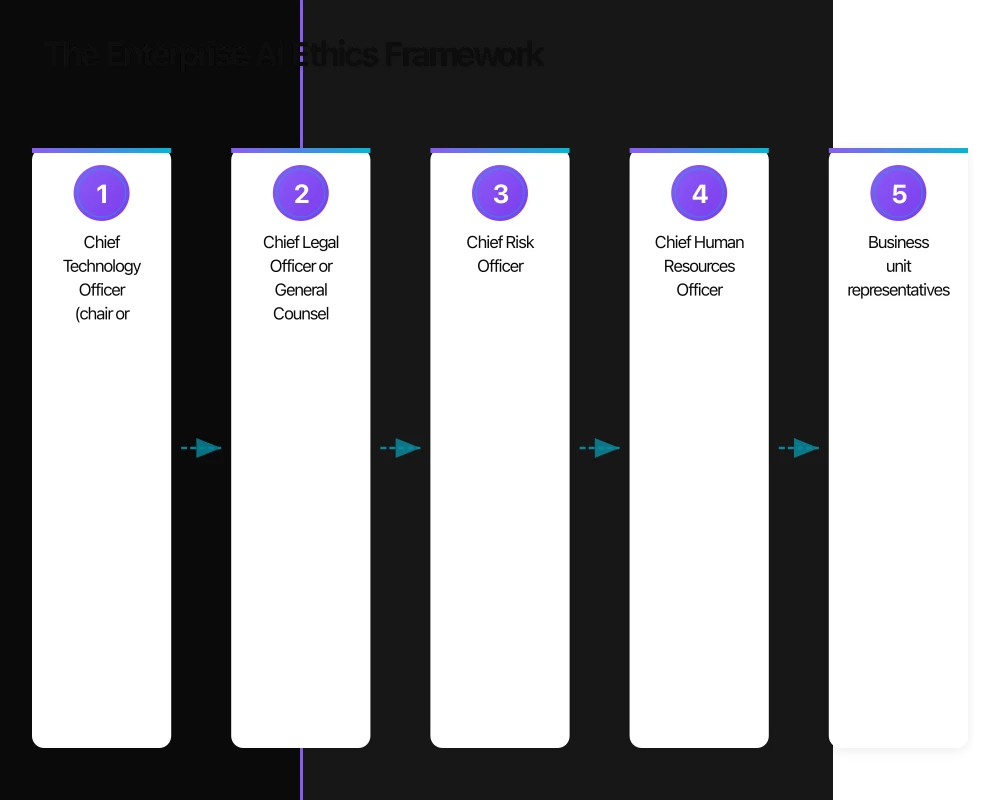
- Chief Technology Officer (chair or co-chair)
- Chief Legal Officer or General Counsel
- Chief Risk Officer
- Chief Human Resources Officer
- Business unit representatives
- External ethics advisors (recommended)
- Data science leadership
Responsibilities:
- Approve AI ethics principles and policies
- Review high-risk AI use cases
- Adjudicate ethics escalations
- Monitor regulatory developments
- Report to board of directors on AI ethics matters
Cadence: Quarterly meetings with ad-hoc sessions for urgent matters
AI Ethics Office
Operational support requires dedicated resources beyond board oversight.
Functions:
- Policy development and maintenance
- Ethics review process management
- Training program development
- Metrics and reporting
- Stakeholder engagement
- Incident response coordination
Staffing: Scale with AI maturity—start with part-time responsibilities, evolve to dedicated roles as AI deployment expands
Distributed Responsibilities
Ethics cannot be centralized exclusively. Every team building or deploying AI shares responsibility.
Data Science Teams: Technical fairness assessment, model documentation, bias testing Product Teams: Use case ethics evaluation, user communication, feedback channels Legal Teams: Regulatory compliance, contract provisions, litigation risk assessment Risk Teams: Risk categorization, control implementation, monitoring
Layer 3: Processes and Controls
Governance structures require processes that embed ethics into AI development and deployment lifecycles.
AI Use Case Registry
Maintain a comprehensive inventory of AI applications across the enterprise.
Registry Contents:
- Use case description and business purpose
- Data inputs and sources
- Model type and methodology
- Decision type (recommendation, automation, augmentation)
- Affected populations
- Risk categorization
- Owner and accountability
- Review status and findings
Benefits:
- Portfolio visibility for governance
- Risk concentration identification
- Regulatory response readiness
- Knowledge sharing across teams
Risk-Based Ethics Review
Not every AI application requires the same scrutiny. Risk-based tiers enable appropriate review intensity.
Tier 1 - Standard Review:
- Internal productivity tools
- Non-consequential recommendations
- Aggregated analytics without individual decisions
Review: Self-certification with spot audits
Tier 2 - Enhanced Review:
- Customer-facing recommendations
- Pricing and eligibility decisions
- Employee performance inputs
Review: Ethics office assessment, fairness testing required
Tier 3 - Full Review:
- Credit, insurance, employment decisions
- Healthcare recommendations
- Safety-critical applications
- Law enforcement cooperation
Review: AI ethics board approval, external audit recommended, ongoing monitoring required
Fairness Assessment Process
For Tier 2 and Tier 3 applications, systematic fairness assessment is essential.
Assessment Components:
-
Problem Formulation Review: Is the problem framed appropriately? Does the target variable introduce bias?
-
Data Audit: What populations are represented in training data? Are there historical biases in labels? What proxies for protected characteristics exist?
-
Metric Selection: Which fairness metrics are appropriate? How do different metrics trade off against each other and accuracy?
-
Bias Testing: What are model outcomes across demographic groups? Do disparities exist? Are they justified?
-
Mitigation Evaluation: If bias exists, what mitigation options are available? What are trade-offs?
-
Documentation: Complete model card documenting assessment findings and decisions.
Model Documentation Requirements
Comprehensive documentation enables accountability and knowledge transfer.
Model Card Contents:
- Model purpose and intended use
- Training data description and limitations
- Performance metrics by relevant segments
- Fairness assessment results
- Known limitations and failure modes
- Deployment constraints and monitoring requirements
- Version history and change log
- Owner and review dates
Layer 4: Culture and Capability
Governance structures and processes are insufficient without cultural commitment and individual capability.
Ethics Training
All employees involved in AI development or deployment require ethics training.
Training Tiers:
Awareness (All employees): 2-hour introduction to AI ethics principles, organizational policies, and escalation procedures
Practitioner (Technical teams): 8-hour deep dive into bias detection, fairness metrics, documentation requirements, and ethical design patterns
Leadership (Managers and executives): 4-hour session on governance responsibilities, risk management, and strategic implications
Psychological Safety for Escalation
Ethics concerns must be raisable without fear of retaliation.
Elements:
- Anonymous reporting channels
- Non-retaliation policy with enforcement
- Recognition for ethics contributions
- Leadership modeling of ethics prioritization
Incentive Alignment
Performance management should reinforce ethics priorities.
Mechanisms:
- Ethics criteria in project success metrics
- Ethics considerations in promotion decisions
- Recognition programs for ethics leadership
- Consequences for ethics violations
Practical Implementation Challenges
Implementing AI ethics governance faces predictable challenges. Acknowledging these challenges enables proactive mitigation.
Challenge: Speed vs. Thoroughness
Problem: Ethics review processes slow AI deployment, frustrating business stakeholders seeking competitive advantage.
Mitigation:
- Risk-based tiers reduce review burden for lower-risk applications
- Parallel processing enables ethics review concurrent with development
- Templates and checklists accelerate common assessments
- Clear SLAs set expectations for review timelines
Challenge: Technical Complexity
Problem: Ethics assessment requires technical sophistication that governance bodies may lack.
Mitigation:
- Technical ethics specialists support governance functions
- Training programs build board member literacy
- External experts supplement internal capabilities
- Clear documentation makes technical concepts accessible
Challenge: Subjective Judgments
Problem: Many ethics questions lack clear answers, requiring judgment calls that create uncertainty.
Mitigation:
- Principles provide decision-making framework
- Precedent documentation enables consistency
- Escalation paths resolve difficult cases
- Accept that perfect consistency is unattainable
Challenge: Vendor and Partner AI
Problem: Third-party AI systems may not meet organizational ethics standards.
Mitigation:
- Procurement requirements for AI vendors
- Contract provisions for transparency and audit rights
- Vendor assessment processes
- Clear accountability for vendor AI outcomes
Challenge: Global Variation
Problem: Ethics expectations and regulatory requirements vary across jurisdictions.
Mitigation:
- Baseline global standards meeting highest common denominator
- Regional adaptations where legally required
- Monitoring of regulatory developments globally
- Flexibility in governance processes for regional variation
Measuring AI Ethics Performance
Governance effectiveness requires measurement. The following metrics enable ongoing assessment.
Process Metrics
Coverage Metrics:
- Percentage of AI applications in registry
- Percentage of high-risk applications with ethics review
- Training completion rates by role
Timeliness Metrics:
- Average ethics review cycle time by tier
- Review backlog size and trend
- Escalation resolution time
Quality Metrics:
- Review finding categories and trends
- Post-deployment issues traced to review gaps
- Audit findings on ethics processes
Outcome Metrics
Fairness Metrics:
- Disparate impact ratios for monitored applications
- Fairness metric trends over time
- Remediation rates for identified bias
Incident Metrics:
- Ethics-related incidents by severity
- Incident root cause categories
- Time to detection and resolution
Stakeholder Metrics:
- Employee ethics confidence survey results
- Customer trust metrics
- Regulatory inquiry frequency and outcomes
Case Studies in AI Ethics Governance
Examining how leading organizations approach AI ethics provides practical insights.
Microsoft Responsible AI
Microsoft has developed comprehensive responsible AI principles and governance structures.
Key Elements:
- Six principles: fairness, reliability/safety, privacy/security, inclusiveness, transparency, accountability
- Office of Responsible AI providing operational support
- Responsible AI Council for strategic oversight
- Responsible AI Standard specifying implementation requirements
- Fairness, Accountability, Transparency, and Ethics (FATE) research group
Lessons: Investment in research alongside governance strengthens both. Clear standards enable decentralized implementation.
Google AI Principles
Google published AI principles following employee concerns about Project Maven military applications.
Key Elements:
- Seven principles including “avoid creating or reinforcing unfair bias”
- AI applications Google will not pursue (weapons, surveillance violating norms)
- Review processes for sensitive applications
- Regular reporting on principle implementation
Lessons: External pressure can accelerate governance development. Bright-line restrictions simplify some decisions.
IBM AI Ethics
IBM has emphasized transparency and accountability in AI governance.
Key Elements:
- AI Ethics Board reviewing high-risk applications
- Transparency reports on AI capabilities and limitations
- Tools for bias detection and mitigation (AI Fairness 360)
- Industry engagement on AI ethics standards
Lessons: Tool development supports governance implementation. Industry collaboration shares burden and establishes norms.
Regulatory Horizon
The regulatory environment for AI is evolving rapidly. CTOs must monitor developments and prepare for compliance obligations.
European Union AI Act
The proposed AI Act establishes risk-based requirements for AI systems operating in the EU.
High-Risk Categories:
- Biometric identification
- Critical infrastructure
- Education and vocational training access
- Employment, worker management
- Essential services access (credit, insurance)
- Law enforcement
- Migration and asylum
Requirements for High-Risk Systems:
- Risk assessment and mitigation
- High-quality training data
- Activity logging
- Transparency and information provision
- Human oversight
- Accuracy, robustness, cybersecurity
Timeline: Final adoption expected 2022, with compliance periods following.
United States Approach
The U.S. takes a sector-specific approach rather than comprehensive AI regulation.
Key Developments:
- FTC guidance on algorithmic accountability
- EEOC focus on algorithmic discrimination in employment
- Financial regulator attention to AI in credit decisions
- FDA framework for AI in medical devices
Preparing for Regulation
Organizations should prepare proactively rather than waiting for regulatory certainty.
Actions:
- Inventory AI applications against emerging risk categories
- Document model development and validation processes
- Build transparency and explanation capabilities
- Establish audit trails for regulatory review
- Monitor regulatory developments through industry associations
Looking Forward
AI ethics governance will continue evolving as technology advances and societal expectations develop.
Emerging Considerations
Generative AI: As AI generates increasingly sophisticated content—text, images, video—new ethics considerations emerge around synthetic media, misinformation, and creative attribution.
Autonomous Systems: AI systems with greater autonomy require enhanced governance for safety-critical decisions without human oversight.
AI Sustainability: The environmental impact of training large AI models is receiving increasing attention as a dimension of AI ethics.
Global AI Governance: International coordination on AI governance is accelerating through bodies like the OECD and G7.
Organizational Evolution
Mature AI ethics governance will become competitive advantage rather than compliance burden.
Signs of Maturity:
- Ethics integrated into AI development methodology
- Proactive ethics consideration rather than reactive review
- Customer and employee trust as measurable outcome
- Regulatory relationship as partnership rather than adversarial
- Continuous improvement culture around AI ethics
Conclusion
AI ethics governance is neither optional nor simple. It requires sustained organizational commitment, appropriate governance structures, embedded processes, and cultural transformation.
The framework presented here provides a starting point:
- Establish principles that articulate organizational values for AI
- Create governance structures with clear roles and accountability
- Implement processes that embed ethics into AI lifecycle
- Build culture and capability that sustain ethical practice
- Measure and improve governance effectiveness over time
- Monitor regulatory developments and prepare proactively
Organizations that build robust AI ethics governance now will be better positioned for the regulatory environment ahead, will earn stakeholder trust, and will attract talent that increasingly cares about ethical technology development.
The question is not whether to govern AI ethics, but how to do so effectively.
Responsible AI deployment requires systematic governance that balances innovation with accountability. The framework presented here provides a foundation for enterprise AI ethics that can evolve with technology and societal expectations.
For hands-on mobile development advice, visit Awesome Apps — our specialist app development blog for Australian businesses.
Ganda Tech Services is my technology consultancy, bringing together cloud infrastructure, web development, and mobile expertise for Australian businesses.
About the Author
Ashish Ganda is the founder of Ganda Tech Services, a Sydney-based technology consultancy specialising in cloud infrastructure, web development, and mobile app solutions for Australian businesses.
AI Strategy Primer for Australian Business Leaders
A practical framework for AI adoption in 2026 — cut through the hype and start with what matters.
Almost done
Check your inbox and click the confirmation link to get your download.