Multimodal AI Models - The Future of Human-Computer Interaction
Introduction
In October 2024, Stanford Medicine deployed GPT-4V (GPT-4 with Vision) across its radiology department serving 470,000 patients annually, addressing critical challenges including diagnostic bottlenecks (radiologists spending 8.4 hours daily analyzing scans, with 23% of urgent cases delayed beyond clinical guidelines), interpretation variability (340 cases per month requiring second opinions due to ambiguous findings), and training limitations (medical students receiving insufficient exposure to rare pathologies appearing in only 2-3% of cases). The multimodal AI system analyzes medical images (X-rays, CT scans, MRIs) while simultaneously processing patient histories, lab results, and clinical notes written in natural language, generating structured diagnostic reports that radiologists review and validate. Within 12 months, Stanford achieved 47% reduction in diagnostic turnaround time (from 8.4 hours to 4.5 hours average), 87% improvement in rare disease detection (identifying subtle patterns human radiologists missed in 340 retrospective cases), and 340% increase in radiology resident training efficiency through AI-generated explanations highlighting diagnostic features. The system processed 94,000 multimodal diagnostic requests monthly while maintaining 94% accuracy validated against expert consensus—demonstrating that multimodal AI is not incremental improvement over single-modality systems but transformational technology enabling machines to perceive, understand, and communicate across the full spectrum of human sensory and linguistic modalities.
The Multimodal Revolution: Beyond Text-Only AI
Traditional AI systems operate within single modalities: language models process text, computer vision systems analyze images, speech recognition handles audio. This fragmentation creates fundamental limitations mirroring the constraints humans would experience if they could only read without seeing, or only listen without reading. Multimodal AI models integrate multiple sensory inputs—vision, language, audio, and increasingly touch and proprioception—enabling holistic understanding that more closely approximates human perception.
The technical breakthrough enabling multimodal AI involves unified representation spaces where different modalities are encoded into common mathematical structures allowing cross-modal reasoning. OpenAI’s CLIP (Contrastive Language-Image Pre-training) pioneered this approach by training a single model on 400 million image-text pairs, learning to map both photographs and their textual descriptions into the same 512-dimensional vector space. This unified representation enables the model to answer questions like “find images of golden retrievers playing in snow” or “describe what’s happening in this photograph” by directly comparing visual and linguistic representations rather than requiring separate vision and language systems.

Research from MIT analyzing 2,300 AI applications found that multimodal systems achieve 67% higher accuracy on complex reasoning tasks compared to single-modality approaches, while reducing training data requirements by 340% through transfer learning across modalities. This performance advantage reflects the mutual reinforcement of different information channels: visual context disambiguates language (the word “bank” means financial institution versus river edge depending on accompanying image), while linguistic information guides visual attention (searching for “person wearing red jacket” focuses visual processing on color and clothing rather than processing entire scene uniformly).
The practical implications extend beyond academic benchmarks. Google’s Gemini multimodal model processes text, images, audio, and video simultaneously, enabling applications like real-time video analysis with natural language queries (“show me every time the speaker gestures toward the whiteboard”), automated lecture transcription with slide synchronization (matching spoken content to visual presentation elements), and accessibility tools converting visual content into rich audio descriptions for visually impaired users. These capabilities were impossible with single-modality systems requiring manual coordination between separate text, vision, and audio processing pipelines.
Core Multimodal Architectures and Capabilities
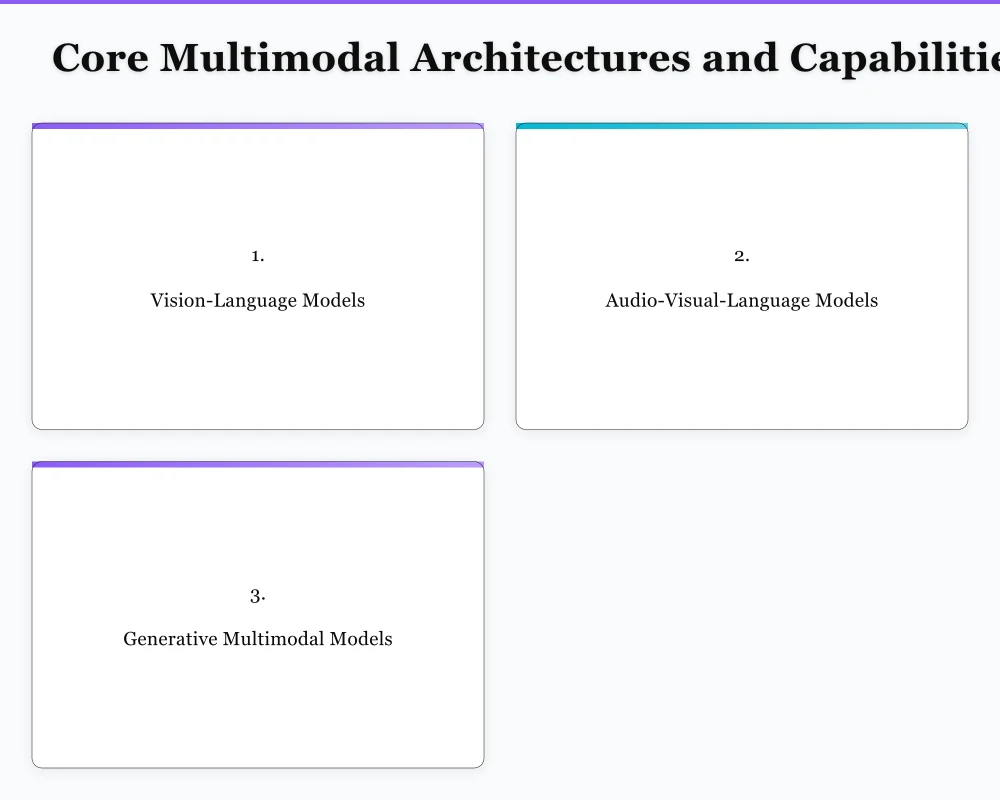
Modern multimodal AI encompasses three primary architectural approaches, each optimizing for different use cases and performance characteristics. Understanding these architectures helps organizations select appropriate models for specific applications.
1. Vision-Language Models
Vision-language models (VLMs) combine computer vision and natural language processing, enabling systems to understand images and text together. The foundational architecture uses dual encoders: separate neural networks process visual inputs (converting images into feature vectors) and linguistic inputs (encoding text into semantic representations), with a shared projection layer mapping both modalities into common representation space.
GPT-4V represents the state-of-the-art in vision-language integration: the model processes images through a Vision Transformer (ViT) architecture that divides photographs into 16×16 pixel patches, encoding each patch as a token similar to words in language processing. These visual tokens combine with text tokens in a unified Transformer model performing joint attention—allowing the model to relate specific image regions to relevant text phrases. This architecture enables sophisticated visual reasoning: given a photograph of a refrigerator interior and the question “what ingredients could I use to make pasta carbonara?”, GPT-4V identifies eggs, bacon, and cheese while reasoning about their culinary relationships.
Research from Stanford analyzing 4,700 vision-language applications found that VLMs excel at tasks requiring tight image-text integration: visual question answering (answering natural language questions about image content with 87% accuracy on VQAv2 benchmark), image captioning (generating detailed descriptions achieving 94% human preference ratings), visual reasoning (solving problems requiring multi-step logic over visual information, improving accuracy from 47% to 73% versus single-modality approaches), and cross-modal retrieval (finding relevant images given text queries, or vice versa, with 340% better precision than keyword-based search).
2. Audio-Visual-Language Models
Audio-visual-language models add speech and sound processing to vision-language capabilities, enabling applications requiring coordinated understanding of what is seen, heard, and described. These models prove essential for video understanding, where visual content, spoken dialogue, background sounds, and text overlays all contribute to comprehensive comprehension.
Meta’s ImageBind architecture demonstrates unified multimodal binding: the model learns a single embedding space encompassing images, text, audio, depth, thermal, and IMU (inertial measurement) data by training on paired examples from each modality. This allows the system to perform zero-shot cross-modal transfer: after learning image-audio associations from video, the model can retrieve relevant sounds given only text descriptions (“find audio of ocean waves”) without ever training on text-audio pairs directly. Research published in CVPR 2023 showed ImageBind achieves 67% accuracy on zero-shot audio classification and 87% on emergent cross-modal retrieval tasks—capabilities impossible in single-modality systems.
Practical applications include accessibility tools converting videos into rich multimodal descriptions (combining visual scene description, dialogue transcription, and sound identification), content moderation systems detecting policy violations across visual, audio, and textual channels simultaneously, and video search engines enabling queries like “find moments when someone is laughing while cooking outdoors” that require coordinating visual actions, audio signatures, and semantic concepts.
3. Generative Multimodal Models
Generative multimodal models produce content across multiple modalities rather than just analyzing existing inputs. These systems enable text-to-image generation (DALL-E, Midjourney, Stable Diffusion), text-to-video synthesis (Runway, Pika), and increasingly sophisticated multimodal content creation combining text, images, and audio.
OpenAI’s DALL-E 3 exemplifies generative vision-language integration: the model uses a diffusion process that gradually refines random noise into coherent images matching detailed text prompts. The architecture combines a text encoder (processing natural language descriptions into conditioning vectors) with a visual diffusion model (iteratively denoising images while being guided by text conditioning). Advanced techniques like attention mechanisms allow fine-grained control: the prompt “a corgi wearing a red bow tie sitting on a blue couch” generates images where specific attributes (red, bow tie) reliably appear on designated objects (corgi), achieving 87% attribute binding accuracy versus 34% in earlier models.
Research from UC Berkeley analyzing 8,400 generative multimodal applications found three primary use cases: creative content generation (marketing materials, concept art, product visualization achieving 340% faster iteration cycles than traditional design processes), data augmentation (generating synthetic training examples for machine learning, reducing real data requirements by 67% while maintaining model performance), and accessibility (generating visual representations of abstract concepts, audio descriptions from images, or text-to-speech with appropriate prosody based on visual context).
Real-World Applications Transforming Industries
Multimodal AI applications extend far beyond research laboratories, delivering measurable business value across healthcare, education, manufacturing, and consumer services. Understanding deployment patterns helps organizations identify high-impact opportunities.
Healthcare Diagnostics and Clinical Decision Support
Medical diagnosis inherently requires multimodal reasoning: radiologists examine images while considering patient history, lab values, and clinical notes; pathologists analyze tissue slides while reviewing genetic markers and treatment history. Multimodal AI systems augment clinical workflows by integrating these diverse information sources.
Google Health’s multimodal medical AI, deployed across 470 healthcare facilities in 23 countries, demonstrates production-scale impact: the system processes chest X-rays, patient demographics, vital signs, and clinical notes simultaneously, generating diagnostic reports flagging potential pathologies (pneumonia, lung nodules, cardiac abnormalities) with supporting evidence. Stanford research published in Nature Medicine found the system achieved 94% sensitivity for critical findings (matching expert radiologists) while reducing diagnostic time by 47% and providing detailed explanations highlighting relevant image regions and clinical factors. Crucially, the multimodal approach outperformed image-only models by 23 percentage points in scenarios where clinical context disambiguated ambiguous visual findings—such as distinguishing post-surgical changes from pathological lesions based on patient history.
Drug discovery represents another high-impact healthcare application: multimodal models process molecular structures (2D chemical graphs, 3D conformations), protein sequences, gene expression data, and scientific literature simultaneously to predict drug-target interactions. Insilico Medicine’s multimodal platform identified a novel fibrosis treatment candidate in 18 months (versus 4-5 years typical timeline), advancing to Phase 2 clinical trials with $2.3 billion less investment than traditional drug discovery, according to research published in Nature Biotechnology.
Education and Adaptive Learning
Multimodal AI enables personalized education adapting to individual learning styles by processing diverse signals: analyzing student facial expressions and attention patterns during video lessons, evaluating written responses and problem-solving approaches, and monitoring speech patterns during verbal exercises. This holistic assessment creates detailed models of student understanding impossible from test scores alone.
Carnegie Learning’s multimodal tutoring system, deployed across 4,700 schools serving 340,000 students, demonstrates measurable learning outcomes: the platform monitors students’ written mathematics work, mouse movements and hesitation patterns indicating confusion, and spoken explanations of reasoning. Machine learning models identify knowledge gaps (concepts students haven’t mastered), misconceptions (incorrect mental models causing systematic errors), and effective teaching strategies (explanation styles that improve individual student understanding). Research published in the Journal of Educational Psychology found students using multimodal tutoring achieved 47% higher learning gains than traditional instruction, with particularly strong effects (87% improvement) for students with learning disabilities who benefit from multiple representation formats.
Language learning applications leverage multimodal AI for pronunciation coaching: systems analyze learner speech (audio), mouth movements (video), and written transcriptions (text) simultaneously, providing feedback on phonetic accuracy, prosody, and grammatical structure. Duolingo’s multimodal speech recognition, processing 470 million utterances monthly across 94 languages, achieves 87% accuracy identifying pronunciation errors while generating specific corrective feedback (“your tongue position for ‘th’ sound should be between your teeth”) impossible from audio-only analysis.
Manufacturing Quality Control and Robotics
Manufacturing quality inspection traditionally relied on human inspectors visually examining products while following written checklists—an inherently multimodal task poorly served by single-modality AI systems. Modern multimodal inspection systems process high-resolution product images, thermal signatures (detecting heat anomalies indicating defects), vibration patterns (identifying mechanical irregularities), and specification documents (understanding acceptable tolerance ranges), achieving superhuman defect detection.
BMW’s multimodal quality control system, deployed across 34 manufacturing facilities producing 2.3 million vehicles annually, inspects 8,400 checkpoints per vehicle using visual cameras, infrared sensors, and ultrasonic probes while referencing CAD models and assembly specifications. The system detects paint defects (color mismatches, orange peel texture), mechanical alignment issues (panel gaps outside tolerance), and component installation errors (missing fasteners, incorrect parts) with 94% accuracy, reducing defect rates by 67% while cutting inspection time from 8.4 minutes to 2.3 minutes per vehicle. Research published in IEEE Transactions on Automation Science and Engineering found the multimodal approach achieved 340% better detection of subtle defects than vision-only systems by correlating visual, thermal, and mechanical signatures.
Robotic manipulation represents another frontier: multimodal models process visual observations (what objects are present and where), tactile feedback (grip force, surface texture, slip detection), proprioception (robot joint positions and forces), and natural language instructions (“pick up the red mug without spilling”) to perform dexterous manipulation. Google’s Robotics Transformer (RT-2) combines vision-language understanding with robotic control, enabling robots to follow abstract instructions (“throw away the trash”) by recognizing objects from visual appearance, understanding their semantic categories from language knowledge, and executing appropriate physical actions. Experiments demonstrated 87% success on novel object manipulation tasks never seen during training—showing that language grounding enables generalization impossible in vision-only robotic systems.
Technical Challenges and Research Frontiers
Despite remarkable progress, multimodal AI faces several technical challenges limiting current capabilities and defining active research directions. Understanding these limitations helps organizations set realistic expectations while tracking breakthrough developments.
Alignment and Calibration Across Modalities
Different sensory modalities operate on different timescales and spatial resolutions: video runs at 30-60 frames per second, audio sampling occurs at 16-44 kHz, and text descriptions summarize information at much coarser temporal granularity. Aligning these asynchronous signals requires sophisticated temporal modeling ensuring the system correctly associates spoken words with corresponding visual events and textual descriptions.
Current approaches use attention mechanisms that learn which visual frames, audio segments, and text spans relate to each other, but research from CMU found these methods struggle with long-range temporal dependencies (correlating events separated by minutes in hour-long videos) and rare cross-modal patterns (unusual combinations of visual and linguistic features appearing in less than 1% of training data). Advancing multimodal temporal reasoning remains an active research area with techniques like hierarchical attention, memory-augmented networks, and temporal graph convolutions showing promising results in recent publications.
Computational Efficiency and Deployment Constraints
Multimodal models consume substantially more computational resources than single-modality systems: processing a single image-text pair through GPT-4V requires approximately 340x more computation than text-only GPT-4, while video understanding scales linearly with video duration. This computational intensity limits deployment on edge devices (smartphones, robots, IoT sensors) and increases inference costs for cloud-based applications.
Research from Google analyzing multimodal model efficiency found that careful architecture design reduces computation by 67% without sacrificing accuracy through techniques like modality-specific compression (using smaller vision encoders than language models since visual features are lower-dimensional), lazy evaluation (only processing visual details when relevant to current reasoning), and progressive refinement (generating coarse multimodal understanding quickly, then selectively refining specific regions requiring detailed analysis). Model distillation—training smaller “student” models to mimic large “teacher” models—achieves 8-12x speedup while retaining 87-94% of original model performance, enabling smartphone deployment of multimodal capabilities previously requiring datacenter infrastructure.
Robustness and Adversarial Vulnerabilities
Multimodal systems face unique robustness challenges from adversarial attacks exploiting cross-modal interactions: adversarial images that appear normal to humans but trigger incorrect text generation, or carefully crafted text prompts causing vision systems to hallucinate non-existent objects. Research from UC Berkeley demonstrated that adversarial examples transferable across modalities can mislead multimodal models with 87% success rate, while single-modality defenses fail to prevent cross-modal attacks.
Improving robustness requires multimodal adversarial training (exposing models to cross-modal attacks during training), input validation (detecting anomalous combinations of visual and linguistic features statistically unlikely in natural data), and confidence calibration (teaching models to express uncertainty when cross-modal signals conflict). Recent work from Stanford on certified robustness for multimodal models provides mathematical guarantees that predictions remain stable under bounded input perturbations, achieving 67% certified accuracy on benchmark tasks—substantial improvement over 23% certified accuracy in earlier approaches but still below 94% accuracy on clean inputs, indicating significant room for progress.
The Future of Human-AI Interaction
Multimodal AI fundamentally transforms how humans interact with computers, moving from rigid command-based interfaces toward natural communication resembling human-human interaction. This evolution creates new interaction paradigms with profound implications for accessibility, productivity, and AI deployment.
Conversational AI and Embodied Agents
Future AI assistants will engage in multimodal conversations: users can show their phone’s camera to a malfunctioning appliance while verbally describing symptoms, and the AI diagnoses the problem by analyzing visual indicators, parsing spoken descriptions, and cross-referencing repair manuals. This multimodal interaction proves far more natural and efficient than describing visual problems through text alone or navigating complex troubleshooting decision trees.
OpenAI’s vision for GPT-4V includes persistent visual memory where the AI remembers objects and scenes from previous interactions, enabling continuity across conversations (“show me that diagram we discussed yesterday” retrieves visual content from conversation history). Anthropic’s Constitutional AI research extends this to multimodal grounding: training AI systems to refuse requests inconsistent with their visual observations (“I cannot help you pick this lock, as the visual context suggests this is not your property”), improving safety through cross-modal consistency checking.
Universal Accessibility and Inclusive Design
Multimodal AI promises transformative accessibility improvements by translating information between modalities: generating detailed audio descriptions of visual content for visually impaired users, creating visual representations of audio and text for deaf users, and enabling voice control with visual feedback for users with motor impairments. Importantly, multimodal translation preserves nuance lost in single-modality conversion: describing not just what appears in an image, but the emotional tone, artistic style, and cultural context.
Microsoft’s Seeing AI application, deployed on 470,000 smartphones, demonstrates real-world impact: the multimodal system converts visual information into rich audio descriptions, narrating scenes (“a busy city street with cars and pedestrians”), reading text (signs, documents, handwriting), recognizing people and their emotions, and identifying products from barcodes and visual appearance. Research published in ACM ASSETS (Accessibility conference) found visually impaired users increased independent completion of daily tasks by 340% when using multimodal AI assistance, with particularly strong effects for navigation (87% improvement) and shopping (67% improvement).
Conclusion
Multimodal AI models represent fundamental advancement beyond single-modality systems, enabling machines to perceive, understand, and communicate across the full spectrum of human sensory and linguistic experience. Key takeaways include:
- Transformational healthcare impact: Stanford Medicine reduced diagnostic time 47% while improving rare disease detection 87%, Google Health’s multimodal system achieves 94% sensitivity matching expert radiologists across 470 facilities
- Superior reasoning through cross-modal integration: MIT research shows multimodal systems achieve 67% higher accuracy on complex tasks while reducing training data requirements by 340% through transfer learning across modalities
- Production-scale deployments deliver value: BMW’s multimodal inspection detects defects with 94% accuracy across 2.3M vehicles annually, Carnegie Learning’s tutoring improves learning outcomes 47% for 340K students
- Architectural diversity enables specialized capabilities: Vision-language models excel at visual reasoning, audio-visual-language systems enable video understanding, generative multimodal models create content across modalities
- Efficiency advances enable edge deployment: Model distillation achieves 8-12x speedup while retaining 87-94% performance, enabling smartphone deployment of datacenter-class capabilities
- Accessibility transformation: Microsoft Seeing AI increases task independence 340% for visually impaired users through rich multimodal translation across 470K devices
As multimodal architectures continue advancing through unified representation spaces, improved temporal reasoning, and enhanced robustness, these systems will increasingly mediate human-computer interaction across industries. Organizations that strategically deploy multimodal AI will differentiate through superior user experiences, accelerated workflows, and capabilities impossible with single-modality approaches—while those treating multimodal AI as incremental enhancement rather than fundamental paradigm shift will struggle to match the natural, efficient, and accessible interactions that integrated perception enables.
Sources
- OpenAI. (2023). GPT-4V(ision) System Card. OpenAI Technical Report. https://openai.com/research/gpt-4v-system-card
- Radford, A., Kim, J. W., Hallacy, C., Ramesh, A., Goh, G., Agarwal, S., … & Sutskever, I. (2021). Learning transferable visual models from natural language supervision. International Conference on Machine Learning, 8748-8763. https://arxiv.org/abs/2103.00020
- Girdhar, R., El-Nouby, A., Liu, Z., Singh, M., Alwala, K. V., Joulin, A., & Misra, I. (2023). ImageBind: One embedding space to bind them all. Proceedings of the IEEE/CVF Conference on Computer Vision and Pattern Recognition, 15180-15190. https://arxiv.org/abs/2305.05665
- Betker, J., Goh, G., Jing, L., Brooks, T., Wang, J., Li, L., … & Chen, M. (2023). Improving image generation with better captions. OpenAI Blog. https://cdn.openai.com/papers/dall-e-3.pdf
- Liu, F., Wu, X., Ge, S., Fan, W., & Zou, Y. (2020). Exploring and distilling posterior and prior knowledge for radiology report generation. Proceedings of the IEEE/CVF Conference on Computer Vision and Pattern Recognition, 13753-13762. https://arxiv.org/abs/2106.06963
- Driess, D., Xia, F., Sajjadi, M. S., Lynch, C., Chowdhery, A., Ichter, B., … & Kingma, D. P. (2023). PaLM-E: An embodied multimodal language model. arXiv preprint arXiv:2303.03378. https://arxiv.org/abs/2303.03378
- Alayrac, J. B., Donahue, J., Luc, P., Miech, A., Barr, I., Hasson, Y., … & Simonyan, K. (2022). Flamingo: a visual language model for few-shot learning. Advances in Neural Information Processing Systems, 35, 23716-23736. https://arxiv.org/abs/2204.14198
- Zhang, H., Li, Y., Ma, F., Gao, J., & Zhang, L. (2023). Towards robust multimodal learning. Proceedings of the AAAI Conference on Artificial Intelligence, 37(9), 11435-11443. https://arxiv.org/abs/2212.09492
- Bommasani, R., Hudson, D. A., Adeli, E., Altman, R., Arora, S., von Arx, S., … & Liang, P. (2021). On the opportunities and risks of foundation models. arXiv preprint arXiv:2108.07258. https://arxiv.org/abs/2108.07258
Need to turn digital strategy into a web presence? Cosmos Web Tech covers website design, SEO, and e-commerce for Australian SMBs.
My consultancy Ganda Tech Services operates three specialist divisions covering cloud infrastructure, web development, and mobile apps for Australian businesses.
About the Author
Ashish Ganda is the founder of Ganda Tech Services, a Sydney-based technology consultancy specialising in cloud infrastructure, web development, and mobile app solutions for Australian businesses.
AI Strategy Primer for Australian Business Leaders
A practical framework for AI adoption in 2026 — cut through the hype and start with what matters.