Mitigating Potential Harms of Custom LLM Models: A Comprehensive Approach
Introduction
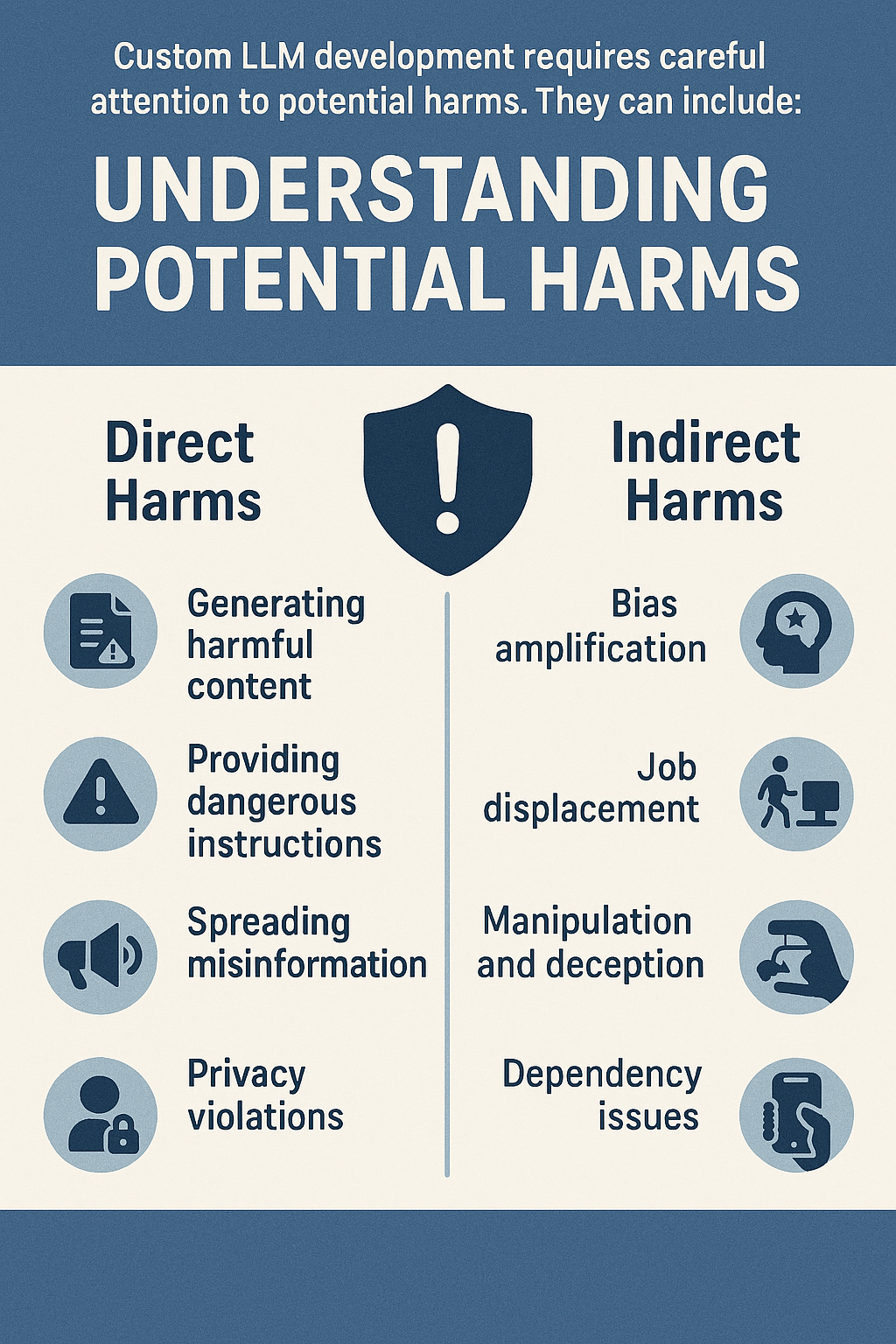
Custom LLM development requires careful attention to potential harms. This guide outlines a comprehensive mitigation approach.
Understanding Potential Harms
Direct Harms
- Generating harmful content
- Providing dangerous instructions
- Spreading misinformation
- Privacy violations
Indirect Harms
- Bias amplification
- Job displacement
- Manipulation and deception
- Dependency issues
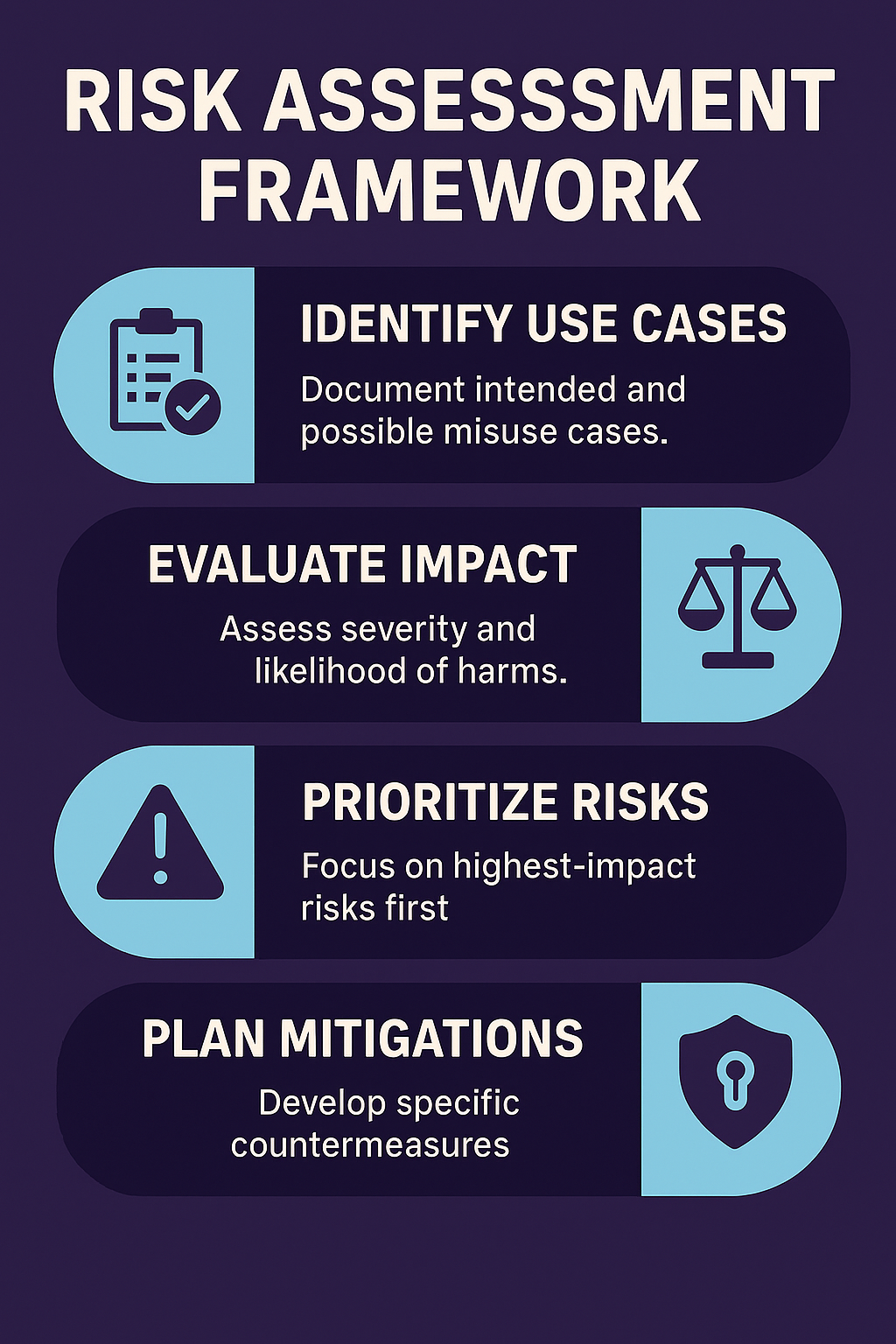
Risk Assessment Framework
Identify Use Cases
Document intended and possible misuse cases.
Evaluate Impact
Assess severity and likelihood of harms.
Prioritize Risks
Focus on highest-impact risks first.
Plan Mitigations
Develop specific countermeasures.
Technical Mitigations
Training Data Curation
- Filter harmful content
- Balance datasets
- Document data sources
Output Filtering
- Safety classifiers
- Content moderation
- Response constraints
Monitoring
- Usage logging
- Anomaly detection
- Feedback loops
Process Mitigations
Red Teaming
Deliberately test for vulnerabilities.
Human Oversight
Appropriate human involvement in decisions.
Incident Response
Plans for addressing problems.
Continuous Improvement
Learn from issues and update.
Governance Framework
Policies
Clear guidelines for development and use.
Accountability
Defined responsibilities.
Documentation
Thorough records of decisions.
External Review
Independent assessment of systems.
Best Practices
- Build safety into development from the start
- Test extensively before deployment
- Monitor continuously in production
- Respond quickly to issues
- Be transparent about limitations
Conclusion
Responsible LLM development requires proactive identification and mitigation of potential harms throughout the lifecycle.
Learn more about AI safety practices.
For the practitioner’s view on mobile app development and app store success, explore Awesome Apps — where strategy meets the app store.
These insights are drawn from my work leading Ganda Tech Services — helping Australian businesses navigate digital transformation through cloud, web, and mobile.
About the Author
Ashish Ganda is the founder of Ganda Tech Services, a Sydney-based technology consultancy specialising in cloud infrastructure, web development, and mobile app solutions for Australian businesses.
AI Strategy Primer for Australian Business Leaders
A practical framework for AI adoption in 2026 — cut through the hype and start with what matters.