Machine Learning Operations: Operationalising AI at Scale
The machine learning capability gap in most enterprises is not in model building — it is in model operations. Data science teams can produce impressive models in Jupyter notebooks, validated against held-out test sets and demonstrating compelling accuracy metrics. But the distance from a notebook to a production system serving predictions reliably, at scale, with appropriate monitoring and governance, remains a chasm that most organisations have not bridged.
Gartner’s estimate that only a fraction of machine learning projects make it to production is frequently cited, and while the exact percentage is debatable, the underlying reality is not. Enterprises invest heavily in data science talent and compute infrastructure for model development, then struggle to realise value because the operational infrastructure, processes, and skills needed to deploy and manage models in production are underdeveloped.
MLOps — the application of DevOps principles to machine learning systems — addresses this gap. It encompasses the practices, tools, and organisational structures needed to reliably deploy, monitor, retrain, and govern machine learning models throughout their lifecycle. For the CTO, MLOps is the bridge between AI investment and AI value.
The MLOps Lifecycle
Machine learning systems differ from traditional software in ways that have profound operational implications. Understanding these differences is the starting point for effective MLOps.
Traditional software behaviour is determined by code. If the code is correct and the inputs are valid, the outputs are predictable. Machine learning systems add two additional sources of behaviour: data and models. The same model code, trained on different data, produces different behaviour. A model that performs well today may degrade tomorrow as the real-world data distribution shifts. This means that the operational concerns for ML systems extend beyond code deployment to encompass data management, model training, model evaluation, and continuous monitoring for performance degradation.
The MLOps lifecycle begins with data management — the collection, validation, versioning, and transformation of training data. Data quality directly determines model quality, and yet many organisations manage their training data with far less rigour than their code. Data versioning (tracking which data was used to train which model), data validation (detecting anomalies and drift in incoming data), and data lineage (understanding how raw data is transformed into training features) are foundational capabilities.
Feature engineering — the transformation of raw data into the inputs that models consume — is a significant operational challenge at scale. Feature stores, an emerging architectural pattern, address this by providing a centralised repository for computed features that can be shared across models and accessed consistently in both training and serving contexts. Feast (Feature Store) and Tecton are among the platforms addressing this challenge, alongside cloud-native offerings from each major provider.
Model training at enterprise scale requires reproducibility. Every training run should record the code version, data version, hyperparameters, and resulting metrics, enabling any model to be reproduced exactly. Experiment tracking platforms like MLflow, Weights & Biases, and Neptune.ai provide this capability, creating an audit trail of model development that supports both operational debugging and regulatory compliance.
Model evaluation must go beyond aggregate accuracy metrics. Enterprise models must be evaluated for performance across demographic groups (fairness), robustness to input perturbations (adversarial resilience), and behaviour on edge cases identified by domain experts. Automated evaluation pipelines that assess these dimensions before models are promoted to production prevent costly failures.
Model deployment in production requires serving infrastructure that provides low-latency predictions with appropriate scaling. Model serving platforms like TensorFlow Serving, TorchServe, and Seldon Core, along with managed offerings like SageMaker Endpoints and Vertex AI, provide the runtime infrastructure. The deployment pipeline should support canary releases — routing a percentage of traffic to the new model while monitoring for performance degradation before full rollout.
Architecture for Enterprise MLOps
The MLOps architecture must support the full lifecycle while providing appropriate separation of concerns between data science teams and platform teams.
The platform layer provides shared infrastructure that data science teams consume through self-service interfaces. This includes compute infrastructure for training (GPU clusters, managed training services), experiment tracking, model registry, feature store, model serving infrastructure, and monitoring. The platform team owns this infrastructure and provides it as an internal product, much like a Kubernetes platform team provides container orchestration as a service.
The model registry is the central coordination point between development and production. A model registry stores trained model artefacts with metadata including training data version, code version, evaluation metrics, and approval status. Models progress through stages — from development to staging to production — with appropriate quality gates at each transition. MLflow’s model registry provides this capability, and cloud-native alternatives exist on each major platform.
The monitoring layer must address multiple dimensions. Infrastructure monitoring covers the health of serving infrastructure — latency, throughput, error rates, and resource utilisation. Model performance monitoring tracks prediction quality over time, comparing real-world outcomes against model predictions to detect degradation. Data monitoring watches for drift in the input data distribution — a shift in the statistical properties of incoming data that may indicate the model is being applied to a population different from its training data.
Automated retraining pipelines respond to detected degradation by triggering model retraining on fresh data, followed by automated evaluation and, if quality gates are met, deployment. This creates a continuous improvement loop that maintains model performance without manual intervention. The sophistication of the retraining trigger — from simple scheduled retraining to drift-detected retraining — increases with organisational maturity.
Organisational Models
The organisational structure for MLOps typically evolves through three stages.
In the embedded model, data scientists handle the full lifecycle including deployment and monitoring. This works for organisations with a small number of models but does not scale — data scientists spending time on infrastructure operations are not developing new models.
In the centralised model, a dedicated ML engineering team manages the operational aspects of the lifecycle — deployment, monitoring, retraining infrastructure — for all models across the organisation. This provides specialisation but can create a bottleneck if the team’s capacity does not scale with the organisation’s model portfolio.
In the platform model, a platform team provides self-service MLOps infrastructure that data science teams use to manage their own model lifecycle. The platform team focuses on tooling and automation that reduces the operational skill required. Data science teams retain ownership of their models through production but use standardised tooling for deployment, monitoring, and retraining.
The platform model is the target state for most enterprises, but reaching it requires maturation through the earlier stages. Attempting to build a comprehensive MLOps platform before the organisation has operational experience with production ML systems leads to platforms that do not address actual needs.
Governance and Compliance
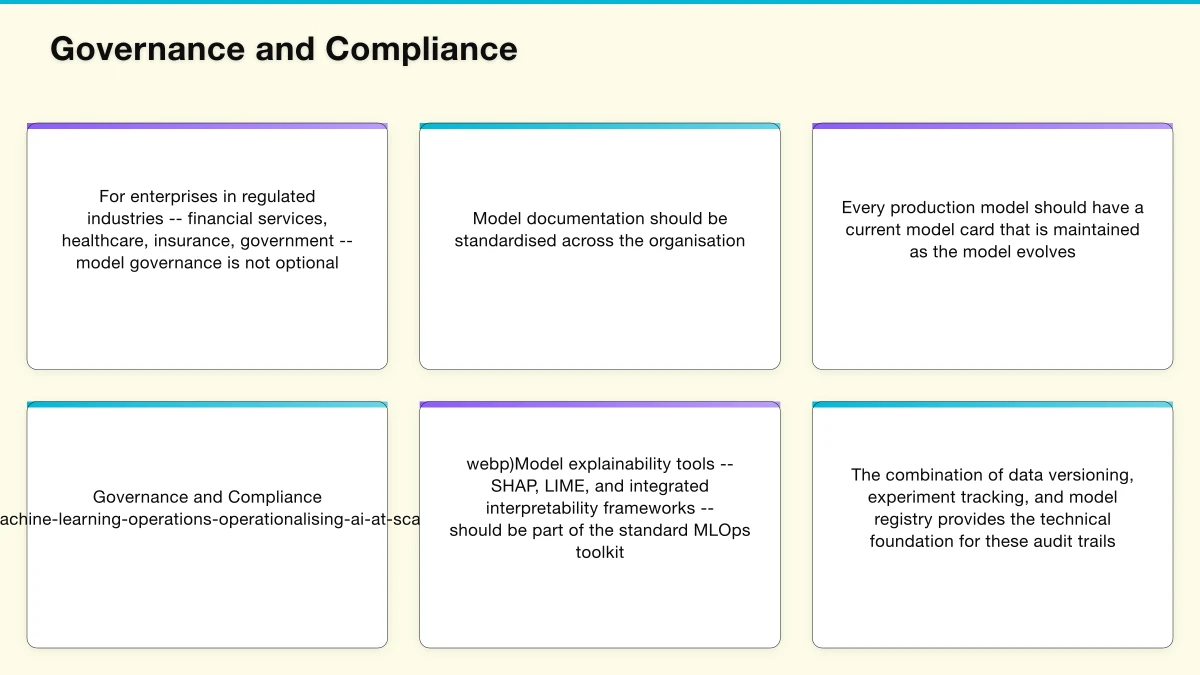
For enterprises in regulated industries — financial services, healthcare, insurance, government — model governance is not optional. Regulators increasingly expect that organisations can explain how their models work, demonstrate that they are fair and unbiased, and produce audit trails of model development and deployment decisions.
Model documentation should be standardised across the organisation. Model cards, a concept introduced by Google researchers, provide a structured format for documenting a model’s intended use, training data, evaluation metrics, ethical considerations, and limitations. Every production model should have a current model card that is maintained as the model evolves.
Model explainability tools — SHAP, LIME, and integrated interpretability frameworks — should be part of the standard MLOps toolkit. For models that influence decisions about individuals (credit, insurance, hiring), explainability is both an ethical imperative and a regulatory requirement.
Audit trails must capture the complete provenance of every production model — from training data through feature engineering, model training, evaluation, and deployment. The combination of data versioning, experiment tracking, and model registry provides the technical foundation for these audit trails.
The CTO who builds MLOps as a strategic capability — not just a deployment mechanism — positions the organisation to capture value from its AI investments while managing the risks that production ML systems create. This is the operational foundation that determines whether AI remains an expensive experiment or becomes a scalable competitive advantage.
Mobile execution is where many digital strategies come to life. Awesome Apps publishes practical guides on app development and mobile UX.
Ash Ganda is the founder of Ganda Tech Services, a Sydney-based technology consultancy delivering cloud, web, and mobile solutions for Australian businesses.
About the Author
Ashish Ganda is the founder of Ganda Tech Services, a Sydney-based technology consultancy specialising in cloud infrastructure, web development, and mobile app solutions for Australian businesses.
AI Strategy Primer for Australian Business Leaders
A practical framework for AI adoption in 2026 — cut through the hype and start with what matters.