Kubernetes Security Best Practices for Enterprise: A CTO's Strategic Guide for 2025
Kubernetes has become the de facto standard for container orchestration across enterprise IT. Gartner projects that by the end of this year, 85% of global organisations will be running containerised applications in production, with Kubernetes managing the vast majority of those workloads. This ubiquity brings both opportunity and risk.
The attack surface Kubernetes presents is substantial and fundamentally different from traditional infrastructure. Clusters are dynamic, with workloads spinning up and down continuously. Network boundaries are fluid. Multiple tenants share infrastructure. Supply chains extend through countless container images and third-party components. Traditional security approaches designed for static, perimeter-based environments simply do not translate.
For CTOs responsible for enterprise security posture, Kubernetes demands strategic attention. The misconfiguration rate remains alarmingly high; a Red Hat survey released this January found that 67% of organisations experienced at least one serious security incident related to Kubernetes in the past year. Most incidents trace back to preventable misconfigurations rather than sophisticated attacks.
This guide examines the security controls that matter most for enterprise Kubernetes deployments, organised around the layers of defence that comprise a comprehensive security strategy.
The Kubernetes Threat Landscape
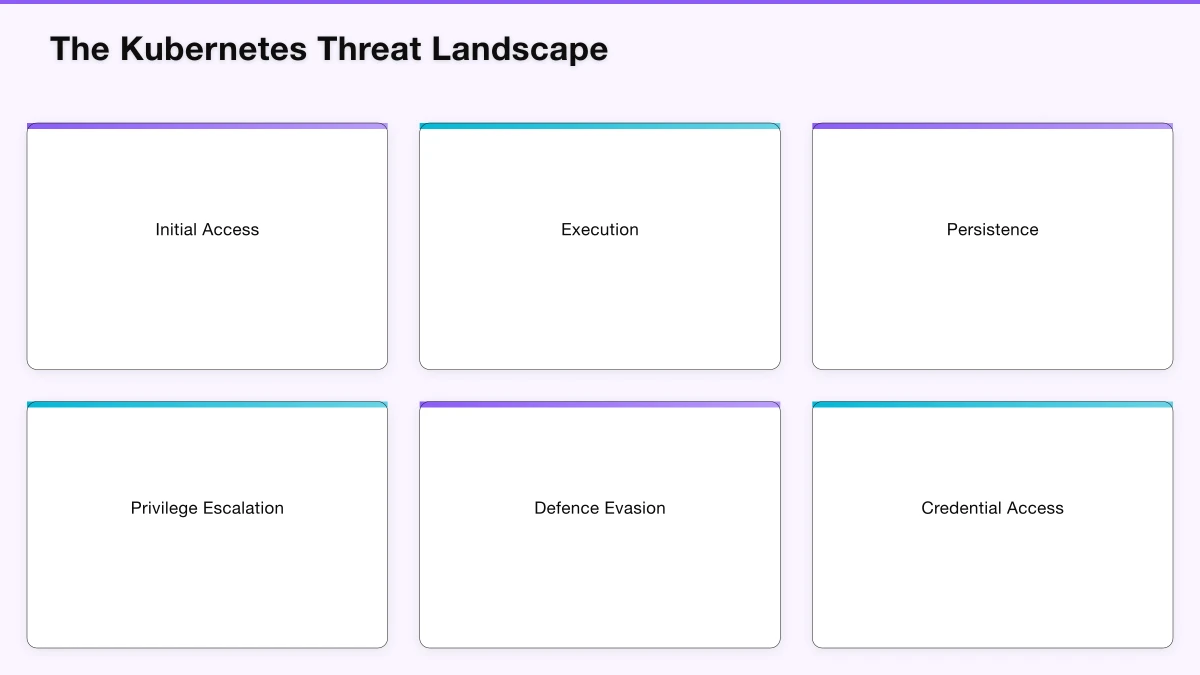
Understanding Kubernetes security requires clarity about the threats you are defending against. The MITRE ATT&CK framework for containers identifies nine primary attack vectors:
Initial Access: Attackers gain entry through exposed dashboards, vulnerable APIs, compromised images, or stolen credentials. The Kubernetes API server, if exposed without proper authentication, provides complete cluster control.
Execution: Once inside, attackers execute malicious code through compromised pods, privileged containers, or exploited vulnerabilities in running applications.
Persistence: Attackers maintain access through malicious images, modified configurations, or backdoor services that survive pod restarts.
Privilege Escalation: Container escapes, service account token theft, and misconfigured RBAC enable attackers to expand from initial foothold to cluster-wide control.
Defence Evasion: Attackers hide their presence by disabling logging, modifying audit configurations, or operating within legitimate-looking workloads.
Credential Access: Service account tokens, secrets stored in etcd, and cloud provider credentials present high-value targets.
Discovery: Attackers enumerate cluster resources, network topology, and available services to identify valuable targets.
Lateral Movement: Pod-to-pod communication, service exploitation, and network pivoting enable attackers to spread across the cluster.
Impact: Finally, attackers achieve their objectives through cryptomining, data exfiltration, service disruption, or ransomware.
Effective security addresses each vector through layered defences, accepting that no single control prevents all attacks.
Cluster Hardening
The foundation of Kubernetes security is a properly hardened cluster. Default configurations prioritise convenience over security, requiring deliberate hardening for enterprise deployments.
API Server Security
The Kubernetes API server is the primary control plane interface. Compromising the API server means compromising the entire cluster.
Authentication Requirements: Never run production clusters with anonymous authentication enabled. Implement strong authentication through OIDC integration with enterprise identity providers. Service accounts should use bound tokens with limited lifetime rather than non-expiring secrets.
# API server authentication flags
--anonymous-auth=false
--oidc-issuer-url=https://identity.enterprise.com
--oidc-client-id=kubernetes
--oidc-username-claim=email
--oidc-groups-claim=groups
Authorisation Configuration: Enable RBAC and disable legacy ABAC. Implement admission controllers to enforce policies at resource creation time.
--authorization-mode=Node,RBAC
--enable-admission-plugins=NodeRestriction,PodSecurityAdmission,ValidatingAdmissionWebhook
API Server Network Exposure: The API server should never be directly exposed to the internet. Use private endpoints, VPN access, or bastion hosts for administrative access. Cloud providers offer private cluster configurations that eliminate public API endpoints entirely.
etcd Protection
etcd stores all cluster state and secrets. Its compromise exposes everything in the cluster.
Encryption at Rest: Enable encryption for etcd data, particularly secrets. Configure encryption providers in the API server:
apiVersion: apiserver.config.k8s.io/v1
kind: EncryptionConfiguration
resources:
  - resources:
      - secrets
      - configmaps
    providers:
      - aescbc:
          keys:
            - name: key1
              secret: <base64-encoded-key>
      - identity: {}
Network Isolation: etcd should only be accessible from API servers. Implement mutual TLS for all etcd communication. Never expose etcd ports beyond the control plane network.
Backup Security: etcd backups contain cluster secrets. Encrypt backups and restrict access to backup storage.
Kubelet Security
Kubelets run on every node and manage container execution. Vulnerable kubelets enable node compromise.
Authentication and Authorisation: Enable kubelet authentication and webhook authorisation:
--authentication-token-webhook=true
--authorization-mode=Webhook
--anonymous-auth=false
Read-Only Port: Disable the read-only port that exposes metrics without authentication:
--read-only-port=0Node Restriction: The NodeRestriction admission plugin limits kubelet access to only resources on their own nodes, preventing compromised nodes from affecting the broader cluster.
Workload Security
Cluster hardening establishes the foundation; workload security protects what runs on the cluster.
Pod Security Standards
Kubernetes Pod Security Standards define three profiles governing pod security contexts:
Privileged: Unrestricted, allowing known privilege escalations. Appropriate only for system-level workloads with explicit justification.
Baseline: Minimally restrictive policy preventing known privilege escalations. Blocks hostNetwork, hostPID, hostIPC, privileged containers, and most host path mounts.
Restricted: Heavily restrictive policy following current hardening best practices. Requires non-root users, drops all capabilities, and restricts volume types.
Enforce these standards through the PodSecurity admission controller:
apiVersion: v1
kind: Namespace
metadata:
  name: production-workloads
  labels:
    pod-security.kubernetes.io/enforce: restricted
    pod-security.kubernetes.io/audit: restricted
    pod-security.kubernetes.io/warn: restricted
Enterprise deployments should enforce Restricted or Baseline profiles for application workloads, reserving Privileged for infrastructure components with explicit security review.
Security Context Configuration
Individual workloads should specify security contexts that minimise privileges:
apiVersion: v1
kind: Pod
metadata:
  name: secure-app
spec:
  securityContext:
    runAsNonRoot: true
    runAsUser: 1000
    runAsGroup: 1000
    fsGroup: 1000
    seccompProfile:
      type: RuntimeDefault
  containers:
    - name: app
      image: secure-registry/app:v1.2.3
      securityContext:
        allowPrivilegeEscalation: false
        readOnlyRootFilesystem: true
        capabilities:
          drop:
            - ALL
      resources:
        limits:
          cpu: 500m
          memory: 512Mi
        requests:
          cpu: 100m
          memory: 128Mi
Key configurations include:
- runAsNonRoot: Prevents containers from running as root
- readOnlyRootFilesystem: Prevents filesystem modifications
- allowPrivilegeEscalation: Blocks privilege escalation attacks
- capabilities drop ALL: Removes Linux capabilities not explicitly needed
- seccompProfile: Applies syscall filtering
- Resource limits: Prevents resource exhaustion attacks
Runtime Security
Runtime security tools monitor container behaviour and block suspicious activity:
Falco: Open-source runtime security tool detecting anomalous behaviour through kernel-level monitoring. Detects shell executions in containers, sensitive file access, privilege escalations, and network anomalies.
Tetragon: eBPF-based security observability and enforcement from Isovalent. Provides deep visibility into process execution, file access, and network activity with enforcement capabilities.
Commercial Solutions: Aqua Security, Sysdig Secure, and Prisma Cloud provide comprehensive runtime protection with policy libraries, threat intelligence integration, and compliance reporting.
Runtime security should integrate with incident response workflows, triggering alerts that security teams can investigate and respond to rapidly.
Network Security
Kubernetes networking defaults to allow-all communication between pods. This simplifies initial deployment but creates significant lateral movement risk.
Network Policies
Network policies restrict pod-to-pod communication, implementing microsegmentation within the cluster:
apiVersion: networking.k8s.io/v1
kind: NetworkPolicy
metadata:
  name: api-ingress-policy
  namespace: production
spec:
  podSelector:
    matchLabels:
      app: api-service
  policyTypes:
    - Ingress
    - Egress
  ingress:
    - from:
        - podSelector:
            matchLabels:
              app: web-frontend
        - namespaceSelector:
            matchLabels:
              name: monitoring
      ports:
        - protocol: TCP
          port: 8080
  egress:
    - to:
        - podSelector:
            matchLabels:
              app: database
      ports:
        - protocol: TCP
          port: 5432
    - to:
        - namespaceSelector: {}
          podSelector:
            matchLabels:
              k8s-app: kube-dns
      ports:
        - protocol: UDP
          port: 53
Effective network policy implementation requires:
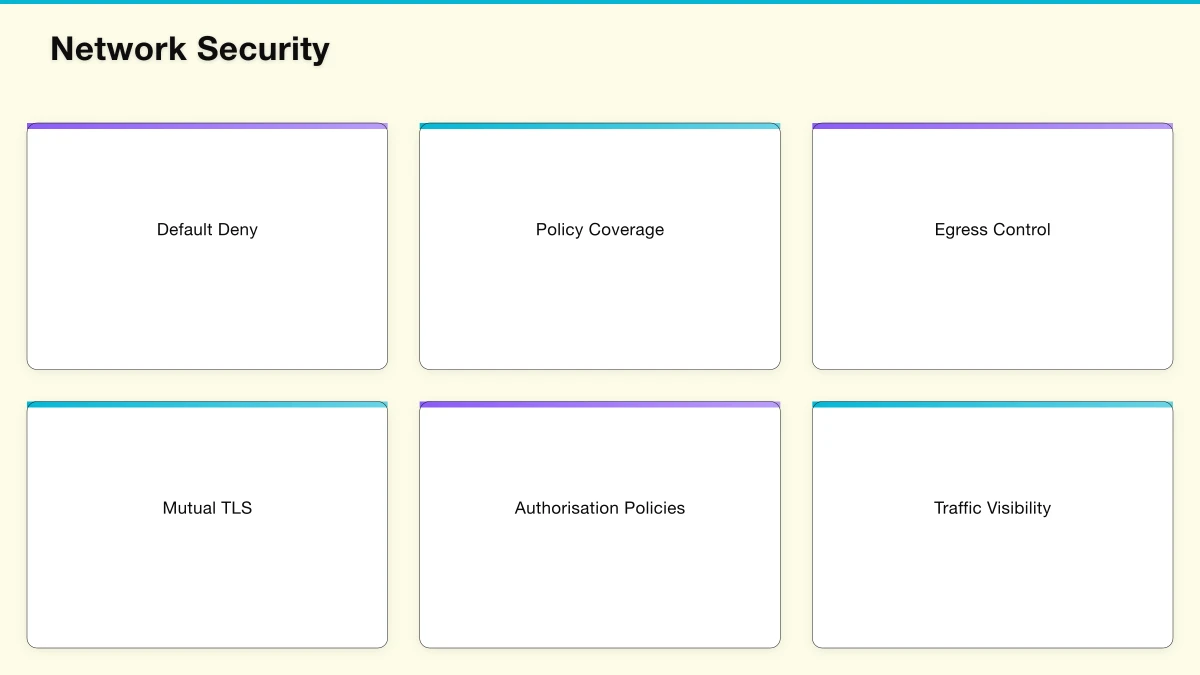
Default Deny: Start with default deny policies for both ingress and egress, then explicitly allow required communication:
apiVersion: networking.k8s.io/v1
kind: NetworkPolicy
metadata:
  name: default-deny-all
  namespace: production
spec:
  podSelector: {}
  policyTypes:
    - Ingress
    - Egress
Policy Coverage: Every namespace should have network policies. Use admission controllers or policy engines to enforce this requirement.
Egress Control: Egress policies are often overlooked but critical for preventing data exfiltration and command-and-control communication.
Service Mesh Security
Service meshes like Istio, Linkerd, and Cilium provide additional network security capabilities:
Mutual TLS: Automatic encryption and authentication for all service-to-service communication. Eliminates cleartext traffic within the cluster.
Authorisation Policies: Fine-grained access control based on service identity, request attributes, and JWT claims.
Traffic Visibility: Complete visibility into service communication patterns, enabling detection of anomalous traffic.
Service mesh adoption continues growing, with CNCF survey data showing 45% of organisations using service mesh in production as of late 2023. For enterprises with complex microservice architectures, service mesh provides security capabilities difficult to achieve otherwise.
Secrets Management
Kubernetes secrets are base64 encoded by default, providing no actual security. Enterprise deployments require proper secrets management.
External Secrets Management
Integrate Kubernetes with external secrets management systems:
HashiCorp Vault: Industry-leading secrets management with dynamic secrets, encryption as a service, and comprehensive audit logging. Vault integration through the Vault Agent injector or External Secrets Operator.
Cloud Provider Solutions: AWS Secrets Manager, Azure Key Vault, and Google Cloud Secret Manager provide managed secrets with Kubernetes integration through CSI drivers or External Secrets Operator.
External Secrets Operator: Kubernetes operator synchronising external secrets into Kubernetes secrets:
apiVersion: external-secrets.io/v1beta1
kind: ExternalSecret
metadata:
  name: database-credentials
spec:
  refreshInterval: 1h
  secretStoreRef:
    name: vault-backend
    kind: SecretStore
  target:
    name: database-credentials
  data:
    - secretKey: username
      remoteRef:
        key: database/creds/production
        property: username
    - secretKey: password
      remoteRef:
        key: database/creds/production
        property: password
Secrets Best Practices
Rotation: Implement automatic secrets rotation. Static credentials should have limited lifetimes with automatic renewal.
Scope Limitation: Apply principle of least privilege to secrets access. Service accounts should only access secrets they require.
Audit Logging: Enable audit logging for all secrets access. Investigate unusual access patterns.
Avoid Environment Variables: Environment variables are visible in process listings. Use mounted secrets files instead.
GitOps Consideration: Never commit secrets to version control. Use sealed secrets, external secrets references, or separate secrets management workflows.
Supply Chain Security
Container supply chain attacks have emerged as a significant threat vector. The SUNBURST attack demonstrated how supply chain compromises can propagate widely before detection.
Image Security
Trusted Registries: Only pull images from trusted registries. Implement admission policies blocking images from untrusted sources:
apiVersion: admissionregistration.k8s.io/v1
kind: ValidatingAdmissionPolicy
metadata:
  name: trusted-registry-only
spec:
  failurePolicy: Fail
  matchConstraints:
    resourceRules:
      - apiGroups: [""]
        apiVersions: ["v1"]
        operations: ["CREATE", "UPDATE"]
        resources: ["pods"]
  validations:
    - expression: "object.spec.containers.all(c, c.image.startsWith('trusted-registry.enterprise.com/'))"
      message: "Images must be from trusted registry"
Image Scanning: Scan all images for vulnerabilities before deployment. Tools like Trivy, Grype, and commercial scanners identify CVEs in base images and application dependencies. Integrate scanning into CI/CD pipelines with quality gates blocking critical vulnerabilities.
Image Signing: Sign images to verify provenance. Sigstore’s Cosign provides keyless signing integrated with OIDC identity. Policy engines verify signatures before deployment:
apiVersion: policy.sigstore.dev/v1beta1
kind: ClusterImagePolicy
metadata:
  name: require-signed-images
spec:
  images:
    - glob: "**"
  authorities:
    - keyless:
        url: https://fulcio.sigstore.dev
        identities:
          - issuer: https://token.actions.githubusercontent.com
            subject: enterprise/repo@refs/heads/main
SBOM and Attestations
Software Bills of Materials (SBOMs) document image contents, enabling vulnerability tracking across the software lifecycle. Generate SBOMs during image builds and store them alongside images.
Build attestations document how images were created, providing provenance information for supply chain verification. SLSA (Supply chain Levels for Software Artifacts) framework defines attestation requirements for different security levels.
Admission Control
Policy engines enforce supply chain requirements at deployment time:
Kyverno: Kubernetes-native policy engine using YAML policies. Validates, mutates, and generates resources based on policy definitions.
Gatekeeper/OPA: Open Policy Agent integration for Kubernetes. Policies written in Rego language provide powerful constraint definitions.
Sigstore Policy Controller: Verifies image signatures and attestations before allowing deployment.
Layered admission control ensures that only approved, verified images run in production clusters.
Identity and Access Management
Kubernetes RBAC provides fine-grained access control but requires careful configuration to be effective.
RBAC Design Principles
Least Privilege: Grant minimum permissions required for each role. Start with no permissions and add only what is needed.
Role Granularity: Create specific roles for specific functions rather than broad roles with excessive permissions. A developer role should differ from a debugger role should differ from an operator role.
Namespace Scoping: Prefer namespace-scoped roles (Role/RoleBinding) over cluster-scoped roles (ClusterRole/ClusterRoleBinding) where possible.
Avoid Wildcards: Avoid wildcard permissions that grant access to all resources or all verbs. Explicitly enumerate allowed operations.
# Poor practice - overly permissive
rules:
  - apiGroups: ["*"]
    resources: ["*"]
    verbs: ["*"]

# Better practice - explicit permissions
rules:
  - apiGroups: ["apps"]
    resources: ["deployments"]
    verbs: ["get", "list", "watch"]
  - apiGroups: [""]
    resources: ["pods", "pods/log"]
    verbs: ["get", "list"]
Service Account Security
Service accounts provide pod identity within the cluster. Misconfigurations create significant risk:
Disable Auto-Mounting: Disable automatic service account token mounting for pods that do not need Kubernetes API access:
apiVersion: v1
kind: ServiceAccount
metadata:
  name: app-service-account
automountServiceAccountToken: false
Bound Service Account Tokens: Use bound tokens with audience and lifetime restrictions rather than long-lived secrets:
apiVersion: v1
kind: Pod
spec:
  containers:
    - name: app
      volumeMounts:
        - name: token
          mountPath: /var/run/secrets/tokens
  volumes:
    - name: token
      projected:
        sources:
          - serviceAccountToken:
              path: token
              expirationSeconds: 3600
              audience: api
Workload Identity: Cloud providers offer workload identity features that map Kubernetes service accounts to cloud IAM roles, enabling secure cloud API access without long-lived credentials.
Compliance and Audit
Enterprise Kubernetes deployments must demonstrate compliance with regulatory requirements and security standards.
Audit Logging
Enable comprehensive audit logging to capture all API server interactions:
apiVersion: audit.k8s.io/v1
kind: Policy
rules:
  - level: Metadata
    resources:
      - group: ""
        resources: ["secrets", "configmaps"]
  - level: RequestResponse
    resources:
      - group: ""
        resources: ["pods/exec", "pods/attach"]
  - level: Request
    verbs: ["create", "update", "patch", "delete"]
Audit logs should flow to centralised SIEM systems for analysis, alerting, and long-term retention. Correlate Kubernetes audit logs with application logs and cloud provider logs for complete visibility.
Compliance Frameworks
Map Kubernetes security controls to compliance requirements:
CIS Kubernetes Benchmark: Industry-standard security configuration guide. Tools like kube-bench automatically assess cluster compliance with CIS benchmarks.
NIST 800-190: Application Container Security Guide providing comprehensive container security guidance.
SOC 2: Map Kubernetes controls to SOC 2 Trust Services Criteria for organisations requiring SOC 2 compliance.
PCI DSS: Payment card industry requirements impose specific controls for cardholder data environments.
Continuous Compliance
Compliance is not a point-in-time assessment but ongoing assurance:
Policy Enforcement: Admission controllers prevent non-compliant deployments before they occur.
Continuous Scanning: Tools like Kubescape, Checkov, and commercial solutions continuously assess cluster configuration against compliance frameworks.
Drift Detection: Monitor for configuration drift from approved baselines. Alert on unauthorised changes.
Incident Response
Security controls reduce but cannot eliminate incident risk. Preparation for incidents is essential.
Detection Capabilities
Layer detection across multiple telemetry sources:
- Audit logs capturing API interactions
- Runtime security alerts for container behaviour
- Network flow logs for traffic analysis
- Application logs for business logic anomalies
Correlate alerts across sources to identify attack patterns that no single source would reveal.
Response Procedures
Document and practise incident response procedures specific to Kubernetes:
Isolation: How to isolate compromised pods or nodes without affecting broader cluster availability.
Evidence Preservation: How to capture pod state, logs, and network traffic before remediation destroys evidence.
Containment: How to prevent lateral movement while investigation proceeds.
Eradication: How to remove malicious workloads and remediate vulnerabilities.
Recovery: How to restore normal operations and verify cluster integrity.
Forensics Preparation
Enable forensics capabilities before incidents occur:
- Retain logs for investigation timelines
- Enable container runtime verbose logging for compromised pods
- Maintain network flow logs for traffic reconstruction
- Document baseline behaviour for anomaly identification
Strategic Recommendations
For CTOs establishing Kubernetes security programmes:
Start with Fundamentals: Many incidents trace to basic misconfigurations. Ensure cluster hardening, RBAC configuration, and network policies are correct before investing in advanced capabilities.
Automate Policy Enforcement: Manual security processes cannot scale with Kubernetes velocity. Implement admission controllers that prevent misconfigurations at deployment time.
Shift Security Left: Integrate security into development workflows. Developers should receive immediate feedback on security issues during development, not after deployment attempts fail.
Invest in Visibility: You cannot secure what you cannot see. Comprehensive logging, monitoring, and tracing provide the visibility necessary for detection and response.
Build Security Culture: Technology alone is insufficient. Train development teams on Kubernetes security. Create clear guidelines and provide tooling that makes secure practices the easy path.
Plan for Incidents: Assume breaches will occur. Prepare detection, response, and recovery capabilities before they are needed.
Kubernetes security is a journey, not a destination. The threat landscape evolves continuously. New vulnerabilities emerge. Attack techniques advance. Security programmes must evolve correspondingly, continuously improving defences while maintaining operational velocity.
The organisations succeeding with Kubernetes security treat it as a strategic capability rather than a compliance checkbox. They invest in security engineering, integrate security into development culture, and build programmes that scale with their Kubernetes footprint.
Ash Ganda advises enterprise technology leaders on cloud security, DevSecOps, and infrastructure architecture. Connect on LinkedIn for ongoing insights on securing modern infrastructure.
For technical deep-dives on the cloud and IT topics I cover strategically, visit Cloud Geeks — our specialist IT infrastructure blog.
My consultancy Ganda Tech Services operates three specialist divisions covering cloud infrastructure, web development, and mobile apps for Australian businesses.
About the Author
Ashish Ganda is the founder of Ganda Tech Services, a Sydney-based technology consultancy specialising in cloud infrastructure, web development, and mobile app solutions for Australian businesses.
AI Strategy Primer for Australian Business Leaders
A practical framework for AI adoption in 2026 — cut through the hype and start with what matters.