
Enterprise WebSocket Architecture for Real-Time Applications
Real-time communication has become an expected capability in enterprise applications. Trading platforms stream market data. Collaboration tools provide live presence and instant messaging. Monitoring dashboards update continuously. Customer support systems deliver real-time notifications. The underlying technology enabling these experiences is increasingly WebSocket — a protocol that provides full-duplex communication channels over a single TCP connection.
While WebSocket has been a standard protocol since 2011 (RFC 6455), enterprise-scale WebSocket architecture remains challenging. The persistent connection model that gives WebSocket its real-time capability also creates scaling, reliability, and operational challenges that do not exist with traditional request-response HTTP architectures. For CTOs building real-time capabilities into enterprise systems, understanding these architectural challenges and the patterns that address them is essential.
Why WebSocket for Enterprise Real-Time
The HTTP request-response model is inherently unsuitable for real-time data delivery. When a client needs continuous updates — stock prices, chat messages, system alerts — HTTP requires the client to repeatedly poll the server, generating unnecessary network traffic, server load, and latency. Each poll request includes full HTTP headers, establishes connection overhead, and introduces the polling interval as a minimum latency floor.
WebSocket eliminates these limitations by establishing a persistent, bidirectional connection between client and server. Once the connection is established (through an HTTP upgrade handshake), data flows freely in both directions with minimal framing overhead. The server can push data to the client instantly, without waiting for a poll request. The client can send data to the server without the overhead of a new HTTP request.
The alternatives to WebSocket — Server-Sent Events (SSE) and long polling — each have limitations that WebSocket addresses. SSE provides server-to-client streaming but is unidirectional; the client cannot send data over the same connection. Long polling emulates push behaviour but with higher latency and server overhead than WebSocket. For applications requiring bidirectional, low-latency communication, WebSocket is the standard technology.
Enterprise use cases for WebSocket span multiple domains. Financial services use WebSocket for real-time market data streaming and order book updates. Collaboration platforms use WebSocket for messaging, presence, and document co-editing. Operations teams use WebSocket for live monitoring dashboards and alerting. E-commerce platforms use WebSocket for real-time inventory updates and auction bidding. Each use case demands different latency, throughput, and reliability characteristics, but the underlying architectural patterns are shared.
Scaling WebSocket Infrastructure
WebSocket’s persistent connection model creates scaling challenges distinct from stateless HTTP architectures.
Connection state and session affinity is the fundamental scaling challenge. Each WebSocket connection maintains state on the server: the connection itself, any subscriptions or channels the client has joined, and application-specific session data. This state means that a client cannot be transparently redirected to a different server — the connection is bound to a specific server instance.
Traditional HTTP load balancing distributes requests across servers without affinity; any server can handle any request because each request is self-contained. WebSocket load balancing must either maintain connection affinity (routing subsequent frames to the same server that accepted the connection) or externalise state so that any server can serve any connection.
In practice, WebSocket scaling uses connection affinity at the load balancer layer. Application Load Balancers (ALB on AWS) and similar Layer 7 load balancers support WebSocket connections, maintaining affinity for the lifetime of the connection. New connections are distributed across servers; established connections remain on their original server.
Horizontal scaling with a message bus enables communication between clients connected to different servers. When Client A on Server 1 sends a message to Client B on Server 2, the message must transit from Server 1 to Server 2. A publish-subscribe message bus — Redis Pub/Sub, Apache Kafka, or a dedicated message broker — provides this inter-server communication.
The architecture is straightforward: each server publishes messages to the bus and subscribes to messages destined for its connected clients. When a message arrives at any server, it is published to the bus, and all servers evaluate whether any of their connected clients should receive it. Redis Pub/Sub is the most common choice for this pattern due to its simplicity and low latency.
The Socket.IO library (for Node.js) and its Redis adapter implement this pattern out of the box, making it the most accessible approach for teams building WebSocket applications. However, Socket.IO adds a protocol layer above WebSocket that may not be appropriate for all use cases, and teams should evaluate whether native WebSocket with a custom message bus integration better serves their requirements.
Connection capacity planning requires understanding the per-connection resource footprint. Each WebSocket connection consumes memory for the connection state, file descriptors (operating system-level resources limited by ulimits), and CPU for message processing. A well-optimised server can handle tens of thousands of concurrent connections, but the exact capacity depends on message volume, processing complexity, and hardware specifications.
Capacity planning should account for connection storms — scenarios where many clients reconnect simultaneously (after a server restart, network interruption, or deployment). Without rate limiting and backoff strategies, connection storms can overwhelm servers and create cascading failures.
Reliability and Resilience Patterns
WebSocket connections are inherently fragile. Network interruptions, server restarts, load balancer timeouts, and client suspensions (mobile devices entering sleep mode) all terminate connections. Enterprise WebSocket architecture must handle connection lifecycle gracefully.
Automatic reconnection with exponential backoff ensures that clients re-establish connections after failures without overwhelming the server. The client should detect disconnection (through close events or heartbeat timeout), wait an increasing duration between reconnection attempts (1 second, 2 seconds, 4 seconds, up to a maximum), and add random jitter to prevent thundering herd reconnections when many clients disconnect simultaneously.
Heartbeat mechanisms detect dead connections before they cause application-level issues. WebSocket’s ping/pong frames provide a protocol-level heartbeat, and application-level heartbeats (periodic messages exchanged between client and server) provide additional detection. When a heartbeat is missed, the server can proactively close the dead connection and release resources; the client can detect disconnection and initiate reconnection.
Message delivery guarantees require application-level implementation because WebSocket provides no delivery guarantee beyond TCP’s reliable delivery. Messages sent while a client is disconnected are lost. For applications requiring message reliability, several patterns apply: message acknowledgement (clients confirm receipt, servers retry unacknowledged messages), message sequencing (sequence numbers enable clients to detect gaps and request missing messages), and state synchronisation (clients fetch current state after reconnection rather than relying on message delivery during the gap).
Graceful deployment requires draining WebSocket connections before shutting down server instances. During deployment, the server should stop accepting new connections, notify connected clients that they should reconnect (to other servers), wait for clients to disconnect or forcefully close remaining connections after a timeout, and then shut down. This prevents the mass disconnection that occurs when a server is terminated without draining.
Security Considerations
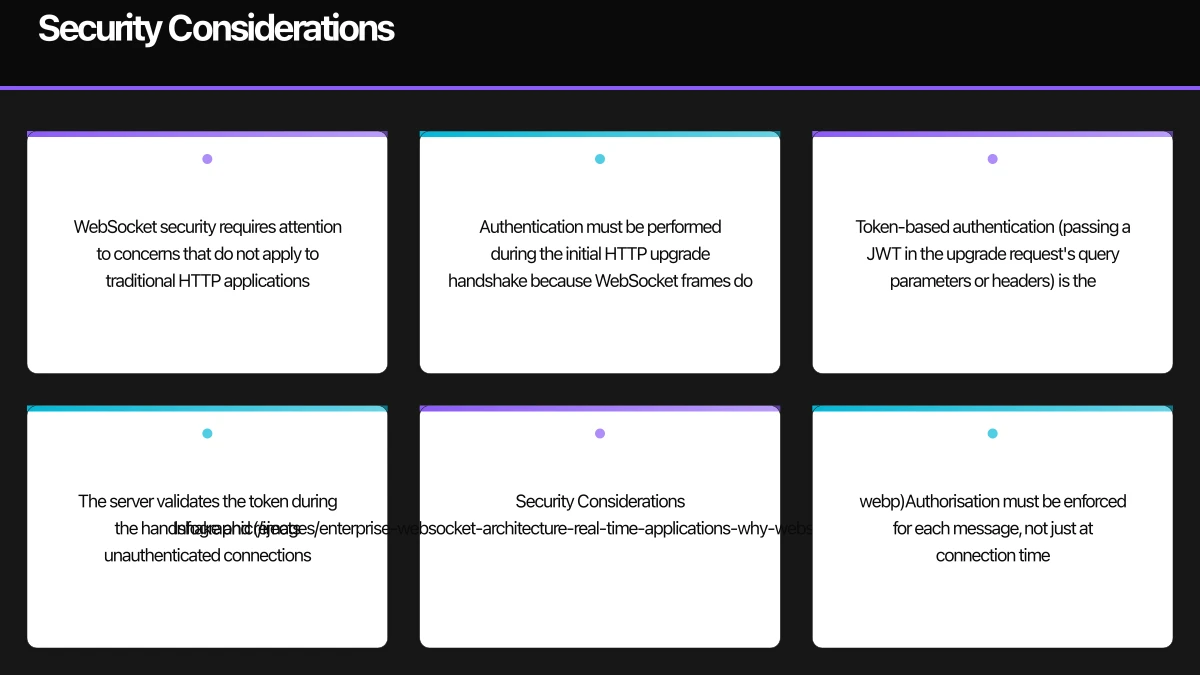
WebSocket security requires attention to concerns that do not apply to traditional HTTP applications.
Authentication must be performed during the initial HTTP upgrade handshake because WebSocket frames do not include authentication headers. Token-based authentication (passing a JWT in the upgrade request’s query parameters or headers) is the standard approach. The server validates the token during the handshake and rejects unauthenticated connections.
Authorisation must be enforced for each message, not just at connection time. A client that is authenticated to connect may not be authorised to access all channels or perform all actions. Message-level authorisation checks prevent privilege escalation through the WebSocket connection.
Rate limiting prevents abusive clients from overwhelming the server with messages. Per-connection and per-user rate limits, implemented at the application level, protect server resources and downstream systems from WebSocket-based denial of service.
Input validation applies to WebSocket messages just as it applies to HTTP requests. Messages received over WebSocket should be validated, sanitised, and treated as untrusted input. Cross-site WebSocket hijacking (CSWSH) can be prevented by validating the Origin header during the upgrade handshake.
Conclusion
Enterprise WebSocket architecture enables the real-time capabilities that modern applications demand, but it introduces scaling, reliability, and operational complexities that require deliberate architectural attention. The persistent connection model, while essential for real-time communication, creates challenges in load balancing, horizontal scaling, connection lifecycle management, and deployment that stateless HTTP architectures do not face.
For CTOs building real-time capabilities in 2022, the architectural patterns are well-established: horizontal scaling with a message bus, automatic reconnection with backoff, heartbeat-based health monitoring, and graceful deployment procedures. The investment in getting these patterns right delivers reliable real-time experiences that increasingly define user expectations.
Strategy without a web presence is invisible. Cosmos Web Tech publishes practical guides on building websites that attract and convert Australian customers.
I lead Ganda Tech Services, where we turn digital strategy into results through specialist cloud, web design, and mobile app teams across Sydney.
About the Author
Ashish Ganda is the founder of Ganda Tech Services, a Sydney-based technology consultancy specialising in cloud infrastructure, web development, and mobile app solutions for Australian businesses.
Digital Transformation Roadmap 2026
A 12-month framework for Australian SMBs ready to modernise — phases, tools, and milestones.