
Enterprise Event-Driven Architecture with Apache Kafka
The request-response paradigm that has dominated enterprise integration for decades is showing its limitations. As organisations decompose monoliths into microservices, as real-time data processing becomes a competitive requirement, and as the volume and velocity of data continues to accelerate, the synchronous point-to-point integration model creates bottlenecks, tight coupling, and fragile dependencies that undermine the agility these architectures are supposed to deliver.
Event-driven architecture offers a fundamentally different model. Instead of services calling each other directly, they produce and consume events — immutable records of things that have happened. A payment is processed. An order is placed. A customer updates their profile. These events flow through a central nervous system that decouples producers from consumers, enables real-time processing, and provides an immutable audit trail of everything that happens in the enterprise.
Apache Kafka has emerged as the dominant platform for enterprise event streaming. Originally developed at LinkedIn and open-sourced in 2011, Kafka has matured into a robust, scalable, and widely adopted platform used by thousands of organisations. Confluent, the company founded by Kafka’s creators, continues to drive the platform’s evolution while maintaining the open-source core. The ecosystem around Kafka — including Kafka Streams, ksqlDB, Kafka Connect, and Schema Registry — provides a comprehensive toolkit for building event-driven systems.
For the CTO evaluating Kafka as the enterprise event backbone, the decision involves architecture design, operational planning, and organisational change. The technology is proven. The strategic question is how to adopt it effectively.
Architecture Patterns for Enterprise
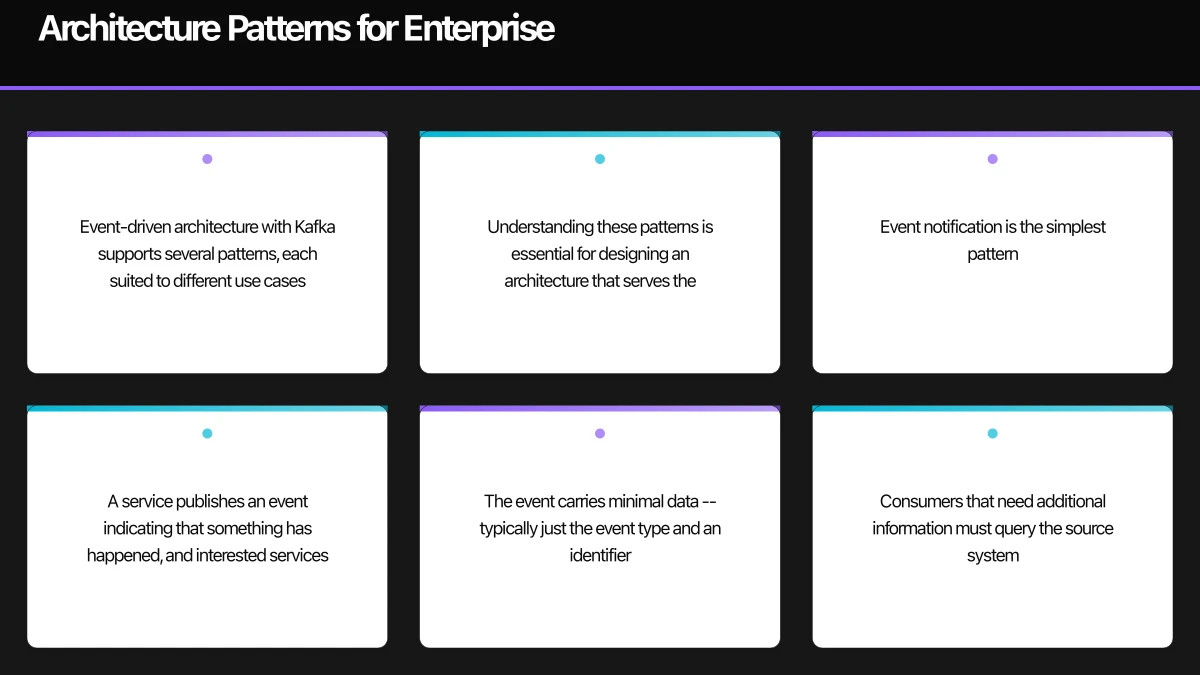
Event-driven architecture with Kafka supports several patterns, each suited to different use cases. Understanding these patterns is essential for designing an architecture that serves the enterprise’s diverse requirements.
Event notification is the simplest pattern. A service publishes an event indicating that something has happened, and interested services react accordingly. The event carries minimal data — typically just the event type and an identifier. Consumers that need additional information must query the source system. This pattern provides loose coupling and is appropriate for triggering downstream workflows, but the callback queries can create load on source systems and introduce latency.
Event-carried state transfer enriches events with the full state needed by consumers, eliminating the need for callbacks. When a customer updates their address, the event contains the complete new address, not just a notification that a change occurred. This pattern reduces inter-service dependencies and enables consumers to maintain local views of the data they need, but it increases event payload size and requires careful management of data evolution as schemas change over time.
Event sourcing takes the concept further by using events as the primary source of truth. Rather than storing the current state of an entity and mutating it, event sourcing stores the sequence of events that led to the current state. The current state is derived by replaying events. This pattern provides a complete audit trail, enables temporal queries (what was the state at any point in time?), and supports sophisticated debugging by replaying events to reproduce issues. The trade-off is implementation complexity — event sourcing requires careful design of event schemas, projection logic, and eventually snapshot mechanisms for performance.
CQRS (Command Query Responsibility Segregation) often accompanies event sourcing by separating the write model (which processes commands and produces events) from the read model (which consumes events and builds optimised query views). This separation allows each side to be optimised independently — the write side for transactional integrity, the read side for query performance. Kafka serves as the channel between the two sides, ensuring that events flow reliably from write to read models.
For most enterprises, the event-carried state transfer pattern provides the best balance of decoupling, operational simplicity, and data availability. Event sourcing and CQRS should be reserved for domains where the audit trail, temporal query, or independent scaling requirements justify the additional complexity.
Kafka Architecture Decisions
The enterprise Kafka deployment requires several architectural decisions that have long-term operational implications.
Cluster topology must balance isolation, cost, and operational complexity. The minimum recommendation is separate clusters for production and non-production workloads. Large enterprises may require additional separation — by business unit, regulatory boundary, or geographic region. Multi-cluster architectures require MirrorMaker 2 or Confluent Replicator for cross-cluster replication, adding operational complexity but providing the isolation that enterprise environments demand.
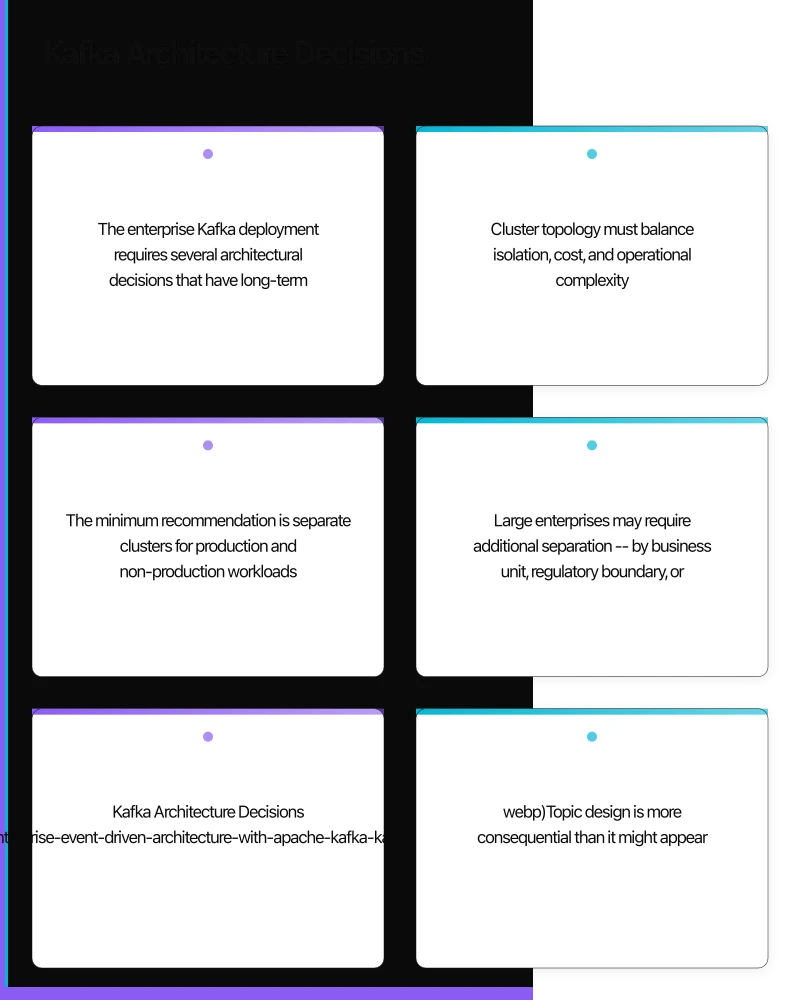
Topic design is more consequential than it might appear. Topics should align with business events, not with producing applications. A well-designed topic namespace follows domain-driven design principles — payments.transaction.completed, orders.fulfillment.shipped, customers.profile.updated. This naming convention makes the event catalogue discoverable and meaningful. Partition count must be set based on throughput requirements and consumer parallelism, keeping in mind that partitions can be increased but not decreased without recreating the topic.
Schema management is essential for long-term maintainability. Events are contracts between producers and consumers, and those contracts must evolve without breaking existing consumers. The Confluent Schema Registry, supporting Avro, Protobuf, and JSON Schema formats, provides schema storage, versioning, and compatibility enforcement. Backward compatibility — the default and recommended mode — ensures that new schema versions can be read by consumers using the previous version. This enables producers to evolve their events without coordinating with every consumer.
Retention strategy determines how long events remain available in Kafka. The default seven-day retention is suitable for operational event processing, but many enterprise use cases benefit from longer or infinite retention. Kafka’s log compaction feature enables indefinite retention of the latest event per key, making topics function as materialised views that new consumers can bootstrap from. For audit and compliance requirements, infinite retention with appropriate storage tiering (a feature being developed in the Kafka community) provides a durable event store.
Operational Excellence
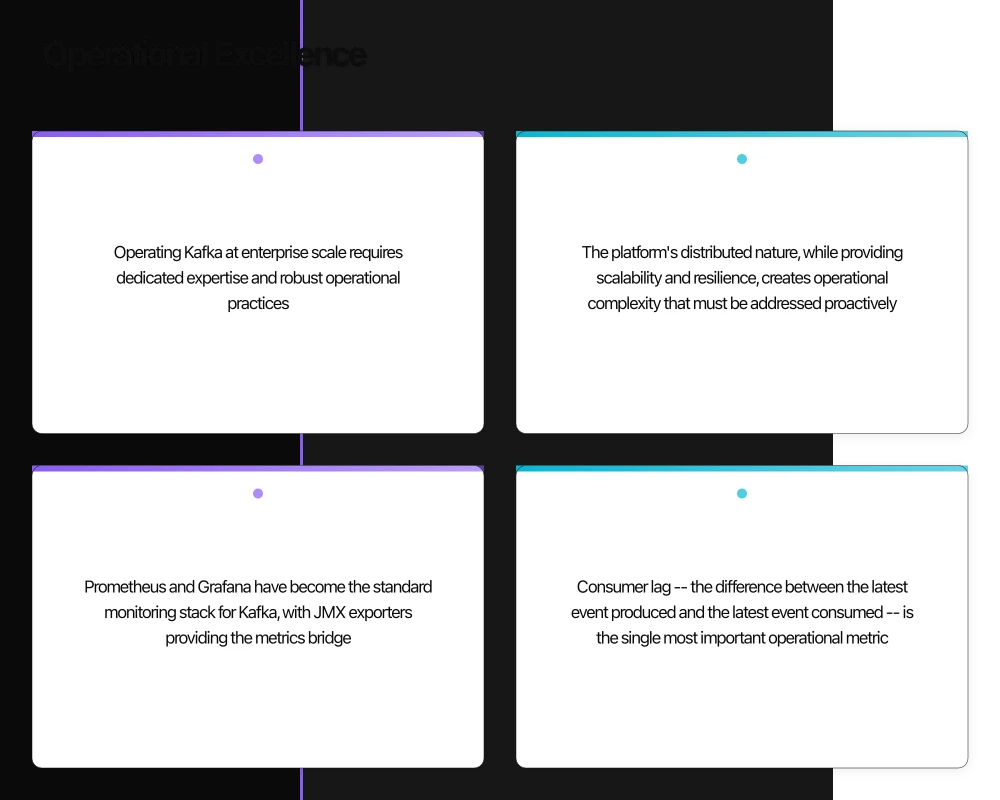
Operating Kafka at enterprise scale requires dedicated expertise and robust operational practices. The platform’s distributed nature, while providing scalability and resilience, creates operational complexity that must be addressed proactively.
Monitoring must cover broker health (CPU, memory, disk I/O, network), topic metrics (throughput, partition distribution, replication status), consumer metrics (lag, processing rate, error rate), and cluster-wide indicators (under-replicated partitions, controller status, inter-broker communication). Prometheus and Grafana have become the standard monitoring stack for Kafka, with JMX exporters providing the metrics bridge.
Consumer lag — the difference between the latest event produced and the latest event consumed — is the single most important operational metric. Rising consumer lag indicates that consumers are falling behind, which can result in data loss if events age out of the retention window. Consumer lag monitoring should include alerting with defined thresholds for each consumer group, enabling proactive intervention before processing delays become business-visible.
Capacity planning for Kafka requires understanding the write throughput, read throughput (including fan-out to multiple consumers), storage requirements (based on throughput and retention), and the replication factor. The replication factor — typically three for production clusters — multiplies storage requirements but provides fault tolerance. Capacity planning should account for growth projections and include sufficient headroom for traffic spikes.
Security encompasses encryption (TLS for inter-broker and client communication), authentication (SASL with mechanisms like SCRAM or OAuth), and authorisation (ACLs controlling which clients can produce to and consume from which topics). For enterprises, integration with existing identity management infrastructure is essential — Kafka’s support for SASL/OAUTHBEARER enables integration with OAuth/OIDC identity providers.
The build-versus-buy decision is significant. Self-managed Kafka provides full control but requires substantial operational investment. Confluent Cloud, Amazon MSK, Azure Event Hubs (with Kafka protocol support), and other managed offerings reduce operational burden at the cost of flexibility and, in some cases, higher per-message cost. The decision depends on the organisation’s operational capability, scale requirements, and strategic preferences around managed services.
Organisational Readiness
Kafka adoption is not just an infrastructure deployment — it changes how teams think about data flow and system integration. Success requires investment in skills, patterns, and governance.
Developer enablement must address both Kafka-specific skills (producer and consumer patterns, serialisation, error handling) and event-driven design skills (event modelling, eventual consistency patterns, idempotent processing). Internal workshops, documentation, and reference implementations accelerate adoption.
An event catalogue — a discoverable registry of all event types, their schemas, owners, and consumers — is essential for event-driven systems to scale beyond a handful of services. Without discoverability, teams resort to direct communication to learn what events exist, recreating the coupling that event-driven architecture was supposed to eliminate.
Governance for event-driven architecture must address event ownership, schema evolution policies, retention standards, and data classification. Each event type should have a defined owner responsible for its schema, quality, and documentation. Schema evolution must follow compatibility rules enforced by the schema registry. Retention policies must account for both operational and regulatory requirements.
The enterprise that invests in these organisational foundations alongside the technical infrastructure will find that Kafka delivers on its promise of decoupled, real-time, scalable event processing. Those that treat it as merely an infrastructure deployment will find themselves with a powerful platform that is underutilised and operationally challenging.
Event-driven architecture represents a paradigm shift in enterprise integration. Kafka provides the platform. The CTO’s challenge is ensuring the organisation is ready to use it effectively.
Turning strategy into infrastructure? Cloud Geeks covers managed cloud, DevOps, and IT security for businesses putting digital plans into action.
Ash Ganda is the founder of Ganda Tech Services, a Sydney-based technology consultancy delivering cloud, web, and mobile solutions for Australian businesses.
About the Author
Ashish Ganda is the founder of Ganda Tech Services, a Sydney-based technology consultancy specialising in cloud infrastructure, web development, and mobile app solutions for Australian businesses.
Digital Transformation Roadmap 2026
A 12-month framework for Australian SMBs ready to modernise — phases, tools, and milestones.
Almost done
Check your inbox and click the confirmation link to get your download.