Enterprise Message Queue Architecture: RabbitMQ vs SQS vs Kafka
Asynchronous messaging is the foundation of resilient, scalable enterprise architecture. By decoupling producers from consumers, message-based systems absorb traffic spikes, enable independent scaling of components, and provide natural fault isolation. The choice of messaging technology profoundly influences system architecture, operational complexity, and the types of patterns that are practical to implement.
Three technologies dominate enterprise messaging: RabbitMQ (traditional message broker), Amazon SQS (managed queue service), and Apache Kafka (distributed event streaming platform). Despite superficially similar capabilities — all three accept messages and deliver them to consumers — they embody fundamentally different architectural philosophies with distinct implications for enterprise systems.
RabbitMQ: The Flexible Message Broker
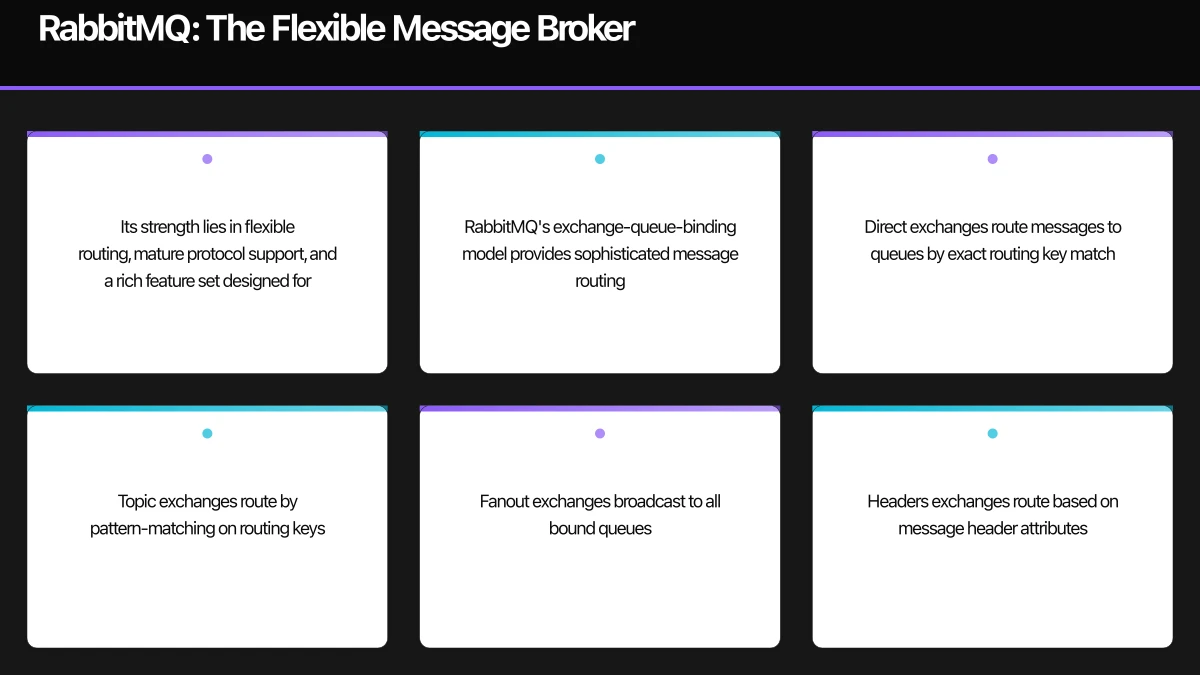
RabbitMQ, originally developed by Rabbit Technologies and now maintained by VMware, implements the Advanced Message Queuing Protocol (AMQP) and has been a staple of enterprise messaging for over fifteen years. Its strength lies in flexible routing, mature protocol support, and a rich feature set designed for traditional enterprise messaging patterns.
RabbitMQ’s exchange-queue-binding model provides sophisticated message routing. Direct exchanges route messages to queues by exact routing key match. Topic exchanges route by pattern-matching on routing keys. Fanout exchanges broadcast to all bound queues. Headers exchanges route based on message header attributes. This routing flexibility enables complex message distribution patterns without application-level logic.
The broker-centric architecture means RabbitMQ maintains responsibility for message delivery. It tracks message acknowledgement, handles redelivery of unacknowledged messages, and supports dead-letter queues for messages that cannot be processed. For enterprises requiring guaranteed delivery with sophisticated routing, RabbitMQ’s model is well-proven.
RabbitMQ supports multiple protocols beyond AMQP: MQTT for IoT devices, STOMP for web applications, and HTTP for simple integrations. This protocol diversity makes it a natural choice for heterogeneous environments where different systems communicate through different protocols but need a unified messaging backbone.
The limitations become apparent at extreme scale. RabbitMQ’s broker-centric architecture means all messages flow through the broker, which becomes a potential bottleneck. Clustering provides horizontal scaling but introduces complexity around queue mirroring, partition handling, and network reliability. At throughput levels exceeding hundreds of thousands of messages per second, RabbitMQ requires careful tuning and infrastructure investment.
Message persistence in RabbitMQ is designed for transient message storage — messages are consumed and removed. While RabbitMQ can persist messages to disk, it is not designed for long-term message retention or replay. Once a message is consumed and acknowledged, it is gone. This is appropriate for traditional work queue patterns but limits use cases that require event replay or consumer catch-up.
Amazon SQS: Managed Simplicity at Scale
Amazon SQS strips messaging to its essentials: send messages, receive messages, delete messages. There are no exchanges, routing keys, or bindings. Messages go into a queue, and consumers poll the queue to receive them. This simplicity is its greatest strength for organisations that want reliable messaging without operational complexity.
SQS is fully managed by AWS — there are no brokers to provision, no clusters to maintain, no capacity to plan. The service scales automatically from zero to millions of messages per second without configuration changes. Availability is built in, with messages replicated across multiple availability zones. The operational burden is effectively zero.
Standard SQS queues provide at-least-once delivery with best-effort ordering. For most enterprise use cases, this is sufficient — consumers are designed to be idempotent, processing the same message twice without side effects. FIFO (First-In-First-Out) queues provide exactly-once processing and strict ordering within message groups, at the cost of reduced throughput (300 messages per second without batching, 3,000 with batching).
SQS integrates deeply with the AWS ecosystem. Lambda functions can be triggered directly by SQS messages, enabling serverless event processing. SNS (Simple Notification Service) provides pub/sub distribution to multiple SQS queues. EventBridge provides event routing with content-based filtering. For AWS-native architectures, SQS is the path of least resistance for asynchronous messaging.
The limitations are the inverse of RabbitMQ’s strengths. SQS provides no routing logic — every message in a queue is available to every consumer. Complex routing requires multiple queues with application-level or SNS-based distribution. There is no message replay — once consumed and deleted, messages are gone. And SQS is exclusively available on AWS, creating vendor dependency that may conflict with multi-cloud strategies.
The polling-based consumption model introduces latency considerations. Standard polling returns messages as they are available, but short polling may return empty responses even when messages exist. Long polling (up to 20 seconds) reduces empty responses and costs but introduces latency. For latency-sensitive workloads, this polling model is a relevant consideration.
Apache Kafka: The Distributed Event Log
Kafka represents a fundamentally different paradigm. Rather than a message broker that routes messages from producers to consumers, Kafka is a distributed commit log that persistently stores events in ordered, partitioned topics. This architectural distinction drives capabilities that neither RabbitMQ nor SQS can replicate.
Kafka’s log-based storage model means events are retained for a configurable period (days, weeks, or indefinitely) regardless of whether they have been consumed. Multiple consumer groups can independently read from the same topic, each maintaining their own position (offset) in the log. A new consumer can start from the beginning of the log, replaying historical events to build state.
This retention and replay capability enables architectural patterns that are impossible with traditional message brokers: event sourcing (deriving application state from event history), CQRS (separate read and write models built from the same event stream), stream processing (continuous transformation and analysis of event streams), and consumer catch-up (new services can process historical events to reach current state).
Kafka’s throughput characteristics are extraordinary. A properly configured Kafka cluster routinely handles millions of messages per second. The append-only log structure, sequential disk I/O, zero-copy network transfer, and batching optimisations combine to deliver throughput that exceeds traditional message brokers by orders of magnitude.
The consumer group model provides natural horizontal scaling. Consumers within a group divide topic partitions among themselves, with each partition consumed by exactly one consumer. Adding consumers (up to the number of partitions) increases processing parallelism linearly. This model is elegant but introduces partition-level ordering constraints — messages within a partition are ordered, but there is no global ordering across partitions.
Kafka’s operational complexity is its primary limitation for enterprise adoption. Managing a Kafka cluster requires expertise in broker configuration, partition rebalancing, consumer group management, topic compaction, rack-aware replication, and ZooKeeper coordination (though the community is actively working to remove the ZooKeeper dependency). Confluent provides a managed Kafka service (Confluent Cloud) and Amazon MSK provides managed Kafka on AWS, both reducing operational burden at additional cost.
Decision Framework: Matching Technology to Requirements
The selection among these technologies should be driven by workload characteristics, organisational capabilities, and strategic alignment.
Choose RabbitMQ when the workload requires complex routing logic, multiple protocol support, or traditional request-reply patterns. RabbitMQ excels for task distribution, RPC-style communication, and scenarios where the broker’s routing intelligence simplifies application logic. It is the best choice for organisations with AMQP expertise and moderate throughput requirements.
Choose SQS when the priority is operational simplicity within an AWS ecosystem. SQS is the right choice for organisations that want reliable asynchronous messaging without operational overhead, that are committed to AWS, and whose messaging patterns are straightforward queue-based processing. The Lambda integration makes SQS particularly compelling for serverless architectures.
Choose Kafka when the workload requires event streaming, event replay, high throughput, or the ability for multiple consumers to independently process the same events. Kafka is the right choice for organisations building event-driven architectures, real-time data pipelines, or systems where event history is valuable. The operational complexity is justified by capabilities that no other technology provides.
Many enterprises use all three technologies, each serving the workload characteristics for which it is best suited. Kafka serves as the enterprise event backbone, providing durable, replayable event streams. RabbitMQ handles task distribution and complex routing for specific services. SQS provides simple, managed queuing for AWS-native workloads. This polyglot approach optimises each technology for its strengths.
Conclusion
Enterprise messaging architecture is a foundational strategic decision that influences system resilience, scalability, and the architectural patterns available to development teams. RabbitMQ, SQS, and Kafka each serve distinct segments of the messaging landscape, and understanding their differences is essential for making sound technology choices.
For CTOs evaluating messaging strategy in 2022, the recommendation is to assess workload requirements honestly, invest in the operational capabilities that the chosen technology demands, and design for the long term. Messaging infrastructure is difficult and expensive to replace, making the initial architecture decision consequential for years to come.
For hands-on mobile development advice, visit Awesome Apps — our specialist app development blog for Australian businesses.
These insights are drawn from my work leading Ganda Tech Services — helping Australian businesses navigate digital transformation through cloud, web, and mobile.
About the Author
Ashish Ganda is the founder of Ganda Tech Services, a Sydney-based technology consultancy specialising in cloud infrastructure, web development, and mobile app solutions for Australian businesses.
Digital Transformation Roadmap 2026
A 12-month framework for Australian SMBs ready to modernise — phases, tools, and milestones.