Enterprise Real-Time Analytics Architecture
Introduction
The enterprise expectation for analytics latency is compressing rapidly. Business decisions that once relied on yesterday’s reports now demand data that is minutes or seconds old. Fraud detection systems must evaluate transactions in real-time. Supply chain operations require immediate visibility into disruptions. Customer-facing applications must personalise experiences based on current behaviour, not historical aggregates.
This compression from batch to real-time analytics represents more than a performance improvement. It is an architectural transformation that changes how data is collected, processed, stored, and consumed. The batch-oriented data warehouse, however powerful for historical analysis, cannot serve these real-time demands. Enterprise analytics architectures must evolve to support both the deep historical analysis that batch processing excels at and the immediate insight that real-time processing provides.
For CTOs and data architects, designing this dual-capability architecture requires understanding the trade-offs between different processing paradigms, the technology landscape for stream processing, and the organisational implications of operating real-time data systems. This analysis provides a strategic framework for these decisions.
The Architecture Paradigm Spectrum
Enterprise analytics architectures can be positioned on a spectrum from pure batch to pure real-time, with most organisations landing somewhere in between.
The Lambda architecture, proposed by Nathan Marz, addresses this by maintaining two parallel processing pipelines: a batch layer that processes complete datasets to produce comprehensive, accurate views, and a speed layer that processes recent data in real-time to provide low-latency, approximate views. A serving layer merges results from both layers to present a unified view. This architecture is well-understood and proven but operationally complex because it requires maintaining and synchronising two separate processing systems with the same business logic.
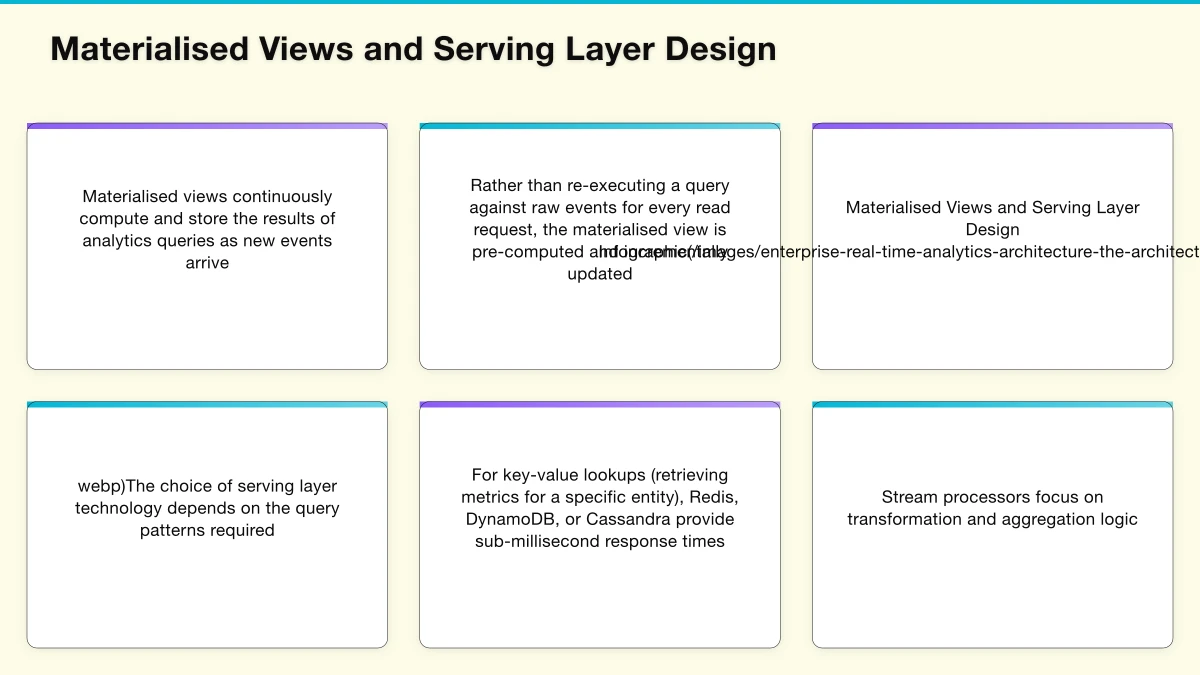
The Kappa architecture, proposed by Jay Kreps, simplifies the Lambda approach by using a single stream processing pipeline for both real-time and historical processing. All data is treated as a stream of events, and historical reprocessing is accomplished by replaying events from the beginning. Apache Kafka’s durable log storage enables this pattern by retaining events for extended periods. The Kappa architecture reduces operational complexity by maintaining a single code base but requires stream processing infrastructure capable of handling both real-time throughput and historical replay.
In practice, most enterprise architectures are hybrid, using stream processing for real-time analytics and use cases that demand low latency, while maintaining batch processing for complex historical analysis, machine learning training, and use cases where completeness matters more than timeliness. The architectural decisions focus on which use cases warrant real-time processing, what the latency requirements are, and how to share data and logic between the two paradigms.
Stream Processing Technology Landscape
The technology landscape for enterprise stream processing has matured significantly, with several platforms providing the reliability, scalability, and tooling that enterprise deployments require.
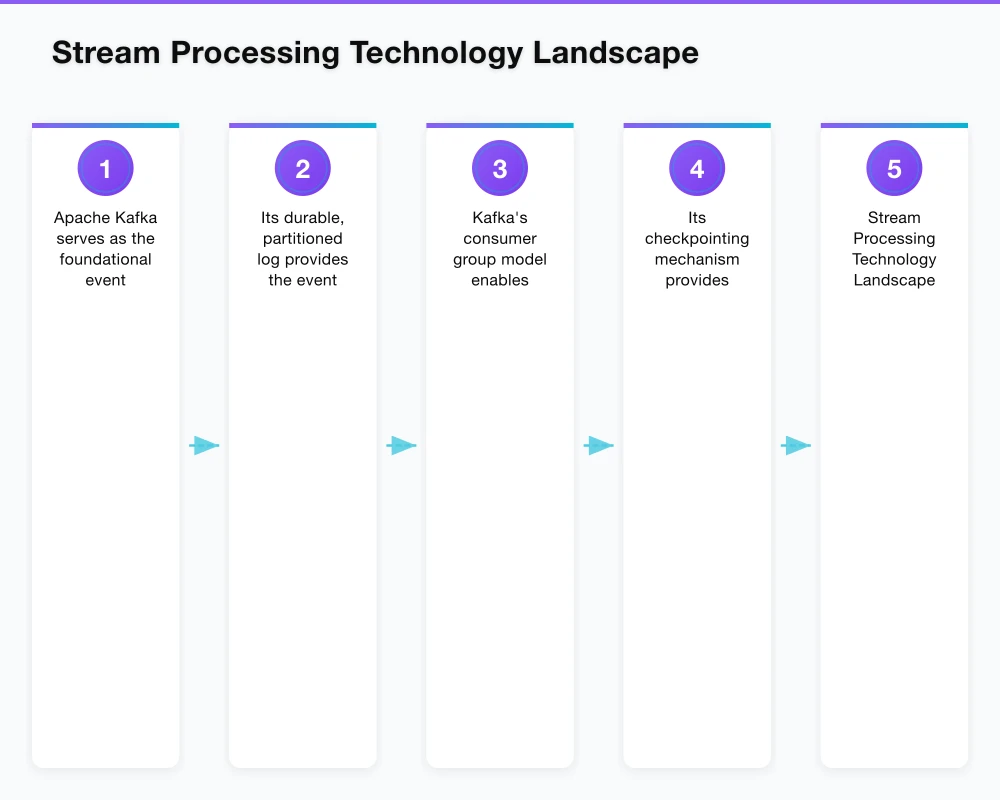
Apache Kafka serves as the foundational event streaming platform for most enterprise real-time analytics architectures. Its durable, partitioned log provides the event backbone from which stream processors consume. Kafka’s consumer group model enables parallel processing, and its retention capabilities support event replay for reprocessing and recovery. For enterprise deployments, Confluent Platform or managed services like Amazon MSK and Azure Event Hubs reduce the operational burden of running Kafka infrastructure.
Apache Flink has emerged as the leading stream processing framework for enterprise applications requiring complex event processing, windowed aggregations, and exactly-once processing guarantees. Flink’s unified batch and stream processing model supports the hybrid architecture pattern, allowing the same processing logic to operate on both real-time streams and historical datasets. Its checkpointing mechanism provides fault tolerance with exactly-once semantics, essential for financial and compliance-sensitive analytics.
Apache Spark Structured Streaming provides micro-batch stream processing within the Spark ecosystem. For organisations already invested in Spark for batch processing, Structured Streaming offers a lower-barrier path to real-time analytics by extending familiar APIs and tooling to streaming workloads. The micro-batch model introduces latency (typically hundreds of milliseconds to seconds) compared to true stream processing, but for many enterprise use cases, this latency is acceptable.
ksqlDB (from Confluent) provides a SQL-based stream processing interface on top of Kafka Streams. For organisations where SQL is the primary analytics language, ksqlDB enables real-time analytics without requiring Java or Scala development. Materialised views in ksqlDB are continuously updated as new events arrive, providing always-current query results. This approach democratises real-time analytics by making it accessible to SQL-proficient analysts and engineers.
Cloud-native options from major providers offer managed stream processing with reduced operational overhead. Amazon Kinesis Data Analytics, Google Cloud Dataflow, and Azure Stream Analytics provide stream processing as a managed service, eliminating infrastructure management at the cost of vendor dependency and potential constraints on processing complexity.
Materialised Views and Serving Layer Design
The serving layer, where real-time analytics results are stored for consumption, is architecturally critical because it determines the query patterns and performance characteristics available to consumers.
Materialised views continuously compute and store the results of analytics queries as new events arrive. Rather than re-executing a query against raw events for every read request, the materialised view is pre-computed and incrementally updated. This pattern provides low-latency read performance (milliseconds) even for complex aggregations that would take seconds or minutes to compute from raw data.
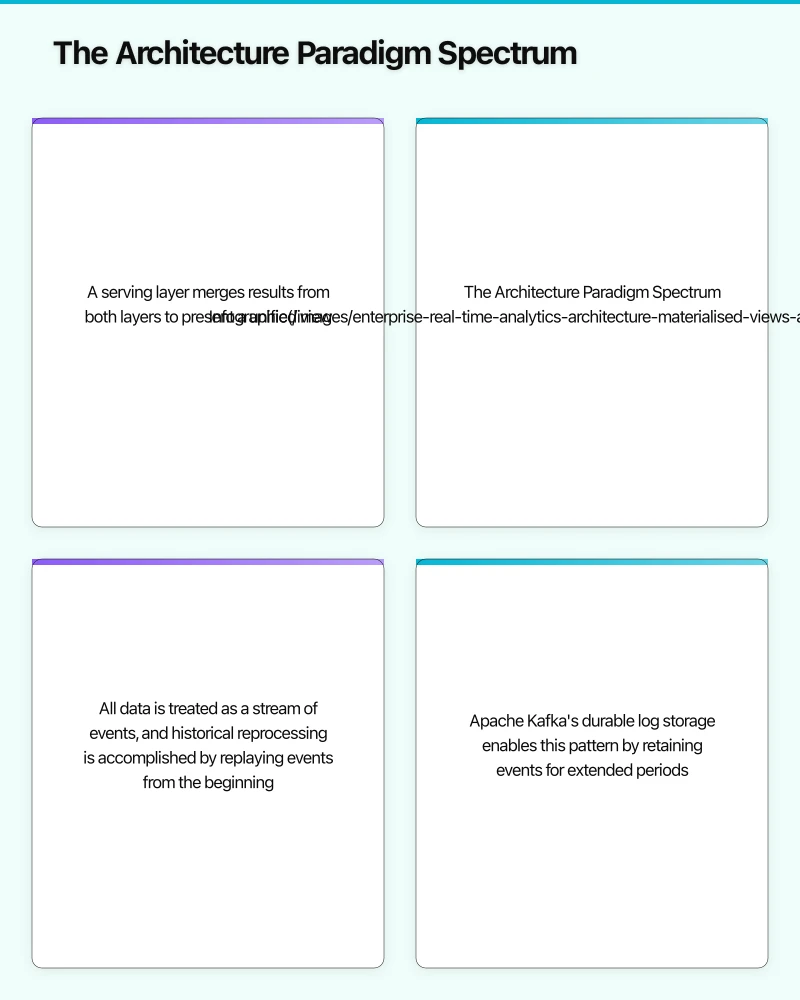
The choice of serving layer technology depends on the query patterns required. For key-value lookups (retrieving metrics for a specific entity), Redis, DynamoDB, or Cassandra provide sub-millisecond response times. For dimensional analytics queries (slicing and dicing metrics across multiple dimensions), specialised OLAP databases like Apache Druid, ClickHouse, or Apache Pinot provide real-time analytical query capability over streaming data. For time-series queries (analysing metrics over time windows), time-series databases like TimescaleDB or InfluxDB provide optimised storage and query patterns.
The event-driven materialised view pattern, where stream processors consume events and update materialised views in the serving layer, creates a clean separation between computation and serving. Stream processors focus on transformation and aggregation logic. The serving layer focuses on fast query response. This separation enables independent scaling of computation and serving capacity.
Enterprise Operational Considerations
Operating real-time analytics systems in enterprise environments introduces challenges beyond those of batch systems. Real-time systems must be continuously available because downtime means missed data and delayed insights. They must handle variable throughput because event volumes can spike unpredictably. And they must maintain data quality in real-time, detecting and handling anomalous or corrupt data before it contaminates analytics results.
Monitoring for real-time analytics systems should track processing latency (time from event generation to analytics availability), throughput (events processed per second), consumer lag (the gap between current time and the most recently processed event), and error rates. These metrics should be alarmed with appropriate thresholds to detect degradation before it impacts consumers.
Schema evolution in event streams requires careful management. As business requirements change, event schemas must evolve without breaking existing consumers. Schema registries with compatibility enforcement (forward, backward, or full compatibility) ensure that schema changes are safe. Planning for schema evolution from the beginning of the architecture avoids painful migrations later.
Exactly-once processing semantics, where each event is guaranteed to be processed exactly once, is important for analytics accuracy but difficult to achieve in distributed systems. Apache Flink provides exactly-once guarantees through its checkpointing mechanism. Kafka provides exactly-once semantics for producer-consumer pairs through idempotent producers and transactional consumers. Understanding where exactly-once guarantees are needed (financial calculations, compliance metrics) versus where at-least-once processing with idempotent consumers is sufficient (aggregate statistics, trend analysis) helps architects design cost-effective solutions.
Real-time analytics represents a fundamental evolution in how enterprises use data. The shift from asking “what happened?” to asking “what is happening right now?” enables new categories of business capability: immediate fraud detection, dynamic pricing, real-time personalisation, and instant operational visibility. For CTOs, the investment in real-time analytics architecture is an investment in the enterprise’s ability to act on information at the speed the business demands.
For the practitioner’s view on cloud, IT, and cybersecurity, explore Cloud Geeks — where strategy meets infrastructure.
These insights are drawn from my work leading Ganda Tech Services — helping Australian businesses navigate digital transformation through cloud, web, and mobile.
About the Author
Ashish Ganda is the founder of Ganda Tech Services, a Sydney-based technology consultancy specialising in cloud infrastructure, web development, and mobile app solutions for Australian businesses.
Digital Transformation Roadmap 2026
A 12-month framework for Australian SMBs ready to modernise — phases, tools, and milestones.