Enterprise PKI and Certificate Management Strategy
Introduction
Public Key Infrastructure (PKI) is one of the most critical and least appreciated components of enterprise security architecture. Certificates enable TLS encryption for every internal and external communication, authenticate services in microservices architectures, secure API integrations, enable code signing, and increasingly underpin zero-trust network access. When PKI works, it is invisible. When it fails, typically through an expired certificate, the consequences range from service outages to complete loss of customer trust.
The enterprise PKI landscape is undergoing several simultaneous shifts that demand strategic attention. Certificate validity periods are shortening: the CA/Browser Forum has progressively reduced maximum TLS certificate lifetimes from five years to the current one year, with further reductions under discussion. Microservices and cloud-native architectures are dramatically increasing the number of certificates that enterprises must manage. Zero-trust security models require mutual TLS authentication between services, further expanding certificate usage. And the emergence of ACME (Automated Certificate Management Environment) protocol support from certificate authorities is enabling automation that was previously impractical.
For CTOs and security architects, these shifts transform certificate management from a manual operational task into a strategic platform capability. This analysis examines the architectural and operational decisions that distinguish enterprises with robust PKI from those living one expired certificate away from an outage.
Enterprise PKI Architecture Design
Enterprise PKI architecture typically comprises a hierarchy of certificate authorities (CAs) that issue and manage certificates for different purposes. The design of this hierarchy affects security, operational flexibility, and disaster recovery capability.
A three-tier CA hierarchy, comprising a root CA, one or more intermediate (or policy) CAs, and issuing CAs, provides the best balance of security and operational flexibility for enterprise environments. The root CA is the trust anchor; its private key is the most sensitive cryptographic asset in the enterprise. It should be maintained offline, in a hardware security module (HSM) stored in a physically secure environment, and used only to sign intermediate CA certificates. The intermediate CAs provide a layer of indirection that allows the root CA to remain offline during normal operations. Issuing CAs, signed by the intermediate CAs, handle the day-to-day issuance of certificates to services, devices, and users.
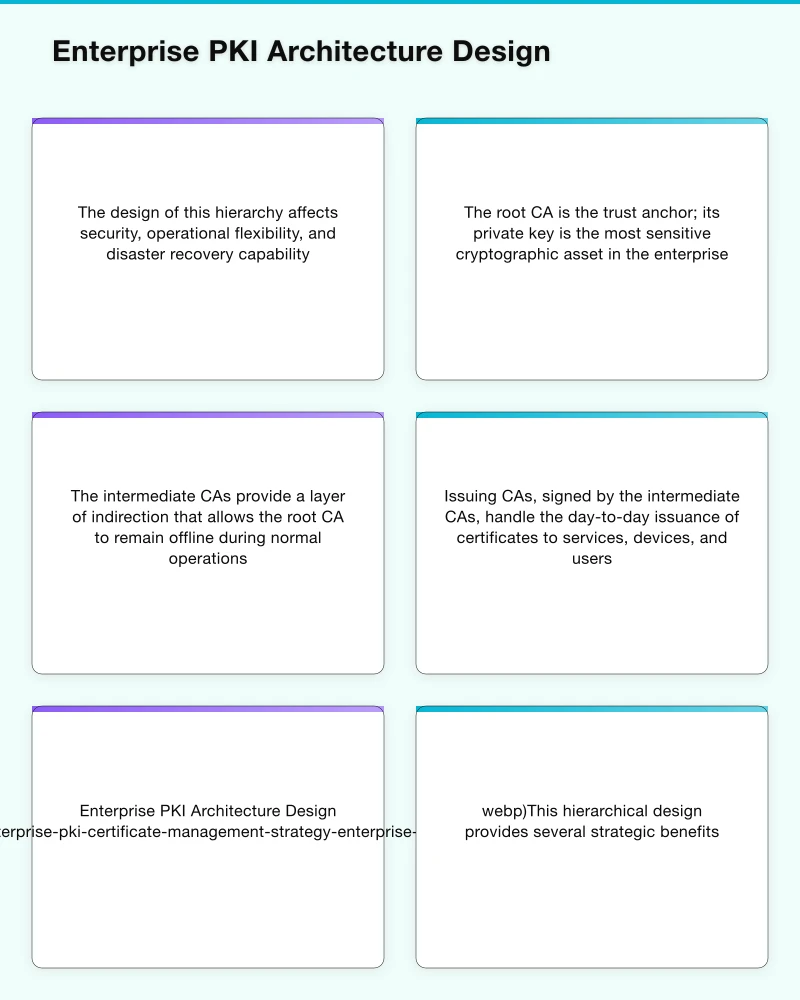
This hierarchical design provides several strategic benefits. If an issuing CA is compromised, it can be revoked without affecting the root CA, limiting the blast radius of a security incident. Different issuing CAs can have different policies, lifecycles, and operational characteristics, allowing the PKI to serve diverse requirements (web server certificates, client authentication certificates, code signing certificates) within a unified trust hierarchy. The offline root CA is protected against network-based attacks, providing the highest level of assurance for the trust anchor.
Hardware Security Modules (HSMs) protect the private keys of certificate authorities against extraction and misuse. Enterprise-grade HSMs, whether on-premises appliances (from vendors like Thales or Entrust) or cloud-based (AWS CloudHSM, Azure Dedicated HSM), provide tamper-resistant key storage and cryptographic operations. All CA private keys should be protected by HSMs. For the root CA, the HSM should support offline operation with air-gapped key ceremony procedures.
The trust model must extend to both internal and external certificates. Internal certificates, issued by the enterprise’s private CA hierarchy, authenticate services, devices, and users within the enterprise. External certificates, issued by publicly trusted CAs for customer-facing services, must chain to roots that are trusted by browsers and operating systems. Managing both internal and external certificates within a unified strategy ensures consistent governance and operational practices.
Automated Certificate Lifecycle Management
The volume of certificates in modern enterprises makes manual certificate management untenable. An enterprise with hundreds of microservices, each requiring certificates for mutual TLS, plus web server certificates, load balancer certificates, API gateway certificates, and client certificates, may manage tens of thousands of certificates with diverse lifetimes and renewal requirements.
Automated certificate lifecycle management encompasses discovery, issuance, renewal, revocation, and monitoring. Each phase should be automated to the greatest extent possible.
Discovery identifies all certificates in the enterprise environment, including certificates that were issued outside of formal processes. Certificate discovery tools scan networks, inspect TLS endpoints, and inventory certificate stores to build a comprehensive inventory. This inventory is the foundation for lifecycle management; certificates that are not inventoried cannot be managed.
Automated issuance eliminates manual certificate request processes. The ACME protocol, originally developed for Let’s Encrypt and now supported by many certificate authorities and enterprise PKI platforms, enables applications and infrastructure to request and install certificates programmatically. For internal certificates, integration between the issuing CA and infrastructure platforms (Kubernetes, cloud providers, load balancers) enables automatic certificate provisioning when new services or endpoints are created.
Automated renewal is the most critical capability because certificate expiration is the most common cause of PKI-related outages. Certificates should be renewed well before expiration, typically when thirty percent or less of the validity period remains. Automated renewal systems monitor certificate expiration dates, initiate renewal requests, and install new certificates without human intervention. For environments using short-lived certificates (hours or days), automated renewal must be continuous and highly reliable.
Certificate revocation remains one of the less automated aspects of PKI, but it is essential for responding to key compromise or certificate misuse. Online Certificate Status Protocol (OCSP) and Certificate Revocation Lists (CRLs) provide mechanisms for communicating revocation status. Enterprise environments should deploy OCSP responders for internal certificates and configure applications to check revocation status before trusting certificates.
Monitoring and alerting provide the safety net for the automation layer. Even with automated renewal, monitoring should track certificate expiration dates and alert when certificates are approaching expiration without having been renewed. This catches automation failures before they cause outages. Monitoring should also track certificate inventory growth, issuance rates, and compliance with organisational policies (key length, signature algorithm, validity period).
Short-Lived Certificates and the Zero-Trust Model
The trend toward shorter certificate validity periods is accelerating, driven by both industry standards for public certificates and security best practices for internal certificates. This trend has profound implications for enterprise PKI operations.
Short-lived certificates, with validity periods measured in hours or days rather than months or years, fundamentally change the risk profile of certificate management. A compromised certificate with a one-hour validity period is useful to an attacker for at most one hour, even if the compromise is not detected. This dramatically reduces the window of exposure compared to a certificate with a one-year validity period and eliminates the dependency on timely revocation, which has historically been the weakest link in PKI security.
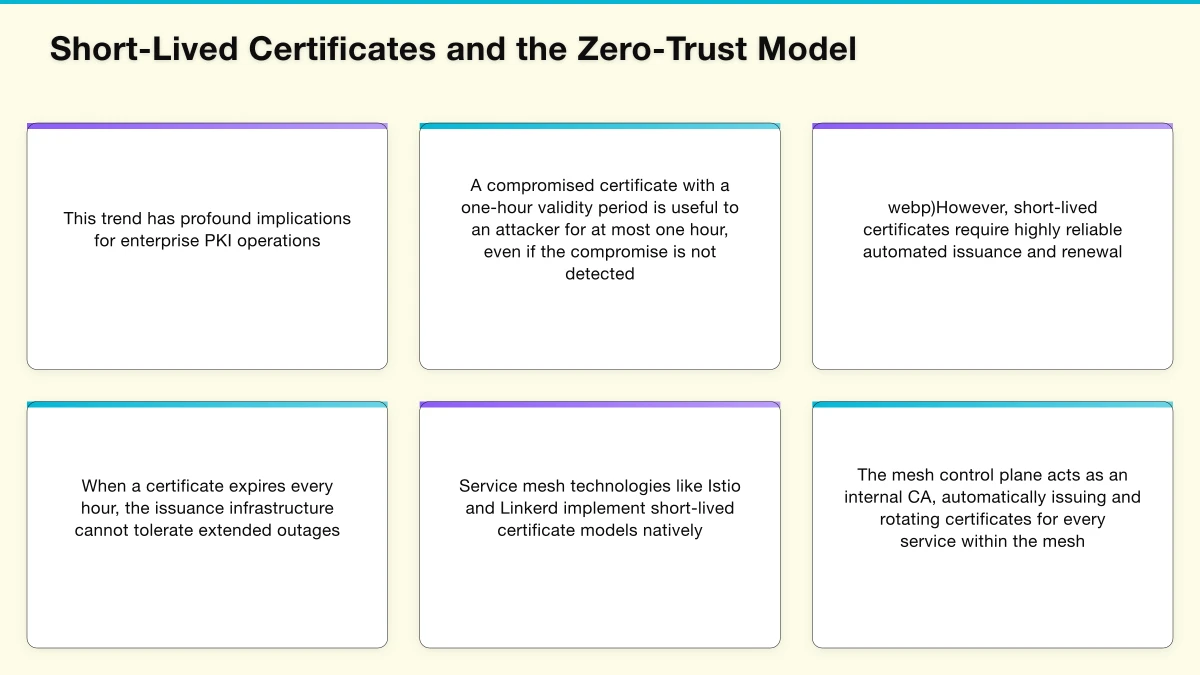
However, short-lived certificates require highly reliable automated issuance and renewal. When a certificate expires every hour, the issuance infrastructure cannot tolerate extended outages. This drives investment in highly available CA infrastructure, robust automation, and graceful degradation mechanisms (such as allowing a brief grace period for expired certificates if the CA is temporarily unavailable).
Service mesh technologies like Istio and Linkerd implement short-lived certificate models natively. The mesh control plane acts as an internal CA, automatically issuing and rotating certificates for every service within the mesh. Certificate lifetimes are typically measured in hours, and rotation is continuous and transparent to the application. For enterprises adopting service mesh architectures, PKI for east-west (service-to-service) traffic is largely handled by the mesh infrastructure.
The zero-trust security model, which requires authentication and encryption for every network communication, relies heavily on PKI. Mutual TLS (mTLS) authentication, where both the client and server present certificates, provides strong identity verification for service-to-service communication. Device certificates enable network access control that authenticates devices before granting connectivity. User certificates, stored on smart cards or in TPM-protected key stores, provide strong multi-factor authentication.
Operational Governance and Compliance
PKI governance ensures that certificates are issued, managed, and used in accordance with organisational security policies and regulatory requirements.
Certificate policies define the rules governing certificate issuance and use. These policies specify minimum key lengths, approved signature algorithms, maximum validity periods, required subject fields, and permitted key usage extensions. Policies should be enforced by the issuing CA configuration, preventing the issuance of non-compliant certificates. As cryptographic standards evolve, policies must be updated: RSA key lengths, ECC curve selection, and the eventual transition to post-quantum algorithms all require policy attention.
Audit and compliance capabilities are essential for regulated industries. Certificate issuance logs, renewal histories, and revocation records should be retained for the compliance-required period and available for audit. Regular compliance reviews should verify that all certificates in the enterprise inventory comply with current policies and that no certificates have been issued outside of governed processes.
Incident response procedures for PKI-related events, including compromised CAs, mis-issued certificates, and cryptographic vulnerabilities, should be documented and rehearsed. The Heartbleed vulnerability in 2014 demonstrated how a single cryptographic vulnerability can require the emergency replacement of certificates across an entire enterprise. Having incident response procedures and the automation capability to execute them rapidly is a fundamental PKI resilience requirement.
Enterprise PKI is infrastructure that the entire technology estate depends on. The investment in robust architecture, automated lifecycle management, and operational governance is justified by the criticality of the services that certificates protect. For CTOs, the strategic imperative is to ensure that PKI is treated as a platform capability with appropriate investment, not as a manual operational task that accumulates risk through neglect.
Strategy needs execution. Cloud Geeks publishes practical cloud computing and cybersecurity guides for Australian businesses ready to act.
Ash Ganda is the founder of Ganda Tech Services, a Sydney-based technology consultancy delivering cloud, web, and mobile solutions for Australian businesses.
About the Author
Ashish Ganda is the founder of Ganda Tech Services, a Sydney-based technology consultancy specialising in cloud infrastructure, web development, and mobile app solutions for Australian businesses.
Digital Transformation Roadmap 2026
A 12-month framework for Australian SMBs ready to modernise — phases, tools, and milestones.