
Enterprise Feature Flag Strategy and Architecture
Feature flags — the ability to enable or disable application functionality at runtime without deploying new code — have evolved from a simple deployment technique to a strategic capability that transforms how enterprises deliver, test, and manage software. Leading technology organisations like Netflix, Facebook, Google, and LinkedIn operate with thousands of feature flags, enabling deployment decoupled from release, progressive rollout to user segments, A/B testing at scale, and instant rollback of problematic features.
For enterprise technology organisations, feature flags represent a maturity leap in software delivery practices. They decouple the risk of deployment from the risk of feature release, enabling teams to deploy continuously with confidence. But enterprise adoption requires more than dropping a feature flag library into applications. It demands architecture, governance, and operational practices that manage the complexity that feature flags introduce.
The Strategic Value of Feature Flags
Feature flags deliver value across multiple dimensions of software delivery that are particularly relevant for enterprises.
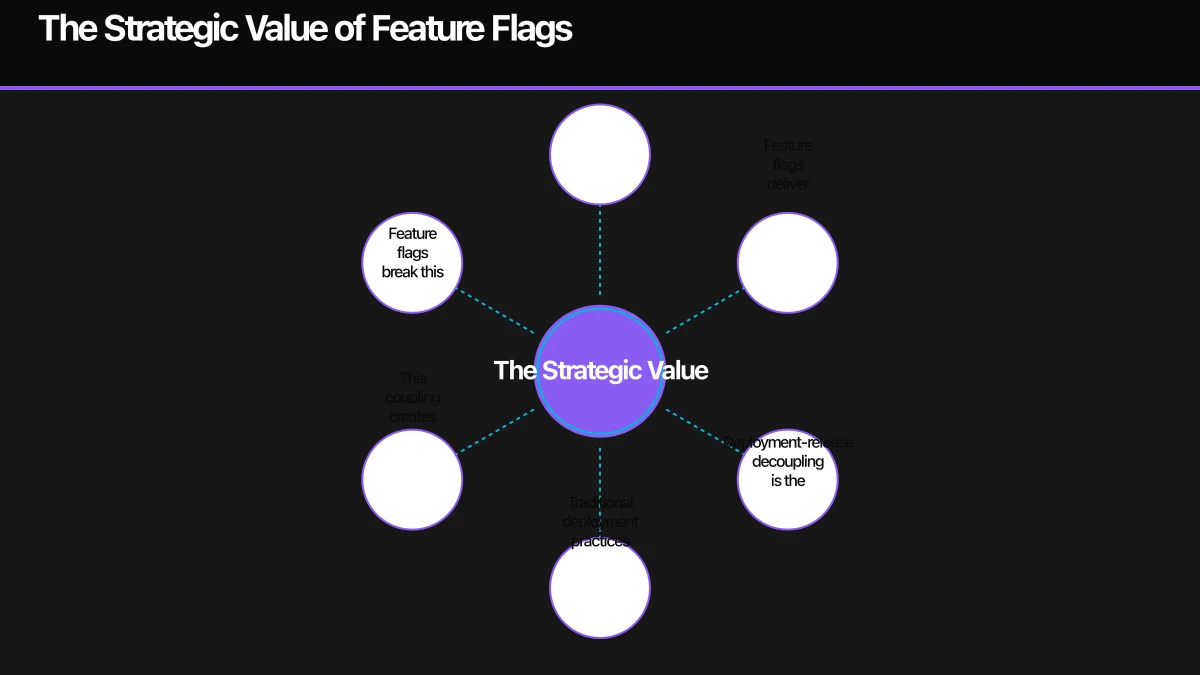
Deployment-release decoupling is the foundational benefit. Traditional deployment practices conflate deploying code to production with releasing functionality to users. This coupling creates high-stakes deployments — every deployment is a release event with potential user impact. Feature flags break this coupling. Code is deployed to production behind disabled flags, reducing deployment risk to near zero. Release is a separate, controlled action — enabling the flag for specific users, percentages, or segments.
This decoupling transforms deployment from a nerve-racking, coordinated event into a routine, continuous activity. Teams that deploy behind feature flags can deploy multiple times per day because deployment itself carries no user-facing risk. The risk is concentrated in the flag enablement, which is granular, controllable, and instantly reversible.
Progressive delivery extends this concept by enabling gradual feature rollout. Rather than releasing a feature to all users simultaneously, organisations enable the feature for 1% of users, monitor metrics (error rates, latency, conversion rates, user satisfaction), increase to 10%, monitor again, and progressively expand until the feature reaches 100%. At any point, if metrics degrade, the feature can be instantly disabled.
For enterprises operating at scale — where a bug affecting 100% of users translates to millions of affected customers and significant revenue impact — progressive delivery is a strategic risk management capability. The blast radius of any feature problem is limited to the percentage of users who have been exposed to it.
Experimentation and A/B testing uses feature flags to show different feature implementations to different user segments and measure the impact on business metrics. This data-driven approach to product development replaces opinion-based decision-making with empirical evidence. Feature A increases conversion by 3%; feature B reduces it by 1% — the flag system provides the infrastructure to run these experiments at scale.
Entitlement management uses feature flags to control feature access based on customer tier, geography, or contractual agreements. Rather than maintaining separate builds for different customer segments, a single codebase with feature flags serves all segments, with flags controlling which features each segment can access. This simplifies deployment while enabling differentiated product offerings.
Architecture for Enterprise Feature Flag Systems
Enterprise feature flag architecture must address performance, reliability, and scale requirements that simple flag implementations cannot meet.
Flag evaluation must be fast and local. Feature flag checks occur in hot code paths — potentially on every request. Network calls to a centralised flag service for every evaluation would add unacceptable latency. Enterprise flag architectures use local evaluation with cached flag configurations: the flag management service distributes flag configurations to application instances (via SDK caching, local files, or edge distribution), and evaluations occur locally against the cached configuration. Configuration updates propagate through streaming connections or periodic polling.
Flag configuration should be hierarchical and targeted. Enterprise flag systems support complex targeting rules: enable a feature for users in a specific geography, with a specific account tier, during specific time windows. This targeting requires a rule evaluation engine that processes boolean logic, percentage rollouts, user attribute matching, and temporal conditions. Platforms like LaunchDarkly, Split, and Unleash provide sophisticated targeting capabilities out of the box.
The flag management interface must support enterprise governance. Flag changes in production environments should require approval workflows, with audit logs recording who changed what and when. Environment separation ensures that flag configurations in development, staging, and production are managed independently. Role-based access control restricts who can create, modify, and enable flags in each environment.
Observability integration connects flag state to application metrics. When a feature flag is enabled and error rates increase, the flag management platform should surface this correlation. Integration with monitoring tools (Datadog, New Relic, Splunk) enables automated analysis: did enabling flag X correlate with metric Y changing? This observability is essential for progressive delivery, where the decision to expand or rollback a feature depends on metric analysis.
Flag Lifecycle Management
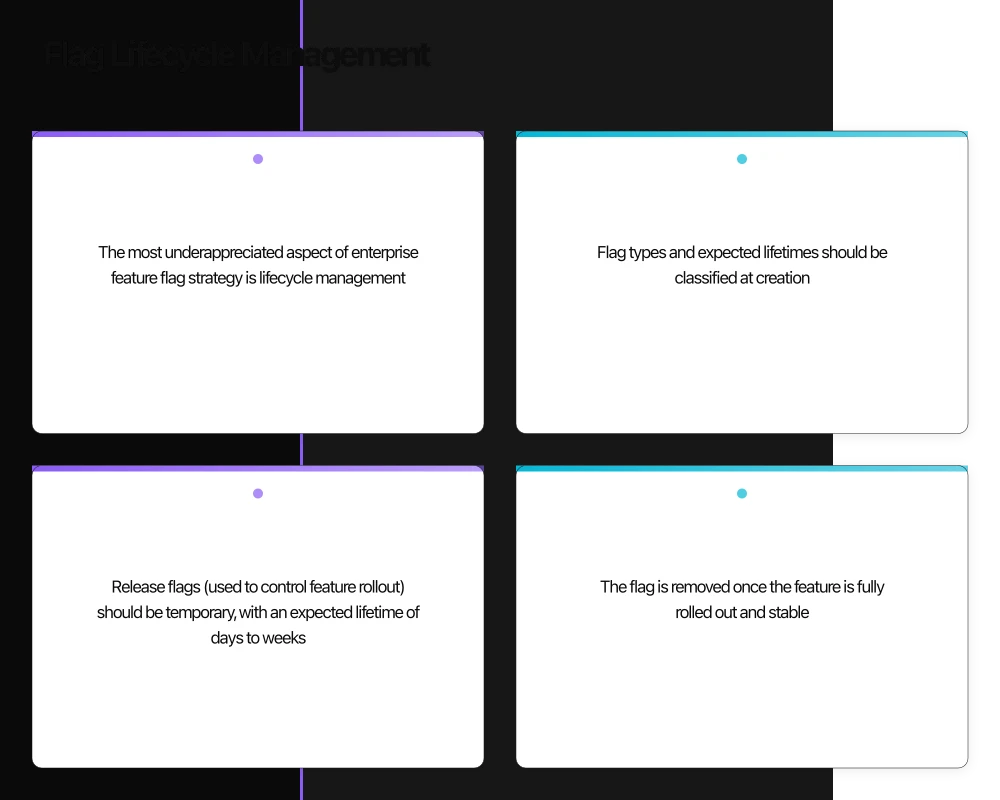
The most underappreciated aspect of enterprise feature flag strategy is lifecycle management. Without active management, feature flags accumulate as technical debt, creating code complexity that degrades development velocity and system reliability.
Flag types and expected lifetimes should be classified at creation. Release flags (used to control feature rollout) should be temporary, with an expected lifetime of days to weeks. The flag is removed once the feature is fully rolled out and stable. Operational flags (kill switches, circuit breakers) should be permanent, providing ongoing operational control. Experiment flags (A/B tests) should be temporary, removed when the experiment concludes. Permission flags (entitlements) should be permanent, tied to business logic.
Stale flag detection and cleanup is the operational discipline that prevents flag accumulation. The flag management platform should track flag age, last modification date, and evaluation patterns. Flags that have been 100% enabled for more than two weeks without modification are candidates for code removal — the flag conditional can be replaced with the enabled code path. Automated stale flag detection, integrated with engineering workflows, creates the discipline needed to prevent accumulation.
Code complexity management requires that feature flag conditionals be implemented cleanly. Flag checks should be concentrated at well-defined decision points rather than scattered throughout the codebase. When a flag is removed, all associated conditional code, test fixtures, and configuration should be removed simultaneously. Flag removal should be treated as a first-class engineering task, not deferred indefinitely.
A practical guideline: for every flag created, the backlog should include a corresponding cleanup ticket with a target date. Release flags should have cleanup tickets due within one sprint of full rollout. This discipline, enforced through the flag management platform and engineering processes, prevents the flag accumulation that plagues organisations with mature flag adoption.
Tooling and Platform Selection
The enterprise feature flag tooling landscape offers both commercial and open source options.
LaunchDarkly is the market leader for enterprise feature flag management, offering sophisticated targeting, enterprise governance, experimentation support, and integrations with major observability and collaboration platforms. Its SDK library covers every major programming language and framework. The trade-off is cost — LaunchDarkly’s pricing can be significant at enterprise scale.
Split combines feature flag management with experimentation capabilities, providing integrated A/B testing and feature impact analysis. Its data-driven approach to feature management is particularly valuable for organisations prioritising experimentation.
Unleash is the leading open source feature flag platform, providing core flag management capabilities without licensing cost. For organisations with the engineering capacity to operate and extend an open source platform, Unleash provides a capable foundation. The trade-off is operational overhead and less sophisticated enterprise features compared to commercial alternatives.
CloudBees Feature Management (formerly Rollout) targets enterprise Java and Kubernetes environments, integrating with the broader CloudBees CI/CD platform.
For most enterprises, the choice between commercial and open source depends on scale, budget, and operational capacity. Commercial platforms provide richer capabilities and reduce operational burden; open source platforms reduce licensing cost but require engineering investment.
Conclusion
Feature flags have evolved from a deployment convenience to a strategic capability that transforms how enterprises deliver, test, and manage software. The organisations that invest in mature feature flag architecture — fast local evaluation, sophisticated targeting, observability integration, and lifecycle governance — gain the ability to deploy continuously, release progressively, experiment systematically, and respond instantly to production issues.
For CTOs building software delivery strategy in 2022, feature flags should be a foundational investment. The capability they provide — separating deployment from release — removes the primary source of deployment risk and enables the continuous delivery practices that distinguish high-performing engineering organisations. The investment in architecture and governance pays for itself many times over through reduced incidents, faster feature delivery, and data-driven product development.
For the practitioner’s view on cloud, IT, and cybersecurity, explore Cloud Geeks — where strategy meets infrastructure.
My consultancy Ganda Tech Services operates three specialist divisions covering cloud infrastructure, web development, and mobile apps for Australian businesses.
About the Author
Ashish Ganda is the founder of Ganda Tech Services, a Sydney-based technology consultancy specialising in cloud infrastructure, web development, and mobile app solutions for Australian businesses.
Digital Transformation Roadmap 2026
A 12-month framework for Australian SMBs ready to modernise — phases, tools, and milestones.
Almost done
Check your inbox and click the confirmation link to get your download.