
CI/CD Pipeline Architecture for Enterprise Scale
Continuous integration and continuous delivery have become table stakes for modern software organisations. The DORA State of DevOps reports consistently demonstrate that elite performers deploy on demand, with lead times measured in hours or less, change failure rates below 15%, and recovery times under an hour. Yet many enterprises struggle to achieve these benchmarks, not because they lack CI/CD tools but because their pipeline architectures do not scale to the complexity of enterprise environments.
Enterprise CI/CD is fundamentally different from CI/CD for a single team or project. When an organisation operates hundreds of services, maintained by dozens of teams, deploying to multiple environments across multiple cloud regions, the pipeline architecture must address concerns that simply do not exist at smaller scales: governance and compliance, cross-service dependency management, environment promotion strategies, secrets management, and the organisational dynamics of shared versus team-owned pipeline infrastructure.
Architectural Foundations for Enterprise Pipelines
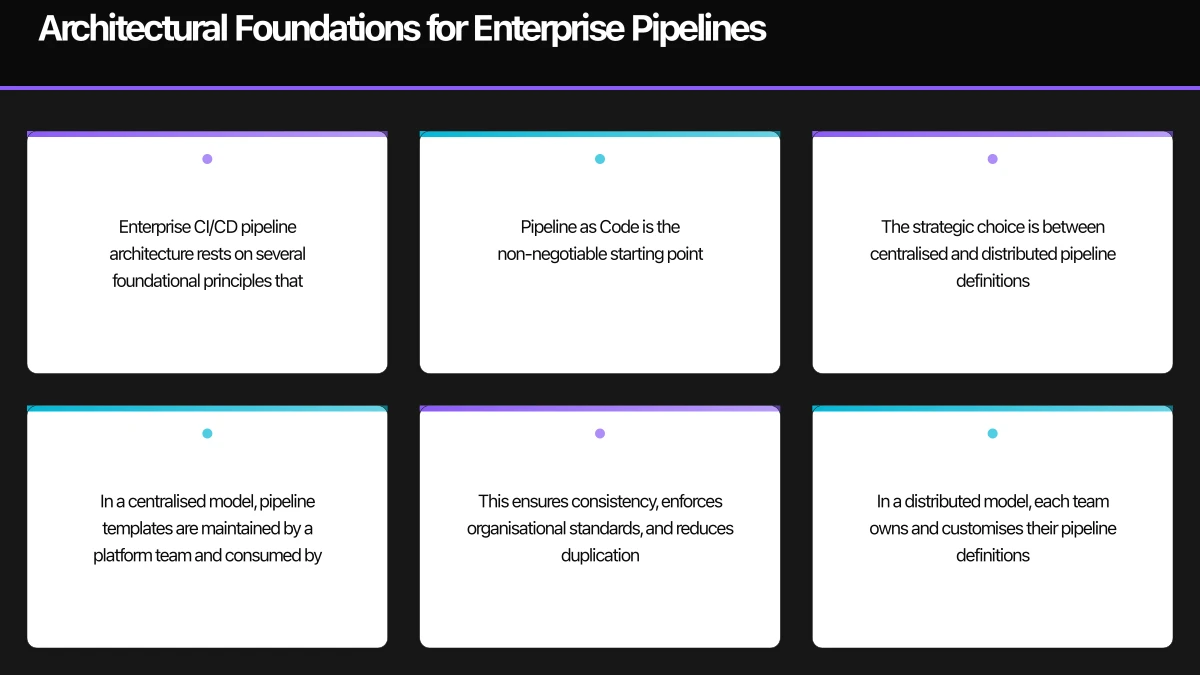
Enterprise CI/CD pipeline architecture rests on several foundational principles that distinguish it from project-level CI/CD implementations.
Pipeline as Code is the non-negotiable starting point. Pipeline definitions stored as code in version control repositories, alongside the application code they build and deploy, provide versioning, auditability, peer review, and the ability to reproduce pipeline behaviour at any point in history. Jenkins Pipeline (Groovy-based Jenkinsfile), GitHub Actions (YAML workflows), GitLab CI (YAML pipeline definitions), and AWS CodePipeline all support pipeline-as-code definitions.
The strategic choice is between centralised and distributed pipeline definitions. In a centralised model, pipeline templates are maintained by a platform team and consumed by application teams. This ensures consistency, enforces organisational standards, and reduces duplication. In a distributed model, each team owns and customises their pipeline definitions. This provides flexibility and team autonomy at the cost of consistency.
The most effective enterprise approach combines both: a platform team provides reusable pipeline templates and shared libraries that encode organisational standards (security scanning requirements, approval gates, deployment strategies), while application teams compose these templates with application-specific steps. This is analogous to the platform engineering model applied to CI/CD — the platform provides golden paths that teams can follow or extend.
Trunk-Based Development as the branching strategy simplifies CI/CD significantly compared to GitFlow or other complex branching models. When all developers integrate to a single main branch, the pipeline can focus on building, testing, and deploying that branch rather than managing the combinatorial complexity of multiple long-lived branches. Feature flags replace feature branches for controlling what is released to users, decoupling deployment from release.
For enterprise teams transitioning from GitFlow, this shift requires cultural change alongside technical change. The confidence to merge to trunk frequently comes from comprehensive automated testing, feature flags, and progressive deployment strategies — capabilities that the CI/CD platform must provide.
Immutable Artifacts ensure that the exact same binary deployed to the test environment is the binary deployed to production. The pipeline builds once and promotes the resulting artifact through environments — from development to staging to production. Environment-specific configuration is injected at deployment time, not build time. This eliminates the class of bugs where “it worked in staging” differs from production behaviour due to build differences.
Container images are the dominant artifact format for modern applications, tagged with the commit SHA or build number to ensure traceability from deployment to source code. Container registries (Amazon ECR, Google Artifact Registry, Docker Hub, JFrog Artifactory) serve as the artifact repository, with vulnerability scanning integrated to prevent deployment of images with known security issues.
Security and Compliance Integration
For enterprise environments, security and compliance are not optional additions to the pipeline — they are integral components that must be architecturally embedded.
Static Application Security Testing (SAST) analyses source code for security vulnerabilities during the build phase. Tools like SonarQube, Checkmarx, and Snyk Code scan for common vulnerability patterns — SQL injection, cross-site scripting, insecure deserialization — and block the pipeline when critical issues are detected. The key architectural decision is where to draw the blocking threshold: organisations that block on any finding create friction that slows development; those that only block on critical findings risk accumulating lower-severity vulnerabilities.
Software Composition Analysis (SCA) examines third-party dependencies for known vulnerabilities. Given that modern applications typically comprise more third-party code than first-party code, SCA is essential for enterprise security. Snyk, Mend (formerly WhiteSource), and FOSSA integrate into CI/CD pipelines to scan dependency manifests and block deployments when critical vulnerabilities are identified.
Dynamic Application Security Testing (DAST) tests running applications for vulnerabilities by simulating attacks. OWASP ZAP and Burp Suite are commonly integrated into later pipeline stages where the application is deployed to a test environment. DAST catches vulnerabilities that static analysis misses — configuration issues, authentication weaknesses, and runtime-specific vulnerabilities.
Infrastructure as Code scanning validates Terraform, CloudFormation, and Kubernetes manifests for security misconfigurations before deployment. Tools like Checkov, tfsec, and Bridgecrew detect issues like publicly accessible S3 buckets, overly permissive security groups, and missing encryption configurations. This shifts infrastructure security left, catching misconfigurations before they reach production.
Approval gates and audit trails satisfy regulatory requirements for change management. Enterprise pipelines typically include manual approval steps for production deployments, with audit logs recording who approved what and when. For regulated industries, these audit trails demonstrate compliance with change management policies.
Deployment Strategies at Enterprise Scale
The deployment phase of enterprise pipelines requires strategies that balance release velocity with risk management across large, interconnected service ecosystems.
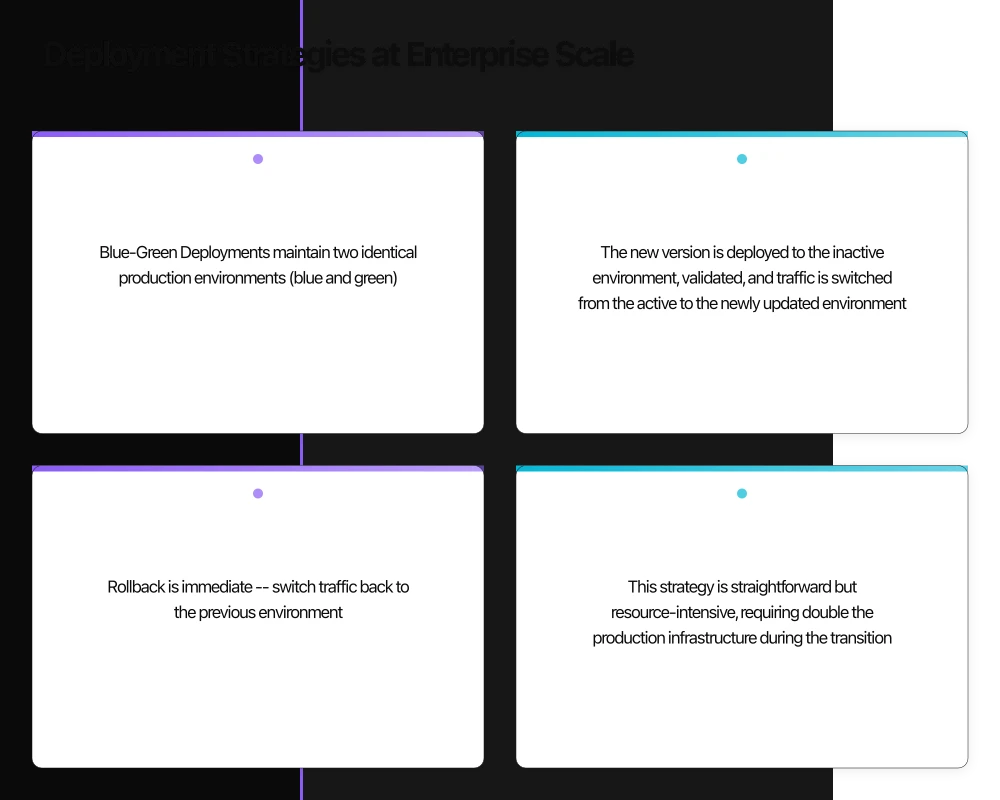
Blue-Green Deployments maintain two identical production environments (blue and green). The new version is deployed to the inactive environment, validated, and traffic is switched from the active to the newly updated environment. Rollback is immediate — switch traffic back to the previous environment. This strategy is straightforward but resource-intensive, requiring double the production infrastructure during the transition period.
Canary Deployments gradually route an increasing percentage of traffic to the new version — starting at 1-5%, increasing to 10%, 25%, 50%, and finally 100% if metrics remain healthy. Automated canary analysis compares error rates, latency percentiles, and business metrics between the canary and baseline populations. If the canary degrades on any metric, traffic is automatically routed back to the stable version.
Tools like Flagger (for Kubernetes), AWS CodeDeploy, and Spinnaker (originally developed by Netflix) provide automated canary deployment capabilities. The investment in canary infrastructure pays significant dividends in deployment confidence and failure reduction.
Progressive Delivery extends canary deployments with feature flag integration. Rather than routing all traffic through the new version, specific features are enabled for specific user segments through feature flags. This allows fine-grained control over feature exposure — enabling a new feature for internal users, then beta customers, then 10% of production traffic, and finally all users. LaunchDarkly, Split, and open-source tools like Unleash provide the feature flag management layer.
Multi-Region Deployment adds geographic complexity to the deployment strategy. Enterprises operating across multiple cloud regions must decide between simultaneous deployment (faster but higher blast radius) and sequential regional deployment (slower but limits the impact of deployment failures to individual regions). Sequential deployment with automated health checks between regions is the safer approach for most enterprises.
Scaling the Pipeline Organisation
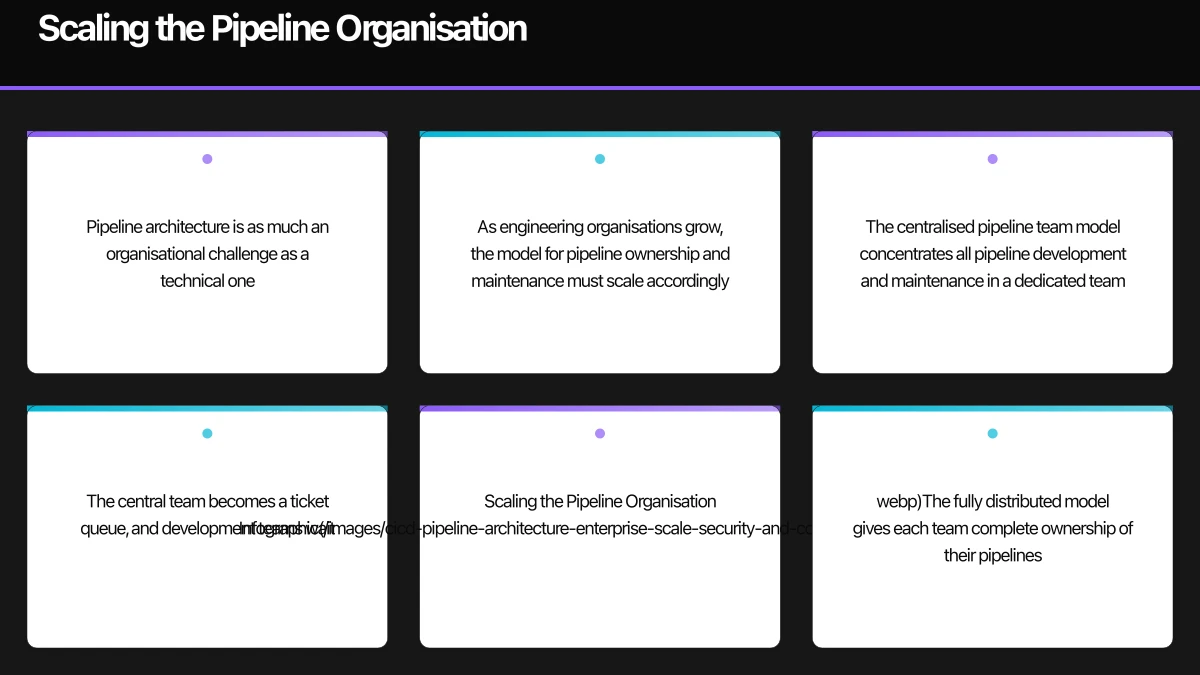
Pipeline architecture is as much an organisational challenge as a technical one. As engineering organisations grow, the model for pipeline ownership and maintenance must scale accordingly.
The centralised pipeline team model concentrates all pipeline development and maintenance in a dedicated team. This ensures consistency and expertise but creates a bottleneck — every team needs pipeline changes, and the central team cannot keep pace with demand. The central team becomes a ticket queue, and development teams wait.
The fully distributed model gives each team complete ownership of their pipelines. This maximises team autonomy and eliminates bottlenecks but sacrifices consistency. Each team makes different security, testing, and deployment decisions, creating a heterogeneous landscape that complicates governance, auditing, and incident response.
The platform model provides the balance. A pipeline platform team builds and maintains reusable pipeline components — build templates, security scanning integrations, deployment strategies, approval workflows — as a self-service platform. Application teams compose these components into application-specific pipelines, customising where needed while inheriting organisational standards by default. This is the model adopted by leading technology organisations and provides the best balance of consistency and autonomy.
Conclusion
Enterprise CI/CD pipeline architecture is the backbone of software delivery capability. The organisations that invest in scalable, secure, well-governed pipeline infrastructure deliver software faster, more reliably, and more securely than those that treat CI/CD as a team-level concern.
For CTOs evaluating their CI/CD strategy in 2022, the priorities are clear: adopt pipeline-as-code with reusable templates, embed security scanning throughout the pipeline, implement progressive deployment strategies that manage risk, and build a pipeline platform that serves the entire engineering organisation through self-service. The investment compounds — every improvement to the pipeline platform accelerates delivery across every team that uses it.
For hands-on web development and SEO advice, visit Cosmos Web Tech — our specialist web design and digital marketing blog.
Ganda Tech Services is my technology consultancy, bringing together cloud infrastructure, web development, and mobile expertise for Australian businesses.
About the Author
Ashish Ganda is the founder of Ganda Tech Services, a Sydney-based technology consultancy specialising in cloud infrastructure, web development, and mobile app solutions for Australian businesses.
Tech Stack Selection Guide 2026
Choose the right tools for your Australian business — without the vendor hype or overlapping spend.