
Enterprise Feature Management: Platform Strategy for Scale
Introduction
Feature management has evolved from a developer convenience to enterprise infrastructure. What began as simple feature flags for hiding incomplete work now encompasses release orchestration, experimentation platforms, and operational safety systems.
For CTOs managing large engineering organisations, feature management platforms determine how quickly teams can ship, how safely they can release, and how effectively they can experiment. The infrastructure decisions made today influence development velocity for years.
This guide examines enterprise feature management strategy: when centralised platforms deliver value, how to evaluate options, and what organisational maturity is required for success.
The Case for Enterprise Feature Management
Beyond Simple Toggles
Feature flags started simply: boolean switches to show or hide features. Enterprise feature management encompasses far more:
Release Management
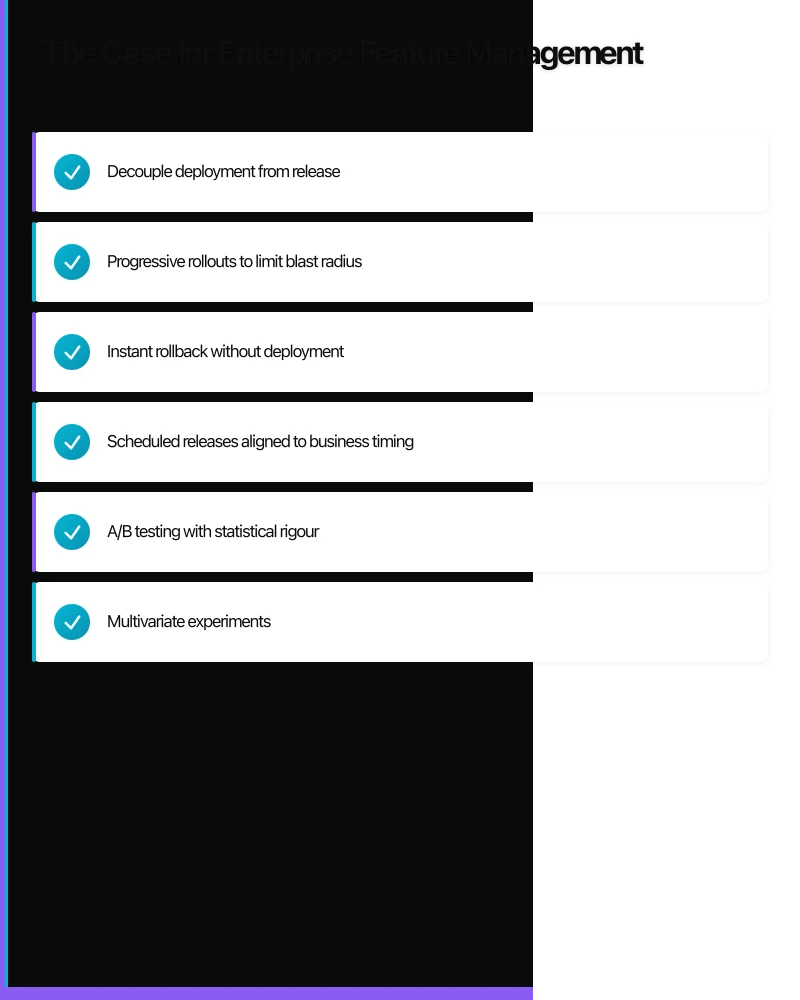
- Decouple deployment from release
- Progressive rollouts to limit blast radius
- Instant rollback without deployment
- Scheduled releases aligned to business timing
Experimentation
- A/B testing with statistical rigour
- Multivariate experiments
- Feature impact measurement
- Data-driven product decisions
Operational Control
- Kill switches for degraded performance
- Gradual migration between systems
- Capacity management through feature limits
- Incident response toggles
Personalisation
- User-segment targeting
- Geographic customisation
- Entitlement-based features
- Beta programme management
Business Impact
Mature feature management delivers measurable outcomes:
Deployment Frequency
Teams with feature flags deploy 2-5x more frequently:
- Trunk-based development becomes practical
- Merge conflicts reduce with smaller changes
- Confidence increases with rollback capability
Incident Recovery
Mean time to recovery improves dramatically:
- Feature disabling in seconds, not deployment minutes
- No code changes required for rollback
- Granular control over problematic features
Experimentation Velocity
Data-driven organisations require experimentation infrastructure:
- Product teams run concurrent experiments
- Statistical significance tracked automatically
- Feature impact quantified before full rollout
Risk Reduction
Progressive delivery limits exposure:
- Percentage rollouts catch issues early
- Canary releases validate in production
- Geographic rollouts isolate regional impact
Platform Architecture Considerations
Core Capabilities
Enterprise feature management platforms require:
Flag Evaluation Engine
The core system determining flag state:
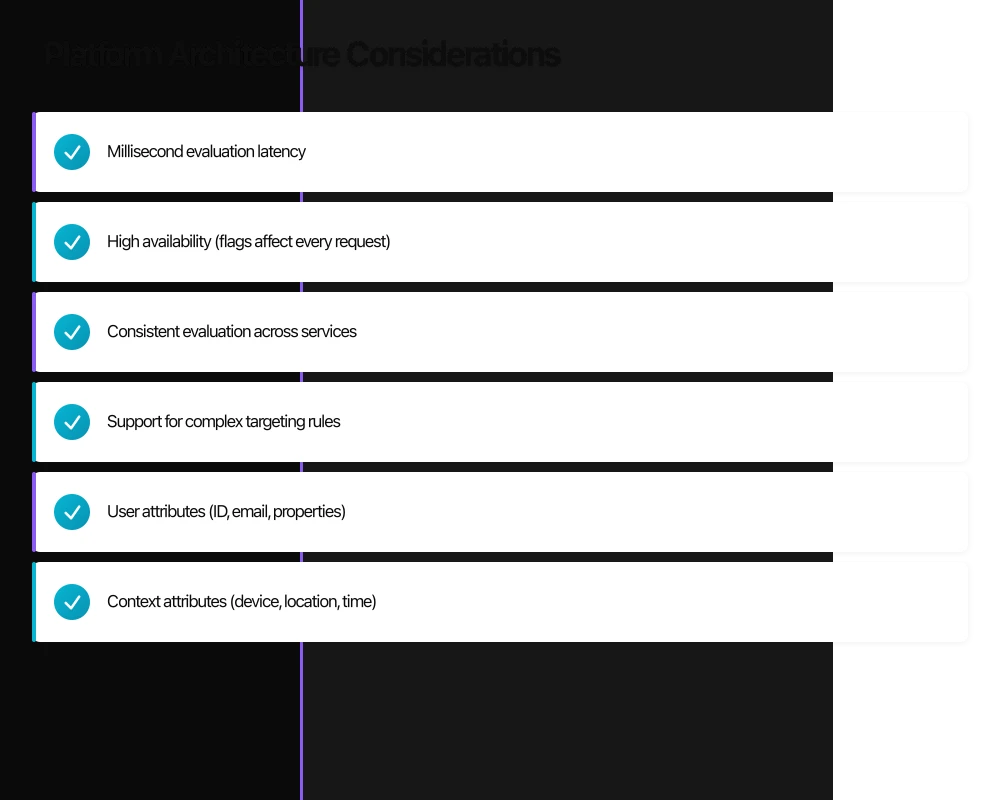
- Millisecond evaluation latency
- High availability (flags affect every request)
- Consistent evaluation across services
- Support for complex targeting rules
Targeting System
Rules determining who sees what:
- User attributes (ID, email, properties)
- Context attributes (device, location, time)
- Percentage rollouts with sticky assignment
- Segment-based targeting
Management Interface
Control plane for flag configuration:
- Role-based access control
- Audit logging for changes
- Environment management
- Approval workflows for production
SDK Ecosystem
Client libraries for all platforms:
- Server-side SDKs (Java, Python, Node, Go, etc.)
- Client-side SDKs (JavaScript, iOS, Android)
- Edge SDKs for CDN integration
- Infrastructure SDKs (Terraform, Kubernetes)
Architecture Patterns
Centralised Service Model
All evaluation through central service:
Application → Feature Service → Flag DecisionAdvantages:
- Single source of truth
- Real-time updates
- Centralised auditing
Disadvantages:
- Latency added to requests
- Service dependency for all applications
- Network partitioning concerns
Local Evaluation Model
SDK evaluates locally with synced rules:
Application (SDK + Rules Cache) → Flag DecisionAdvantages:
- Microsecond evaluation latency
- No network dependency for evaluation
- Resilient to service outages
Disadvantages:
- Eventual consistency for rule updates
- SDK complexity
- Memory overhead for rule cache
Hybrid Model
Combine approaches based on requirements:
- Local evaluation for performance-critical paths
- Service calls for complex decisions
- Edge evaluation for client-side flags
Most enterprise platforms use local evaluation with background synchronisation for optimal performance and reliability.
Scalability Dimensions
Flag Volume
Enterprise organisations accumulate flags:
- Thousands of flags across products
- Hundreds of environments
- Complex targeting rules per flag
Platform must handle flag management at scale without performance degradation.
Evaluation Volume
High-traffic applications evaluate flags frequently:
- Millions of evaluations per second
- Sub-millisecond evaluation requirements
- Global distribution of evaluations
Architecture must support evaluation scale independently from flag management scale.
User Volume
Targeting often involves large user populations:
- Millions of users in segments
- Complex attribute combinations
- Percentage rollout consistency
Targeting system must scale with user population size.
Vendor Landscape
Commercial Platforms
LaunchDarkly
Market leader with comprehensive enterprise features.
Strengths:
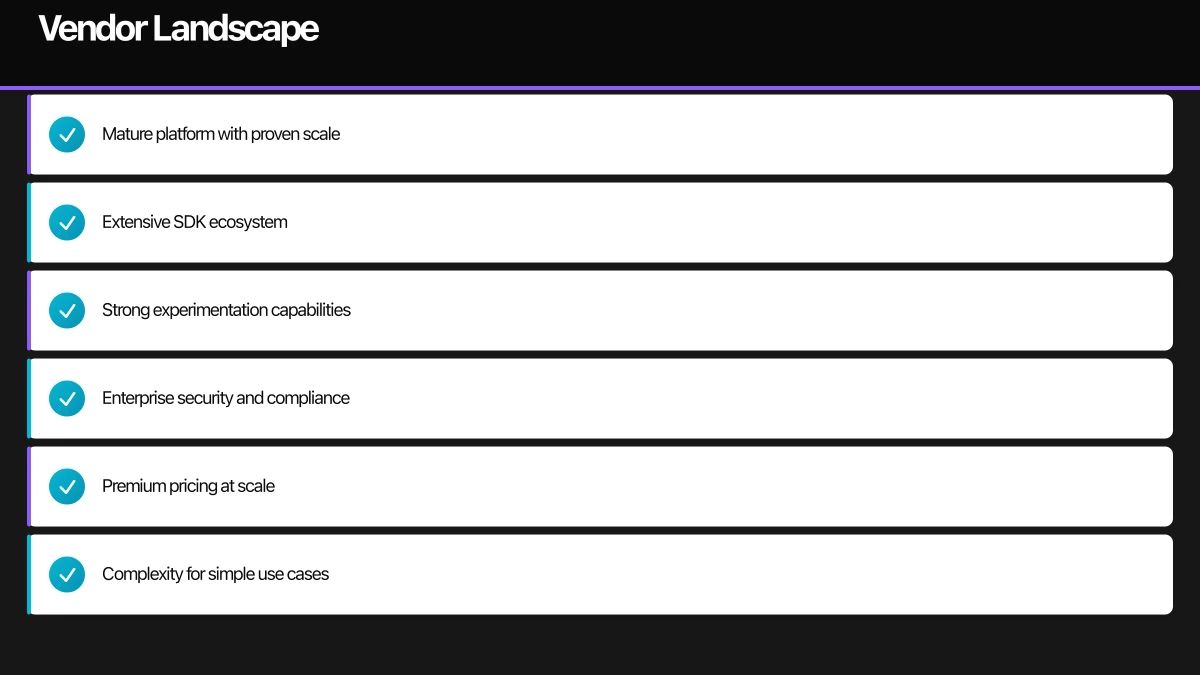
- Mature platform with proven scale
- Extensive SDK ecosystem
- Strong experimentation capabilities
- Enterprise security and compliance
Considerations:
- Premium pricing at scale
- Complexity for simple use cases
- Vendor lock-in with proprietary features
Best for: Large enterprises prioritising capability over cost
Split
Enterprise platform with strong experimentation focus.
Strengths:
- Sophisticated experimentation and analytics
- Attribute-based targeting
- Good developer experience
- Competitive enterprise pricing
Considerations:
- Smaller market share than LaunchDarkly
- SDK coverage slightly less extensive
Best for: Organisations prioritising experimentation capabilities
Optimizely (Feature Experimentation)
Combined experimentation and feature management.
Strengths:
- Strong experimentation heritage
- Integrated with broader Optimizely platform
- Good for product-led organisations
Considerations:
- Complex if only feature flags needed
- Pricing can be significant
Best for: Organisations already using Optimizely for experimentation
Statsig
Modern platform with usage-based pricing.
Strengths:
- Competitive pricing model
- Strong analytics and metrics
- Good developer experience
- Rapid feature development
Considerations:
- Younger platform, less enterprise track record
- Smaller ecosystem
Best for: Growth-stage companies scaling feature management
Open Source Options
Unleash
Open-source feature management with commercial enterprise version.
Strengths:
- Self-hosted option available
- No vendor lock-in for core
- Active community
- Enterprise version adds governance
Considerations:
- Operational overhead for self-hosting
- Fewer advanced features than commercial leaders
- Enterprise features require commercial license
Best for: Organisations prioritising self-hosting or cost control
Flagsmith
Open-source with managed cloud option.
Strengths:
- Flexible deployment options
- Growing feature set
- Reasonable pricing
- Good basic capabilities
Considerations:
- Less mature than established players
- Smaller SDK ecosystem
Best for: Teams wanting open-source foundation with commercial support option
OpenFeature
Open standard for feature flag APIs (not a platform itself).
Value:
- Vendor-neutral SDK interface
- Reduces vendor lock-in
- Growing provider ecosystem
- CNCF sandbox project
Consideration:
- Standard, not implementation
- Requires compatible platform/provider
Best for: Organisations prioritising vendor portability
Cloud Provider Options
AWS AppConfig
Feature flags within AWS Systems Manager.
Strengths:
- AWS-native integration
- Simple pricing model
- Good for AWS-centric architectures
Considerations:
- Limited targeting capabilities
- Basic compared to dedicated platforms
- AWS-only
Azure App Configuration
Feature management in Azure.
Strengths:
- Azure-native integration
- Reasonable capability set
- Simple operations
Considerations:
- Azure-centric
- Less sophisticated than dedicated platforms
Best for: Azure-committed organisations with basic requirements
Evaluation Framework
Requirements Assessment
Before vendor selection, quantify needs:
Technical Requirements
- Evaluation latency tolerance
- Expected evaluation volume
- SDK language requirements
- Integration needs (analytics, observability)
Functional Requirements
- Targeting sophistication needed
- Experimentation requirements
- Approval workflow needs
- Environment management complexity
Operational Requirements
- Self-hosted requirement or preference
- Compliance certifications needed
- Support level expectations
- SLA requirements
Strategic Requirements
- Vendor stability importance
- Lock-in tolerance
- Budget constraints
- Build vs buy philosophy
Evaluation Criteria
| Criteria | Weight | Considerations |
|---|---|---|
| SDK Coverage | High | Languages and platforms you use |
| Evaluation Performance | High | Latency impact on applications |
| Targeting Flexibility | Medium | Rule complexity needed |
| Experimentation | Varies | A/B testing requirements |
| Enterprise Features | Medium | SSO, RBAC, audit, approvals |
| Pricing Model | High | TCO at your scale |
| Vendor Stability | Medium | Long-term platform viability |
Proof of Concept Structure
Week 1-2: Integration Testing
- Deploy SDKs in representative applications
- Measure evaluation latency
- Validate targeting rule capabilities
- Test flag synchronisation behaviour
Week 3-4: Workflow Testing
- Configure production-like environments
- Test approval workflows
- Evaluate management interface usability
- Assess audit and compliance features
Week 5-6: Scale Testing
- Load test evaluation performance
- Validate behaviour under scale
- Test failure scenarios
- Measure operational overhead
Implementation Strategy
Organisational Readiness
Success requires more than technology:
Executive Sponsorship
Feature management changes release processes:
- Engineering leadership commitment
- Product leadership buy-in
- Support for process changes
Team Capability
Teams need skills and understanding:
- Developer training on flag usage
- Product manager training on targeting
- Operations training on incident response
Process Maturity
Existing practices must accommodate:
- CI/CD pipeline integration
- Release process changes
- Incident response updates
- Change management adjustments
Rollout Strategy
Phase 1: Foundation (Months 1-2)
Start controlled:
- Select 2-3 pilot teams
- Deploy platform infrastructure
- Implement basic flags for new features
- Establish flag lifecycle guidelines
Phase 2: Expansion (Months 3-6)
Grow adoption:
- Expand to additional teams
- Implement targeting and percentage rollouts
- Integrate with observability tools
- Develop internal best practices
Phase 3: Maturity (Months 6-12)
Enterprise capability:
- Organisation-wide availability
- Experimentation programme launch
- Self-service for teams
- Governance and cleanup processes
Integration Points
CI/CD Pipeline
Automate flag lifecycle:
- Create flags during feature development
- Link flags to deployment pipelines
- Automate cleanup of released flags
- Track flag age and status
Observability
Connect flags to monitoring:
- Include flag state in telemetry
- Correlate performance with flag changes
- Alert on flag-related anomalies
- Experiment metrics integration
Incident Management
Enable rapid response:
- Kill switch documentation
- Flag-based runbooks
- Integration with incident tools
- Post-incident flag review
Governance and Best Practices
Flag Hygiene
Prevent flag accumulation debt:
Naming Conventions
Consistent naming aids management:
{team}-{feature}-{type}pattern- Clear, descriptive names
- Avoid abbreviations
Flag Types
Categorise flags by purpose:
- Release: Temporary, for shipping features
- Experiment: Time-bound, for A/B tests
- Operational: Permanent, for system control
- Permission: Permanent, for entitlements
Lifecycle Management
Flags should not live forever:
- Define expected lifespan at creation
- Automated reminders for old flags
- Regular cleanup reviews
- Metrics on flag age distribution
Access Control
Govern who can change what:
Role-Based Permissions
- Developers: Create and modify in non-production
- Release managers: Production rollout control
- Product managers: Experiment configuration
- Administrators: Platform configuration
Approval Workflows
- Production changes require approval
- Percentage rollout thresholds
- Scheduled release approvals
- Emergency bypass procedures
Audit Requirements
- All changes logged with attribution
- Change history retained
- Compliance reporting
- Integration with security tools
Technical Standards
Establish patterns for flag usage:
Evaluation Patterns
Consistent usage across codebase:
- Centralised flag evaluation
- Default values defined
- Fallback behaviour specified
- Testing with flag variations
Flag Scope
Clear boundaries for flag impact:
- Single responsibility per flag
- Avoid nested flag dependencies
- Document flag interactions
- Test combinations that matter
Performance Guidelines
Prevent flag-related performance issues:
- Cache evaluation results appropriately
- Batch evaluations where possible
- Monitor evaluation latency
- Profile flag-heavy code paths
Measuring Success
Adoption Metrics
Track platform usage:
- Teams actively using flags
- Flags created and released
- Evaluation volume trends
- Feature coverage
Delivery Metrics
Measure impact on delivery:
- Deployment frequency change
- Lead time for changes
- Mean time to recovery
- Change failure rate
Business Metrics
Connect to business outcomes:
- Experiments run and concluded
- Feature adoption rates
- Incident impact reduction
- Product iteration velocity
Platform Health
Monitor platform itself:
- Evaluation latency percentiles
- Service availability
- SDK version adoption
- Flag cleanup rate
Common Challenges
Flag Explosion
Uncontrolled flag growth creates management burden.
Prevention:
- Mandatory cleanup dates
- Automated age alerts
- Regular flag reviews
- Cleanup as part of definition of done
Testing Complexity
Flags multiply test scenarios.
Mitigation:
- Test with defaults and overrides
- Focus on meaningful combinations
- Automate flag-specific test runs
- Document critical combinations
Dependency Management
Flags can create hidden dependencies.
Solutions:
- Avoid flag dependencies where possible
- Document when necessary
- Implement dependency validation
- Regular dependency audits
Performance Impact
Poor implementation affects application performance.
Prevention:
- Local evaluation for hot paths
- Appropriate caching strategies
- Performance monitoring
- SDK optimisation
Conclusion
Enterprise feature management has become infrastructure as fundamental as CI/CD pipelines. The ability to control feature exposure without deployment, experiment systematically, and respond instantly to incidents defines modern software delivery.
Platform selection should match organisational scale, technical requirements, and strategic priorities. Commercial platforms offer comprehensive capabilities with premium pricing. Open-source options provide flexibility with operational investment. Cloud-native options suit simpler requirements within specific ecosystems.
Success depends as much on organisational readiness as technology choice. Teams need training, processes need adaptation, and governance needs establishment. The technology enables—the organisation must adopt.
Start with clear use cases, implement incrementally, and build toward feature management as a core delivery capability.
Sources
- Forsgren, N., Humble, J., & Kim, G. (2018). Accelerate: The Science of Lean Software and DevOps. IT Revolution Press.
- LaunchDarkly. (2025). State of Feature Management Report. LaunchDarkly Research.
- Hodgson, P. (2024). Feature Toggles (aka Feature Flags). martinfowler.com.
- CNCF. (2025). OpenFeature Specification. https://openfeature.dev/
Strategic guidance for technology leaders building modern release capabilities.
Turning mobile strategy into a shipped app? Awesome Apps covers Flutter, React Native, and native development for Australian businesses.
I lead Ganda Tech Services, where we turn digital strategy into results through specialist cloud, web design, and mobile app teams across Sydney.
About the Author
Ashish Ganda is the founder of Ganda Tech Services, a Sydney-based technology consultancy specialising in cloud infrastructure, web development, and mobile app solutions for Australian businesses.
Tech Stack Selection Guide 2026
Choose the right tools for your Australian business — without the vendor hype or overlapping spend.