
Enterprise DNS Architecture and Traffic Management
DNS is the invisible foundation of every internet-connected enterprise system. Every API call, every web page load, every service-to-service communication begins with a DNS resolution that translates a human-readable name into a network address. Despite this criticality, DNS architecture rarely receives the strategic attention it deserves in enterprise technology planning. Most organisations treat DNS as a commodity service until a DNS failure causes a catastrophic outage — and then discover that their DNS architecture lacks the resilience, performance, and traffic management capabilities that their systems depend on.
For enterprises operating globally distributed applications, DNS is not merely an address lookup service — it is a traffic management layer that determines which data centre serves each user, how traffic flows during failures, and how deployments are orchestrated across regions. Understanding and deliberately architecting this layer is essential for CTOs building resilient, performant global systems.
DNS as a Traffic Management Layer
Enterprise DNS architecture extends far beyond simple name resolution. Modern DNS services provide traffic management capabilities that are essential for globally distributed applications.
Geographic routing directs users to the nearest data centre based on the geographic location inferred from the DNS resolver’s IP address. AWS Route 53 geolocation routing, Cloudflare’s geo-steering, and Azure Traffic Manager’s geographic routing all provide this capability. For enterprises with data centres or cloud regions on multiple continents, geographic routing ensures that users experience low latency by connecting to nearby infrastructure.
The implementation is more nuanced than it appears. DNS resolvers do not always represent the end user’s location accurately — corporate DNS resolvers may be centralised, and public resolvers like Google’s 8.8.8.8 serve from distributed locations that may not match the end user’s geography. The EDNS Client Subnet (ECS) extension partially addresses this by including a portion of the client’s IP address in DNS queries, enabling more accurate geographic routing. Enterprise DNS configurations should leverage ECS-compatible resolvers where possible.
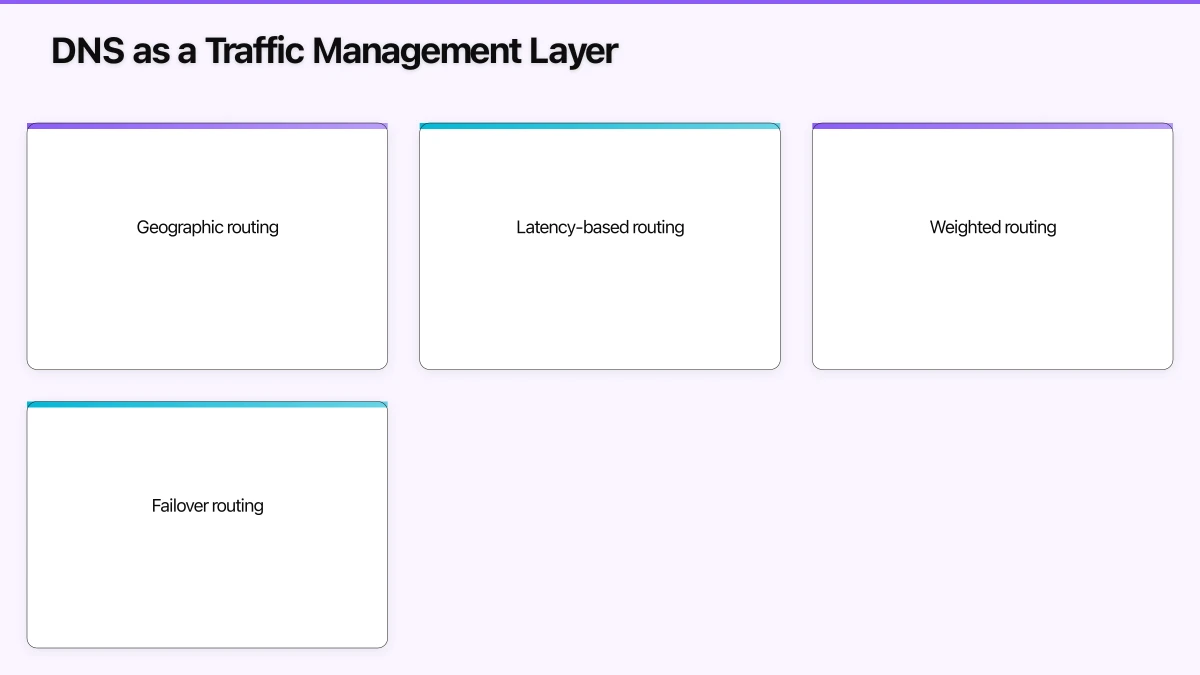
Latency-based routing improves on geographic routing by directing users to the data centre that provides the lowest latency rather than the geographically closest. AWS Route 53 latency routing measures latency from each DNS resolver to each endpoint and routes to the lowest-latency option. This accounts for network topology realities where the closest data centre is not always the fastest — a user in Eastern Europe might be better served by a Western European data centre with excellent connectivity than by a geographically closer data centre with poor transit.
Weighted routing distributes traffic across multiple endpoints in defined proportions. This capability supports several enterprise use cases: gradual migration between old and new infrastructure (routing 10% of traffic to the new system, monitoring, then increasing), A/B testing at the DNS level, and capacity management across data centres with different sizes.
Failover routing provides automatic redirection when a primary endpoint becomes unhealthy. Health checks monitor endpoint availability, and when the primary fails the health check, DNS responses automatically switch to a secondary endpoint. This provides a coarse-grained but effective failover mechanism for disaster recovery scenarios.
The combination of these routing capabilities transforms DNS from a static address lookup into a dynamic traffic management layer. Enterprise architects should design DNS routing strategies that leverage these capabilities to optimise performance, manage capacity, and automate failover.
Resilience Patterns for Enterprise DNS
DNS failures can be catastrophic because they affect all services simultaneously. When DNS resolution fails, no service is reachable, regardless of the health of the underlying infrastructure. Enterprise DNS architecture must be designed for resilience at multiple levels.
Multi-provider DNS uses two or more DNS providers to serve the same zones. If one provider experiences an outage, the other continues to resolve queries. This requires maintaining consistent zone configurations across providers — either manually or through automation tools like OctoDNS or dnscontrol that synchronise zone definitions from version control to multiple providers.
The implementation requires that all providers’ nameservers be included in the domain’s NS records. DNS resolvers will query any available nameserver, providing automatic failover when one provider is unavailable. The operational complexity is maintaining configuration consistency across providers — a zone update that reaches one provider but not the other creates inconsistency that can cause intermittent resolution failures.
TTL strategy balances caching efficiency against change propagation speed. Low TTLs (60-300 seconds) ensure that DNS changes propagate quickly, enabling rapid failover. High TTLs (3600+ seconds) reduce DNS query volume and improve resolver cache hit rates, reducing latency for subsequent queries. The enterprise trade-off is clear: critical records that may need to change quickly (failover records, traffic management records) should use low TTLs, while stable records (MX records, static infrastructure) can use higher TTLs.
During planned changes (migrations, failovers), lowering TTLs in advance (at least one full TTL period before the change) ensures that the old, high-TTL records have expired from resolver caches before the change is made. This operational discipline prevents the common scenario where a DNS change is made but old cached records continue to direct traffic to the previous destination.
DNS-based health checking monitors endpoint availability and automatically updates DNS responses when endpoints become unhealthy. AWS Route 53 health checks, Cloudflare health checks, and similar services poll endpoints at regular intervals and remove unhealthy endpoints from DNS responses. The health check configuration — protocol, path, interval, threshold — should be tuned to detect genuine failures without triggering false positives from transient issues.
Internal DNS architecture for service discovery within enterprise networks uses private DNS zones that are only resolvable within the organisation’s network. AWS Route 53 private hosted zones, Azure Private DNS, and internal DNS servers (CoreDNS, BIND) provide name resolution for internal services. This architecture enables service discovery without exposing internal service addresses to the internet and supports different naming conventions for internal versus external services.
DNS Security Considerations
DNS is a frequent target for attacks and a common vector for data exfiltration, making DNS security an essential component of enterprise security architecture.
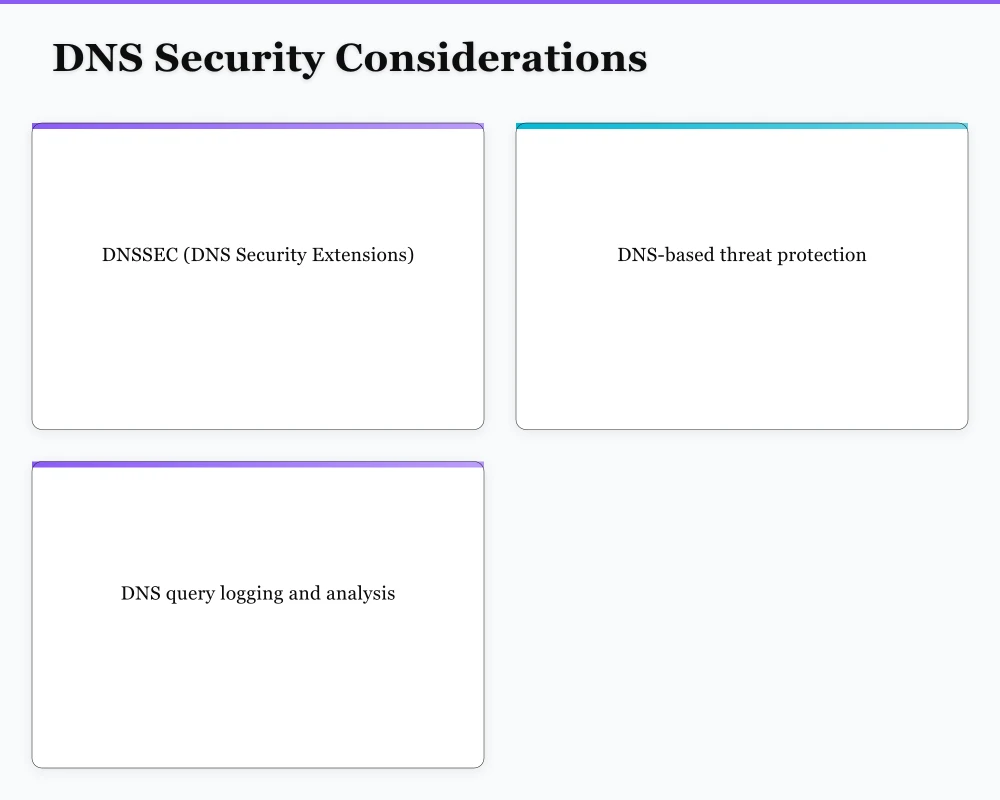
DNSSEC (DNS Security Extensions) provides cryptographic authentication of DNS responses, preventing attackers from forging DNS records to redirect traffic to malicious servers. DNSSEC adoption has been gradual but is increasingly expected for enterprise domains, particularly those serving financial, healthcare, or government applications.
DNS-based threat protection uses DNS query analysis to detect and block malicious activity. Queries to known command-and-control domains, DNS tunnelling (using DNS queries to exfiltrate data), and domain generation algorithms (used by malware to locate control servers) can be detected and blocked at the DNS layer. Services like Cisco Umbrella, Cloudflare Gateway, and AWS Route 53 Resolver DNS Firewall provide these capabilities.
DNS query logging and analysis provides visibility into DNS activity that supports both security monitoring and operational troubleshooting. Logging all DNS queries enables detection of unusual resolution patterns, identification of misconfigured services, and forensic analysis during security incidents.
Operational Best Practices
Enterprise DNS operations should be treated with the rigour applied to any critical infrastructure component.
DNS as Code manages zone configurations in version control, with changes deployed through CI/CD pipelines. Tools like OctoDNS, dnscontrol, and Terraform DNS providers automate zone management and provide the auditability, review, and rollback capabilities that manual DNS management lacks.
Change management for DNS should include peer review for all zone changes, staged rollout where possible (change development/staging zones before production), and monitoring during and after changes to detect resolution failures.
Monitoring DNS performance and availability should track resolution latency from multiple geographic locations, query success rates, and cache hit ratios. DNS monitoring services like Catchpoint, ThousandEyes, and Pingdom provide external perspective on DNS performance that internal monitoring cannot.
Conclusion
Enterprise DNS architecture is a foundational capability that directly impacts application performance, availability, and security. The organisations that architect DNS deliberately — leveraging traffic management capabilities, building resilience through multi-provider redundancy, and securing DNS against attack — operate with confidence that their systems are reachable, performant, and secure.
For CTOs reviewing infrastructure architecture in 2022, DNS deserves strategic attention proportionate to its criticality. Audit the current DNS architecture for single points of failure, evaluate traffic management capabilities against application requirements, and invest in DNS security and operational practices that match the sophistication of the rest of the technology stack.
If this strategic perspective has you thinking about cloud adoption, Cloud Geeks provides the implementation detail — from AWS setup to security hardening.
Ganda Tech Services is my technology consultancy, bringing together cloud infrastructure, web development, and mobile expertise for Australian businesses.
About the Author
Ashish Ganda is the founder of Ganda Tech Services, a Sydney-based technology consultancy specialising in cloud infrastructure, web development, and mobile app solutions for Australian businesses.
Digital Transformation Roadmap 2026
A 12-month framework for Australian SMBs ready to modernise — phases, tools, and milestones.