Enterprise Container Registry and Artifact Management
Container images have become the standard unit of deployment for modern enterprise applications. Every microservice, batch job, and infrastructure component is packaged as a container image, stored in a registry, and deployed to orchestration platforms. The container registry has quietly become one of the most critical infrastructure components in the enterprise — a failure in the registry stops all deployments, and a compromise of the registry enables supply chain attacks that affect every deployed application.
Yet many organisations treat their container registry as a simple storage service, with minimal governance, inconsistent security practices, and no clear strategy for managing the lifecycle of container artifacts. As container adoption scales from dozens to thousands of images, this approach creates security, compliance, and operational risks that demand a more strategic approach.
Registry Architecture Patterns
Enterprise container registry architecture must address availability, security, geographic distribution, and integration with the development and deployment pipeline.
Centralised vs. Distributed Registries: Small organisations typically operate a single registry instance. Enterprises with multiple development teams, cloud accounts, or geographic regions need a more distributed architecture. The common pattern is a central registry that serves as the authoritative source for approved images, with satellite registries or caches in each deployment region that provide low-latency access.
JFrog Artifactory, Harbor (the CNCF project), and cloud-native registries (Amazon ECR, Google Artifact Registry, Azure Container Registry) all support replication between registries. The replication topology — hub-and-spoke, bidirectional, or hierarchical — depends on the organisation’s deployment architecture and governance requirements.
Multi-Tenant Registry Design: When multiple teams share a registry, namespace isolation prevents naming conflicts and enables team-level access controls. A consistent naming convention — organisation/team/service:version — makes images discoverable and attributable. Access controls at the namespace level ensure that teams can push images to their own namespaces but only pull from others.
High Availability: The registry must be available for every deployment. If the registry is down, no application can be deployed, updated, or scaled. This means redundant storage, load-balanced endpoints, and automated failover. Cloud-native registries provide built-in high availability. Self-hosted registries like Harbor require careful infrastructure design to achieve equivalent availability.
Security: Scanning, Signing, and Admission Control
Container security is a supply chain problem. A container image incorporates the application code, its dependencies, the runtime environment, and the base operating system. A vulnerability in any layer is present in every deployment of that image.
Vulnerability Scanning: Every image should be scanned for known vulnerabilities before it is deployed to production. Scanning tools like Trivy (open source), Snyk Container, Aqua Security, and cloud-native scanners (ECR scanning, GCR vulnerability scanning) compare image contents against vulnerability databases (CVE, NVD) and report findings with severity ratings.
The critical architectural decision is where in the pipeline to scan. Scanning at build time provides fast feedback to developers. Scanning at the registry level catches images that bypassed build-time scanning. Continuous scanning of stored images detects newly disclosed vulnerabilities in previously scanned images. A comprehensive strategy includes all three.
Equally important is defining what to do with scan results. A policy that blocks deployment of images with critical vulnerabilities provides the strongest protection but may block urgent deployments. A policy that allows deployment with critical vulnerabilities but generates alerts and requires remediation within a defined timeframe balances security with operational flexibility.
Image Signing: Signing container images with cryptographic signatures ensures that only authorised images are deployed and that images have not been modified after signing. Sigstore’s Cosign, Docker Content Trust (based on Notary), and cloud-native signing services provide image signing capabilities.
The signing workflow typically involves the CI/CD pipeline signing images after successful builds, the registry storing signatures alongside images, and the deployment platform verifying signatures before allowing deployment. This chain of trust prevents unauthorised or tampered images from reaching production.
Admission Control: Kubernetes admission controllers like OPA Gatekeeper and Kyverno enforce policies at deployment time: only allow images from approved registries, only allow signed images, only allow images that have passed vulnerability scanning with acceptable results. Admission control is the enforcement point that turns scanning and signing from informational to mandatory.
Image Lifecycle Management
Enterprise registries accumulate images rapidly. Each CI/CD pipeline run produces a new image, and without lifecycle management, the registry grows indefinitely. This creates storage costs, increases the attack surface (old images with known vulnerabilities remain available), and makes it harder to find current images.
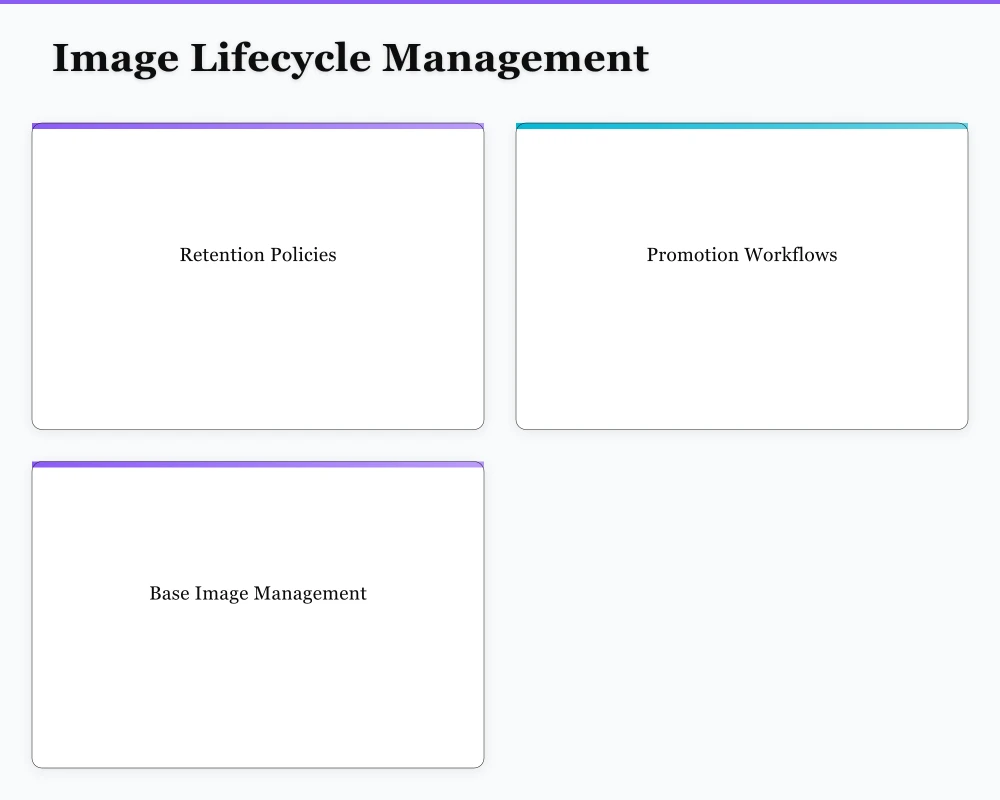
Retention Policies: Define how long images should be retained based on their purpose. Development and testing images may be retained for days or weeks. Production release images should be retained for the duration of the support lifecycle. Compliance-mandated retention may require specific images to be preserved for years.
Automated retention policies that delete images based on age, tag patterns, or usage data prevent unbounded growth. Most registry platforms support tag-based retention rules (keep images tagged with “release-*” for one year, delete untagged images after seven days).
Promotion Workflows: Rather than using a single registry for all environments, mature organisations implement promotion workflows where images progress through stages: development, staging, and production. Each promotion gate may include additional scanning, testing, or approval steps. This ensures that production registries contain only images that have passed all quality and security gates.
The promotion workflow can be implemented as separate registries for each environment, separate repositories within a single registry, or tag-based distinctions within a single repository. The key is that the promotion process is automated, auditable, and enforceable.
Base Image Management: Most container images are built on base images that provide the operating system and common libraries. Managing base images centrally — maintaining a curated set of approved, hardened, and regularly updated base images — improves security and consistency across the organisation.
When a base image is updated (to patch a vulnerability, for example), all images built on it should be rebuilt and redeployed. Tracking the base image lineage of deployed images enables automated rebuild triggers when base images change.
Software Bill of Materials
The software supply chain security conversation, amplified by incidents like the SolarWinds compromise and the Log4Shell vulnerability, has elevated the importance of knowing what is inside deployed software. A Software Bill of Materials (SBOM) provides a machine-readable inventory of all components in a container image: the base OS, installed packages, application dependencies, and their versions.
Generating SBOMs during the build process (using tools like Syft, Trivy, or Docker’s built-in SBOM generation) and storing them alongside container images in the registry enables rapid impact assessment when new vulnerabilities are disclosed. When Log4Shell was announced in December 2021, organisations with comprehensive SBOMs could identify affected applications within hours. Organisations without SBOMs spent days or weeks on manual inventory.
Executive Order 14028, issued by the US government in May 2021, requires SBOMs for software sold to federal agencies. While this directly affects government suppliers, the SBOM requirement is likely to expand to broader enterprise software procurement. Organisations that establish SBOM practices now will be prepared for this evolution.
Container registry and artifact management may lack the visibility of customer-facing initiatives, but it underpins the security, compliance, and operational efficiency of the entire container-based application estate. The CTO who invests in registry architecture, security automation, lifecycle management, and supply chain transparency builds a foundation that scales with the organisation’s container adoption and protects against the supply chain risks that are increasingly in the spotlight.
For hands-on guidance on cloud migration and managed IT, my team at Cloud Geeks helps Australian businesses implement these strategies.
I lead Ganda Tech Services, where we turn digital strategy into results through specialist cloud, web design, and mobile app teams across Sydney.
About the Author
Ashish Ganda is the founder of Ganda Tech Services, a Sydney-based technology consultancy specialising in cloud infrastructure, web development, and mobile app solutions for Australian businesses.
AI Strategy Primer for Australian Business Leaders
A practical framework for AI adoption in 2026 — cut through the hype and start with what matters.