Enterprise Data Lineage: Building Trust in Your Data Assets
When a financial services executive asks “Can I trust this number?”, they’re asking a question that reverberates through the entire data organization. That single KPI on the dashboard represents the culmination of dozens of data transformations, joins, aggregations, and business logic applications. Without understanding this journey—the data lineage—trust remains an article of faith rather than demonstrated fact.
Enterprise data lineage has evolved from a compliance checkbox to a strategic capability that enables data-driven decision making. Organizations that can trace data from source to consumption build confidence in their analytics, accelerate troubleshooting when issues arise, and satisfy increasingly stringent regulatory requirements.
For CTOs navigating the complexity of modern data architectures—spanning on-premises data warehouses, cloud data lakes, streaming systems, and hundreds of analytical tools—implementing comprehensive data lineage is both a technical challenge and an organizational imperative.
The Business Case for Data Lineage
Data lineage answers fundamental questions about data assets: Where did this data come from? How was it transformed? Who modified it and when? What downstream systems depend on it? These questions arise constantly in enterprise environments, and without lineage capability, answering them requires manual investigation that consumes engineering time and delays decision making.
The trust deficit in enterprise data is significant. Gartner research indicates that data professionals spend 40% of their time validating data quality rather than performing analysis. Business users routinely maintain shadow spreadsheets because they don’t trust enterprise systems. Executives make decisions based on intuition because they can’t verify the data supporting recommendations.
Data lineage directly addresses this trust deficit. When users can trace a metric from the dashboard back to source systems, understanding every transformation along the way, they can evaluate data quality with confidence. When data engineers can identify all downstream dependencies, they can assess change impact before making modifications.
Regulatory compliance increasingly mandates lineage capability. GDPR requires organizations to document data processing activities and demonstrate compliance. Financial regulations demand audit trails for reporting data. Healthcare organizations must track PHI throughout its lifecycle. Without automated lineage tracking, compliance becomes a manual documentation burden that scales poorly.
Incident response accelerates dramatically with lineage. When a data quality issue appears in a dashboard, lineage traces backward to identify the root cause—was it a source system issue, a transformation bug, or a data pipeline failure? When source data changes, lineage traces forward to identify affected reports and trigger revalidation. Organizations with mature lineage capability report 60-80% reduction in data incident investigation time.
The financial services industry provides compelling examples. JP Morgan implemented enterprise data lineage to support regulatory reporting requirements, reducing time for lineage documentation from weeks to hours. Goldman Sachs leverages lineage for change impact assessment, preventing data quality issues that previously caused reporting errors.
Understanding Data Lineage Dimensions
Data lineage encompasses multiple dimensions that capture different aspects of the data journey. Understanding these dimensions guides implementation strategy and tooling selection.
Technical lineage captures the physical data flow: which systems, tables, columns, and transformations move data from point A to point B. This is the foundation of lineage—the mechanical reality of how data moves through your infrastructure. Technical lineage answers questions like “What SQL query populated this column?” and “Which Spark job processes this dataset?”
Business lineage maps technical assets to business concepts. A business user doesn’t think in terms of tables and columns but in terms of “customer revenue” and “product margin.” Business lineage creates the translation layer that makes technical lineage accessible to non-technical stakeholders. It connects the abstract business metric to the concrete data implementation.
Operational lineage tracks runtime characteristics: when did this data load complete? How many records were processed? What was the processing duration? Operational lineage enables monitoring and alerting, identifying pipeline failures or performance degradation before they affect downstream consumers.
The granularity of lineage significantly affects implementation complexity. Column-level lineage tracks transformations at the individual field level—this column in the target was derived from these columns in the source using this transformation logic. Table-level lineage tracks dependencies at the dataset level without field-specific detail. Column-level lineage provides more precision but requires more sophisticated parsing and tracking.
Forward and backward lineage serve different use cases. Backward lineage (also called upstream lineage) traces from a data asset back to its sources, supporting root cause analysis and data quality investigation. Forward lineage (downstream lineage) traces from a data asset to its consumers, supporting impact analysis and change management.
Architecture for Enterprise Data Lineage
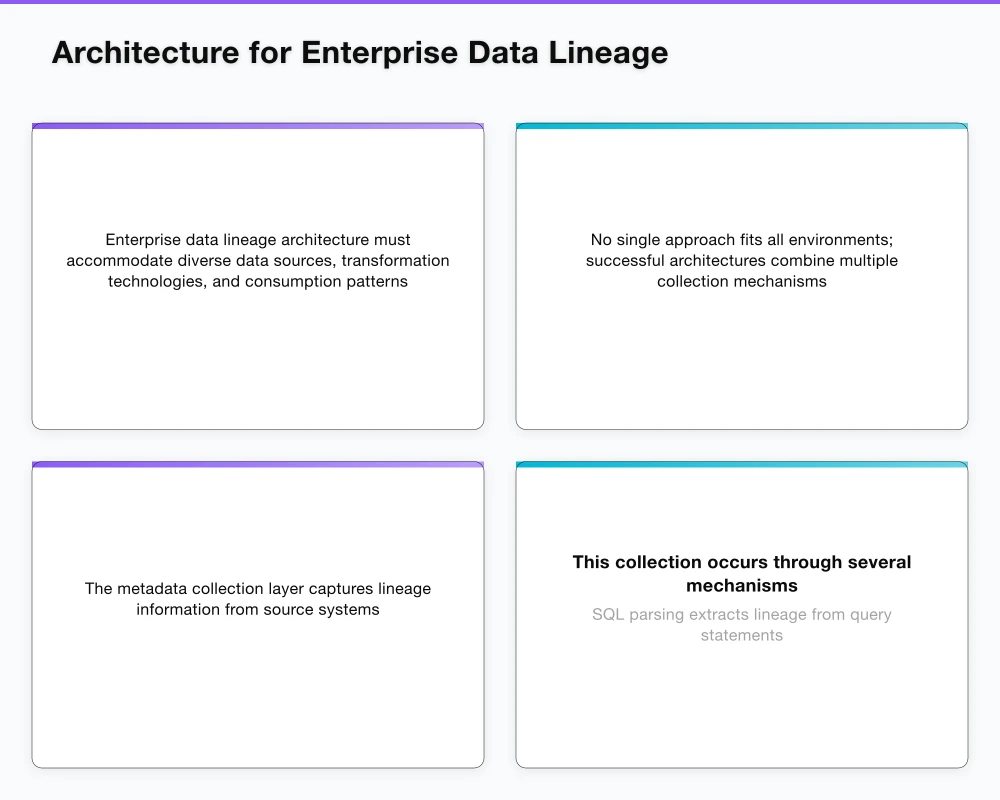
Enterprise data lineage architecture must accommodate diverse data sources, transformation technologies, and consumption patterns. No single approach fits all environments; successful architectures combine multiple collection mechanisms.
The metadata collection layer captures lineage information from source systems. This collection occurs through several mechanisms:
SQL parsing extracts lineage from query statements. When a transformation tool executes SQL, the parser analyzes the query to identify source tables, target tables, and column-level transformations. This approach works across SQL-based systems—data warehouses, databases, SQL-on-Hadoop engines—providing consistent lineage regardless of the execution platform.
API integration captures lineage from transformation platforms that expose metadata through APIs. Modern data tools like Databricks, dbt, and Informatica provide APIs that export transformation definitions and execution history. The lineage system calls these APIs to ingest lineage information.
Agent-based collection deploys lightweight agents alongside data processing systems. The agent monitors data flow, captures transformation operations, and reports lineage to the central repository. This approach captures runtime lineage that may not be visible through parsing or APIs.
Manual annotation supplements automated collection. Some transformations occur in systems that don’t support automated lineage capture—legacy applications, spreadsheets, manual data entry. Manual annotation allows data stewards to document these relationships.
The lineage repository stores collected metadata and relationships. Graph databases excel at this workload—they’re optimized for traversing relationship-heavy data structures. Neo4j, Amazon Neptune, and JanusGraph are common choices for lineage repositories. Alternatively, some organizations use specialized metadata platforms that include lineage repositories.
The discovery and visualization layer exposes lineage to consumers. Interactive visualizations show data flow diagrams, allowing users to navigate upstream and downstream from any data asset. Search capabilities help users find relevant lineage without knowing the exact asset names. APIs enable programmatic lineage access for automation and integration.
Tool Landscape for Data Lineage
The data lineage tool market has matured significantly, with options ranging from open-source frameworks to comprehensive commercial platforms. Selection depends on your technical environment, integration requirements, and organizational maturity.
Apache Atlas provides an open-source foundation for metadata management and lineage. Originally developed for the Hadoop ecosystem, Atlas offers robust lineage capabilities for HDFS, Hive, Spark, and related technologies. The platform provides a graph-based metadata repository, REST APIs for integration, and a web interface for exploration. Organizations committed to open-source and running Hadoop-centric architectures find Atlas a solid choice, though extending to non-Hadoop systems requires additional integration work.
Alation pioneered the data catalog category and includes strong lineage capabilities. The platform automatically harvests lineage from databases, BI tools, and ETL systems, combining technical lineage with business context through its collaborative catalog interface. Alation’s strength lies in connecting lineage to data stewardship—users can document data definitions, quality rules, and ownership alongside lineage relationships.
Collibra positions itself as a data intelligence platform, with lineage as one component of a broader data governance offering. The platform provides sophisticated lineage visualization and integrates with enterprise governance workflows—data access requests, policy management, compliance documentation. Organizations requiring comprehensive governance capability find Collibra’s integrated approach attractive.
Informatica Enterprise Data Catalog offers lineage tightly integrated with Informatica’s data integration tools. For organizations heavily invested in Informatica for ETL and data quality, the catalog provides native lineage capture without additional integration. The platform also harvests lineage from non-Informatica systems through parsers and connectors.
Atlan represents the newer generation of modern data stack tools, built for cloud-native data environments. The platform provides active metadata management with automated lineage from tools like Snowflake, dbt, Looker, and Fivetran. Atlan’s approach emphasizes collaboration and integration with modern analytics workflows.
Open-source alternatives continue to develop. DataHub (originally developed at LinkedIn) and Amundsen (developed at Lyft) provide open-source data discovery platforms with lineage capabilities. These tools appeal to engineering-oriented organizations willing to invest in customization.
Implementation Strategy and Roadmap
Enterprise data lineage implementation requires a phased approach that delivers incremental value while building toward comprehensive coverage. Attempting to capture lineage across all systems simultaneously typically fails—the complexity overwhelms the implementation team, and stakeholders lose patience waiting for results.
Phase one focuses on high-value use cases that demonstrate lineage value. Identify one or two critical data domains—perhaps regulatory reporting data or key executive dashboards—and implement end-to-end lineage for those domains. This focused scope allows the team to learn tooling, develop processes, and demonstrate value without enterprise-wide complexity.
Select initial domains based on business impact and technical accessibility. Domains with clear regulatory requirements provide compelling ROI justification. Domains with frequent data quality issues benefit immediately from root cause analysis capability. Domains with well-understood technical architectures reduce implementation complexity.
During phase one, establish foundational infrastructure: deploy lineage tools, configure initial connectors, and create basic lineage visualizations. Develop operational processes for lineage validation and maintenance. Train initial users and gather feedback that shapes subsequent phases.
Phase two expands coverage across additional data domains while deepening capability. Add connectors for additional source systems. Implement column-level lineage for domains where granular tracking provides value. Integrate lineage with data quality monitoring to automatically flag lineage breaks when data quality issues occur.
Organizational adoption accelerates during phase two. As more users interact with lineage tools, feedback drives capability refinement. Data engineers integrate lineage into development workflows. Business users begin relying on lineage for data validation.
Phase three achieves enterprise-scale coverage and operational maturity. Lineage collection becomes standard for all new data systems. Legacy systems without native lineage support receive manual annotation or custom integration. Lineage drives automated impact analysis and change management workflows.
The timeline varies by organizational size and complexity. Small to mid-size organizations may complete all three phases in 12-18 months. Large enterprises with complex data landscapes may require 2-3 years for comprehensive coverage. The key is continuous value delivery—each phase should demonstrate measurable business impact.
Technical Integration Patterns
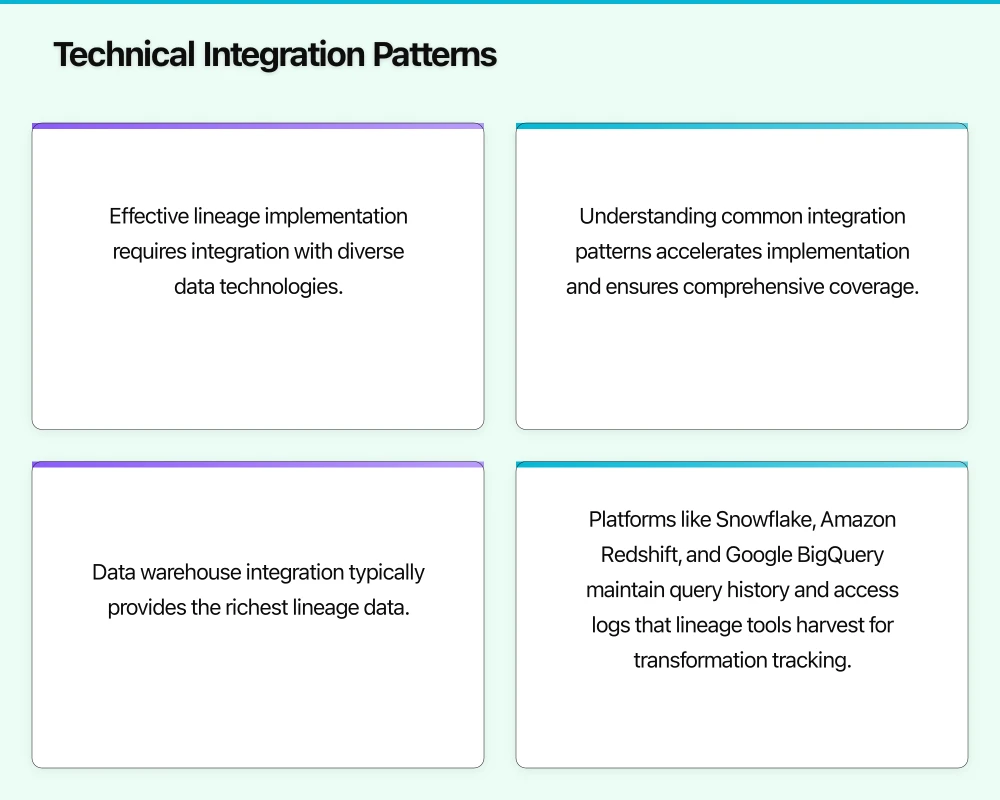
Effective lineage implementation requires integration with diverse data technologies. Understanding common integration patterns accelerates implementation and ensures comprehensive coverage.
Data warehouse integration typically provides the richest lineage data. Platforms like Snowflake, Amazon Redshift, and Google BigQuery maintain query history and access logs that lineage tools harvest for transformation tracking. Some platforms offer native lineage APIs—Snowflake’s recently released Access History feature provides detailed column-level lineage for queries and transformations.
ETL and ELT tool integration varies by platform architecture. Traditional ETL tools like Informatica PowerCenter and Talend maintain metadata repositories that export lineage information. Modern ELT tools like dbt generate lineage as part of their transformation compilation process—dbt’s manifest files contain complete lineage graphs that integrate easily with data catalogs.
Orchestration platform integration captures execution-time lineage. Apache Airflow, the dominant orchestration platform, tracks DAG execution including task dependencies and data artifacts. Lineage plugins extract this information for central repository storage. Similar integrations exist for Prefect, Dagster, and other orchestration tools.
BI tool integration closes the lineage loop from source to consumption. Tableau, Power BI, and Looker all expose report metadata including data source connections and field definitions. Integrating BI metadata shows which reports and dashboards consume which data assets, enabling impact analysis for data changes.
API-based integration provides flexibility for custom systems. When standard connectors don’t exist, lineage tools typically offer APIs for custom lineage submission. Development teams instrument their data processing code to emit lineage events, capturing transformations in proprietary systems or custom applications.
Real-time streaming systems present unique challenges. Kafka-based architectures involve continuous data flow without discrete transformation events. Schema registries (Confluent Schema Registry, AWS Glue Schema Registry) capture data structure definitions. Stream processing frameworks like Kafka Streams and Apache Flink emit lineage as they process data.
Governance Integration
Data lineage achieves maximum value when integrated with broader data governance programs. Lineage provides the foundation that enables governance policies to operate effectively.
Data quality integration connects lineage with quality monitoring. When quality rules detect anomalies—unexpected nulls, out-of-range values, referential integrity failures—lineage traces backward to identify the root cause. Was the issue in source data? Did a transformation introduce the problem? This integration accelerates incident resolution and enables preventive action.
Classification and sensitivity tracking overlay lineage with data categorization. When lineage shows that a column derives from a PII-containing source field, downstream consumers inherit sensitivity classifications. This lineage-based classification propagation ensures that sensitivity tags remain accurate as data flows through transformations.
Access control integration uses lineage to inform permissions. If a report contains data derived from restricted sources, access to that report should reflect source restrictions. Lineage enables policy engines to evaluate downstream access based on upstream sensitivity.
Change management workflows leverage lineage for impact assessment. Before modifying a source system schema or transformation logic, lineage-based impact analysis identifies all affected downstream assets. Stakeholders for affected systems receive notifications. Change approval workflows incorporate impact analysis results.
Compliance documentation generates automatically from lineage. Regulatory frameworks require documented data processing inventories—lineage provides the foundation for these inventories. Auditors can trace any data element from consumption to source, validating processing compliance.
Data ownership integrates with lineage to clarify accountability. Each data asset has defined owners responsible for quality and governance. Lineage shows ownership transfer as data flows between systems, clarifying responsibility for issues that arise at different points in the data journey.
Operational Excellence and Maintenance
Deployed lineage systems require ongoing operational attention to maintain accuracy and coverage. Without maintenance, lineage degrades as systems evolve—transformations change, new data sources appear, and documented lineage diverges from reality.
Lineage validation ensures that captured lineage reflects actual data flow. Automated validation compares lineage metadata against query logs, detecting discrepancies between documented and actual transformations. Validation should run continuously, flagging drift for investigation.
Coverage monitoring tracks what percentage of data assets have lineage documentation. New systems should automatically trigger lineage integration tasks. Coverage dashboards identify gaps requiring attention.
Performance optimization prevents lineage systems from becoming bottlenecks. SQL parsing for large queries can be computationally expensive. Lineage graph traversal for highly connected assets may time out. Monitor query performance and optimize indexing, caching, and query patterns as lineage volumes grow.
Version management tracks lineage evolution over time. Data pipelines change—transformations are modified, sources are replaced, new consumers are added. Lineage systems should maintain history, showing how data flow has evolved and enabling point-in-time lineage queries.
User feedback loops capture lineage issues identified by consumers. Despite automated collection, lineage errors occur—parsers may misinterpret complex queries, manual annotations may become outdated. Easy mechanisms for reporting lineage issues enable continuous improvement.
Integration maintenance responds to upstream system changes. When data platforms upgrade versions, lineage integrations may break. When new data tools are adopted, lineage coverage gaps appear. Treat lineage integrations as production systems requiring maintenance attention.
Overcoming Common Implementation Challenges
Enterprise lineage implementations encounter predictable challenges. Anticipating these challenges and planning mitigation strategies improves implementation success.
Legacy system coverage gaps are inevitable. Organizations have data processing systems built over decades—mainframe batch jobs, Access databases, Excel macros—that predate modern lineage tools. These systems won’t support automated lineage capture. Accept that some lineage will require manual documentation, and prioritize automated capture for high-value data flows.
Organizational resistance emerges when lineage exposes uncomfortable truths. Lineage may reveal undocumented transformations, shadow IT data systems, or data quality issues that teams prefer to keep hidden. Executive sponsorship and governance integration help overcome resistance by framing lineage as organizational improvement rather than blame assignment.
Complexity overwhelms teams attempting comprehensive initial scope. The instinct to capture everything simultaneously fragments focus and delays value delivery. Disciplined scope management—starting with bounded, high-value domains—builds momentum and demonstrates value that justifies broader investment.
Tooling limitations become apparent in complex environments. No tool supports every data platform out of the box. Custom integration work is inevitable for comprehensive coverage. Evaluate tools based on extensibility and API quality, not just native connector count.
Performance and scale challenges emerge as lineage volumes grow. Enterprises with thousands of data assets and millions of lineage relationships stress lineage systems. Architecture decisions made early—repository technology, indexing strategy, query optimization—determine scalability limits.
Ongoing maintenance burden surprises organizations expecting one-time implementation. Lineage is a living system that requires continuous attention. Budget for ongoing operational support, not just initial implementation.
Measuring Lineage Program Success
Effective measurement demonstrates lineage program value and guides investment decisions. Metrics should span coverage, quality, adoption, and business impact.
Coverage metrics track lineage completeness. What percentage of data assets have documented lineage? What percentage of critical data domains have end-to-end lineage from source to consumption? Coverage should increase steadily as the program matures.
Quality metrics assess lineage accuracy. What percentage of validated lineage paths are accurate? How quickly are lineage errors identified and corrected? Quality validates that coverage metrics reflect meaningful lineage, not just metadata collection.
Adoption metrics measure organizational engagement. How many users access lineage tools monthly? What percentage of data teams reference lineage in their workflows? Which use cases drive the most lineage queries? Adoption indicates whether lineage delivers value that attracts users.
Business impact metrics connect lineage to outcomes. How much faster are data incidents resolved? How many data quality issues were prevented through impact analysis? What compliance effort reduction resulted from automated lineage documentation? Business impact justifies continued investment.
Track these metrics over time to demonstrate program maturation. Early phases emphasize coverage growth. As coverage matures, focus shifts to quality and adoption. Mature programs demonstrate sustained business impact.
Strategic Recommendations for CTOs
Enterprise data lineage represents a strategic investment that compounds over time. Organizations that establish lineage capability early build advantages that become increasingly difficult for competitors to replicate.
Start with clear business drivers. Lineage implementation without specific use cases becomes a technology exercise that struggles to demonstrate value. Connect lineage to compliance requirements, data quality initiatives, or specific business problems that demand lineage capability.
Invest in foundational architecture. Lineage tools and platforms will evolve; foundational architecture decisions—metadata models, repository technology, integration patterns—provide stability across tool transitions. Build for extensibility rather than comprehensive initial coverage.
Plan for organizational change alongside technical implementation. Lineage visibility changes how organizations think about data. Data stewardship roles may need definition or refinement. Development processes may require modification to incorporate lineage capture. Technical implementation without organizational adaptation delivers limited value.
Recognize lineage as ongoing capability, not a project. The value of lineage grows with coverage and organizational adoption. Initial implementation represents the beginning of a capability that requires sustained investment to mature and deliver full value.
The enterprises that establish robust data lineage capability today position themselves for the data-intensive decision making that will define competitive success in the years ahead.
Building enterprise data lineage capability? I advise technology leaders on data strategy and governance. Connect to discuss your data lineage journey.
For practical web design and SEO guidance, my team at Cosmos Web Tech helps Australian businesses build high-performing websites.
I lead Ganda Tech Services, where we turn digital strategy into results through specialist cloud, web design, and mobile app teams across Sydney.
About the Author
Ashish Ganda is the founder of Ganda Tech Services, a Sydney-based technology consultancy specialising in cloud infrastructure, web development, and mobile app solutions for Australian businesses.
Digital Transformation Roadmap 2026
A 12-month framework for Australian SMBs ready to modernise — phases, tools, and milestones.
Almost done
Check your inbox and click the confirmation link to get your download.