Enterprise Data Lakehouse Architecture: A Strategic Design Guide
The enterprise data landscape is converging. For two decades, organisations maintained separate systems for analytics and machine learning: structured data warehouses for business intelligence and data lakes for unstructured data and advanced analytics. This bifurcation created data silos, duplicated pipelines, and governance gaps that frustrated both business users and data scientists.
The data lakehouse architecture resolves this convergence by combining data warehouse management capabilities with data lake storage economics and flexibility. Lakehouse platforms provide ACID transactions, schema enforcement, and SQL analytics on data stored in open formats on object storage. This enables a single platform serving BI dashboards, ML training, and real-time analytics without the data duplication and governance inconsistencies of separate systems.
For CTOs evaluating data platform strategy, lakehouse architecture represents a significant shift in what is possible. The technology has matured rapidly; major platforms now deliver the performance, reliability, and governance capabilities enterprises require. The question is no longer whether lakehouse architecture can work, but how to implement it effectively given your specific data landscape.
The Lakehouse Value Proposition
Understanding why lakehouse architecture has gained such momentum requires examining the limitations of prior approaches.
Data Warehouse Limitations
Traditional data warehouses excel at structured analytics. They provide strong ACID guarantees, excellent SQL performance, and sophisticated optimisation. Yet they struggle with modern data requirements:
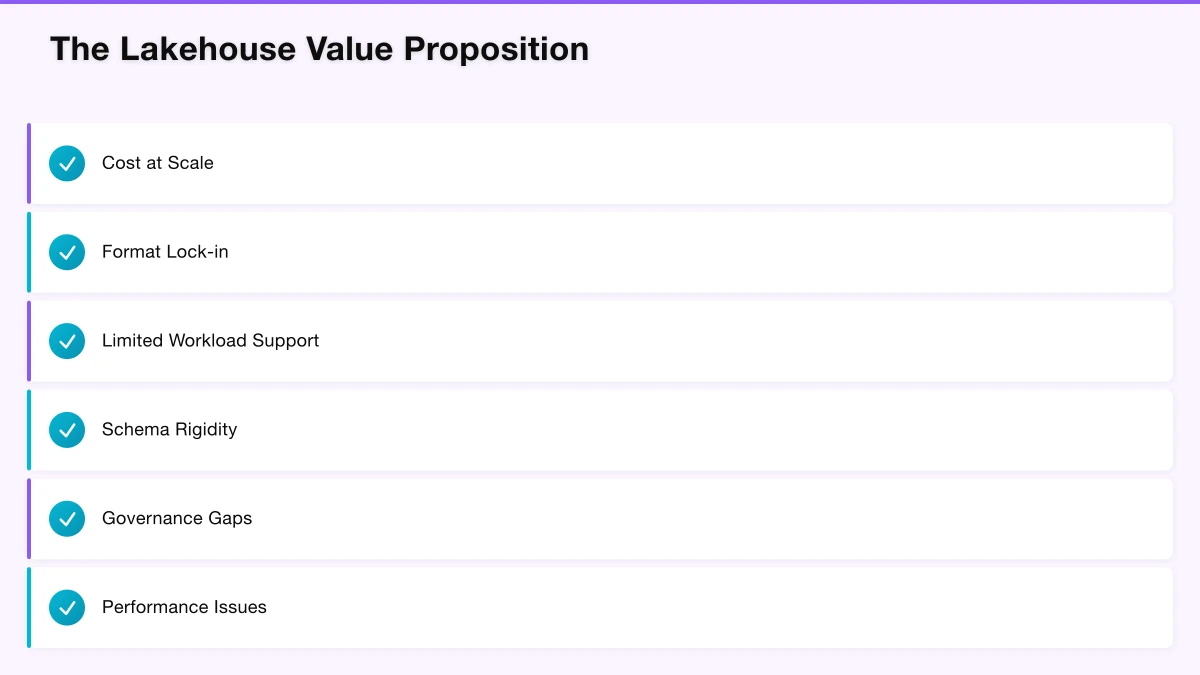
Cost at Scale: Warehouses couple storage and compute, making large-scale data storage expensive. Storing years of historical data for ML training becomes cost-prohibitive.
Format Lock-in: Proprietary storage formats create vendor dependency. Extracting data for non-warehouse workloads requires expensive ETL processes.
Limited Workload Support: Warehouses optimise for SQL queries. Machine learning, streaming, and unstructured data require separate platforms.
Schema Rigidity: Schema-on-write approaches struggle with semi-structured and evolving data schemas common in modern applications.
Data Lake Limitations
Data lakes addressed warehouse limitations through open formats and storage/compute separation. Yet lakes created their own challenges:
Governance Gaps: Without transaction support, concurrent writes corrupt data. Without schema enforcement, data quality degrades over time.
Performance Issues: Without optimisation metadata, queries scan entire datasets. Performance at scale disappoints compared to warehouses.
Complexity: Lakes require substantial engineering to achieve basic reliability. Teams spend more time managing infrastructure than deriving insights.
Data Swamp Risk: Without governance, lakes accumulate data that nobody understands, trusts, or uses, becoming expensive storage for neglected assets.
Lakehouse Convergence
Lakehouse architecture combines strengths while addressing weaknesses:
┌────────────────────────────────────────────────────────────┐
│                    Data Lakehouse                          │
├────────────────────────────────────────────────────────────┤
│  Warehouse Capabilities          Lake Capabilities         │
│  • ACID transactions             • Open formats            │
│  • Schema enforcement            • Storage/compute split   │
│  • SQL analytics                 • All data types          │
│  • BI integration                • ML/AI workloads         │
│  • Performance optimisation      • Cost-effective storage  │
└────────────────────────────────────────────────────────────┘
                            │
                            ▼
            ┌───────────────────────────────┐
            │     Object Storage            │
            │  (S3, ADLS, GCS)             │
            │  Open Table Formats          │
            │  (Delta Lake, Iceberg, Hudi) │
            └───────────────────────────────┘
This architecture enables:
- Single platform for all analytical workloads
- Open formats preventing vendor lock-in
- Cost-effective storage at any scale
- Strong governance and reliability guarantees
Open Table Formats
Open table formats are the enabling technology for lakehouse architecture. They add transactional capabilities to file-based storage without proprietary lock-in.
Delta Lake
Developed by Databricks and donated to the Linux Foundation, Delta Lake has become the most widely adopted open table format.
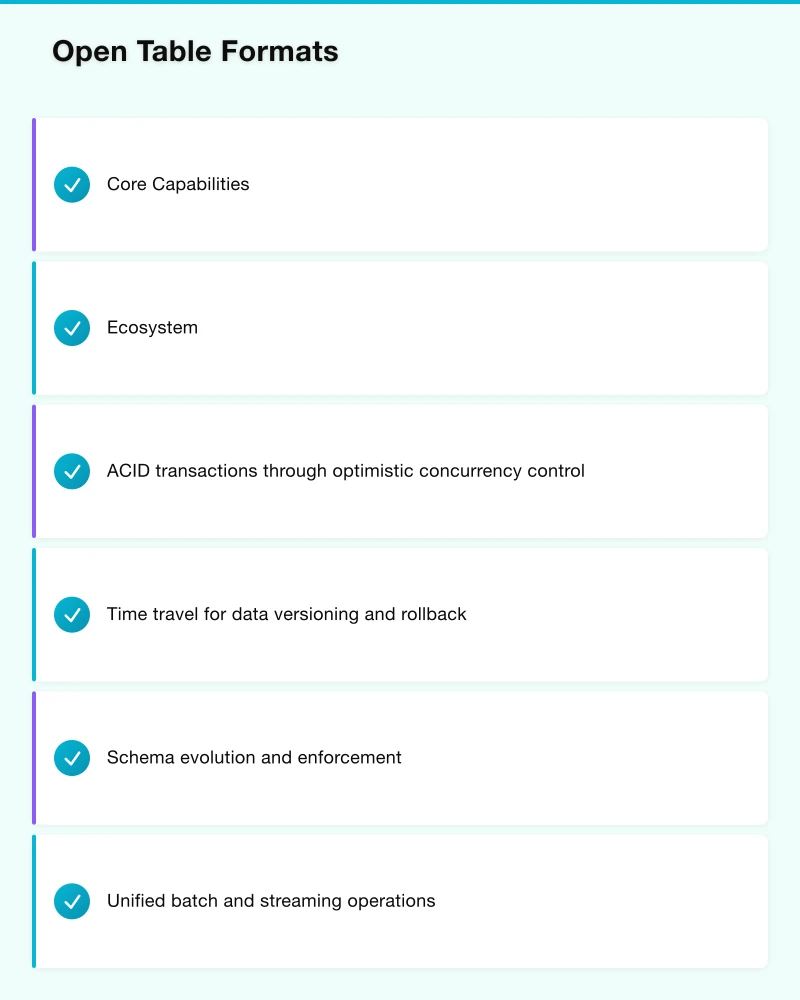
Core Capabilities:
- ACID transactions through optimistic concurrency control
- Time travel for data versioning and rollback
- Schema evolution and enforcement
- Unified batch and streaming operations
- Optimisation features: Z-ordering, compaction, caching
Ecosystem: Deep integration with Databricks platform; broad integration with Apache Spark, Trino, Presto, and other engines.
Delta Lake dominates in Spark-centric environments and Databricks customers.
Apache Iceberg
Developed at Netflix for their massive-scale requirements, Iceberg has gained significant momentum as a vendor-neutral option.
Core Capabilities:
- ACID transactions with serializable isolation
- Hidden partitioning (partitioning without requiring user knowledge of partition layout)
- Schema and partition evolution
- Time travel and rollback
- Optimisation through metadata and indexing
Ecosystem: Strong support across cloud providers and compute engines. AWS, Google Cloud, and independent vendors have rallied around Iceberg.
Iceberg suits multi-engine environments and organisations prioritising vendor neutrality.
Apache Hudi
Originally developed at Uber for incremental data processing, Hudi focuses on streaming and incremental use cases.
Core Capabilities:
- ACID transactions
- Incremental processing optimised for streaming
- Record-level updates and deletes
- Optimised for CDC and streaming workloads
Ecosystem: Strong in streaming-heavy environments and Uber’s ecosystem.
Hudi excels for organisations with heavy streaming and incremental processing requirements.
Format Selection
| Factor | Delta Lake | Iceberg | Hudi |
|---|---|---|---|
| Databricks environment | Excellent | Good | Limited |
| Multi-engine | Good | Excellent | Good |
| Streaming/CDC | Good | Good | Excellent |
| Vendor neutrality | Good | Excellent | Good |
| Ecosystem breadth | Excellent | Growing | Moderate |
| Maturity | High | High | High |
Many organisations adopt multiple formats for different use cases while maintaining interoperability through format-agnostic query engines.
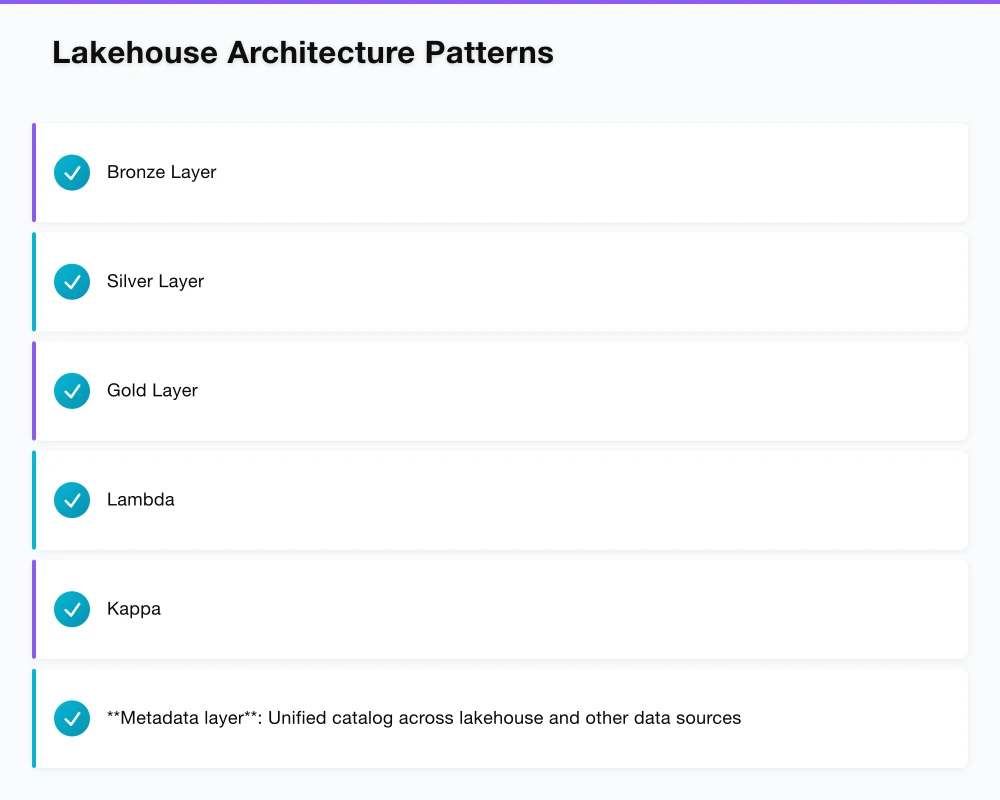
Lakehouse Architecture Patterns
Lakehouse implementations follow several architectural patterns depending on organisational requirements:
Medallion Architecture
The medallion pattern organises data into bronze, silver, and gold layers based on refinement level:
┌─────────────────────────────────────────────────────────┐
│                                                         │
│  ┌─────────┐     ┌─────────┐     ┌─────────┐          │
│  │ Bronze  │────>│ Silver  │────>│  Gold   │          │
│  │ (Raw)   │     │(Cleaned)│     │(Business)│          │
│  └─────────┘     └─────────┘     └─────────┘          │
│                                                         │
│  • Ingested data    • Deduplicated    • Business       │
│  • Original format  • Validated       • aggregates     │
│  • Full history     • Standardised    • Curated views  │
│  • No transformation • Joined          • Ready for BI  │
│                                                         │
└─────────────────────────────────────────────────────────┘
Bronze Layer: Raw data as received from sources. Preserves original data for reprocessing and audit. Minimal transformation.
Silver Layer: Cleaned, deduplicated, standardised data. Business logic applied. Quality validated. Ready for broad consumption.
Gold Layer: Business-aggregated, optimised views. Tailored for specific consumption patterns. Performance-optimised.
The medallion pattern provides clear organisation while preserving raw data for reprocessing when requirements change.
Data Mesh Integration
Lakehouse architecture supports data mesh principles through domain-oriented organisation:
┌────────────────────────────────────────────────────────┐
│                  Shared Infrastructure                  │
│         (Object Storage + Open Table Format)           │
├────────────────────────────────────────────────────────┤
│                                                        │
│  ┌────────────┐  ┌────────────┐  ┌────────────┐      │
│  │  Customer  │  │   Sales    │  │  Finance   │      │
│  │   Domain   │  │   Domain   │  │   Domain   │      │
│  │            │  │            │  │            │      │
│  │ Bronze     │  │ Bronze     │  │ Bronze     │      │
│  │ Silver     │  │ Silver     │  │ Silver     │      │
│  │ Gold       │  │ Gold       │  │ Gold       │      │
│  └────────────┘  └────────────┘  └────────────┘      │
│                                                        │
└────────────────────────────────────────────────────────┘
Each domain owns its lakehouse layers while sharing common infrastructure. Cross-domain consumption occurs through well-defined data products at gold layer.
Lambda/Kappa Architecture
Lakehouse platforms can support unified batch and streaming through:
Lambda: Separate batch and streaming pipelines merge at serving layer.
Kappa: Single streaming pipeline handles both real-time and historical processing.
Modern lakehouse platforms increasingly support unified processing, enabling simpler architectures where the same logic handles both batch and streaming.
Data Fabric Integration
Lakehouse serves as storage layer within broader data fabric architectures:
- Metadata layer: Unified catalog across lakehouse and other data sources
- Integration layer: Connectors to operational systems, SaaS applications
- Governance layer: Policy enforcement across the fabric
- Consumption layer: Self-service access for various personas
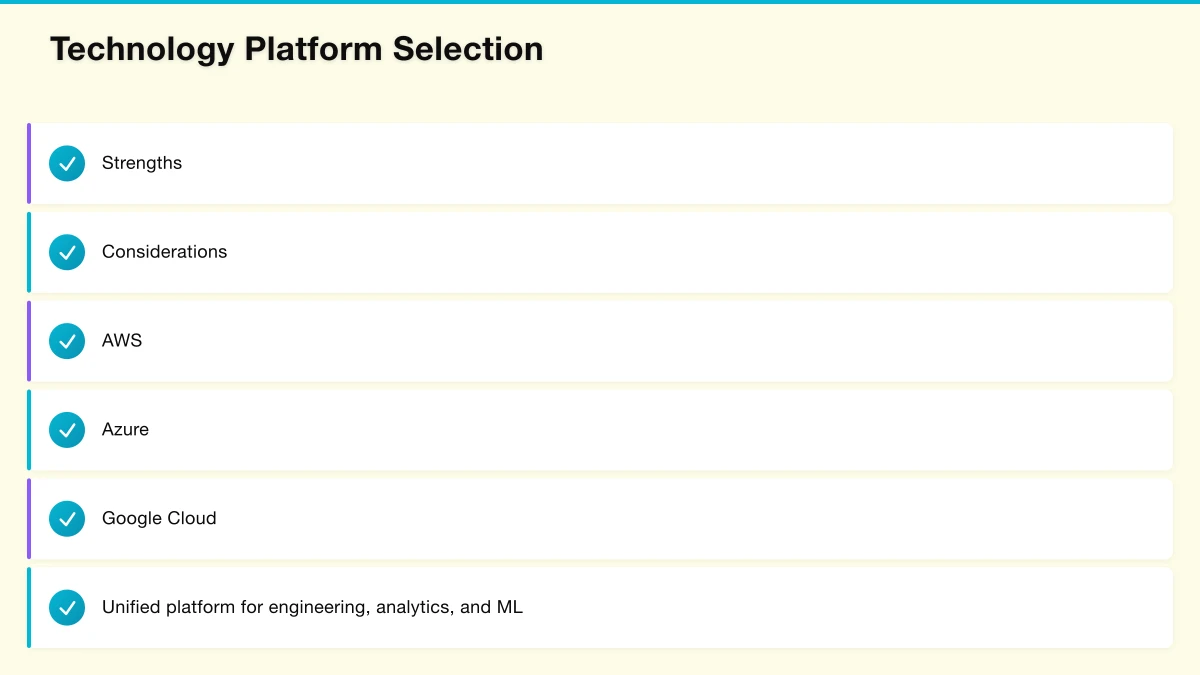
Technology Platform Selection
Several platforms provide lakehouse capabilities with different strengths:
Databricks
The lakehouse pioneer, Databricks provides the most mature implementation:
Strengths:
- Unified platform for engineering, analytics, and ML
- Deep Delta Lake integration
- Unity Catalog for governance
- Strong ML and AI capabilities
- Excellent performance through Photon engine
Considerations:
- Premium pricing at scale
- Delta Lake-centric (though Iceberg support growing)
- Platform dependency for full capability set
Databricks suits organisations seeking unified data and AI platform with strong ML requirements.
Snowflake
Originally a cloud data warehouse, Snowflake has expanded into lakehouse territory:
Strengths:
- Industry-leading SQL performance
- Near-zero administration
- Strong BI ecosystem integration
- Iceberg support for open lakehouse
- Data sharing and marketplace capabilities
Considerations:
- SQL-centric; ML workloads require integration
- Storage costs for native tables
- External table performance versus native
Snowflake suits organisations prioritising SQL analytics with lakehouse flexibility.
Cloud Provider Options
Each major cloud offers lakehouse capabilities:
AWS: Lake Formation + Athena + Redshift Spectrum on S3 with Iceberg. Integrated but complex multi-service architecture.
Azure: Synapse Analytics + Azure Data Lake Storage. Microsoft Fabric emerging as unified offering.
Google Cloud: BigLake on Cloud Storage with Iceberg support. BigQuery integration for analytics.
Cloud provider options suit organisations committed to a specific cloud seeking integrated services.
Open Source Stack
Open source components enable self-managed lakehouse:
- Storage: S3-compatible object storage
- Format: Delta Lake, Iceberg, or Hudi
- Compute: Apache Spark, Trino, Dremio
- Catalog: Apache Hive Metastore, Nessie, Unity Catalog
- Orchestration: Apache Airflow, Dagster
Open source suits organisations with strong engineering capability seeking maximum flexibility and cost control.
Governance in Lakehouse Architecture
Governance is essential for lakehouse success. Without proper governance, lakehouses become data swamps with transactional capabilities.
Unified Catalog
A unified catalog provides single source of truth for data assets:
Capabilities:
- Table metadata management
- Schema documentation
- Lineage tracking
- Search and discovery
- Access control integration
Leading options include Databricks Unity Catalog, AWS Glue Catalog, and open source alternatives like Apache Hive Metastore with extensions.
Access Control
Fine-grained access control ensures appropriate data access:
Row/Column Level Security: Restrict access to specific rows or columns based on user attributes.
Dynamic Data Masking: Mask sensitive data based on user permissions.
Attribute-Based Access Control: Policy decisions based on user attributes, data classifications, and context.
Implement access control at the catalog layer rather than relying on storage-level permissions alone.
Data Quality
Lakehouse architectures should integrate data quality throughout:
Schema Enforcement: Prevent data that violates schema from entering tables.
Constraint Validation: Enforce business rules (uniqueness, referential integrity, range constraints).
Quality Metrics: Track completeness, accuracy, freshness, and validity.
Data Contracts: Define quality expectations between producers and consumers.
Tools like Great Expectations, Soda, and platform-native quality features enable comprehensive quality management.
Lineage
Data lineage tracks data origins and transformations:
Benefits:
- Impact analysis for schema changes
- Compliance and audit support
- Debugging data quality issues
- Understanding data provenance
Modern catalogs capture lineage automatically from transformation jobs, providing visibility without manual documentation.
Performance Optimisation
Lakehouse performance requires deliberate optimisation different from traditional warehouses:
File Organisation
Compaction: Consolidate small files into optimal sizes (typically 256MB-1GB) for query efficiency.
Partitioning: Organise data by commonly filtered columns. Balance partition granularity against file count.
Z-Ordering/Clustering: Co-locate related data within files for efficient filtering. Particularly valuable for high-cardinality filter columns.
Query Optimisation
Statistics Collection: Maintain accurate statistics for query optimisation.
Caching: Utilise compute engine caching for frequently accessed data.
Materialised Views: Pre-compute expensive aggregations and joins.
Predicate Pushdown: Ensure filters are pushed to storage layer, minimising data scanned.
Cost Management
Storage Tiering: Move infrequently accessed data to cheaper storage tiers automatically.
Compute Right-Sizing: Match compute resources to workload requirements; avoid over-provisioning.
Query Governance: Implement cost controls preventing runaway queries from consuming excessive resources.
Migration Strategy
Migrating from legacy data platforms to lakehouse architecture requires careful planning:
Assessment Phase
Data Inventory: Catalogue existing data assets, volumes, and usage patterns.
Workload Analysis: Understand query patterns, SLAs, and consumption requirements.
Dependency Mapping: Identify downstream consumers and integration points.
Readiness Evaluation: Assess team skills and organisational readiness.
Architecture Design
Target Architecture: Define lakehouse architecture aligned to requirements.
Technology Selection: Select platform and components based on evaluation criteria.
Governance Design: Plan catalog, access control, and quality frameworks.
Migration Approach: Determine phased migration strategy.
Migration Execution
Parallel Operation: Run lakehouse alongside legacy systems during migration.
Incremental Migration: Migrate data domains incrementally rather than big-bang.
Validation: Comprehensive testing ensuring data accuracy and query equivalence.
Cutover: Controlled transition of consumers to lakehouse platform.
Common Migration Patterns
Data Warehouse to Lakehouse:
- Establish lakehouse infrastructure
- Replicate warehouse data to lakehouse
- Migrate reporting workloads
- Validate and optimise
- Deprecate warehouse
Data Lake to Lakehouse:
- Add table format to existing data
- Implement governance layer
- Migrate compute to lakehouse-aware engines
- Add warehouse capabilities progressively
Greenfield Lakehouse:
- Establish foundation with initial data sources
- Build medallion layers progressively
- Expand source coverage
- Mature governance and optimisation
Real-World Considerations
Hybrid and Multi-Cloud
Many enterprises operate across multiple clouds or hybrid environments:
Strategies:
- Single lakehouse with multi-cloud replication
- Federated lakehouses with cross-query capability
- Cloud-specific lakehouses with data sharing
Open table formats enable multi-cloud strategies by avoiding format lock-in.
Real-Time Requirements
Lakehouse architectures increasingly support real-time through:
- Streaming ingestion with transaction support
- Near-real-time query on fresh data
- Change data capture integration
- Event-driven processing pipelines
Evaluate platform capabilities against real-time requirements; significant variation exists.
Cost Modelling
Lakehouse cost models differ from traditional platforms:
Storage: Object storage is cheap; costs scale with volume retained.
Compute: Charged by usage; efficient queries cost less than inefficient queries.
Operations: Compaction, optimisation, and governance consume resources.
Model total cost of ownership considering all factors, not just headline storage rates.
Strategic Recommendations
For CTOs evaluating lakehouse architecture:
Start with Clear Objectives
Lakehouse is not an end in itself. Define what business outcomes you seek:
- Unified analytics reducing data silos?
- Cost reduction at scale?
- ML enablement on warehouse data?
- Governance improvement for compliance?
Clear objectives guide architecture decisions and measure success.
Evaluate Platforms Rigorously
Platform selection has long-term implications. Evaluate:
- Fit with existing technology ecosystem
- Total cost of ownership at scale
- Governance and security capabilities
- Ecosystem and integration breadth
- Vendor trajectory and stability
Proof-of-concept implementations validate assumptions before commitment.
Plan for Governance First
Governance gaps create data swamps regardless of technology. Establish:
- Catalog and metadata management
- Access control frameworks
- Quality standards and monitoring
- Lineage and documentation requirements
Governance architecture should precede data migration.
Build Incrementally
Lakehouse transformation is multi-year for most enterprises. Plan phased delivery:
- Foundation with initial use cases
- Progressive expansion of scope
- Continuous optimisation and maturation
Attempting wholesale transformation creates execution risk.
Invest in Skills
Lakehouse platforms require different skills than traditional warehouses:
- Modern data engineering practices
- Open table format expertise
- Cloud infrastructure competency
- ML engineering for AI workloads
Training, hiring, or partnering addresses skill gaps.
Conclusion
Data lakehouse architecture resolves the historical tension between data warehouse governance and data lake flexibility. By combining transactional capabilities with open storage formats, lakehouses enable unified platforms serving BI, ML, and real-time analytics without data duplication and governance gaps.
The technology has matured significantly. Major platforms provide enterprise-ready capabilities. Open table formats prevent lock-in while enabling sophisticated optimisation. The architectural patterns are well-established from early adopter experience.
For CTOs leading data platform strategy, lakehouse represents the convergence point for enterprise data architecture. The remaining questions are not whether the architecture works, but how to implement it effectively for your specific requirements, existing landscape, and organisational capabilities.
The organisations that execute lakehouse transformations successfully will operate unified data platforms that serve all analytical needs cost-effectively. Those that delay will continue managing duplicate systems, governance gaps, and data silos that impede business value from data.
The convergence is underway. The question is whether your organisation will lead or follow.
Ash Ganda advises enterprise technology leaders on data architecture, AI strategy, and digital transformation. Connect on LinkedIn for ongoing insights on building modern data platforms.
Turning mobile strategy into a shipped app? Awesome Apps covers Flutter, React Native, and native development for Australian businesses.
I lead Ganda Tech Services, where we turn digital strategy into results through specialist cloud, web design, and mobile app teams across Sydney.
About the Author
Ashish Ganda is the founder of Ganda Tech Services, a Sydney-based technology consultancy specialising in cloud infrastructure, web development, and mobile app solutions for Australian businesses.
Digital Transformation Roadmap 2026
A 12-month framework for Australian SMBs ready to modernise — phases, tools, and milestones.