Data Mesh Architecture: The Complete Enterprise Implementation Guide
The centralised data platform paradigm is reaching its architectural limits. After decades of consolidating enterprise data into monolithic data warehouses and data lakes, CTOs face a troubling reality: these central platforms have become bottlenecks rather than enablers. Data engineering teams are overwhelmed with integration requests. Business domains wait months for access to their own data. AI initiatives stall waiting for clean, well-governed datasets that never materialise.
Data mesh represents a fundamental paradigm shift in how enterprises think about data architecture. Rather than treating data as a technical asset managed by central IT, data mesh positions data as a product owned by the business domains that understand it best. This distributed approach, first articulated by Zhamak Dehghani at Thoughtworks, is gaining significant traction among enterprises seeking to unlock data value at scale.
Yet implementing data mesh is not simply a technology decision. It requires organisational transformation, new operating models, and careful navigation of the tension between domain autonomy and enterprise governance. For CTOs considering this architectural shift, understanding both the strategic promise and implementation realities is essential.
The Case Against Centralised Data Platforms
The centralised data platform model emerged from sound reasoning. Consolidating data into a single platform promised economies of scale, consistent governance, and unified analytics capabilities. For many organisations, this model delivered substantial value during the business intelligence era.
However, three fundamental challenges have emerged as enterprises scale their data ambitions:
Cognitive Load and Bottlenecks: Central data teams cannot possibly understand the nuances of every business domain. When the marketing analytics team needs to integrate campaign data with customer behaviour, they must explain their requirements to data engineers who lack marketing context. These translations introduce delays, misunderstandings, and quality issues. A 2024 McKinsey study found that 73% of enterprise data initiatives fail to deliver expected value, with integration delays and quality issues cited as primary causes.
Scaling Limitations: Central data teams become bottlenecks as data volume and use case diversity increase. Every new data source, every new analytical requirement, every AI initiative competes for limited central team capacity. Prioritisation becomes political. Innovation slows. Business teams build shadow data infrastructure to work around central constraints, fragmenting the data landscape further.
Misaligned Incentives: When data is managed centrally, business domains have limited accountability for data quality. They produce data as a byproduct of operations rather than as a valued asset. Central teams inherit data quality problems they lack context to resolve. This creates a vicious cycle where data quality degrades because no one has both the authority and the knowledge to improve it.
Data Mesh Principles
Data mesh addresses these challenges through four interconnected principles that fundamentally reframe enterprise data architecture:
Domain Ownership
Data mesh assigns data ownership to the business domains that create and understand it. The sales domain owns sales data. The supply chain domain owns logistics data. Manufacturing owns production data. This alignment creates clear accountability and ensures data is managed by teams with deep domain expertise.
Domain ownership extends beyond data storage to encompass the entire data lifecycle: collection, transformation, quality assurance, and consumption interfaces. Domain teams become responsible not just for producing data but for ensuring it serves downstream consumers effectively.
This principle requires significant organisational change. Domains must develop data engineering capabilities. They must invest in understanding how their data serves other parts of the organisation. They must treat data as a first-class product rather than an operational byproduct.
Data as a Product
Perhaps the most transformative principle, data as a product applies product management thinking to data assets. Each domain publishes data products with clear interfaces, quality guarantees, documentation, and support models.
A data product has defined consumers whose needs shape its design. It has service level objectives governing availability, freshness, and quality. It has an owner accountable for its success. It evolves based on consumer feedback and changing requirements.
Consider a customer data product from a banking domain. This product might include standardised customer profiles, transaction summaries, and risk indicators. The product owner ensures documentation is current, quality metrics are met, and consumer requirements are understood. When the fraud detection team needs additional attributes, they engage with the customer data product team rather than building their own customer data integration.
Spotify exemplifies this approach, organising data capabilities around data products with clear ownership and consumer focus. Their implementation reduced time-to-insight for new data initiatives from months to weeks while improving overall data quality.
Self-Serve Data Infrastructure
While domains own their data products, they should not each build infrastructure from scratch. The platform team provides self-serve infrastructure enabling domains to create, publish, and manage data products efficiently.
This infrastructure includes:
- Data storage primitives: Managed databases, object storage, and streaming platforms
- Data pipeline tooling: Orchestration, transformation, and quality validation frameworks
- Discovery and governance: Metadata catalogs, lineage tracking, and access management
- Observability: Monitoring, alerting, and quality dashboards
The critical distinction from traditional platforms is that domain teams use these capabilities self-service rather than submitting requests to central teams. A marketing analyst can provision a new data pipeline without raising a ticket. A product team can publish a new data product without waiting for infrastructure approval.
Netflix has demonstrated the power of this approach through their data platform, which enables hundreds of domain teams to manage data products independently while maintaining enterprise consistency. Their platform handles petabytes of data daily with a relatively small central platform team.
Federated Computational Governance
Data mesh is not data anarchy. Federated governance establishes enterprise standards while respecting domain autonomy. Central governance teams define policies, standards, and guardrails. Domains implement these within their contexts.
Governance becomes computational, meaning policies are expressed in code and enforced automatically rather than through manual review processes. When a domain publishes a new data product, automated checks validate schema compliance, quality thresholds, privacy classifications, and access controls.
This approach balances the need for enterprise consistency with the flexibility domains require. Privacy policies are uniformly enforced. Metadata standards ensure interoperability. Yet domains retain autonomy over implementation details that don’t affect enterprise concerns.
Implementation Architecture
Translating data mesh principles into architecture requires careful design across multiple dimensions:
Domain Decomposition
The foundation of data mesh is clear domain boundaries. This decomposition should align with business capabilities rather than organisational structure or existing system boundaries.
Effective domain decomposition considers:
- Business capability alignment: Domains should map to coherent business functions with clear ownership
- Data affinity: Data created and consumed together should likely reside in the same domain
- Team structure: Domains must be small enough for teams to genuinely own, typically 5-9 engineers
- Autonomy requirements: Domains should be able to evolve independently with minimal coordination
A retail enterprise might decompose into domains including: Customer (profiles, preferences, loyalty), Inventory (stock levels, locations, suppliers), Orders (transactions, fulfillment, returns), Marketing (campaigns, segments, attribution), and Finance (payments, accounting, reporting).
Each domain maintains internal data stores optimised for operational needs and publishes data products for enterprise consumption. The orders domain, for instance, might use a transactional database for order processing while publishing aggregated order analytics as a data product.
Data Product Architecture
Data products require standardised architecture enabling discovery, access, and governance:
┌─────────────────────────────────────────────────────────┐
│                    Data Product                         │
├─────────────────────────────────────────────────────────┤
│  Output Ports                                           │
│  ├── REST API (synchronous queries)                     │
│  ├── SQL Interface (analytical access)                  │
│  ├── Event Stream (real-time consumption)               │
│  └── File Export (batch integration)                    │
├─────────────────────────────────────────────────────────┤
│  Data Transformation                                    │
│  ├── Source ingestion                                   │
│  ├── Quality validation                                 │
│  ├── Business logic                                     │
│  └── Output formatting                                  │
├─────────────────────────────────────────────────────────┤
│  Input Ports                                            │
│  ├── Operational databases                              │
│  ├── Event streams                                      │
│  └── Other data products                                │
├─────────────────────────────────────────────────────────┤
│  Metadata & Governance                                  │
│  ├── Schema definitions                                 │
│  ├── Quality SLOs                                       │
│  ├── Lineage information                                │
│  ├── Access policies                                    │
│  └── Documentation                                      │
└─────────────────────────────────────────────────────────┘
Each data product exposes multiple consumption interfaces suited to different use cases. Analytical consumers query through SQL. Real-time systems subscribe to event streams. External integrations use REST APIs. This polyglot approach maximises data product utility without forcing consumers into inappropriate access patterns.
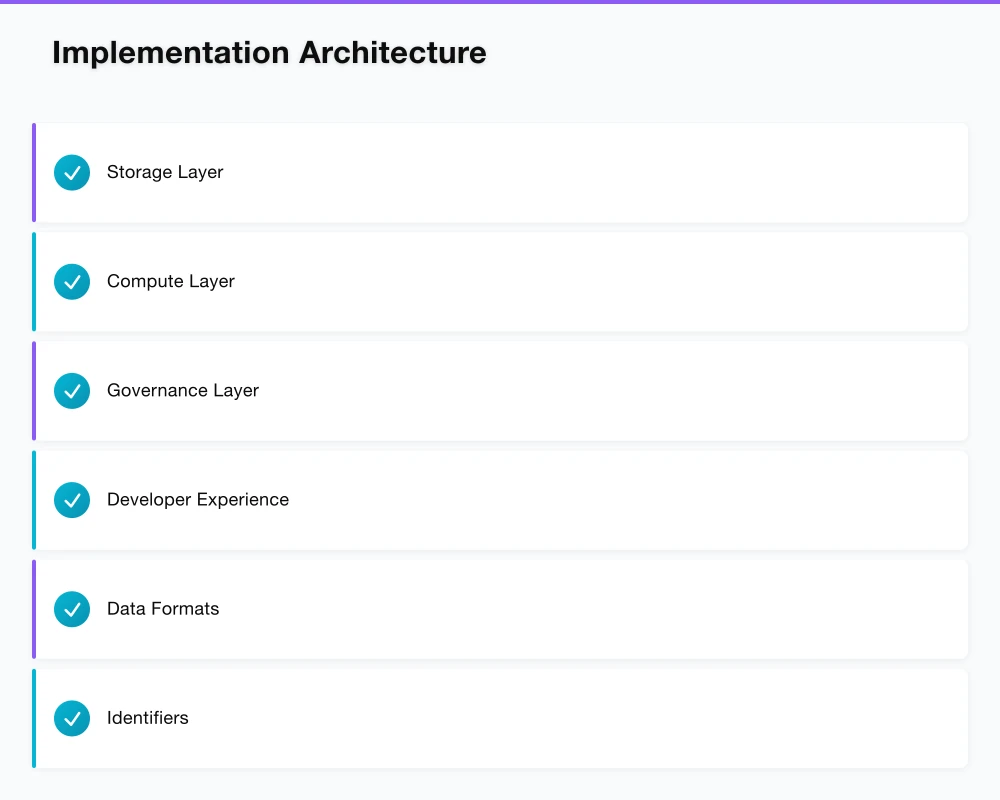
Platform Architecture
The self-serve data platform provides shared infrastructure and governance capabilities:
Storage Layer: Object storage (S3, GCS, Azure Blob) provides cost-effective, scalable storage for data products. Cloud data warehouses (Snowflake, Databricks, BigQuery) enable analytical query access. Streaming platforms (Kafka, Pulsar) support real-time data products.
Compute Layer: Data processing frameworks (Spark, Flink, dbt) enable transformation. Container orchestration (Kubernetes) hosts data product services. Serverless functions handle event-driven processing.
Governance Layer: Metadata catalogs (DataHub, Atlan, Collibra) provide discovery and documentation. Policy engines (Open Policy Agent) enforce access controls. Quality frameworks (Great Expectations, Monte Carlo) validate data quality.
Developer Experience: Self-service portals enable domain teams to provision infrastructure. Templates and generators accelerate data product development. CI/CD pipelines automate deployment and validation.
Leading implementations use infrastructure-as-code to enable consistent, auditable platform provisioning. Domain teams define data products in configuration files that platform automation converts into running infrastructure.
Interoperability Standards
Data products must interoperate despite independent development. This requires enterprise standards for:
Data Formats: Standard serialisation formats (Parquet, Avro) ensure compatibility. Schema registries enforce format compliance and evolution.
Identifiers: Global identifier standards enable joining data across products. Customer IDs, product SKUs, and transaction references must follow enterprise conventions.
Semantics: Shared business glossaries ensure consistent terminology. A “customer” in the orders domain must mean the same thing as in the marketing domain.
Quality Metrics: Standard quality dimensions and measurement approaches enable comparison across products. Completeness, accuracy, freshness, and validity should be measured consistently.
Organisational Transformation
Technology alone cannot deliver data mesh benefits. Organisational change is equally important and often more challenging.
Domain Team Structure
Each domain requires data engineering capabilities embedded within business teams. This typically includes:
- Data product owner: Sets product direction, prioritises consumer needs, defines SLOs
- Data engineers: Build and maintain data pipelines and transformation logic
- Analytics engineers: Develop semantic models and analytical interfaces
- Data stewards: Ensure quality, documentation, and governance compliance
For organisations without distributed data engineering capability, this requires significant hiring or reskilling. Some enterprises start with hybrid models where central data engineers are embedded in domains, gradually transferring knowledge and building local capability.
Platform Team Structure
The central platform team shifts from building data solutions to enabling domain teams:
- Platform engineers: Build and maintain self-serve infrastructure
- Developer experience: Create tools, templates, and documentation
- Governance architects: Design policies and compliance frameworks
- Enablement: Train and support domain teams
This represents a significant mindset shift for traditional data teams. Success is measured by domain team productivity rather than direct data product delivery.
Governance Operating Model
Federated governance requires new operating structures:
Data Council: Cross-domain forum establishing enterprise policies and resolving conflicts. Includes representatives from major domains and central platform team.
Domain Data Owners: Senior business leaders accountable for their domain’s data strategy, quality, and compliance.
Guild Structure: Communities of practice connecting data professionals across domains for knowledge sharing and standard development.
Governance should be enabling rather than controlling. The goal is helping domains succeed, not creating bureaucratic barriers.
Implementation Roadmap
Enterprise data mesh implementation typically follows a phased approach spanning 18-36 months:
Phase 1: Foundation (Months 1-6)
Assess Current State: Catalogue existing data assets, systems, and capabilities. Identify pain points with current architecture. Evaluate domain maturity and readiness.
Define Target Architecture: Establish domain boundaries aligned to business capabilities. Design platform architecture and governance model. Select technology components.
Build Platform Foundation: Implement core infrastructure: storage, compute, and basic governance. Create initial templates and self-service capabilities.
Pilot Domains: Select 2-3 domains with strong data culture and clear use cases. Implement first data products with heavy platform team support. Iterate on patterns and tooling based on learnings.
Phase 2: Scale (Months 7-18)
Expand Domain Coverage: Onboard additional domains systematically. Transfer knowledge from pilot domains. Develop training and enablement programs.
Mature Platform: Enhance self-service capabilities based on domain feedback. Implement advanced governance automation. Build comprehensive observability.
Establish Operating Model: Formalise governance structures and processes. Create data product standards and quality frameworks. Implement cross-domain interoperability patterns.
Phase 3: Optimise (Months 19-36)
Full Enterprise Coverage: Complete domain onboarding. Migrate remaining centralised data assets. Deprecate legacy data infrastructure.
Advanced Capabilities: Implement sophisticated governance automation. Enable cross-domain data products. Support AI/ML workloads natively.
Continuous Improvement: Measure and optimise platform performance. Refine governance based on experience. Evolve architecture for emerging requirements.
Common Pitfalls and Mitigations
Data mesh implementations frequently encounter predictable challenges:
Underestimating Organisational Change: Technology implementation is the easier part. Building data engineering capability across domains, shifting mindsets from central provision to domain ownership, and establishing effective governance takes years of sustained effort. Mitigation: Start with cultural change and capability building before technology. Invest heavily in enablement and change management.
Creating Data Silos: Poorly implemented data mesh can fragment the data landscape rather than improving it. Domains may build incompatible systems that cannot interoperate. Mitigation: Establish strong interoperability standards from the outset. Implement governance automation ensuring compliance.
Platform Team Overwhelm: During transition, platform teams face dual demands: maintaining existing systems while building new capabilities. Domain teams need substantial support before becoming self-sufficient. Mitigation: Plan for temporary capacity increase during transition. Sequence domain onboarding to match support capacity.
Governance Imbalance: Too little governance creates fragmentation and compliance risk. Too much governance recreates centralised bottlenecks. Mitigation: Start with minimal viable governance focused on interoperability and compliance. Add constraints only when problems emerge.
Scope Creep: The vision of comprehensive data mesh can overwhelm execution. Organisations attempt too much too quickly, delivering nothing well. Mitigation: Focus on incremental value delivery. Each phase should deliver measurable benefits before expanding scope.
Measuring Success
Data mesh success should be measured across multiple dimensions:
Time to Value: How quickly can new data initiatives go from concept to production? Target: reduce from months to weeks.
Data Product Adoption: Are data products being discovered and used? Measure consumption metrics, consumer satisfaction, and data product proliferation.
Quality Improvement: Are data quality metrics improving across domains? Measure completeness, accuracy, freshness, and validity trends.
Domain Autonomy: Can domains execute data initiatives without central bottlenecks? Measure self-service utilisation and request backlogs.
Platform Efficiency: What is the ratio of platform team size to supported domains? Healthy implementations achieve 1:10 or better ratios.
Strategic Considerations for CTOs
Data mesh is not appropriate for every organisation. Consider these factors:
Organisational Readiness: Data mesh requires substantial organisational change. Organisations with rigid hierarchies, limited cross-functional collaboration, or weak engineering culture will struggle. Assess readiness honestly before committing.
Scale Requirements: Data mesh addresses challenges that emerge at scale. Smaller organisations with limited data diversity may not benefit enough to justify implementation complexity. Consider whether current centralised approaches are actually limiting value creation.
Data Culture Maturity: Domains must treat data as a strategic asset, not operational byproduct. This requires executive commitment, investment in data literacy, and cultural prioritisation of data quality.
Investment Horizon: Data mesh benefits compound over time but require substantial upfront investment. Organisations seeking quick wins or facing near-term cost pressure may find the investment profile challenging.
For organisations where data mesh aligns strategically, the benefits are compelling. JPMorgan Chase reported 40% reduction in time-to-insight after implementing domain-driven data architecture. Zalando achieved 3x improvement in data team productivity through their data mesh implementation. ING Bank reduced their data engineering backlog by 60% through self-serve data infrastructure.
The Path Forward
Data mesh represents a fundamental evolution in enterprise data architecture, shifting from centralised provision to distributed ownership while maintaining enterprise coherence through federated governance and self-serve platforms.
For CTOs leading data transformation, the question is not whether the centralised model has limitations, but whether your organisation is ready for the change data mesh requires. The benefits of domain ownership, data products, and self-serve infrastructure are substantial. So are the implementation challenges.
Success requires treating data mesh as an organisational transformation enabled by technology, not a technology implementation with organisational implications. It requires sustained executive commitment, significant capability investment, and patience to navigate a multi-year journey.
The organisations that navigate this transition successfully will emerge with data capabilities far exceeding what centralised models can deliver. They will innovate faster, govern more effectively, and create competitive advantages from data that elude their peers.
The architectural shift has begun. The question is whether your organisation will lead or follow.
Ash Ganda advises enterprise technology leaders on data architecture, AI strategy, and digital transformation. Connect on LinkedIn for ongoing insights on building data-driven organisations.
For practical mobile app development guidance, my team at Awesome Apps helps Australian businesses build iOS and Android applications.
Ash Ganda is the founder of Ganda Tech Services, a Sydney-based technology consultancy delivering cloud, web, and mobile solutions for Australian businesses.
About the Author
Ashish Ganda is the founder of Ganda Tech Services, a Sydney-based technology consultancy specialising in cloud infrastructure, web development, and mobile app solutions for Australian businesses.
Digital Transformation Roadmap 2026
A 12-month framework for Australian SMBs ready to modernise — phases, tools, and milestones.
Almost done
Check your inbox and click the confirmation link to get your download.