Data Lakehouse Architecture: Databricks vs Snowflake for Enterprise
Data Lakehouse Architecture: Databricks vs Snowflake for Enterprise
The data lakehouse has emerged as the dominant architecture pattern for enterprise data platforms, promising to unify the analytical capabilities of data warehouses with the flexibility and economics of data lakes. For CTOs evaluating platform strategies in 2024, the choice between Databricks and Snowflake represents more than a vendor selection—it’s a foundational decision that will shape data strategy, team composition, and competitive advantage for the next 3-5 years.
Recent market dynamics underscore the urgency of this decision. Snowflake’s Q1 2024 earnings revealed 38% year-over-year revenue growth, while Databricks’ recent $43 billion valuation signals investor confidence in lakehouse adoption. Both platforms are expanding rapidly into adjacent markets: Snowflake through its Unistore hybrid workload engine and Snowpark container services, Databricks via Delta Live Tables and the acquisition of MosaicML for generative AI capabilities. The competitive landscape is intensifying precisely as enterprises face mounting pressure to modernize legacy data warehouses and enable real-time analytics.
The Lakehouse Architecture Imperative
Traditional data architectures force enterprises into artificial choices. Data warehouses like Teradata and Oracle Exadata deliver excellent SQL performance but struggle with unstructured data, ML workloads, and cost efficiency at scale. Data lakes built on HDFS or cloud object storage handle variety and volume but lack ACID transactions, schema enforcement, and query performance for business intelligence.
The lakehouse architecture eliminates this dichotomy by implementing warehouse-like capabilities directly on data lake storage. Delta Lake, Apache Iceberg, and Apache Hudi enable ACID transactions on object storage. Metadata layers provide schema enforcement and time travel. Advanced indexing and caching deliver sub-second query performance. The result: a unified platform supporting batch analytics, real-time streaming, data science, and ML production workloads.
For enterprises, the strategic implications are significant. According to Gartner’s 2024 Data Management Survey, organizations operating separate data lakes and warehouses spend 40% of data engineering resources on integration and data movement. A properly implemented lakehouse consolidates infrastructure, reduces data duplication, and enables new use cases by eliminating artificial barriers between operational and analytical data.
Databricks: The Spark-Native Lakehouse
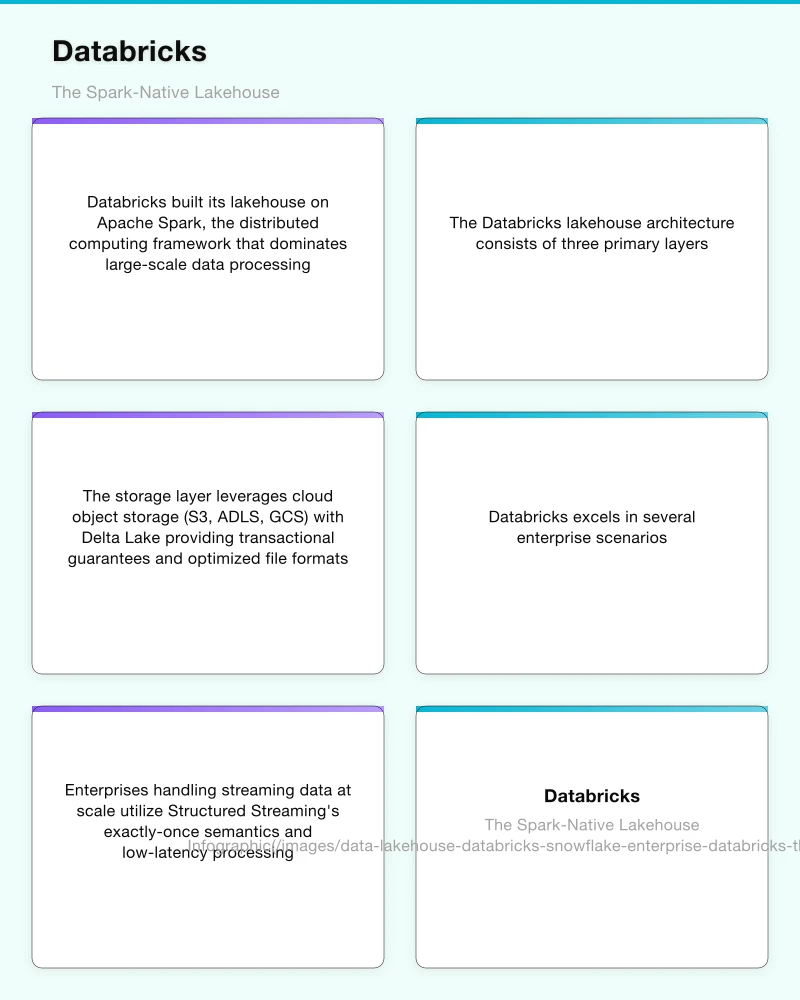
Databricks built its lakehouse on Apache Spark, the distributed computing framework that dominates large-scale data processing. The platform’s architecture centers on Delta Lake, an open-source storage layer that brings reliability to data lakes through ACID transactions, scalable metadata handling, and time travel capabilities.
The Databricks lakehouse architecture consists of three primary layers. The storage layer leverages cloud object storage (S3, ADLS, GCS) with Delta Lake providing transactional guarantees and optimized file formats. The compute layer uses Spark clusters with Photon, a vectorized query engine written in C++ that accelerates SQL and DataFrame operations by up to 12x compared to standard Spark. The orchestration layer includes Unity Catalog for governance, Delta Live Tables for ETL pipeline management, and MLflow for machine learning lifecycle management.
Databricks excels in several enterprise scenarios. Organizations with significant data engineering requirements benefit from native Spark integration and support for complex transformations in Python, Scala, SQL, and R. Companies pursuing advanced analytics and ML production workloads leverage built-in capabilities for distributed training, model serving, and feature store management. Enterprises handling streaming data at scale utilize Structured Streaming’s exactly-once semantics and low-latency processing.
The platform’s recent additions strengthen its enterprise positioning. Unity Catalog, generally available since late 2023, provides centralized governance across clouds with fine-grained access controls, data lineage, and audit logging. Delta Sharing enables secure data exchange without copying data. Databricks SQL has evolved into a legitimate BI engine with serverless compute and sub-second query performance on properly optimized Delta tables.
Cost structure follows a consumption model: compute charges based on DBU (Databricks Units) consumed, typically 2-3x the underlying cloud VM costs. Storage costs align with cloud object storage rates ($0.023/GB/month for S3 Standard). For a typical enterprise workload processing 100TB with continuous ETL and ad-hoc analytics, monthly costs range from $50,000 to $150,000 depending on compute optimization and workload patterns.
The platform’s learning curve represents its primary challenge. Teams must understand Spark fundamentals, cluster configuration, and Delta Lake optimization techniques. Organizations without existing Spark expertise face 6-12 months before data engineers achieve full productivity. The notebook-centric development model, while powerful for data scientists, requires workflow discipline to maintain production-quality code.
Snowflake: The Cloud-Native Data Warehouse Evolved
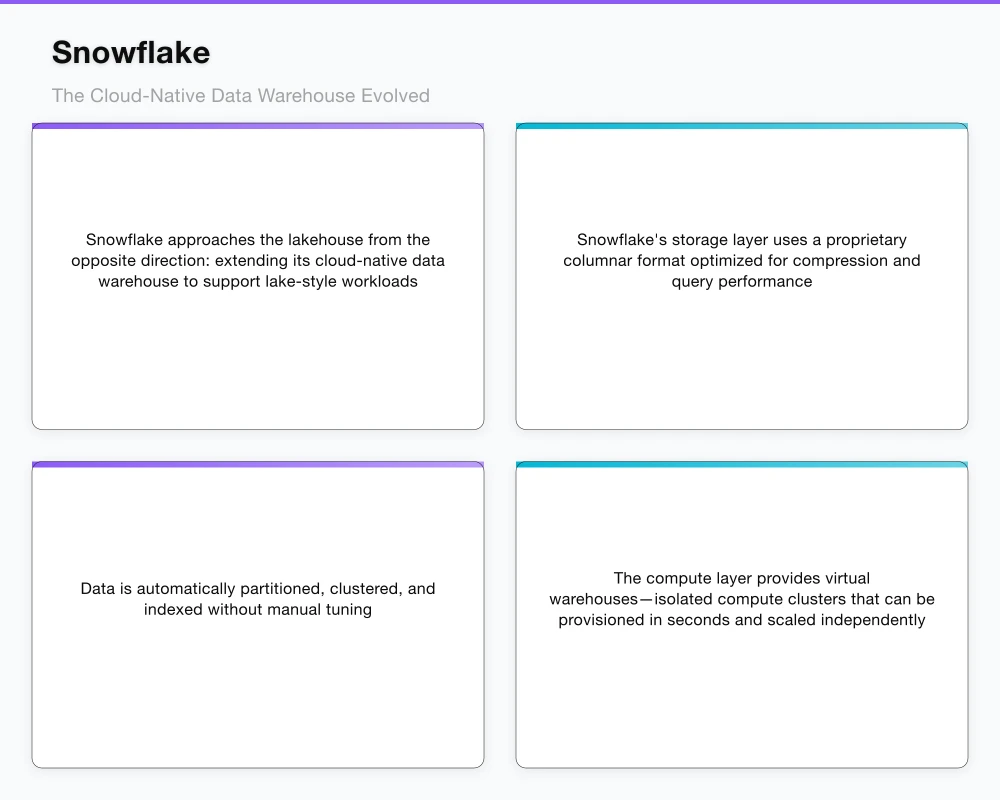
Snowflake approaches the lakehouse from the opposite direction: extending its cloud-native data warehouse to support lake-style workloads. The platform’s architecture separates storage, compute, and services into independently scalable layers—a design that revolutionized data warehousing when Snowflake launched in 2014 and continues to differentiate today.
Snowflake’s storage layer uses a proprietary columnar format optimized for compression and query performance. Data is automatically partitioned, clustered, and indexed without manual tuning. The compute layer provides virtual warehouses—isolated compute clusters that can be provisioned in seconds and scaled independently. The cloud services layer handles query optimization, metadata management, security, and data sharing.
The platform’s lakehouse capabilities arrive through several mechanisms. External tables query data in cloud object storage formats (Parquet, ORC, Avro) without ingestion. Iceberg Tables, announced in 2023 and now in public preview, provide full read-write support for Apache Iceberg format with ACID guarantees. Snowpark enables Python, Java, and Scala code execution directly within Snowflake, supporting data engineering and ML workloads previously requiring external Spark clusters.
Snowflake’s enterprise strengths center on operational simplicity and SQL accessibility. Zero-copy cloning enables instant database duplication for development and testing. Time travel allows querying historical data states without backup restoration. Multi-cluster warehouses automatically scale to handle concurrency spikes. Data sharing via Snowflake Marketplace enables secure collaboration with partners and customers.
For BI-heavy workloads with primarily structured data, Snowflake delivers exceptional performance with minimal tuning. A financial services firm processing daily transaction analytics might load 500GB of new data overnight, run 10,000 concurrent queries during business hours, and serve dashboards to 1,000 analysts—all without dedicated performance optimization. The platform handles partition pruning, join optimization, and result caching automatically.
Recent platform additions expand Snowflake’s scope beyond traditional warehousing. Snowpark Container Services, in public preview, allows running containerized applications with access to Snowflake data. Unistore combines transactional and analytical workloads in a single table, targeting operational analytics use cases. Native support for Iceberg tables positions Snowflake as a compute engine over open lakehouse formats.
Cost structure uses a credit-based consumption model. Compute costs approximately $2-$3 per credit hour depending on cloud and region, with warehouse sizes ranging from X-Small (1 credit/hour) to 6X-Large (512 credits/hour). Storage costs $23-$40 per TB per month including fail-safe and time travel. A typical enterprise analytics workload might consume 5,000-15,000 credits monthly ($10,000-$45,000) plus storage costs.
The platform’s limitations become apparent in data engineering and ML-intensive scenarios. While Snowpark enables Python workloads, performance lags purpose-built Spark environments for complex transformations on semi-structured data. ML capabilities remain nascent compared to Databricks’ integrated MLflow and Feature Store. Organizations with significant real-time streaming requirements must integrate external tools like Apache Kafka and Flink.
Enterprise Decision Framework: Matching Architecture to Requirements
The Databricks vs. Snowflake decision hinges on workload composition, team capabilities, and strategic data priorities. Neither platform universally dominates—competitive positioning depends on specific enterprise contexts.
Choose Databricks when:
Data engineering complexity is high. Organizations building sophisticated ETL pipelines with complex business logic, streaming data integration, and real-time processing requirements benefit from Databricks’ Spark-native architecture. A retail company ingesting clickstream data, IoT sensor readings, and transaction logs in real-time while performing complex sessionization and fraud detection leverages Databricks’ streaming and processing capabilities.
Machine learning is a strategic priority. Enterprises pursuing competitive advantage through ML production benefit from Databricks’ integrated lifecycle management. A telecommunications firm building churn prediction models at scale uses Databricks for feature engineering, distributed training, model versioning, and real-time inference serving—all within a unified platform.
Team expertise includes Spark and Python. Organizations with data engineers experienced in Spark, Python-based data science teams, and tolerance for infrastructure complexity extract maximum value from Databricks. The platform’s flexibility enables optimization and customization unavailable in more managed alternatives.
Multi-cloud strategy requires portability. While both platforms support AWS, Azure, and GCP, Databricks’ architecture based on open formats (Delta Lake, MLflow) and standard Spark APIs provides greater portability. Enterprises committed to avoiding cloud vendor lock-in value this strategic optionality.
Choose Snowflake when:
Business intelligence dominates analytics workloads. Organizations where 80%+ of data consumption flows through SQL-based BI tools, dashboards, and reports achieve faster time-to-value with Snowflake. A healthcare analytics company serving regulatory reports and operational dashboards to 500 business analysts prioritizes Snowflake’s ease of use and query performance.
Operational simplicity is paramount. Enterprises with limited data engineering resources, preference for managed services, and focus on business outcomes over infrastructure management benefit from Snowflake’s zero-administration model. No cluster tuning, no file format optimization, no infrastructure monitoring—just SQL and results.
Structured data represents 90%+ of analytics. While Snowflake handles semi-structured data, it excels with relational schemas. Financial services firms analyzing transaction databases, customer records, and market data achieve optimal price-performance with Snowflake’s columnar storage and automatic optimization.
Data marketplace and sharing drive strategy. Organizations monetizing data products, collaborating with partners through data sharing, or consuming third-party datasets leverage Snowflake’s mature data sharing ecosystem. A media company distributing audience analytics to advertisers uses Snowflake Data Sharing for secure, governed data products.
Hybrid and Multi-Platform Strategies
Progressive enterprises increasingly reject binary choices in favor of fit-for-purpose architecture. A hybrid approach deploys both platforms, routing workloads to the optimal environment based on requirements.
A common pattern uses Databricks for data engineering and ML, Snowflake for BI and analytics. Raw data lands in S3/ADLS, Databricks performs complex transformations and feature engineering, curated datasets are exported to Snowflake for business consumption. This architecture maximizes each platform’s strengths while accepting integration overhead.
Implementation requires careful orchestration. Apache Airflow or Prefect coordinates cross-platform workflows. Delta Sharing or cloud storage provides the data interchange layer. Unity Catalog and Snowflake’s governance features must align on access policies and data classification.
The hybrid approach introduces operational complexity: multiple platforms to monitor, separate billing to optimize, different security models to align. Organizations must evaluate whether workload diversity justifies the added management burden. For enterprises with annual data platform spending exceeding $1M, the optimization benefits typically outweigh integration costs.
Cost Optimization Strategies
Both platforms use consumption-based pricing, making cost management essential for enterprise deployments. Effective optimization requires understanding each platform’s cost drivers and implementing appropriate controls.
Databricks cost optimization:
-
Right-size clusters. Match cluster configuration to workload requirements. Production ETL jobs benefit from memory-optimized instances, while ad-hoc analytics performs adequately on general-purpose VMs. Over-provisioned clusters waste 30-50% of compute spending.
-
Implement auto-scaling and auto-termination. Configure clusters to scale based on load and terminate after inactivity periods. Development clusters left running overnight represent pure waste.
-
Leverage spot instances for fault-tolerant workloads. Batch processing and model training tolerate interruptions. Spot instances reduce compute costs 60-80% compared to on-demand pricing.
-
Optimize Delta Lake table layout. Regular OPTIMIZE commands compact small files and improve query performance. Z-ORDER clustering on common filter columns reduces data scanning. Performance improvements translate directly to reduced compute consumption.
-
Monitor and govern notebook usage. Interactive notebooks consume resources unpredictably. Implement policies limiting cluster sizes for exploration workloads and requiring justification for large interactive clusters.
Snowflake cost optimization:
-
Size warehouses appropriately. Start small and scale up based on performance requirements. Many workloads run efficiently on Small or Medium warehouses costing 2-4 credits per hour versus X-Large warehouses at 32 credits per hour.
-
Leverage result caching. Snowflake caches query results for 24 hours. Identical queries from different users consume zero credits. Educate analysts to benefit from caching through query standardization.
-
Implement resource monitors. Set credit limits per warehouse, per user, or per account with alerts and suspension thresholds. Prevent runaway queries from generating surprise bills.
-
Use clustering keys strategically. Automatic clustering incurs compute costs. Apply clustering only to large tables with consistent filter patterns where performance gains justify expense.
-
Optimize table design. Snowflake’s micro-partition architecture performs best with proper data types, normalized structures, and reasonable partition sizes. Poor schema design forces excessive data scanning.
Both platforms benefit from governance policies limiting resource consumption. Tagging workloads by business unit enables chargeback models that align incentives. Regular cost reviews identify optimization opportunities and anomalous spending patterns.
Implementation Roadmap and Migration Considerations
Successful lakehouse adoption requires phased implementation with clear success criteria. Enterprises migrating from legacy platforms face technical, organizational, and cultural challenges beyond pure technology deployment.
Phase 1: Foundation and Pilot (Months 1-3)
Establish core infrastructure, governance framework, and initial use cases. Select a representative workload—typically a medium-complexity ETL pipeline or analytics dataset—that demonstrates platform capabilities without business-critical dependencies.
For Databricks deployments, configure Unity Catalog for governance, establish workspace organization aligned with business units, define cluster policies, and implement cost monitoring. Build initial pipelines using Delta Live Tables to validate architecture patterns.
For Snowflake deployments, establish role-based access control hierarchy, configure network policies and encryption, define database organization strategy, and set up resource monitors. Migrate initial datasets and validate query performance against existing systems.
Both platforms require integration with identity providers (Azure AD, Okta), monitoring tools (Datadog, New Relic), and orchestration frameworks. Establish CI/CD pipelines for code deployment and infrastructure-as-code practices using Terraform.
Phase 2: Core Workload Migration (Months 4-9)
Migrate production workloads in priority order based on business value and technical complexity. Start with batch analytics pipelines before tackling real-time streaming or complex ML workloads.
Implement data quality frameworks to validate migration accuracy. Reconciliation processes compare source and target datasets, checking row counts, aggregates, and sample data. Parallel running periods maintain existing systems while validating new platform performance.
Address performance issues proactively. Databricks workloads may require Spark tuning, partition strategy optimization, and Delta Lake configuration. Snowflake migrations benefit from proper warehouse sizing, clustering key selection, and query optimization.
This phase exposes organizational challenges. Legacy BI tools may require reconfiguration or replacement. Data engineers need training on platform-specific best practices. Existing workflows and interdependencies emerge during migration, requiring coordination across teams.
Phase 3: Advanced Capabilities and Optimization (Months 10-12)
Enable differentiated capabilities that justify platform investment. For Databricks, implement ML production pipelines, real-time feature serving, and advanced streaming analytics. For Snowflake, leverage data sharing for partner collaboration, deploy Snowpark applications, and optimize for concurrent BI workloads.
Optimize costs based on observed consumption patterns. Right-size infrastructure, eliminate waste, and implement chargeback models. Establish centers of excellence to share best practices and support continued platform adoption.
Measure success through defined KPIs: time from data to insight, data engineering productivity (pipelines per engineer), query performance compared to legacy systems, cost per TB processed, and user adoption rates.
Governance and Security in Lakehouse Architecture
Enterprise data platforms must enforce governance, security, and compliance requirements across increasingly complex data estates. Both platforms provide comprehensive capabilities with architectural differences affecting implementation.
Databricks Unity Catalog provides centralized governance across workspaces and clouds. Fine-grained access controls operate at catalog, schema, table, column, and row levels. Attribute-based access control (ABAC) enables dynamic policies based on user attributes. Data lineage tracks transformations from source to consumption, critical for impact analysis and regulatory compliance.
Snowflake’s governance model integrates security into its core architecture. Role-based access control (RBAC) hierarchies align with organizational structures. Row-access policies and column-masking policies implement data segmentation without duplicating tables. Object tagging enables classification-based policies across databases.
Both platforms support encryption at rest and in transit, private connectivity through AWS PrivateLink/Azure Private Link, and integration with enterprise key management systems. Compliance certifications include SOC 2 Type II, ISO 27001, HIPAA, and regional requirements like GDPR.
Critical governance considerations for CTOs include:
Data residency and sovereignty. Both platforms support regional deployment, but data movement across regions requires careful orchestration. Organizations operating in regulated industries must ensure data processing occurs in approved geographies.
Access audit and compliance reporting. Comprehensive audit logging captures data access patterns essential for regulatory requirements. Integration with SIEM platforms enables security monitoring and threat detection.
Data classification and sensitivity labeling. Automated discovery and classification of PII, PHI, and sensitive data supports compliance obligations and risk management. Both platforms provide APIs for integration with data catalog tools.
Data retention and right to deletion. GDPR and similar regulations mandate data deletion capabilities. Time travel and fail-safe features must be balanced against retention requirements and deletion obligations.
The Future of Lakehouse Architecture
The lakehouse market continues rapid evolution with implications for enterprise platform strategy. Several trends will shape the competitive landscape through 2025 and beyond.
Open table formats gain adoption. Apache Iceberg, Delta Lake, and Apache Hudi enable table-level interoperability across engines. Snowflake’s Iceberg support and potential Delta Lake compatibility reduce platform lock-in concerns. Enterprises benefit from flexibility to query data across multiple engines while maintaining a single copy.
AI workloads drive architecture evolution. Generative AI and large language models create new data requirements: vector databases for embeddings, high-throughput inference serving, and integration with GPU compute. Databricks’ MosaicML acquisition and Snowflake’s Snowpark Container Services both target these emerging workloads. CTOs evaluating platforms must consider AI roadmaps and required capabilities.
Real-time analytics become table stakes. The boundary between operational and analytical data continues blurring. Snowflake’s Unistore and Databricks’ Delta Live Tables both address sub-second analytics on continuously updated data. Enterprises requiring real-time dashboards, fraud detection, and operational intelligence prioritize these capabilities.
Data mesh patterns influence platform architecture. Domain-oriented decentralized data ownership challenges centralized platform models. Both vendors are adapting: Databricks through workspace federation and Unity Catalog’s delegation model, Snowflake via data sharing and cross-cloud governance. Organizations pursuing data mesh must evaluate how platforms support domain autonomy while maintaining governance.
Competitive dynamics intensify. Snowflake’s expansion into data engineering and ML, Databricks’ strengthening of SQL and BI capabilities—convergence reduces differentiation. For enterprises, this means either platform can satisfy most requirements given sufficient investment. Strategic decisions increasingly depend on existing relationships, team capabilities, and specific workload priorities rather than absolute feature gaps.
Strategic Recommendations for Enterprise CTOs
The lakehouse platform decision requires aligning technology capabilities with organizational context and strategic priorities. Based on current market positioning and enterprise requirements, consider the following framework:
Assess workload distribution quantitatively. Document current and planned analytics workloads across categories: SQL/BI, data engineering/ETL, streaming analytics, ML/data science, and operational analytics. Platforms excel in different areas—match strengths to requirements.
Evaluate team capabilities honestly. Databricks rewards engineering sophistication and Spark expertise. Snowflake optimizes for SQL-centric teams and business analyst accessibility. Neither is universally better—fit matters more than features.
Consider total cost of ownership beyond platform pricing. Include migration costs, training investment, operational overhead, and opportunity cost of delayed capabilities. A platform requiring 6 months and 3 FTEs for production readiness costs significantly more than licensing fees suggest.
Prioritize optionality and avoid lock-in. Open table formats, standard APIs, and multi-cloud support provide strategic flexibility. Proprietary formats and platform-specific features create switching costs that compound over time.
Plan for hybrid scenarios. Few enterprises operate single-platform data architectures indefinitely. Design integration patterns, governance alignment, and operational processes assuming multi-platform reality.
The lakehouse architecture represents a fundamental improvement over legacy data platform patterns. Both Databricks and Snowflake deliver production-grade implementations with proven enterprise deployments. The strategic question is not which platform is superior in absolute terms, but which aligns with your organization’s capabilities, priorities, and trajectory.
For CTOs making this decision in 2024, the good news is that either choice provides a solid foundation for modern data architecture. The critical success factors lie not in vendor selection but in disciplined implementation, effective change management, and continuous optimization aligned with evolving business requirements.
Need guidance on enterprise data platform strategy? Contact Ash Ganda for executive advisory on cloud architecture, platform evaluation, and digital transformation roadmaps.
Your digital strategy starts with being found online. Cosmos Web Tech covers SEO, WordPress, and web performance for Australian businesses.
I lead Ganda Tech Services, where we turn digital strategy into results through specialist cloud, web design, and mobile app teams across Sydney.
About the Author
Ashish Ganda is the founder of Ganda Tech Services, a Sydney-based technology consultancy specialising in cloud infrastructure, web development, and mobile app solutions for Australian businesses.
Digital Transformation Roadmap 2026
A 12-month framework for Australian SMBs ready to modernise — phases, tools, and milestones.
Almost done
Check your inbox and click the confirmation link to get your download.