Enterprise Configuration Management at Scale
Configuration management — the practice of externalising application behaviour from code into configurable parameters — seems deceptively simple. Set a feature toggle, adjust a timeout value, change a database connection string. Yet at enterprise scale, configuration management becomes one of the most challenging operational disciplines. Misconfigured systems are a leading cause of outages, security incidents, and performance degradation. The 2017 Amazon S3 outage, which disrupted significant portions of the internet, was caused by a configuration error. Configuration-related incidents are routine at every scale.
For enterprises operating hundreds of services across multiple environments and cloud regions, configuration management is a strategic capability. The ability to change system behaviour safely, rapidly, and at scale — without deploying new code — provides operational agility that is essential for incident response, capacity management, and feature delivery.
The Configuration Landscape in Enterprise Systems
Enterprise configuration spans several categories, each with different change frequencies, sensitivity levels, and management requirements.
Infrastructure configuration defines the compute, networking, storage, and security infrastructure on which applications run. Managed through Infrastructure as Code (IaC) tools like Terraform, CloudFormation, and Pulumi, infrastructure configuration is version-controlled, peer-reviewed, and deployed through CI/CD pipelines. This category is well-understood and broadly adopted in modern enterprises.
Application configuration defines application behaviour: feature flags, timeout values, retry policies, batch sizes, cache TTLs, and logging levels. This configuration changes more frequently than infrastructure configuration and often needs to change without code deployment. The management approach ranges from environment variables and configuration files to dedicated configuration services.
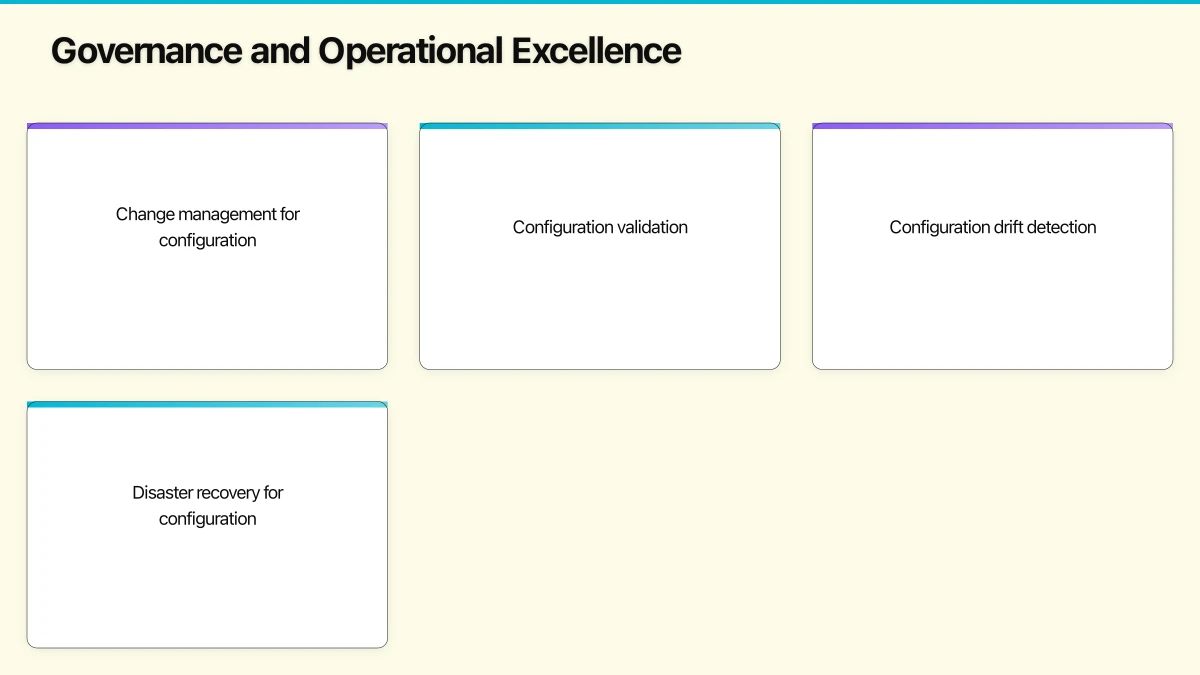
Secrets — database passwords, API keys, encryption keys, certificates — are a special category of configuration requiring encryption at rest and in transit, access control, rotation capabilities, and audit logging. The consequences of secret mismanagement (exposure, breach, compliance violation) are severe enough to warrant dedicated tooling and processes.
Connection configuration defines how services find and communicate with each other: service URLs, database connection strings, message queue endpoints, and external API addresses. In dynamic environments where services scale horizontally and infrastructure changes frequently, connection configuration must adapt automatically.
The challenge of enterprise configuration management is that these categories interact. An infrastructure change (new database instance) requires connection configuration update (new connection string), which may require secret rotation (new database password), and potentially application configuration change (connection pool sizing for the new instance). Managing these changes in coordination, across environments, without error, is the core discipline.
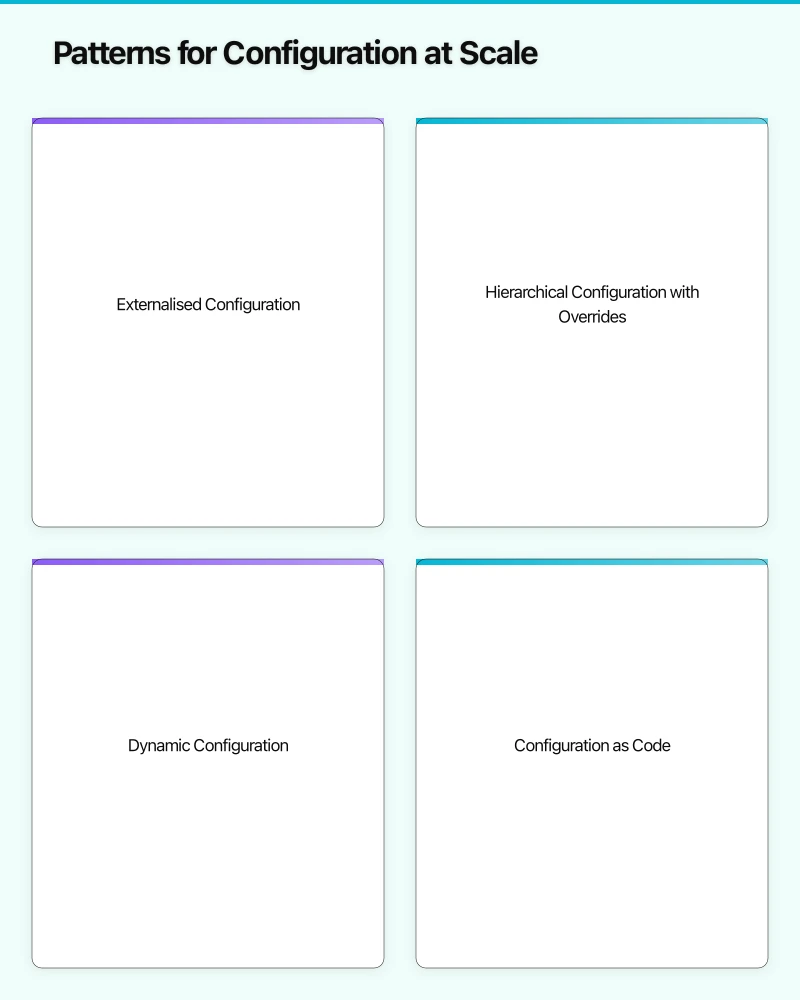
Patterns for Configuration at Scale
Several patterns address the challenges of managing configuration across large, distributed enterprise systems.
Externalised Configuration moves all configuration out of application code and deployment artifacts into external stores. Applications read configuration from environment variables, configuration files mounted at known paths, or configuration services accessed at startup and runtime. The twelve-factor app methodology popularised this principle, and it remains the foundation of manageable configuration.
The benefit is clear: changing configuration does not require rebuilding or redeploying applications. A timeout value change propagates by updating the configuration source and (depending on the pattern) restarting or dynamically refreshing the application. This decoupling enables operational changes at the speed of configuration rather than the speed of deployment.
Hierarchical Configuration with Overrides organises configuration into layers: global defaults, environment-specific values, region-specific values, and instance-specific overrides. Each layer overrides the previous, creating a cascade that minimises duplication while allowing specific customisation. A retry policy might default to 3 attempts globally, be overridden to 5 in the production environment, and further overridden to 1 in a specific region experiencing latency.
This pattern reduces configuration management burden — most values are defined once at the global level and overridden only where specific requirements differ. It also reduces the risk of divergence between environments, since most configuration is shared and differences are explicit overrides.
Dynamic Configuration enables configuration changes to take effect at runtime without application restart. Applications periodically poll a configuration service, subscribe to configuration change events, or use libraries that refresh configuration transparently. Dynamic configuration is essential for operational scenarios where restart costs are high: adjusting rate limits during a traffic spike, enabling verbose logging during incident investigation, or disabling a feature exhibiting production issues.
The implementation requires careful attention to consistency and safety. When a configuration value changes, all instances of a service should update within a bounded time window. Values should be validated before application — an invalid database connection string should not be propagated. And changes should be auditable — who changed what, when, and why.
Configuration as Code treats configuration with the same rigour as application code: version-controlled, peer-reviewed, tested, and deployed through automated pipelines. This practice provides auditability (every change is a commit), reversibility (revert the commit), and review (pull requests for configuration changes). Tools like Ansible, Puppet, and Chef pioneered this approach for infrastructure configuration, and modern practices extend it to application configuration.
Tooling for Enterprise Configuration Management
The tooling landscape for enterprise configuration management has matured, with options ranging from cloud-native services to dedicated configuration platforms.
HashiCorp Consul provides service discovery and distributed key-value configuration storage. Applications register with Consul and discover other services through DNS or HTTP API. Configuration values are stored in Consul’s key-value store and accessed by applications through the API or through template rendering (consul-template). Consul’s distributed architecture provides high availability and multi-datacenter support.
AWS Systems Manager Parameter Store and AWS Secrets Manager provide managed configuration and secret storage within the AWS ecosystem. Parameter Store stores configuration values (including encrypted secrets) in a hierarchical namespace. Secrets Manager adds automatic rotation capabilities for database credentials and API keys. Both integrate with IAM for access control and CloudTrail for audit logging.
Spring Cloud Config provides configuration management for Java/Spring applications, serving configuration from Git repositories. Applications fetch configuration at startup and can refresh dynamically. For enterprises with large Spring application portfolios, Spring Cloud Config integrates naturally with existing development practices.
etcd serves as the configuration store for Kubernetes and provides a reliable distributed key-value store for application configuration. Its strong consistency guarantees (based on the Raft consensus protocol) and watch capabilities make it suitable for configuration that must be consistent across all consumers.
For secrets specifically, HashiCorp Vault has emerged as the enterprise standard. Vault provides secret storage with encryption, dynamic secret generation (creating short-lived database credentials on demand), secret rotation, and comprehensive audit logging. Its pluggable authentication and secret engine architecture supports diverse enterprise requirements.
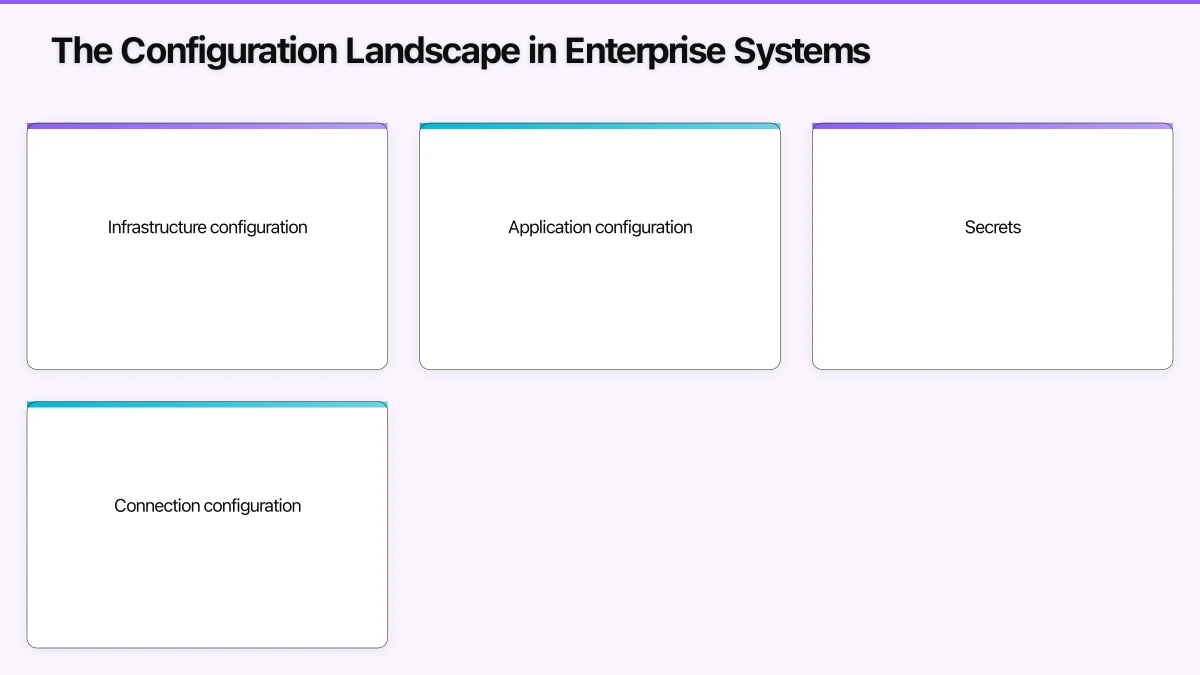
Governance and Operational Excellence
Configuration governance prevents the misconfiguration incidents that dominate enterprise outage reports.
Change management for configuration should be proportionate to the risk of the change. Routine changes (adjusting a log level) may require only peer review. High-risk changes (modifying database connection parameters) should require approval from both the application team and the platform team. Production environment changes should always be auditable, with clear attribution and timestamps.
Configuration validation prevents invalid values from reaching applications. Validation should occur at multiple points: in the configuration management tool (schema validation), in the deployment pipeline (integration testing with configuration changes), and in the application (startup validation that rejects invalid configuration). Defence in depth catches errors that individual validation layers miss.
Configuration drift detection identifies divergence between the intended configuration (stored in version control) and the actual configuration (running in the environment). Drift occurs when emergency changes bypass the standard change process, when manual interventions modify running configurations, or when configuration synchronisation fails. Regular drift detection — and remediation of detected drift — maintains the integrity of configuration management.
Disaster recovery for configuration ensures that configuration can be restored in the event of configuration service failure. Configuration should be backed up, and applications should cache the last known good configuration locally. A configuration service outage should not prevent applications from operating — it should only prevent configuration changes.
Conclusion
Enterprise configuration management is a foundational operational capability that directly impacts system reliability, security, and operational agility. The organisations that invest in structured configuration management — externalised, versioned, validated, and governed — operate with confidence and speed. Those that treat configuration as an afterthought experience the recurring outages and security incidents that misconfiguration inevitably produces.
For CTOs building operational excellence in 2022, configuration management deserves investment proportionate to its impact. Standardise on configuration management tools and patterns, establish governance that balances safety with operational speed, and treat configuration changes with the same rigour applied to code changes. The discipline required is modest; the reliability benefits are substantial.
For the practitioner’s view on web design and digital marketing, explore Cosmos Web Tech — where strategy meets execution.
My consultancy Ganda Tech Services operates three specialist divisions covering cloud infrastructure, web development, and mobile apps for Australian businesses.
About the Author
Ashish Ganda is the founder of Ganda Tech Services, a Sydney-based technology consultancy specialising in cloud infrastructure, web development, and mobile app solutions for Australian businesses.
Digital Transformation Roadmap 2026
A 12-month framework for Australian SMBs ready to modernise — phases, tools, and milestones.
Almost done
Check your inbox and click the confirmation link to get your download.