Enterprise Cloud Networking: VPC Design Patterns
Introduction
Network architecture in the cloud is simultaneously more flexible and more consequential than traditional on-premises networking. The ease with which virtual private clouds can be created belies the complexity of designing network topologies that support enterprise requirements for security segmentation, hybrid connectivity, multi-account governance, and cost-effective data transfer.
Poor VPC design decisions made early in cloud adoption create persistent problems: overlapping IP address spaces that prevent connectivity, flat network topologies that provide inadequate security segmentation, and point-to-point connections that create management overhead scaling quadratically with the number of VPCs. These problems are expensive to remediate because network architecture changes often require application re-deployment and connectivity re-establishment.
For enterprise architects designing or refactoring their cloud network architecture, the investment in proper VPC design pays dividends across every workload deployed on the platform. This analysis presents the strategic design patterns that enterprises should adopt, with a focus on AWS VPC architecture, though the principles translate to Azure Virtual Networks and Google Cloud VPCs with appropriate terminology adjustments.
Multi-Account VPC Topology
Enterprise cloud environments should use a multi-account strategy where different workloads, environments, and business units are separated into distinct cloud accounts. This separation provides security boundaries, cost isolation, and service quota independence. The VPC design must support connectivity across these accounts while maintaining the isolation benefits that motivated the multi-account approach.
The hub-and-spoke topology, implemented using a transit gateway, is the dominant enterprise pattern. A central networking account hosts the transit gateway, which serves as the routing hub for all inter-VPC and hybrid connectivity. Each workload account creates VPCs that attach to the transit gateway, enabling communication through the hub rather than through direct VPC peering connections.
This topology offers several advantages over direct VPC peering. Transit gateway scales to thousands of attachments, whereas VPC peering connections must be established individually between each pair of VPCs that need to communicate, creating management complexity that grows quadratically. Transit gateway supports transitive routing, meaning that a VPC connected to the transit gateway can reach any other connected VPC without establishing a direct relationship. Transit gateway also provides a central point for implementing network-wide routing policies and traffic inspection.
The IP address space design is one of the most important and least reversible decisions in enterprise cloud networking. Each VPC requires a non-overlapping CIDR block, and the aggregate address space must accommodate future growth. Enterprise architects should allocate a large private address space (typically from the 10.0.0.0/8 range) and establish a systematic allocation scheme that reserves blocks for different environments, regions, and business units. Address space exhaustion or overlap creates connectivity problems that are extremely painful to resolve after workloads are deployed.
Subnet design within each VPC should follow a tiered model that separates public-facing resources, application tier resources, and data tier resources into distinct subnets with appropriate routing and security group configurations. Each tier should span multiple availability zones for resilience. The public tier routes through an internet gateway, the application tier typically uses NAT gateways for outbound internet access, and the data tier has no internet connectivity, accessible only from within the VPC or through private network connections.
Hybrid Connectivity Architecture
Most enterprises require connectivity between their cloud VPCs and on-premises networks for data access, application integration, and migration support. The hybrid connectivity architecture must balance performance, reliability, security, and cost.
AWS Direct Connect (or Azure ExpressRoute, or Google Cloud Interconnect) provides dedicated, private network connections between on-premises data centres and cloud regions. These connections offer consistent low-latency performance and do not traverse the public internet, which is important for security-sensitive and latency-sensitive workloads. Enterprise deployments should use redundant connections, ideally from different Direct Connect locations, to ensure high availability.
Site-to-site VPN provides encrypted connectivity over the public internet and serves as either a primary connection for less demanding workloads or a backup connection for Direct Connect. VPN connections are faster to establish and less expensive than Direct Connect but offer lower bandwidth and less consistent latency.
The transit gateway simplifies hybrid connectivity by terminating Direct Connect and VPN connections centrally. On-premises networks connect to the transit gateway through a Direct Connect gateway or VPN attachment, and the transit gateway’s routing tables distribute traffic to the appropriate VPCs. This centralised model is far simpler to manage than establishing separate hybrid connections to each VPC.
DNS resolution in hybrid environments requires careful configuration to ensure that resources in both cloud and on-premises environments can resolve each other’s domain names. Route 53 Resolver endpoints (inbound and outbound) enable bidirectional DNS resolution between cloud VPCs and on-premises DNS infrastructure. Centralising the resolver endpoints in a shared services VPC and routing DNS queries through the transit gateway provides a clean, manageable architecture.
Network Security and Segmentation
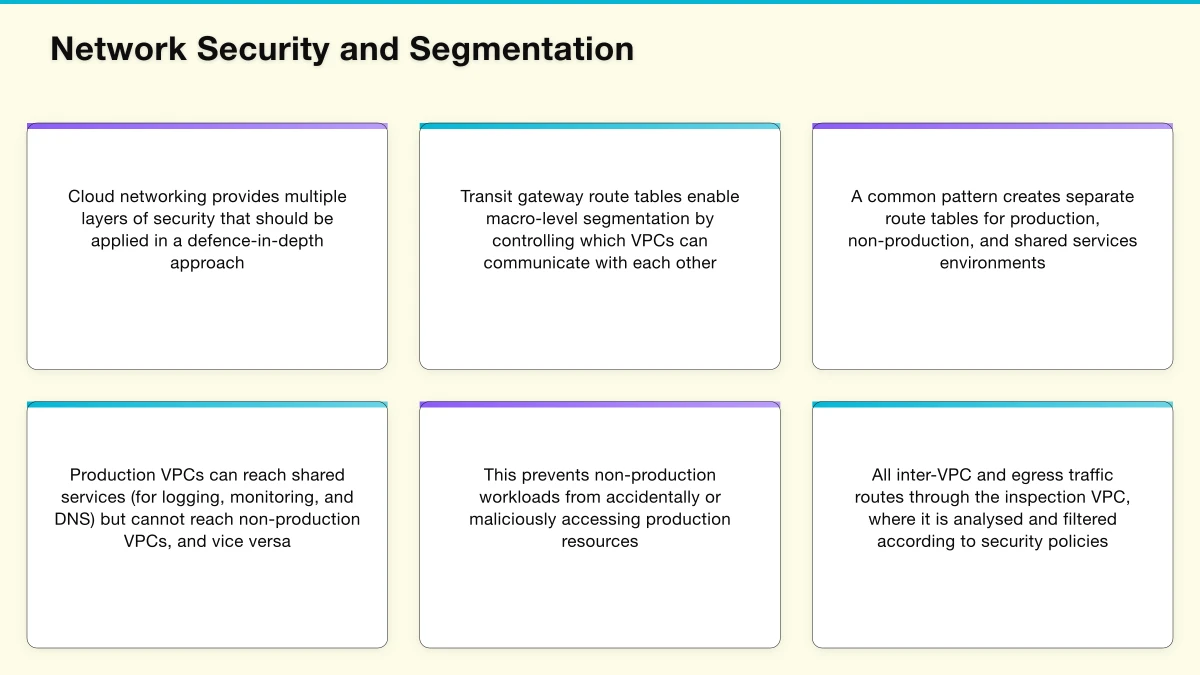
Cloud networking provides multiple layers of security that should be applied in a defence-in-depth approach. The combination of VPC isolation, subnet routing, network ACLs, security groups, and transit gateway route tables creates a segmentation model that is more granular and more dynamic than traditional on-premises network security.
Transit gateway route tables enable macro-level segmentation by controlling which VPCs can communicate with each other. A common pattern creates separate route tables for production, non-production, and shared services environments. Production VPCs can reach shared services (for logging, monitoring, and DNS) but cannot reach non-production VPCs, and vice versa. This prevents non-production workloads from accidentally or maliciously accessing production resources.
For environments requiring traffic inspection, a centralised inspection VPC with network firewall appliances (such as AWS Network Firewall, Palo Alto, or Fortinet) can be inserted into the transit gateway traffic flow. All inter-VPC and egress traffic routes through the inspection VPC, where it is analysed and filtered according to security policies. This centralised inspection model provides comprehensive visibility and control but introduces additional latency and cost.
Security groups provide instance-level and container-level micro-segmentation. Best practice in enterprise environments is to define security groups by function (web server, application server, database) rather than by specific application, creating reusable security group definitions that enforce consistent access patterns. Security group rules should reference other security groups rather than IP addresses wherever possible, creating dynamic rules that automatically accommodate infrastructure changes.
VPC Flow Logs capture metadata about network traffic at the VPC, subnet, or network interface level. Enabling flow logs and analysing them through a centralised security information and event management (SIEM) platform provides network-level visibility essential for threat detection, incident investigation, and compliance auditing.
Cost Optimisation and Operational Considerations
Cloud networking costs can be substantial and are often underestimated. Data transfer charges, NAT gateway processing costs, transit gateway attachment and processing fees, and Direct Connect port fees accumulate quickly in enterprise environments.
Data transfer architecture significantly impacts cost. Intra-AZ traffic within a VPC is free, but cross-AZ traffic incurs charges. For high-volume internal services, deploying replicas in each AZ and routing traffic to local instances (using topology-aware load balancing) can substantially reduce cross-AZ data transfer costs. Egress to the internet is the most expensive data transfer path; caching, content delivery networks, and efficient API design all reduce egress costs.
VPC endpoints (gateway endpoints for S3 and DynamoDB, interface endpoints for other AWS services) route traffic to AWS services through the private network rather than through NAT gateways and the internet. This eliminates NAT gateway processing charges and improves security by keeping traffic off the public internet. Enterprise environments should systematically deploy VPC endpoints for frequently accessed services.
Operational management of enterprise cloud networking benefits from infrastructure as code (Terraform, CloudFormation, or Pulumi) for all network resources. Network configurations should be version-controlled, peer-reviewed, and deployed through automated pipelines, the same discipline applied to application code. This practice prevents configuration drift, enables disaster recovery, and provides audit trails for compliance.
Network architecture is infrastructure that outlives the applications deployed on it. The patterns described here, multi-account hub-and-spoke topology, systematic IP address management, defence-in-depth security, and cost-aware data transfer design, create a network foundation that supports enterprise cloud operations for years. The upfront investment in proper design avoids the far greater cost of remediation after the fact.
For the practitioner’s view on cloud, IT, and cybersecurity, explore Cloud Geeks — where strategy meets infrastructure.
My consultancy Ganda Tech Services operates three specialist divisions covering cloud infrastructure, web development, and mobile apps for Australian businesses.
About the Author
Ashish Ganda is the founder of Ganda Tech Services, a Sydney-based technology consultancy specialising in cloud infrastructure, web development, and mobile app solutions for Australian businesses.
Digital Transformation Roadmap 2026
A 12-month framework for Australian SMBs ready to modernise — phases, tools, and milestones.
Almost done
Check your inbox and click the confirmation link to get your download.