Cloud Network Architecture for Enterprise: Building Secure, Scalable Foundations
Introduction
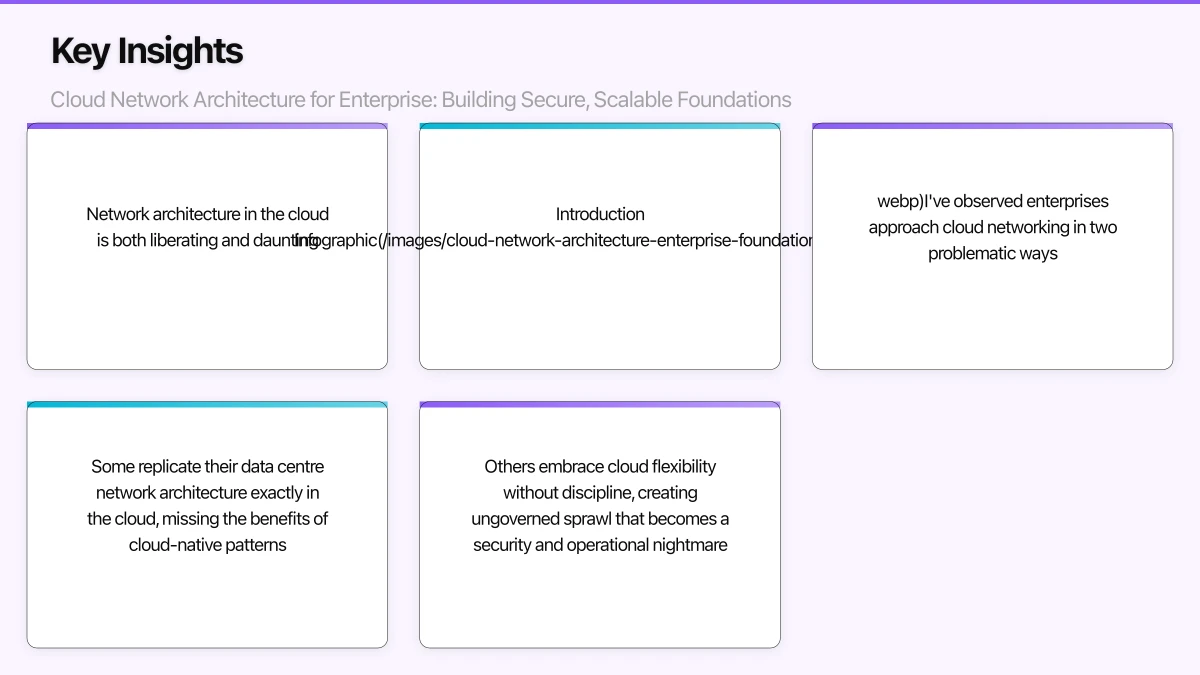
Network architecture in the cloud is both liberating and daunting. The software-defined nature of cloud networking enables patterns impossible in traditional data centres, but it also introduces complexity that can overwhelm teams accustomed to physical infrastructure.
I’ve observed enterprises approach cloud networking in two problematic ways. Some replicate their data centre network architecture exactly in the cloud, missing the benefits of cloud-native patterns. Others embrace cloud flexibility without discipline, creating ungoverned sprawl that becomes a security and operational nightmare.
The right approach lies between these extremes: leveraging cloud networking capabilities while maintaining the governance and security discipline that enterprise environments require.
Foundational Concepts
Virtual Private Clouds
The VPC (Virtual Private Cloud) is the fundamental building block of cloud networking. It provides an isolated network environment within the cloud provider’s infrastructure.
Key VPC design decisions:
CIDR range allocation: Plan IP address ranges carefully. Ranges must not overlap with on-premises networks or other VPCs that may need connectivity. Leave room for growth—re-IPing is painful.
Subnet strategy: Subnets define network segments within VPCs. Typically organised by:
- Availability zones (for resilience)
- Tier (public, private, data)
- Workload type (compute, database, management)
Internet connectivity: Not all workloads need direct internet access. Design explicit ingress and egress paths rather than allowing arbitrary connectivity.
Software-Defined Networking Advantages
Cloud networking enables patterns impractical in physical networks:
Instant provisioning: Create networks in seconds, not weeks. Enable self-service networking for development teams.
Declarative configuration: Define networks as code. Version control, review, and audit network changes.
Programmatic security: Security groups and network ACLs enforce policy consistently at scale.
Global reach: Connect resources across regions and availability zones without physical infrastructure.
Elastic scaling: Network capacity scales with workload without capacity planning.
Network Architecture Patterns
Hub-and-Spoke Topology
The hub-and-spoke pattern centralises shared services and connectivity:
                    [Internet]
                        |
                  [Hub VPC/VNet]
                  - Firewall
                  - Shared services
                  - Transit connectivity
                   /    |    \
            [Spoke]  [Spoke]  [Spoke]
            Dev      Prod     Analytics
Hub components:
- Internet ingress/egress with centralised security inspection
- Shared services (DNS, monitoring, authentication)
- Transit connectivity to on-premises
- Security appliances and logging
Spoke characteristics:
- Isolated workload environments
- Minimal direct connectivity between spokes
- Traffic flows through hub for inspection and control
This pattern provides security and operational control but can create bottlenecks and single points of failure at the hub.
Mesh Connectivity
For workloads requiring direct communication, mesh patterns enable spoke-to-spoke connectivity:
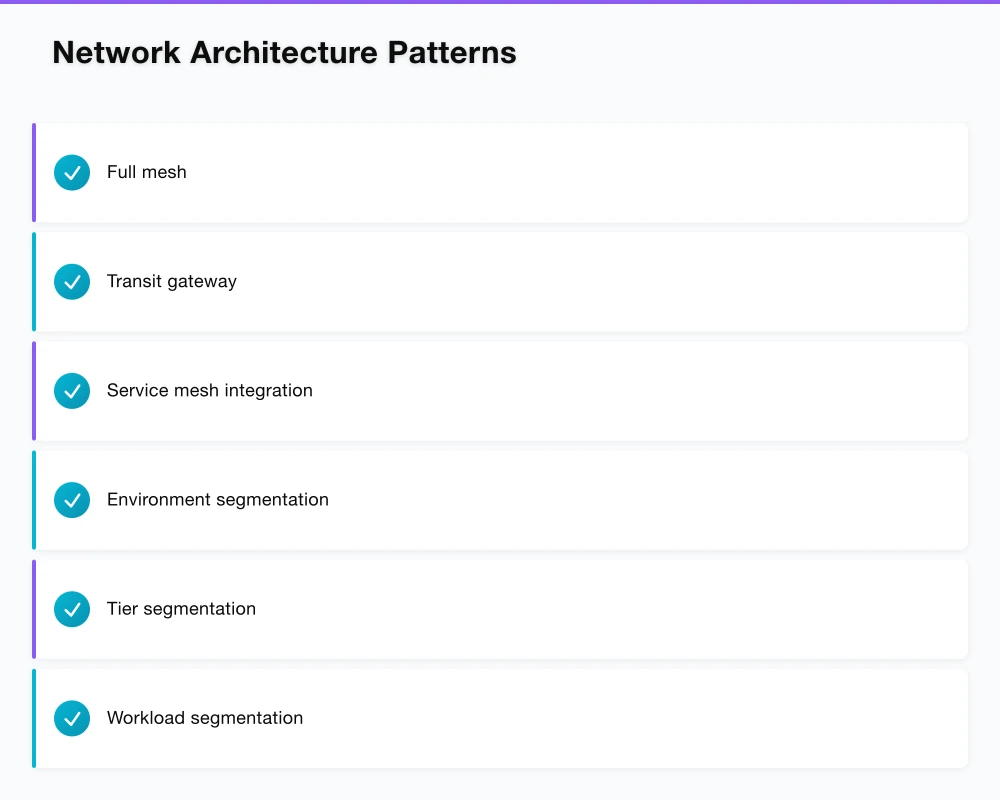
Full mesh: Every VPC connects to every other VPC. Simple conceptually but doesn’t scale—connection count grows quadratically.
Transit gateway: Cloud-native transit services (AWS Transit Gateway, Azure Virtual WAN, Google Cloud Interconnect) provide scalable hub connectivity without dedicated hub VPCs.
Service mesh integration: Application-layer service meshes can complement network-layer connectivity, providing observability and policy enforcement at Layer 7.
Segmentation Strategy
Network segmentation limits blast radius of security incidents and enforces least-privilege access:
Environment segmentation: Separate development, staging, and production into distinct network boundaries. Production should be isolated from development networks.
Tier segmentation: Web tier, application tier, and data tier in separate subnets with explicit allowed traffic flows.
Workload segmentation: Sensitive workloads (PCI, HIPAA, financial systems) isolated with additional controls.
Micro-segmentation: Fine-grained segmentation at the workload level using security groups. Each component only communicates with its required dependencies.
Security Architecture
Defence in Depth
Cloud network security requires multiple layers:
Perimeter security: Internet-facing load balancers and firewalls. DDoS protection services. Web application firewalls for HTTP traffic.
Network layer security: Security groups controlling instance-level traffic. Network ACLs for subnet-level rules. Private subnets for non-public workloads.
Traffic inspection: Network firewalls (AWS Network Firewall, Azure Firewall, third-party appliances) for deep packet inspection. Consider performance implications.
Encryption in transit: TLS for application traffic. IPsec or cloud-native encryption for VPC-to-VPC and hybrid connectivity.
Zero Trust Principles
Traditional perimeter-based security assumes trust within the network. Zero trust assumes no implicit trust:
Verify explicitly: Authenticate and authorise every request, regardless of network location.
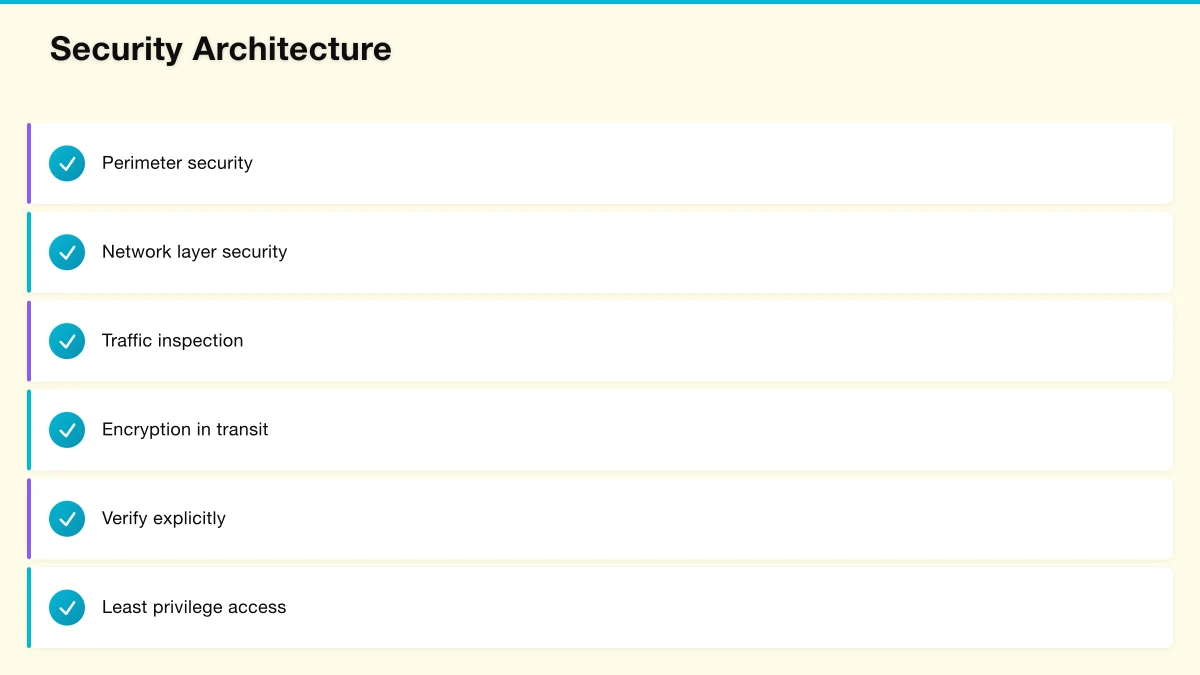
Least privilege access: Grant minimum necessary permissions. Segment networks to enforce access boundaries.
Assume breach: Design assuming attackers are already inside. Limit lateral movement through segmentation.
Implementing zero trust in cloud networks:
- Micro-segmentation with security groups denying all traffic by default
- Identity-aware proxies for application access
- Mutual TLS for service-to-service communication
- Continuous monitoring for anomalous traffic patterns
Security Group Strategy
Security groups are the primary network security control in cloud environments:
Application-centric groups: Create security groups per application component, not per network tier. “web-frontend-prod” rather than “public-subnet-rules.”
Reference by group, not by IP: Allow traffic from security groups rather than CIDR ranges where possible. This maintains security as instances scale.
Explicit denies: While security groups are default-deny, document intended restrictions for audit purposes.
Review automation: Automated review of security group changes. Alert on rules allowing broad access.
Hybrid Connectivity
On-Premises Integration
Enterprise cloud adoption typically requires connectivity to existing data centres:
VPN connectivity: IPsec VPN tunnels over public internet. Appropriate for development and low-bandwidth production workloads. Relatively simple to establish.
Dedicated connectivity: AWS Direct Connect, Azure ExpressRoute, Google Cloud Interconnect. Private connections through colocation facilities. Higher bandwidth, lower latency, more consistent performance. Required for production workloads with significant data transfer.
SD-WAN integration: Software-defined WAN solutions can simplify hybrid connectivity management across multiple sites and cloud providers.
DNS Architecture
DNS is critical infrastructure that requires careful design in hybrid environments:
Split-horizon DNS: Resolve cloud resources differently for internal and external clients. Internal clients resolve to private IPs.
DNS forwarding: Configure bidirectional DNS forwarding between on-premises and cloud. On-premises resolvers forward cloud domain queries to cloud DNS.
Private DNS zones: Cloud-native private DNS (Route 53 Private Hosted Zones, Azure Private DNS) for cloud workloads.
DNS security: DNSSEC for external zones. Monitor DNS queries for security anomalies.
Identity Integration
Network access controls integrate with identity systems:
Directory integration: Extend on-premises Active Directory to cloud or use cloud-native directories with synchronisation.
VPN authentication: Integrate VPN access with corporate identity provider. Multi-factor authentication for VPN access.
Service accounts: Workload identity for cloud resources. Avoid long-lived credentials where possible.
Multi-Cloud Networking
Cross-Cloud Connectivity
Organisations operating across multiple cloud providers need cross-cloud networking:
Direct interconnect: Some cloud providers offer direct connections to others (e.g., AWS and Azure cross-connect in certain locations).
Third-party connectivity: Services like Megaport and Equinix Cloud Exchange provide cross-cloud connectivity through colocation facilities.
VPN over internet: IPsec VPN tunnels between cloud providers over the internet. Simpler but less performant than dedicated connectivity.
SD-WAN solutions: Multi-cloud SD-WAN provides consistent connectivity abstraction across providers.
Abstraction Strategies
Managing networking across providers requires abstraction:
Infrastructure as code: Define networks in provider-agnostic terms where possible. Terraform supports multiple providers.
Overlay networks: Solutions like HashiCorp Consul Connect or Cilium provide service mesh capabilities across providers.
Common security policies: Define security intent centrally, translate to provider-specific implementations.
The goal isn’t complete provider abstraction—that sacrifices provider-specific capabilities. Rather, it’s consistent operational patterns while leveraging each provider’s strengths.
Operational Considerations
Network Observability
You can’t secure or troubleshoot what you can’t see:
Flow logs: Enable VPC flow logs for traffic visibility. Aggregate logs for analysis and anomaly detection.
Traffic mirroring: For deeper inspection, mirror traffic to analysis tools. Use selectively due to cost.
Latency monitoring: Measure network latency between components. Establish baselines and alert on degradation.
Connectivity testing: Automated testing of expected connectivity paths. Detect segmentation failures or routing issues.
Change Management
Network changes can have broad impact:
Infrastructure as code: All network configuration in version-controlled code. No manual changes to production networks.
Review process: Network changes require review by qualified personnel. Automated policy checks before deployment.
Staged rollouts: Test network changes in non-production environments. Consider blue-green for significant changes.
Rollback capability: Design for quick rollback. Maintain known-good configurations.
Cost Management
Cloud networking costs can surprise:
Data transfer charges: Understand your cloud provider’s data transfer pricing. Inter-region and internet egress charges add up.
NAT gateway costs: NAT gateway data processing charges can be substantial at scale. Consider alternatives for high-volume traffic.
Load balancer costs: Elastic load balancers have hourly and data processing charges. Consolidate where appropriate.
Reserved capacity: For dedicated connectivity (Direct Connect, ExpressRoute), commit to capacity for discounted rates.
Design Principles
Start Simple
Complexity in network architecture creates operational burden and security risk:
- Begin with straightforward hub-and-spoke patterns
- Add complexity only when requirements demand
- Document the “why” for every architectural decision
- Prefer cloud-native services over custom implementations
Design for Failure
Cloud networks fail. Design accordingly:
- Redundant connectivity paths for critical workloads
- Multi-AZ deployment for network components
- Health checks and automatic failover
- Chaos engineering practices for network failure scenarios
Automate Everything
Manual network operations don’t scale:
- Infrastructure as code for all network configuration
- Automated compliance checking
- Self-service network provisioning with guardrails
- Automated incident response for common issues
Security by Default
Security should be the default state:
- Deny-all default policies
- Private subnets unless public access is required
- Encryption in transit everywhere
- Audit logging for all network changes
Conclusion
Cloud network architecture establishes the foundation for everything an enterprise runs in the cloud. Get it right, and teams can move fast with confidence. Get it wrong, and every application deployment becomes a security review, every incident becomes a network debugging session, and every audit becomes a scramble.
The patterns that work—hub-and-spoke with appropriate transit, defence in depth security, infrastructure as code, automated operations—aren’t revolutionary. They’re disciplined application of sound engineering principles to cloud-specific constraints.
For CTOs, network architecture decisions have long-lasting implications. Early choices constrain or enable future capabilities. Investment in proper foundation design pays dividends for years. The alternative—organic growth without governance—creates technical debt that compounds over time.
Take the time to design networks properly. Document decisions and rationale. Build teams that understand both traditional networking and cloud-native patterns. The intersection of these competencies is where effective cloud network architecture lives.
Cloud network architecture requires balancing cloud-native capabilities with enterprise governance requirements. For CTOs leading cloud transformations, investing in network architecture foundations creates the secure, scalable environment that enables everything else the organisation wants to accomplish in the cloud.
Strategy needs execution. Cloud Geeks publishes practical cloud computing and cybersecurity guides for Australian businesses ready to act.
As founder of Ganda Tech Services, I work with Australian businesses to align technology investments with business growth — across cloud, web, and mobile.
About the Author
Ashish Ganda is the founder of Ganda Tech Services, a Sydney-based technology consultancy specialising in cloud infrastructure, web development, and mobile app solutions for Australian businesses.
Digital Transformation Roadmap 2026
A 12-month framework for Australian SMBs ready to modernise — phases, tools, and milestones.
Almost done
Check your inbox and click the confirmation link to get your download.