Enterprise Cloud Migration Patterns: Lift-and-Shift vs Re-Architecture
As we enter 2022, the enterprise cloud migration landscape has matured significantly. The question for most CTOs is no longer whether to migrate to the cloud but how to do it in a way that maximises business value while minimising disruption. Two dominant patterns have emerged: lift-and-shift and re-architecture. Each carries distinct strategic implications that go far beyond the technical execution, touching workforce planning, competitive positioning, and long-term operational economics.
Having observed and guided numerous large-scale migrations, I can say with confidence that the decision between these approaches is rarely binary. Most enterprises end up with a portfolio strategy, but the initial framing and the criteria used to classify workloads determine the trajectory for years to come. This article provides a strategic framework for making that decision.
Understanding the Migration Spectrum
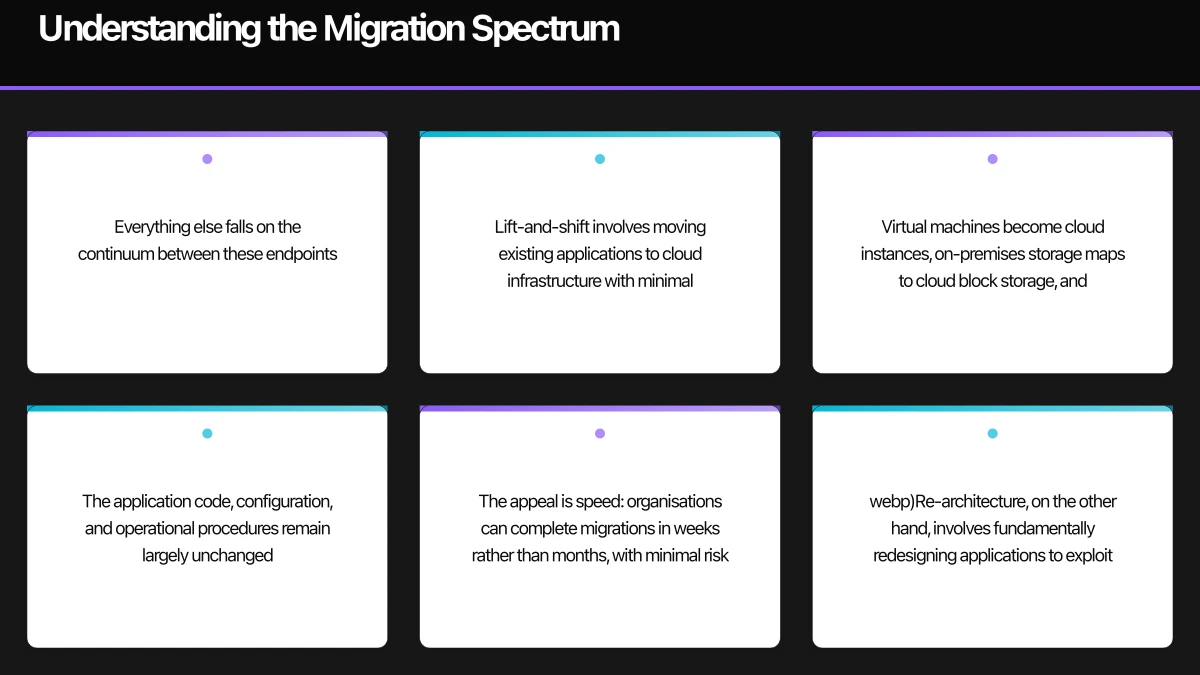
The industry has converged on Gartner’s 6 Rs framework — Rehost, Replatform, Refactor, Repurchase, Retire, and Retain — but in practice, the strategic tension sits primarily between two poles: lift-and-shift (rehosting) and re-architecture (refactoring). Everything else falls on the continuum between these endpoints.
Lift-and-shift involves moving existing applications to cloud infrastructure with minimal modification. Virtual machines become cloud instances, on-premises storage maps to cloud block storage, and networking is replicated through virtual private clouds. The application code, configuration, and operational procedures remain largely unchanged. The appeal is speed: organisations can complete migrations in weeks rather than months, with minimal risk of introducing functional regressions.
Re-architecture, on the other hand, involves fundamentally redesigning applications to exploit cloud-native capabilities. Monolithic applications are decomposed into microservices. Stateful components are refactored to use managed databases and distributed caching. Synchronous communication patterns are replaced with event-driven architectures. The application emerges as something entirely different — more resilient, more scalable, and significantly more cost-efficient at scale.
The spectrum between these poles is not merely technical. It represents a trade-off between time-to-value, risk tolerance, capital expenditure, and the strategic ambition of the technology organisation. Getting this balance right is one of the most consequential decisions a CTO can make.
The Strategic Case for Lift-and-Shift
There are legitimate strategic reasons to choose lift-and-shift, and dismissing it as a “lazy” approach misses important nuances. The most compelling scenarios include data centre exit deadlines, where lease expirations or hardware end-of-life create hard timelines that preclude lengthy re-architecture efforts. In these cases, the fastest path to cloud infrastructure preserves optionality for future modernisation while eliminating immediate capital expenditure requirements.
Financial modelling often favours lift-and-shift in the near term. The total cost of migration is typically 30-50% lower than re-architecture, and the time to realise operational savings is measured in months rather than years. For organisations under pressure to demonstrate cloud ROI to boards and investors, this acceleration can be strategically significant.
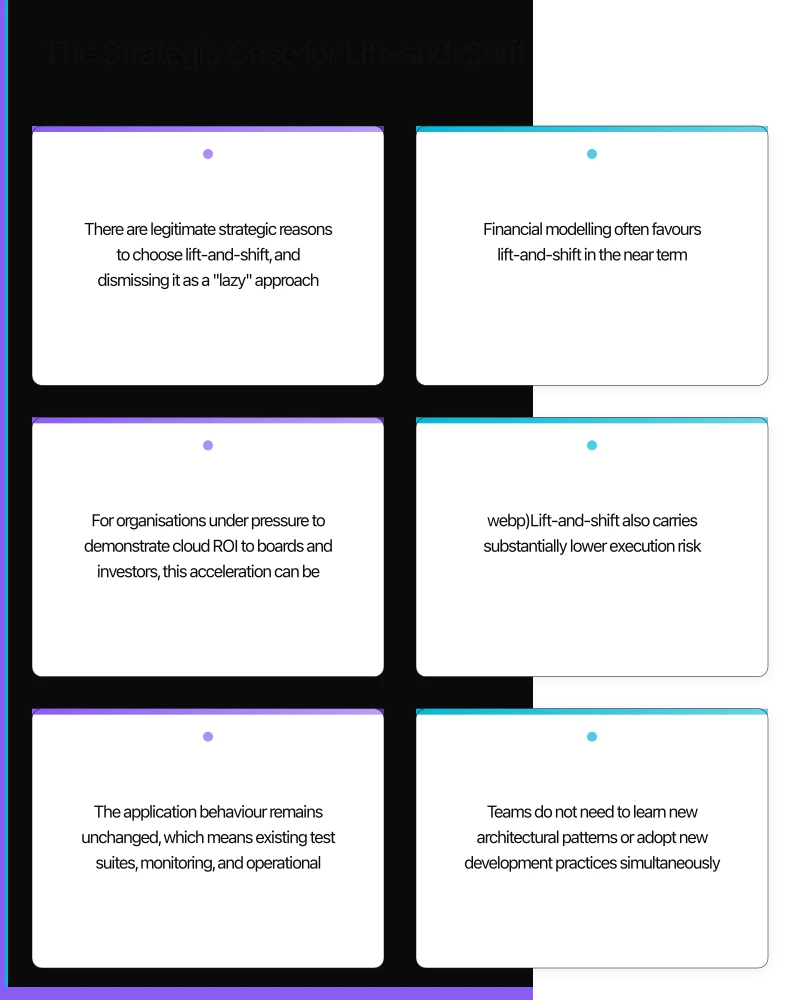
Lift-and-shift also carries substantially lower execution risk. The application behaviour remains unchanged, which means existing test suites, monitoring, and operational runbooks continue to function. Teams do not need to learn new architectural patterns or adopt new development practices simultaneously with migration. This is particularly relevant for organisations with critical compliance requirements where application behaviour changes trigger re-certification processes.
However, the limitations are real and compounding. Lifted-and-shifted applications typically cost 20-40% more to operate in the cloud than equivalent cloud-native implementations. They cannot leverage auto-scaling effectively, often requiring peak-capacity provisioning that mirrors the on-premises model. They remain vulnerable to the same scalability bottlenecks, single points of failure, and operational complexity that motivated the migration in the first place.
The most dangerous outcome is what I call “cloud-hosted legacy” — applications running on cloud infrastructure but delivering none of the agility, resilience, or economic benefits that justify the cloud operating model. This creates a worst-of-both-worlds scenario where organisations bear the complexity of cloud operations without the corresponding advantages.
The Strategic Case for Re-Architecture
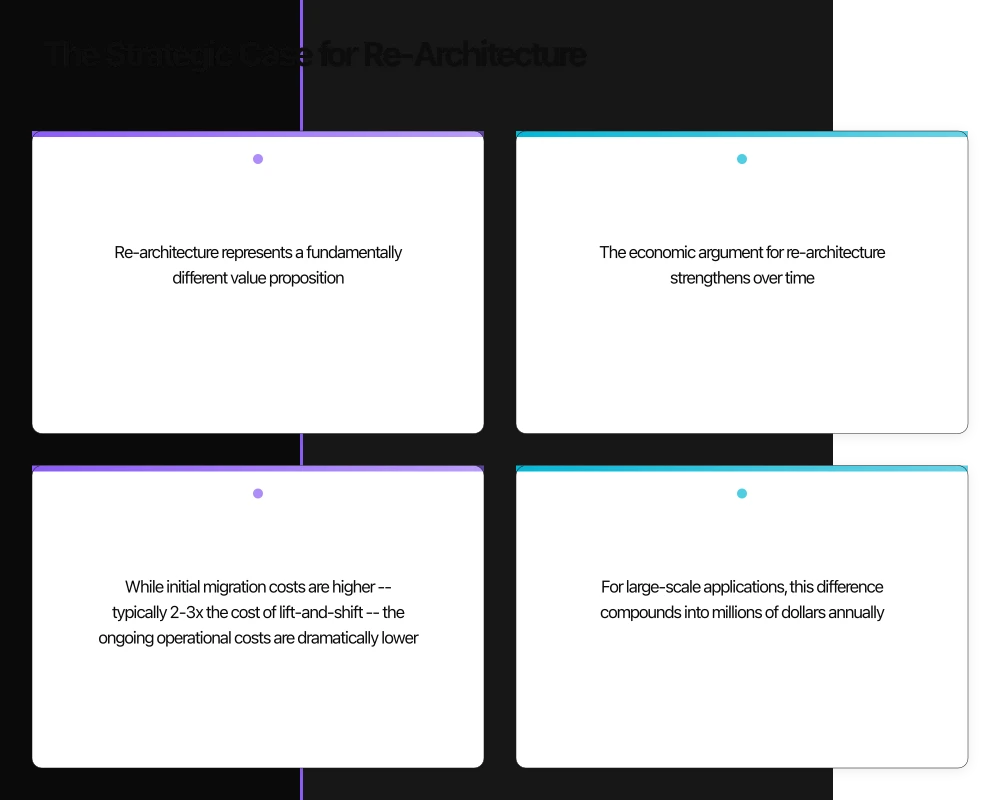
Re-architecture represents a fundamentally different value proposition. Rather than preserving the status quo in a new location, it reimagines applications to exploit the capabilities that cloud platforms uniquely provide: elastic scaling, managed services, global distribution, and consumption-based pricing.
The economic argument for re-architecture strengthens over time. While initial migration costs are higher — typically 2-3x the cost of lift-and-shift — the ongoing operational costs are dramatically lower. Applications that leverage auto-scaling, serverless compute, and managed data services can achieve 50-70% lower operational costs compared to their lifted-and-shifted equivalents. For large-scale applications, this difference compounds into millions of dollars annually.
Beyond economics, re-architecture delivers strategic capabilities that lift-and-shift cannot. Cloud-native applications can scale to meet demand instantaneously, deploy updates multiple times per day without downtime, and recover from failures automatically. These capabilities translate directly into competitive advantages: faster time-to-market for new features, better customer experience during peak demand, and higher overall system reliability.
The workforce implications are equally significant. Re-architecture forces engineering teams to develop cloud-native skills, adopt modern development practices, and think in terms of distributed systems. While this creates short-term productivity drag, it builds organisational capabilities that accelerate all future development. Teams that have been through a re-architecture programme emerge as fundamentally more capable technology organisations.
The risks are substantial but manageable with proper planning. Re-architecture introduces functional risk as application behaviour changes. It requires significantly more skilled engineering talent. It creates extended periods of parallel operation where both legacy and cloud-native systems must be maintained. And it demands strong architectural governance to prevent the distributed systems equivalent of spaghetti code — where microservices proliferate without clear domain boundaries or ownership models.
A Portfolio Approach: The Decision Framework
The most effective enterprise cloud migration strategies I have observed use a portfolio approach, applying different migration patterns to different workloads based on strategic criteria. The decision framework should evaluate each application across four dimensions.
Business Criticality and Change Velocity: Applications that are both business-critical and undergoing frequent change are the strongest candidates for re-architecture. The investment in cloud-native capabilities pays dividends through faster feature delivery and higher reliability for the workloads that matter most. Conversely, stable applications with low change rates and limited strategic importance are natural candidates for lift-and-shift.
Technical Debt and Architecture Quality: Applications with well-defined domain boundaries, clean interfaces, and comprehensive test coverage are easier to re-architect successfully. Applications with decades of accumulated technical debt, undocumented dependencies, and brittle integration patterns carry disproportionate re-architecture risk. Paradoxically, these are often the applications that would benefit most from re-architecture, but the execution risk may be prohibitive.
Talent and Organisational Readiness: Re-architecture requires teams with distributed systems expertise, cloud-native development experience, and strong DevOps practices. If these capabilities do not exist within the organisation, the migration timeline must account for hiring, training, and cultural transformation. Starting with lift-and-shift for initial workloads while building cloud-native capabilities for subsequent waves is a pragmatic approach.
Regulatory and Compliance Constraints: Certain regulated industries require extensive validation and certification processes when application behaviour changes. In these contexts, re-architecture carries not just technical risk but regulatory risk, with potential timelines measured in years for re-certification. Lift-and-shift may be the only viable approach for these workloads in the near term.
The portfolio approach also enables organisational learning. Early lift-and-shift migrations build operational familiarity with cloud infrastructure, networking, security, and cost management. This foundation makes subsequent re-architecture efforts more likely to succeed because teams understand the target environment before attempting to redesign applications for it.
Conclusion
The lift-and-shift versus re-architecture decision is ultimately about strategic time horizons. Lift-and-shift optimises for the next 12-18 months: faster migration, lower initial cost, reduced execution risk. Re-architecture optimises for the next 3-5 years: lower operational costs, greater agility, stronger competitive positioning, and a more capable technology organisation.
For most enterprises in 2022, the answer is a carefully orchestrated combination. Use lift-and-shift to build momentum, demonstrate value, and develop cloud operational capabilities. Simultaneously, invest in re-architecture for the workloads where cloud-native capabilities create genuine competitive advantage. The key is making these decisions deliberately, based on strategic criteria rather than defaulting to the path of least resistance.
The organisations that execute this balance well will emerge from their cloud migrations not just with lower infrastructure costs, but with fundamentally more capable technology platforms and teams. Those that default to wholesale lift-and-shift risk spending the next decade paying cloud prices for on-premises capabilities.
Strategy needs execution. Cloud Geeks publishes practical cloud computing and cybersecurity guides for Australian businesses ready to act.
As founder of Ganda Tech Services, I work with Australian businesses to align technology investments with business growth — across cloud, web, and mobile.
About the Author
Ashish Ganda is the founder of Ganda Tech Services, a Sydney-based technology consultancy specialising in cloud infrastructure, web development, and mobile app solutions for Australian businesses.
Digital Transformation Roadmap 2026
A 12-month framework for Australian SMBs ready to modernise — phases, tools, and milestones.
Almost done
Check your inbox and click the confirmation link to get your download.