Cloud Cost Optimization: The Rise of FinOps in Enterprise
Introduction
As enterprises accelerated their cloud migrations throughout 2020, a sobering reality has emerged: cloud spending is spiraling beyond initial projections. Gartner estimates that by the end of 2021, more than 45% of IT spending will shift from traditional solutions to cloud. Yet the same research indicates that organizations waste approximately 30% of their cloud spend due to inefficient resource allocation and lack of visibility.
This challenge has given rise to FinOps—a portmanteau of Finance and Operations—representing a cultural practice and operational framework that brings financial accountability to the variable spend model of cloud computing. For CTOs navigating the post-pandemic digital acceleration, understanding and implementing FinOps is no longer optional; it’s a strategic imperative.
The Cloud Cost Crisis: Understanding the Challenge
Why Traditional IT Budgeting Fails in Cloud
Traditional IT budgeting operated on capital expenditure models—you purchased servers, depreciated them over five years, and planned upgrades cyclically. Cloud computing fundamentally disrupts this paradigm with its operational expenditure model where resources are consumed on-demand, costs are variable, and spending authority is distributed across engineering teams.
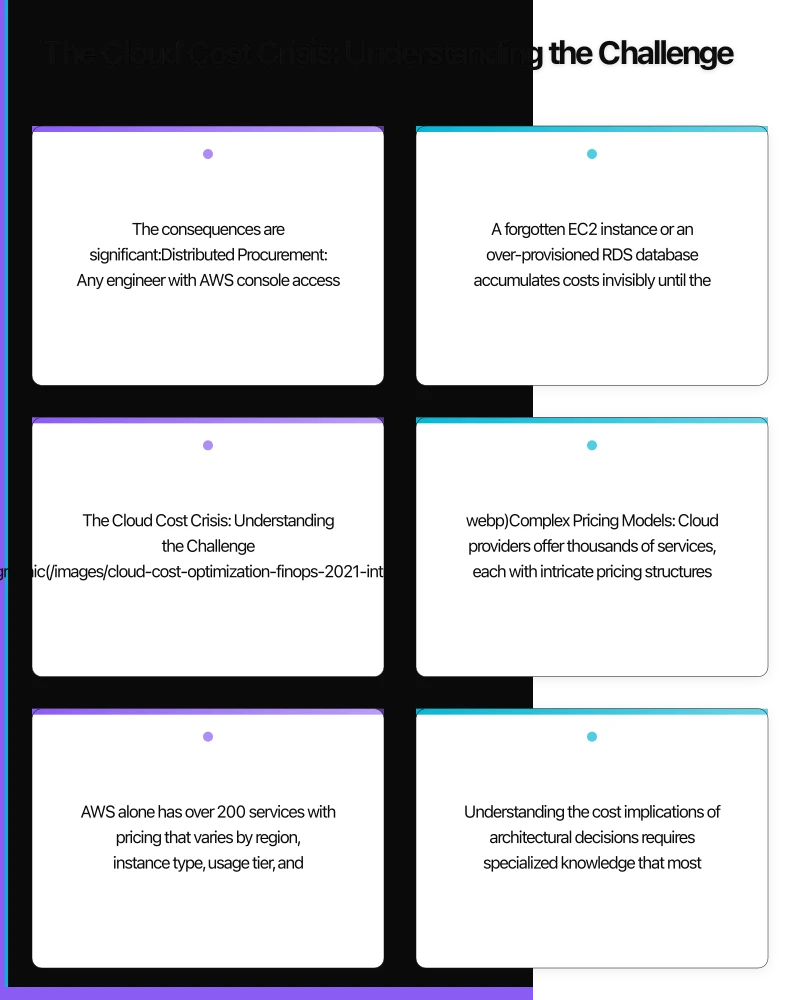
The consequences are significant:
Distributed Procurement: Any engineer with AWS console access can spin up resources. A forgotten EC2 instance or an over-provisioned RDS database accumulates costs invisibly until the monthly bill arrives.
Complex Pricing Models: Cloud providers offer thousands of services, each with intricate pricing structures. AWS alone has over 200 services with pricing that varies by region, instance type, usage tier, and commitment level. Understanding the cost implications of architectural decisions requires specialized knowledge that most engineering teams lack.
Usage-Based Variability: Unlike fixed infrastructure costs, cloud spending fluctuates with business activity, traffic patterns, and development cycles. A successful marketing campaign can double infrastructure costs overnight.
The Scale of the Problem
According to Flexera’s 2020 State of the Cloud Report, organizations estimate they are wasting 30% of their cloud spend. For enterprises spending tens of millions annually on cloud services, this represents substantial capital that could be deployed toward innovation and competitive advantage.
The FinOps Foundation’s research indicates that companies at the “crawl” stage of FinOps maturity have cloud waste exceeding 35%, while those at the “run” stage reduce waste to under 15%. This gap—often representing millions of dollars—illustrates the strategic value of FinOps investment.
The FinOps Framework: Principles and Practices
Core Principles
The FinOps Foundation, established in 2019 and now part of the Linux Foundation, has codified six core principles that guide effective cloud financial management:
1. Teams Need to Collaborate
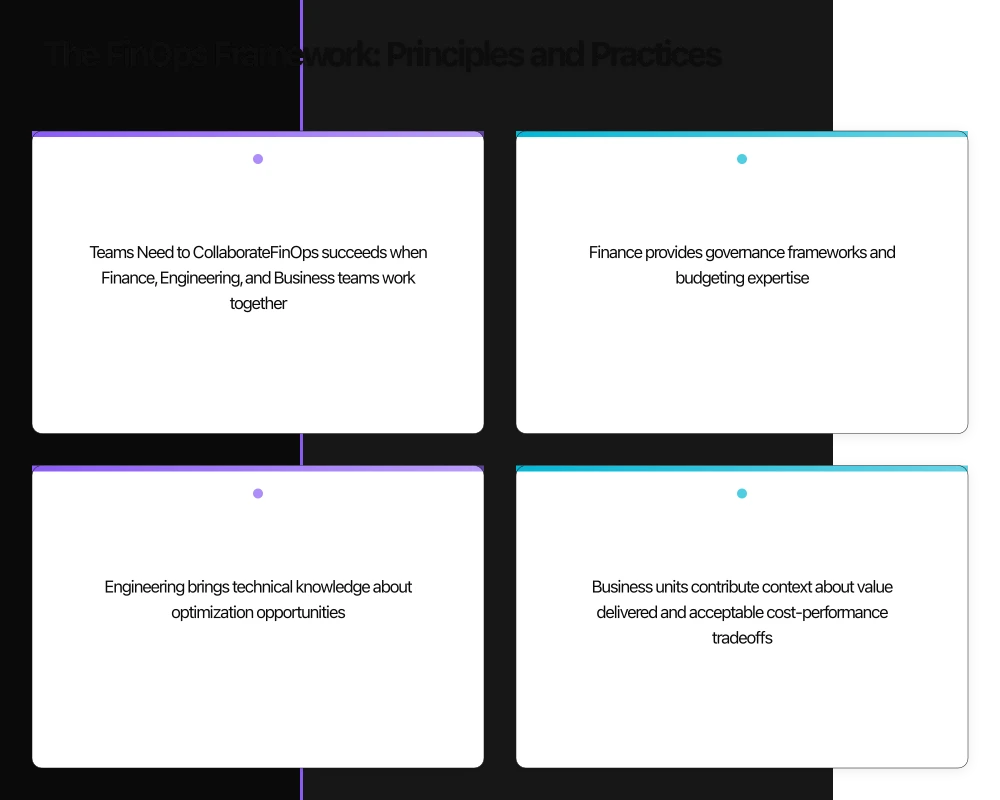
FinOps succeeds when Finance, Engineering, and Business teams work together. Finance provides governance frameworks and budgeting expertise. Engineering brings technical knowledge about optimization opportunities. Business units contribute context about value delivered and acceptable cost-performance tradeoffs.
2. Everyone Takes Ownership
Cloud cost management cannot be delegated solely to a central team. Every engineer, product manager, and business stakeholder must understand the cost implications of their decisions and be accountable for their cloud consumption.
3. A Centralized Team Drives FinOps
While everyone owns costs, a dedicated FinOps team provides governance, tools, automation, and expertise. This team establishes policies, builds dashboards, identifies optimization opportunities, and coaches teams on cost-effective practices.
4. Reports Should Be Accessible and Timely
Cloud cost data must be visible to all stakeholders in near-real-time. Monthly retrospective analysis is insufficient when a misconfigured auto-scaling policy can consume a quarter’s budget in days.
5. Decisions Are Driven by Business Value
Not all cloud spending should be minimized. Some workloads justify premium resources. FinOps focuses on maximizing value per dollar spent rather than minimizing absolute spending.
6. Take Advantage of the Variable Cost Model
Cloud’s pay-as-you-go model is a feature, not a bug. Effective FinOps practices leverage elasticity to match resources with demand, using reserved capacity strategically for predictable workloads.
The FinOps Lifecycle
FinOps implementation follows a continuous lifecycle of three phases:
Inform Phase: Establish visibility into cloud spending through tagging strategies, cost allocation, and reporting dashboards. Teams cannot optimize what they cannot see.
Optimize Phase: Identify and execute optimization opportunities including rightsizing, reserved instance purchases, spot instance adoption, and architectural improvements.
Operate Phase: Embed FinOps into organizational culture through policies, automation, training, and continuous improvement processes.
Building a FinOps Practice: Strategic Implementation
Organizational Structure
Effective FinOps requires dedicated organizational investment. The FinOps team typically reports to the CTO, CFO, or CIO depending on organizational structure and culture. Key roles include:
FinOps Lead: Sets strategy, coordinates across functions, and represents FinOps at the executive level. This role requires both technical credibility and financial acumen.
Cloud Economists: Analyze spending patterns, model optimization scenarios, and provide recommendations. They translate technical metrics into business language.
FinOps Engineers: Build automation, integrate tools, implement tagging strategies, and develop custom reporting. They bridge the gap between analysis and action.
For organizations beginning their FinOps journey, starting with a single FinOps Lead who coordinates existing Finance and Engineering resources is pragmatic. As the practice matures, dedicated roles can be justified by demonstrated savings.
Technology Foundation
FinOps requires robust tooling for cost visibility and optimization. The technology stack typically includes:
Cloud Provider Native Tools: AWS Cost Explorer, Azure Cost Management, and Google Cloud Billing provide foundational visibility. These tools are free and should be fully utilized before investing in third-party solutions.
Multi-Cloud Cost Platforms: For enterprises with multi-cloud strategies, platforms like CloudHealth, Cloudability, and Spot.io (recently acquired by NetApp) provide unified visibility across providers, allocation capabilities, and optimization recommendations.
Tagging and Metadata Management: Consistent resource tagging enables accurate cost allocation. Tools like AWS Tag Editor, Terraform’s tagging capabilities, or dedicated solutions like CloudCustodian help enforce tagging policies.
Anomaly Detection: Platforms like AWS Cost Anomaly Detection or third-party tools like Harness provide automated detection of unusual spending patterns, enabling rapid response to cost incidents.
Governance Framework
Effective FinOps requires clear governance:
Budget Ownership: Every team should own a defined cloud budget with authority to make decisions within their allocation and accountability for variances.
Approval Workflows: Significant spending decisions—such as reserved instance purchases or new service adoption—should require appropriate approval based on materiality thresholds.
Showback/Chargeback: Teams should see the costs they generate. Showback makes costs visible; chargeback allocates costs to business unit P&Ls. The right approach depends on organizational culture and maturity.
Policy Enforcement: Automated policies prevent cost overruns. Examples include stopping development instances outside business hours, preventing deployment of oversized instances without approval, and requiring cost estimates for infrastructure changes.
Optimization Strategies: Technical Approaches
Rightsizing
The most common optimization opportunity is rightsizing—matching instance sizes to actual workload requirements. Studies consistently show that 40-60% of instances are oversized for their workloads.
Rightsizing requires analysis of CPU, memory, network, and storage utilization over representative time periods. AWS Compute Optimizer, Azure Advisor, and GCP Recommender provide automated rightsizing recommendations based on utilization metrics.
However, rightsizing decisions must consider:
- Peak load requirements, not just average utilization
- Growth projections and seasonal patterns
- Application architecture constraints
- The operational cost of frequent changes
Reserved Capacity
For predictable workloads, reserved instances (RIs) or savings plans offer 30-72% discounts compared to on-demand pricing. The tradeoff is commitment—typically one or three years.
Strategic RI management involves:
Coverage Analysis: Identify workloads with stable, predictable demand suitable for reservation.
Commitment Optimization: Balance discount depth against flexibility. Convertible RIs offer lower discounts but allow modifications.
Portfolio Management: Treat RIs as financial instruments requiring active management. Monitor utilization, plan renewals, and adjust as workload patterns change.
AWS Savings Plans, introduced in late 2019, provide a more flexible alternative to traditional RIs, allowing commitment to a spending level rather than specific instance types.
Spot Instances
Spot instances (AWS), Preemptible VMs (GCP), and Low-Priority VMs (Azure) offer 60-90% discounts for workloads that can tolerate interruption. Suitable use cases include:
- Batch processing and analytics
- CI/CD pipelines
- Development and testing environments
- Stateless web tier behind load balancers
- Containerized microservices with graceful termination
Effective spot usage requires architectural patterns for interruption handling, including checkpointing, graceful shutdown, and rapid replacement.
Architectural Optimization
Beyond tactical optimizations, architectural decisions have profound cost implications:
Serverless Adoption: For appropriate workloads, Lambda, Cloud Functions, and similar services eliminate idle capacity costs. However, serverless can be more expensive than containers for sustained high-volume workloads.
Storage Tiering: Implementing lifecycle policies to move data through storage tiers—from high-performance SSD to archival storage—dramatically reduces storage costs.
Network Optimization: Data transfer costs often surprise enterprises. Optimizing data locality, using CDNs effectively, and minimizing cross-region traffic can yield substantial savings.
Database Optimization: Right-sizing database instances, implementing read replicas strategically, and considering managed versus self-hosted options all impact costs significantly.
Implementing FinOps: A Roadmap
Phase 1: Foundation (Months 1-3)
Visibility First: Implement comprehensive tagging across all cloud resources. Define a tagging schema that enables cost allocation by team, application, environment, and business function.
Establish Baseline: Document current cloud spending by provider, service, team, and application. Understand where money is going before attempting optimization.
Quick Wins: Identify and execute obvious optimizations—stopping unused resources, rightsizing significantly oversized instances, purchasing RIs for clearly stable workloads.
Stakeholder Alignment: Educate leadership on FinOps principles. Establish executive sponsorship and clarify roles and responsibilities.
Phase 2: Optimization (Months 4-9)
Deep Analysis: Conduct detailed analysis of top spending categories. Develop business cases for significant optimization initiatives.
Automation Investment: Build or buy tools for automated rightsizing recommendations, reserved instance management, and policy enforcement.
Team Enablement: Train engineering teams on cost-effective practices. Embed cost awareness into architecture review processes.
Governance Implementation: Establish budget ownership, approval workflows, and accountability mechanisms.
Phase 3: Cultural Integration (Months 10+)
Continuous Improvement: FinOps becomes an ongoing discipline rather than a project. Regular reviews, continuous optimization, and evolving practices become embedded in organizational culture.
Advanced Capabilities: Implement sophisticated capabilities like unit economics tracking, forecasting models, and value-based optimization.
Maturity Assessment: Regularly assess FinOps maturity against frameworks like the FinOps Foundation’s maturity model. Identify gaps and prioritize improvements.
Measuring Success: FinOps Metrics
Effective FinOps requires appropriate metrics:
Cost Efficiency Metrics:
- Cloud spend as percentage of revenue
- Cost per transaction/user/unit of value
- Resource utilization rates
- Reserved instance coverage and utilization
Operational Metrics:
- Tagging compliance rate
- Time to detect cost anomalies
- Optimization recommendation implementation rate
- Budget variance by team
Business Value Metrics:
- Cost savings versus baseline
- Cost avoidance through optimization
- Engineering time saved through automation
Looking Ahead: FinOps in 2021 and Beyond
As cloud adoption accelerates, FinOps will evolve:
Kubernetes Cost Management: Container orchestration adds complexity to cost allocation. Emerging tools like Kubecost address this challenge, but practices are still maturing.
Multi-Cloud Complexity: Enterprises increasingly adopt multi-cloud strategies, requiring unified cost management across providers with different pricing models and tooling.
AI/ML Workload Optimization: As enterprises scale AI/ML initiatives, optimizing expensive GPU instances and training workflows becomes critical.
Edge Computing: The expansion of computing to edge locations introduces new cost management challenges with different pricing models and operational constraints.
Conclusion
FinOps represents a fundamental shift in how enterprises manage cloud investments. It’s not merely a cost-cutting exercise—it’s a practice that enables organizations to maximize the business value of cloud spending while maintaining the agility and innovation velocity that cloud adoption promises.
For CTOs, the message is clear: cloud cost management is a strategic capability, not an operational detail. Organizations that master FinOps will have sustainable competitive advantages—they’ll be able to invest more in innovation while maintaining financial discipline.
The journey to FinOps maturity requires investment in people, processes, and technology. But the return—often measured in millions of dollars of savings and waste elimination—makes this investment compelling. As we enter 2021, there’s no better time to accelerate your FinOps journey.
How is your organization approaching cloud financial management? I welcome the conversation—connect with me to discuss FinOps strategies and implementation approaches.
If this strategic perspective has you thinking about cloud adoption, Cloud Geeks provides the implementation detail — from AWS setup to security hardening.
My consultancy Ganda Tech Services operates three specialist divisions covering cloud infrastructure, web development, and mobile apps for Australian businesses.
About the Author
Ashish Ganda is the founder of Ganda Tech Services, a Sydney-based technology consultancy specialising in cloud infrastructure, web development, and mobile app solutions for Australian businesses.
Digital Transformation Roadmap 2026
A 12-month framework for Australian SMBs ready to modernise — phases, tools, and milestones.
Almost done
Check your inbox and click the confirmation link to get your download.