Enterprise Cloud Cost Forecasting Models
Cloud cost forecasting has become one of the most requested and most poorly executed disciplines in enterprise FinOps. The request is straightforward: “What will our cloud bill be next quarter?” The answer is consistently wrong, typically by margins of twenty to forty percent, because the methods used to produce forecasts do not account for the dynamics that drive cloud spending.
The consequences of poor forecasting are practical and political. Budget shortfalls trigger emergency cost reduction exercises that disrupt engineering priorities. Budget surpluses result in end-of-quarter spending rushes or, worse, reduced budget allocations in subsequent periods. In either case, the FinOps team loses credibility with finance and executive leadership.
Building accurate cloud cost forecasting models requires understanding the cost drivers, selecting appropriate forecasting methods, and establishing processes for incorporating planned changes that historical data cannot predict.
Understanding Cloud Cost Drivers
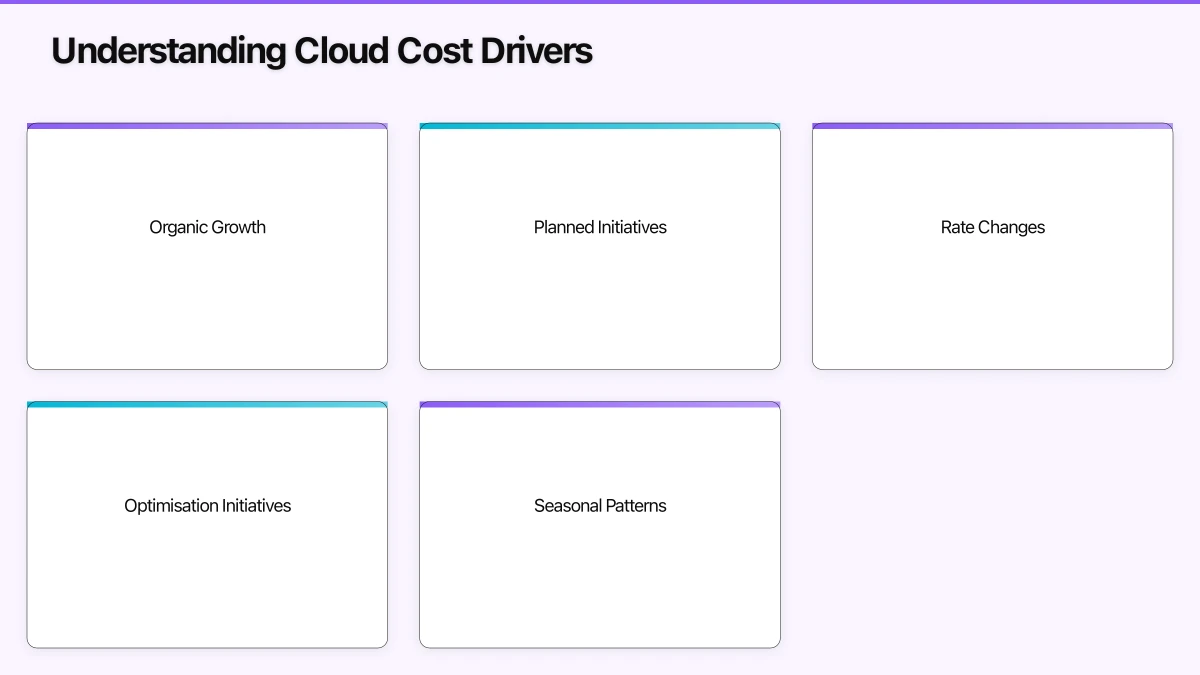
Cloud costs are driven by five categories of factors, each requiring different forecasting approaches:
Organic Growth: As the business grows — more customers, more transactions, more data — cloud consumption grows proportionally. This is the most predictable cost driver because it correlates with business metrics that are themselves forecast. If the business expects twenty percent customer growth, and cloud costs scale linearly with customers, organic growth contributes twenty percent cost increase.
The relationship is rarely perfectly linear, however. Many cloud costs have step functions: a database instance handles up to a certain load, then requires a larger instance type. Container clusters scale in node increments. Reserved instances are purchased in fixed quantities. The forecasting model must account for these step functions rather than assuming smooth linear scaling.
Planned Initiatives: New products, cloud migrations, platform changes, and architectural transformations create cost changes that historical data cannot predict. A new data analytics platform being deployed in Q2 will add costs that no historical trend line captures. These planned changes must be explicitly modelled as cost events layered on top of the baseline forecast.
The challenge is that initiative cost estimates are often optimistic. Engineering teams underestimate the cloud costs of new systems because they plan for steady-state costs without accounting for development, testing, and data migration costs that precede steady state. Building contingency margins into initiative cost estimates improves forecast accuracy.
Rate Changes: Cloud providers periodically change pricing, introduce new instance types, and modify discount structures. These changes can have significant impact on costs without any change in consumption. Monitoring provider announcements and modelling the impact of known rate changes improves forecast accuracy.
Reserved instance and savings plan expirations are a common source of forecast error. A three-year reservation expiring mid-quarter causes costs to jump to on-demand rates unless a new commitment is in place. Tracking commitment expirations and modelling their impact is essential.
Optimisation Initiatives: FinOps teams typically have a backlog of cost optimisation opportunities: rightsizing overprovisioned instances, eliminating unused resources, increasing reserved instance coverage, and architectural changes that reduce consumption. The forecast should include the expected savings from planned optimisation work, discounted by a realisation factor that accounts for delays and partial implementation.
Seasonal Patterns: Many businesses have seasonal consumption patterns — retail peaks in Q4, tax software peaks in Q1, education platforms peak in September. Cloud costs follow these patterns. The forecast model should identify and account for seasonal variations in the historical data.
Forecasting Methodologies
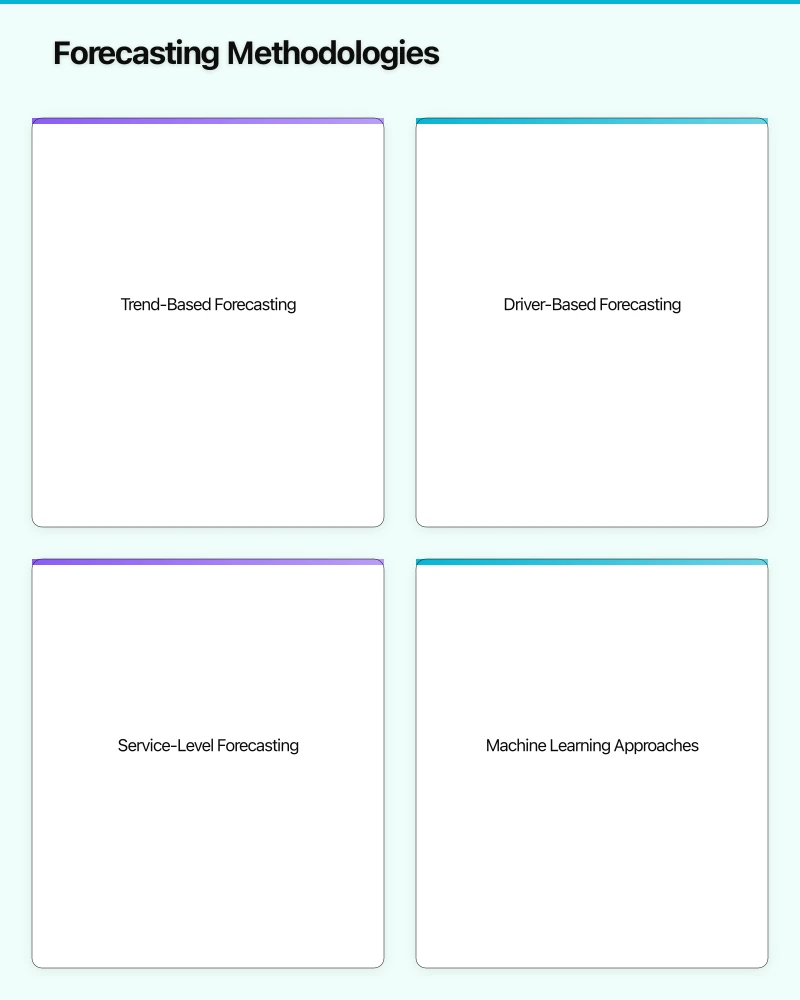
Several methodologies apply to cloud cost forecasting, each with different strengths:
Trend-Based Forecasting: The simplest approach extrapolates recent cost trends into the future. If cloud costs have grown eight percent month-over-month for the past six months, the forecast assumes continued eight percent growth. This method works reasonably well for stable environments where the cost drivers are consistent and where no significant changes are planned.
The limitation is that trend-based forecasting cannot account for discontinuities: new projects, migrations, optimisation efforts, or business model changes that alter the cost trajectory. Using trend-based forecasting as the baseline and layering explicit adjustments for known changes improves accuracy.
Driver-Based Forecasting: This approach models cloud costs as a function of business drivers: number of customers, transaction volume, data storage volume, API call counts. By forecasting the business drivers (using the business’s own growth projections) and applying cost-per-unit ratios, the model produces a forecast that is directly linked to business outcomes.
Driver-based forecasting requires establishing and maintaining the relationships between business metrics and cloud costs. These relationships change over time as architecture evolves, pricing changes, and optimisation efforts alter the cost-per-unit. Regular calibration against actual costs ensures the model remains accurate.
Service-Level Forecasting: Rather than forecasting total cloud cost, this approach forecasts costs for each major service or workload independently. Each service has its own growth trajectory, planned changes, and optimisation opportunities. Aggregating service-level forecasts produces the total forecast.
Service-level forecasting is more accurate because it captures the specific dynamics of each workload. It is also more expensive to produce and maintain, requiring input from each service team. For the largest cost drivers (top ten to fifteen services typically account for seventy to eighty percent of total cloud spend), the additional accuracy justifies the effort.
Machine Learning Approaches: Time series forecasting models (ARIMA, Prophet, LSTM networks) can identify patterns in historical cost data that manual analysis misses. These models excel at capturing complex seasonal patterns, weekly cycles, and non-linear trends.
The limitation of ML-based forecasting for cloud costs is the same as for any ML approach: the model can only learn from the past. Planned changes, rate modifications, and organisational decisions that alter cost trajectories are invisible to the model. ML forecasting works best as one input to a composite forecast, not as the sole method.
Operationalising Cost Forecasts
A forecast that sits in a spreadsheet provides limited value. Operationalising cost forecasting means embedding it into financial planning, executive reporting, and engineering decision-making.
Monthly Forecast Reviews: Compare actual costs against forecast monthly, analyse variances, and update the forward forecast. Variance analysis — understanding why actual costs differed from forecast — improves the model over time and surfaces cost changes before they become surprises.
Forecast Accuracy Tracking: Measure forecast accuracy consistently (mean absolute percentage error is a common metric) and set improvement targets. Most organisations start with thirty to forty percent error rates and can improve to ten to fifteen percent with mature forecasting practices.
Integration with Financial Planning: Cloud cost forecasts should feed directly into the organisation’s financial planning processes. This requires alignment on forecast timing (matching the financial planning calendar), granularity (cost centre level, business unit level, or total), and assumptions (growth rates, discount rates, exchange rates).
Scenario Modelling: Producing a single-point forecast implies certainty that does not exist. Scenario-based forecasting that produces optimistic, expected, and pessimistic cases provides leadership with a range of outcomes and the assumptions underlying each. This is more honest and more useful than a single number that will almost certainly be wrong.
Cloud cost forecasting is a discipline that improves with practice. The first forecast will be inaccurate. The tenth will be significantly better, because each cycle refines the model, improves the data, and deepens the organisation’s understanding of its cost dynamics. The CTO who invests in this capability builds financial credibility, enables proactive cost management, and ensures that cloud economics support rather than undermine the technology strategy.
Strategy without a web presence is invisible. Cosmos Web Tech publishes practical guides on building websites that attract and convert Australian customers.
As founder of Ganda Tech Services, I work with Australian businesses to align technology investments with business growth — across cloud, web, and mobile.
About the Author
Ashish Ganda is the founder of Ganda Tech Services, a Sydney-based technology consultancy specialising in cloud infrastructure, web development, and mobile app solutions for Australian businesses.
Digital Transformation Roadmap 2026
A 12-month framework for Australian SMBs ready to modernise — phases, tools, and milestones.
Almost done
Check your inbox and click the confirmation link to get your download.